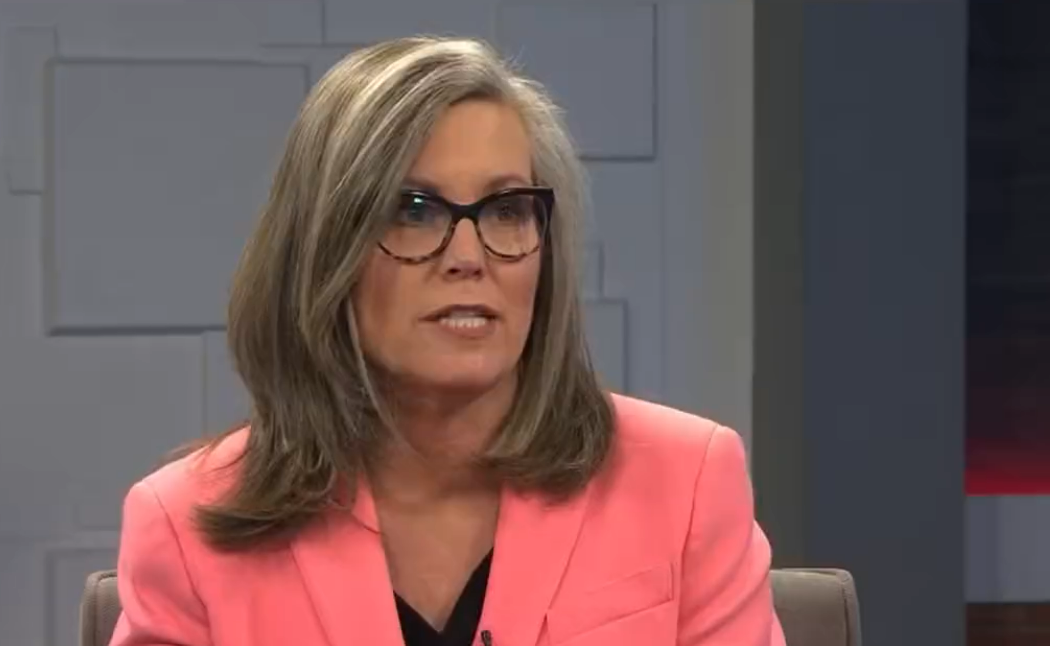
Arizona’s Republican state lawmakers are challenging Gov. Katie Hobbs to sign into law a government transparency bill amid the ongoing “pay-to-play” scandal involving the governor.
This past week, the Republican-led legislature sent SB 1186 to Hobbs’ desk. The legislation was inspired partly by ongoing legal challenges to the legality of the Arizona Medicaid program’s contract award system, and partly by ongoing allegations that Hobbs arranged for a unique rate increase to one of her top campaign donors.
Sunshine Residential Homes, a group home operator, donated more than $400,000 collectively to Hobbs’ gubernatorial campaign, Hobbs’ inaugural fund, and the Arizona Democratic Party.
Once Hobbs took office, the Arizona Department of Child Safety gave Sunshine Residential Homes a 30% rate increase, though no other group homes received rate increases and over a dozen contracts were terminated. This was reported initially by the Arizona Republic in 2024, along with another key detail indicating a close relationship between the governor and the company: Hobbs fine dining at the mansion of Sunshine Residential Homes CEO Simon Kottoor.
Hobbs’ inaugural fund — which reached nearly $2 million — was another funding source that was shrouded in secrecy. The inauguration event cost about $200,000, leaving the million-plus as a nonprofit source of funds to be spent at Hobbs’ discretion.
Attorney General Kris Mayes, a fellow Democrat, has maintained that her investigation into the alleged pay-to-play arrangement remains ongoing. Hobbs has yet to take Mayes up on her request for an interview.
The proposed legislation from Arizona’s Republican lawmakers would require companies that obtain state contracts or certain state grants to disclose anything of value provided in the previous five years to the governor, campaign-related entities, inaugural funds, and organizations making independent expenditures supporting or opposing the governor or their political opponents.
The legislation would also prohibit state agencies and employees from destroying notes created during the evaluation
The bill sponsor, State Sen. T.J. Shope (R-LD16), said financial disclosures should come before the state awards any contracts and grants, in order to ensure transparency and fairness in the process.
“Arizonans have watched one contracting controversy after another and are rightly asking whether political connections are influencing decisions involving billions of taxpayer dollars,” said Shope. “Governor Hobbs now has an opportunity to show Arizonans she supports transparency in government by signing this legislation.”
An advisory team was formed in the House to address this alleged pay-to-play scheme by Hobbs, and they also have their own investigation underway. The lawmakers hired outside counsel from out of state — Justin Smith with the Missouri-based James Otis Law Group — to conduct an independent investigation.
Smith led a battery and defamation lawsuit against E. Jean Carroll, an accuser of President Donald Trump.
That independent investigation initiated by lawmakers is ongoing. All findings from the outside counsel go to the advisory team and House leadership.
Maricopa County Attorney Rachel Mitchell and Auditor General Lindsey Perry are also coordinating on an investigation into the matter involving Hobbs and Sunshine Residential Homes. The House advisory team announced last year it would coordinate with Mitchell and Perry on their investigation.
AZ Free News is your #1 source for Arizona news and politics. You can send us news tips using this link.
Arizona lawmakers have sent Gov. Katie Hobbs a bill creating a statewide cargo theft task force as law enforcement agencies report organized theft crews targeting freight along the state’s rail and trucking corridors.
Senate Bill 1452, sponsored by Sen. Kevin Payne (R-LD27), would require the Arizona Attorney General, subject to legislative appropriation, to establish a Cargo Theft Task Force to combat crimes involving theft, diversion, embezzlement, unlawful taking, or fraudulent acquisition of cargo or freight.
🚨FOR IMMEDIATE RELEASE: Senator Payne Bill Creating Specialized Task Force to Combat Cargo Theft Passes Legislature
Under the bill, the Attorney General would invite federal, state, and local law enforcement agencies to participate in the task force. The task force would focus on offenses involving cargo moving in, constituting, or affecting interstate or intrastate commerce.
The proposed task force would include one full-time prosecutor, one full-time paralegal, one full-time support staff member, six investigators, and any additional law enforcement personnel designated by the Attorney General.
The task force would be required to meet regularly to review investigations and intelligence, provide updates on ongoing cases, investigate and recommend prosecutions for organized or repeat offenders, review cases referred by law enforcement agencies, and coordinate with law enforcement and industry stakeholders to identify emerging cargo theft trends and prevention strategies.
The bill defines cargo as merchandise, goods, or wares transported or intended to be transported in commerce, including goods at any stage of the supply chain from origin to final destination. It defines cargo theft to include unlawful taking or appropriation of cargo or freight through fraud, deception, misrepresentation, or identity manipulation from a commercial motor vehicle, trailer, railcar, intermodal container, warehouse, freight facility, distribution center, or other location within the supply chain.
The task force would also be required to submit an annual report beginning July 1, 2027, to the governor, Senate president, and House speaker, with a copy provided to the Secretary of State. The report would include summaries of investigations, prosecutions, enforcement actions, cargo theft trends and patterns, recovered cargo, restitution, forfeited assets, and recommendations for legislative or policy action.
The Senate Republican Caucus said Arizona’s position as a major transportation and logistics hub for the Southwest makes the state vulnerable to cargo theft schemes targeting trucks, warehouses, freight facilities, and supply chains.
“Cargo theft is not a victimless crime,” Payne said. “When organized criminals steal truckloads of merchandise, food, medical supplies, or other goods moving through our supply chains, the cost doesn’t simply disappear. Businesses lose inventory, consumers pay higher prices, and law enforcement is left chasing increasingly sophisticated criminal operations that often cross city, county, and state boundaries.”
Payne said Arizona’s location makes it a critical transportation corridor and a target for organized cargo theft.
“SB 1452 gives law enforcement another tool to identify criminal networks, recover stolen property, hold offenders accountable, and better protect the businesses, workers, and families who depend on a secure and reliable supply chain,” Payne said. “At a time when Americans are already struggling with the cost of everyday necessities, we should be doing everything possible to stop organized theft from making those costs even worse.”
The legislation comes as Arizona law enforcement agencies have reported organized cargo theft activity along the state’s rail corridors. FreightWaves reported Wednesday that two men were arrested and more than $500,000 in merchandise was recovered after a train burglary near Meteor Crater, west of Winslow.
According to the report, Coconino County investigators received a report on May 29 that several individuals were removing merchandise from a stopped BNSF Railway train and loading it into a van and box truck parked near the tracks. Authorities later stopped the van and arrested Jaime Beltran-Bojorquez, 32, and Gerardo Mares Vazquez, 28. Investigators said a second vehicle fled from deputies before crashing near Williams, and two unidentified suspects fled on foot and remained at large.
Detective Curtis Peery of the Coconino County Sheriff’s Office told FreightWaves that investigators are encountering both independent theft crews and organized criminal networks operating in the region. Peery told AZFamily that Northern Arizona sees “somewhere between 8 to 12 events a month.”
Peery told FreightWaves that electronics and clothing are among the most frequently targeted commodities because they can be quickly resold. He said the remote locations of many rail thefts make investigations more difficult and that coordination among agencies has been critical. “When we as departments work together that is where we have been the most effective and successful at combating these criminal organizations,” he added.
Cargo theft has become a growing concern for the trucking industry and law enforcement agencies nationwide. In a June 4 report, the National Insurance Crime Bureau, citing reporting from Transport Topics and industry data, said truckers nationwide are experiencing freight theft at a rate of $18 million per day. The report also noted that cargo theft schemes increasingly include deceptive pickups, fake identities, forged credentials, and carrier impersonation.
Tony Bradley, president and CEO of the Arizona Trucking Association, previously testified in support of SB 1452 before the House Transportation and Infrastructure Committee. According to Land Line, Bradley told lawmakers cargo theft has become “a very sophisticated international crime issue” and identified Arizona as a hotspot.
Bradley said trucking industry members have increasingly contacted the association for help after cargo theft incidents and said a central point of coordination through the Attorney General’s Office could help law enforcement across all 15 counties.
SB 1452 follows similar efforts in other states to address cargo theft and organized freight crime. The National Insurance Crime Bureau reported that Arkansas and Tennessee have enacted new cargo theft laws, while California and Arizona have considered task-force legislation.
Small business job openings declined sharply in May while concerns over rising labor costs reached the highest level in the survey’s history, according to the National Federation of Independent Business (NFIB) May Jobs Report released Friday.
The NFIB Small Business Employment Index remained essentially flat in May, standing at 100.3 after 100.4 in April. This marks the third consecutive monthly decline. The index now sits below the 2025 average of 101.2, though it remains slightly above the long-term historical average of 100.
In May, 29% of small business owners reported job openings they could not fill, a 5-point drop from April and the lowest reading since May 2020. Openings for skilled workers fell 2 points to 27%, while openings for unskilled positions dropped 4 points to 9%.
“Concerns about rising labor costs increased significantly to the highest reading in the survey’s history,” stated Chief Economist Bill Dunkelberg. “Small business owners are facing mounting pressure to retain workers, and many firms are navigating costly new state mandates. While current conditions restrict Main Street’s already-thin profit margins, compensation measures remain steady for now.”
Arizona-specific concerns added to the unease. “Arizona small businesses are growing increasingly uneasy as labor costs climb and uncertainty around state tax policy remains unresolved,” NFIB State Director Chad Heinrich added. “Failure to conform with the business provisions Congress made permanent at the federal level will result in a tax hike on Main Street Arizonans. Small businesses need certainty to plan, invest, and create jobs, and time is running short for lawmakers to deliver.”
Looking ahead, hiring plans weakened further. A seasonally adjusted net 9% of owners plan to create new jobs in the next three months, down 4 points from April and the lowest level since May 2020. This falls below the historical average of a net 11%.
Overall, 55% of owners reported hiring or trying to hire in May, up slightly from April. However, 46% of all owners (representing 84% of those actively hiring or trying to hire) reported few or no qualified applicants for open positions.
Labor quality, the most important business problem eased to 13%, the lowest since December 2016. In contrast, labor costs surged in importance, cited by 14% of owners as their top problem — a 5 point increase from April and the highest reading on record.
Despite softening demand for new hires, compensation pressures persisted. A net 31% of owners reported rising worker compensation in May, up 1 point from April. Plans to raise compensation in the coming three months held steady at 18%.
Ethan Faverino is a reporter for AZ Free News. You can send him news tips using this link.
The Arizona Supreme Court has agreed to take on a case determining whether Arizona State University (ASU) can mandate diversity, equity, and inclusion (DEI) trainings for its employees.
Professor Owen Anderson sued the Arizona Board of Regents in 2024 after ASU required him to take a DEI training called “Inclusive Communities” (ASU referred to their version of DEI as “DEIB,” or “diversity, equity, inclusion, and belonging”).
ASU requires the Inclusive Communities training as a condition of employment upon hire and every two years.
The Goldwater Institute, a Phoenix-based public policy and litigation organization, filed on Anderson’s behalf. Goldwater Institute attorney Stacy Skankey said the case represented Arizonans’ right to hold government agencies accountable for violating the law.
Arizona law prohibits any mandatory trainings which impart “blame or judgment on the basis of race, ethnicity or sex.”
“No one should be forced to participate in divisive DEI training or endorse race-based ideology as a condition for holding a government job,” said Skankey. “That’s exactly why Arizona lawmakers banned mandatory trainings that teach discriminatory ideas about race, ethnicity, or sex. But a law without enforcement is no law at all.”
The Inclusive Communities training included materials which taught that white supremacy exists as a structural phenomenon, minority faculty don’t have authority or control due to structural inequalities like racism and sexism, white privilege and white fragility exist and impact communities, white people have a duty to combat their privilege, racism can be implicit even if not intended, and sexual identities yield power.
Transcript examples from the training materials were included in the Goldwater Institute’s filing within the Arizona Supreme Court.
Along with the training, ASU formerly required employees to pass an accompanying module quiz. This exam graded certain answers as correct which served to advance DEIB ideology; the Goldwater Institute argued this final test further proved the training served as an impermissible mandate for employees to accept blame or judgment on the basis of race, ethnicity, and sex.
Anderson said ASU’s mandate violated state law because the training assigned “race blame” based on skin color.
Anderson added that ASU’s training was rooted in a Marxist dichotomy reducing the world to oppressor versus oppressed, and that the training imparted impermissibly discriminatory teachings that conflicted with his religious and political beliefs. Anderson is a tenured faculty member who teaches philosophy and religious studies.
“Arizona State leaders broke the law when they forced me and every other employee to take part in an ideological training that taught that it’s okay to judge people on their race, ethnicity, religion, and sex. I simply refuse to do that,” said Anderson. “Ultimately, the question before the Arizona Supreme Court isn’t a left or right issue — it’s about whether a state employee has the right to hold their employer accountable when it violates the law.”
The Arizona Court of Appeals previously rejected Anderson’s lawsuit. The court ruled that the law doesn’t have a provision allowing individuals like Anderson to seek legal recourse.
AZ Free News is your #1 source for Arizona news and politics. You can send us news tips using this link.
Arizona public schools would be required to allow students to attend off-campus religious instruction during the school day with parental consent under a Republican-backed bill approved by the Legislature and sent to Gov. Katie Hobbs.
The Arizona Released Time Education Act, SB 1741, sponsored by Senate President Warren Petersen (R-LD14), would require school district governing boards and charter school governing bodies to allow students to attend released time courses during regular school hours if the program meets statutory requirements. The measure was transmitted to the governor on June 10.
Under the bill, schools would be required to allow students to participate in released time courses if the school receives written consent from the student’s parent. Course providers would be required to keep attendance records, provide copies of those records to the school, assume legal responsibility for students while they are under the provider’s control, and provide religious instruction for at least one hour and no more than five hours per week.
🚨FOR IMMEDIATE RELEASE: Legislature Approves President Petersen-Backed Bill Expanding Parental Rights in Education
The legislation requires released time course providers, participating students, or parents to provide any necessary transportation. Students would remain responsible for completing any other schoolwork missed while attending the released-time course.
“Parents have the fundamental right to direct the upbringing and education of their children, including their religious education,” Petersen said. “For generations, families have taught faith and values at home and in their communities. This legislation simply ensures government does not stand in the way when parents choose to incorporate religious instruction into their child’s education.”
The bill would require schools to award academic credit to students who successfully complete a released time course. School districts and charter schools would determine how much credit to award using only secular criteria that are substantially similar to those used to evaluate comparable courses, including classroom instructional time, course requirements, instructional materials, and student assessments.
The measure also provides that time spent in a released time course during regular school hours would count as instructional time and instructional hours for purposes of state requirements, average daily membership, and daily attendance calculations.
Released time courses could not be provided on school property, and school districts and charter schools could not incur expenses to provide the courses. The bill also states that schools may not deny released-time course providers equal access to money, benefits, or services that schools provide to other community groups or independent entities.
Arizona law already recognizes parents’ right to have a child excused from school attendance for religious purposes under A.R.S. 15-102. SB 1741 would add new requirements governing released-time courses for school districts and charter schools.
The bill also creates a private cause of action allowing a person adversely affected by a violation to seek injunctive relief, monetary damages, court costs, attorney fees, and other relief available under law against the school district or charter school.
Petersen said the legislation is intended to strengthen parental choice while preserving safeguards around school costs and student responsibility.
“SB 1741 respects religious liberty, strengthens parental choice, and recognizes that parents, not bureaucrats, are best positioned to decide what is right for their children,” Petersen said.
The bill passed the Senate on Feb. 25 by a 16-10 vote and passed the House on June 9 by a 31-24 vote.
The proposal drew opposition from Democrats and secular advocacy groups during the legislative process. Rep. Nancy Gutierrez (D-LD18) argued during House debate that off-campus religious instruction would take away from instructional time, while Rep. Matt Gress (R-LD4) said the bill would be voluntary and require parental approval.
Arizona is on track to become one of the first states in the nation to modernize workplace radiation safety standards for health care professionals after lawmakers approved legislation aimed at reducing long-term health risks associated with occupational radiation exposure.
Senate Bill 1121, sponsored by Senator Carine Werner (R-LD4), passed the Arizona Legislature this week, and now awaits action by Governor Katie Hobbs.
The measure would allow hospitals equipped with advanced radiation protection systems to utilize those technologies in place of requiring medical personnel to wear traditional lead aprons during certain procedures involving real-time X-ray imaging.
The legislation primarily applies to physicians, nurses, physician assistants and other health care professionals working in cardiac catheterization laboratories and procedure rooms where ionizing radiation is routinely used.
Current radiation safety protocols often require medical personnel to wear lead aprons weighing more than 15 pounds during procedures. Studies have linked long-term occupational radiation exposure to increased risks of cancer, cataracts, thyroid disorders, reproductive complications, and other health concerns. Additionally, years of wearing heavy protective equipment have been associated with chronic neck, back, and orthopedic injuries.
“Medical professionals should not have to choose between protecting their patients and protecting their own health,” stated Senator Werner. “The technology exists today to shield workers from radiation exposure more effectively while reducing the physical strain caused by wearing heavy lead aprons for hours at a time. This bill allows hospitals to use those advancements while maintaining strict safety standards and real-time monitoring.”
Under SB 1121, hospitals performing cardiac catheterization procedures may not require health care workers to wear lead aprons if the procedure room is equipped with a qualifying radiation protection system that is being used according to manufacturer specifications. The bill defines radiation protection system as shielding technology that provides protections equal to or greater than the effectiveness of a 0.25-millimeter lead-equivalent apron.
The legislation also includes safeguards to ensure continued monitoring of radiation exposure. Health care professionals who choose not to wear lead aprons while using approved radiation protection systems would be required to wear real-time dosimeters capable of continuously monitoring radiation exposure during procedures.
Hospitals would retain the authority to require lead aprons, thyroid collars, or other protective equipment if a radiation safety officer determines that staff exposure levels could approach occupational dose thresholds or elevated exposure levels under the “As Low As Reasonably Achievable” (ALARA) standard.
The bill also preserves the right of individual health care workers to voluntarily wear lead aprons regardless of whether a radiation protection system is in use.
“This is a commonsense modernization of workplace safety standards,” said Werner. “When we have proven technology that can better protect the people performing these procedures every day, we should be embracing it. Arizona’s doctors, nurses, and medical staff deserve the safest working environment possible so they can continue providing exceptional care to patients across our state.”
If signed into law, Arizona would join a small number of states recognizing emerging radiation protection technologies as an alternative to traditional lead-apron requirements in certain medical settings.
Ethan Faverino is a reporter for AZ Free News. You can send him news tips using this link.