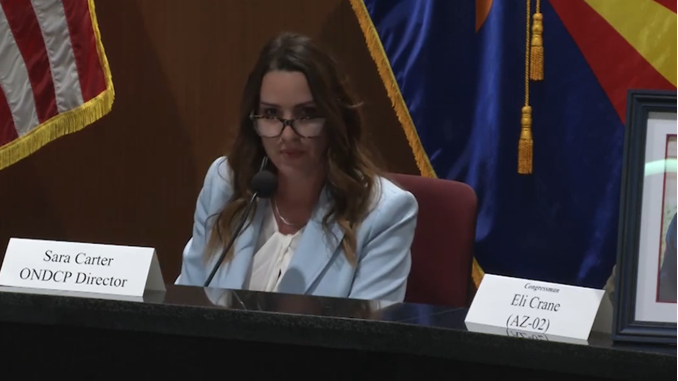
The White House Office of National Drug Control Policy (ONDCP) paid a visit to Arizona last week.
Sara Carter, director of the ONDCP, came to address Arizona’s unique situation with its ongoing drug crisis. Arizona was one of few states to experience an increase in drug overdose deaths rather than a decrease in 2025. Not only that: Arizona had the most drug overdose deaths last year.
While drug overdose deaths decreased 31% nationwide, Arizona experienced a 30% increase in drug overdose deaths.
Republican Rep. Andy Biggs (AZ-05) hosted Carter’s visit to Arizona, and Republican Rep. Eli Crane (AZ-02) joined the pair for meetings according to a press release from Biggs. These meetings were also attended by Drug Enforcement Administration officials, tribal partners, local law enforcement, and Angel Families.
Angel Families include all family members of individuals victimized or killed by criminal illegal aliens. Nearly all of the Angel Families in attendance last week were those whose loved ones fell victim to the crimes and violence resulting from drug cartel activity.
Eight of those families testified at a roundtable hosted at the Arizona State Capitol on Friday. These families claimed that the deaths of their loved ones were preventable through stricter immigration enforcement policies.
Among those to testify were Mary Ann Mendoza, who recounted how her son, Mesa police officer Brandon Mendoza, was killed in 2014 by an illegal alien drunk driver who had a criminal record dating back to 1994 and was living as a fugitive at the time of the crash.
Doug and Patricia Quets shared how their adult son Nicholas Quets, a Marine veteran, was murdered by Sinaloa cartel members in 2024.
Fernando Basurto explained that his grandson, Fernando Jose Basurto Jr., was about to graduate high school and had plans to enter the Air Force when he was murdered by a criminal illegal alien in 2016, who had been released shortly prior to the murder. Basurto said that former Sen. Martha McSally initially soured him on Congress because she refused to see their family to discuss Fernando Jose’s murder.
Patti Fox testified alongside her adult daughter, Carissa Aspnes, who was struck and severely disabled by an illegal alien running a stop sign in 2025. Carissa — a second-generation American on her grandmother’s side, a legal immigrant from Thailand — suffered a traumatic brain injury and now requires full-time care. Fox said local investigators initially covered up the fact that Carissa’s assailants were illegal aliens who entered the country under the Biden administration.
Karen Griffin explained that her teen son, Tyler Griffin, passed away in 2020 after taking a pill he believed to be Tylenol, but was actually laced with fentanyl.
Similarly, Anne Fundner shared that her 15-year-old son, Weston Fundner, passed away in 2022 after taking pills laced with fentanyl.
Carter promised to incorporate those suggestions from Friday’s roundtable into legislative proposals and policies put forth by the Trump administration.
Attendees included Reps. Quang Nguyen (R-LD-1), Nick Kupper (R-LD-25), and Lisa Fink (RLD-27); Sen. Carine Wrner (RLD-4); Maricopa County Supervisor Debbie Lesko; Queen Creek Mayor Julia Wheatley; and Art Del Cueto, formerly president of the National Border Patrol Council.
As part of its mission to address the drug crisis, ONDCP has taken a special focus on Arizona’s increase in drug overdose deaths, especially those involving fentanyl. It is the belief of the Trump administration, and Biggs and Crane, that the border policies of former President Joe Biden are to blame for Arizona’s ongoing drug crisis.
Carter commended Arizona as taking steps to fight back against the drug crisis.
“These communities know firsthand the devastating impact of illicit drugs,” said Carter. “President Trump and his administration will continue to fight for our citizens until every American is free to live a safe and healthy life, free from the scourge of illicit drugs.”
Earlier this month, ONDCP released a 200-page National Drug Control Strategy for 2026.
Under this administration, Trump has signed legislation classifying fentanyl-related compounds as Schedule I drugs; designated cartels as foreign terrorist organizations; designated illicit fentanyl and its core precursor chemicals as weapons of mass destruction; and signed legislation expanding the border wall and increasing deportations.
AZ Free News is your #1 source for Arizona news and politics. You can send us news tips using this link.
Congressman Abe Hamadeh (R-AZ08) predicted Republicans could see unexpectedly strong results in November, citing voter dissatisfaction with Democratic leadership, ongoing redistricting battles, and what he described as a “hidden voter” poised to influence upcoming elections.
Hamadeh made the remarks during an appearance on James T. Harris’ Conservative Circus radio program and later shared excerpts from the interview on social media.
The real story is the growing sentiment across the country: people are tired of living like this and are finally ready to push back hard.
This November, many will be surprised. There’s a hidden voter who sees Democrats offering nothing — 20% approval, candidates with Nazi… pic.twitter.com/L9kzoY6TgI
— Office of Congressman Abe Hamadeh (@RepAbeHamadeh) June 1, 2026
“The real story is the growing sentiment across the country: people are tired of living like this and are finally ready to push back hard,” Hamadeh wrote in a post accompanying the interview.
“This November, many will be surprised,” he continued. “There’s a hidden voter who sees Democrats offering nothing — 20% approval, candidates with Nazi tattoos, and open America-haters. That’s not what voters want. They want leaders who inspire us to do better.”
During the interview, Harris asked Hamadeh whether Republicans were “underestimating the backlash building against the progressive left for their vision of America.”
“I think so,” Hamadeh responded.
The Arizona congressman pointed to recent redistricting efforts in Republican-led states and said Republicans had become more willing to counter Democratic political strategies.
“I think Republicans finally got smart. They started punching back at the Democrats,” Hamadeh said. “The redistricting wars that we’ve been succeeding on is one aspect.”
Hamadeh also referenced the Los Angeles mayoral campaign of Spencer Pratt, describing the campaign as reflective of broader voter dissatisfaction.
“Whether he wins or not, it isn’t really the issue,” Hamadeh said. “It’s a matter of there’s a growing sentiment in our country that people feel that they don’t have to live like this anymore and that they’re going to push back and punch back as much as possible.”
Hamadeh said he believes those frustrations could produce election results that exceed current expectations.
“So I think this November, people are going to be surprised at the result because there is a hidden voter right now that understands the Democrats, they offer nothing to the table,” Hamadeh said.
Hamadeh cited polling showing low approval ratings for Democrats and criticized Democratic candidates.
A recent Quinnipiac University survey found 20% of voters approved of the way Democrats in Congress were handling their jobs, while 72% disapproved, approaching an all-time low for congressional Democrats.
“If that’s what the voters want, I don’t think so,” Hamadeh said. “I think they want somebody that inspires them, that we can do better as a country.”
The Goldwater Institute filed a lawsuit against the City of Phoenix seeking to block a proposed sale of downtown city-owned land to Pennrose, LLC. The lawsuit alleges the deal violates the Arizona Constitution’s Gift Clause and a state law governing municipal housing requirements.
The complaint, filed May 26 in Maricopa County Superior Court, challenges the city’s proposed sale of public land located at 1016 North 2nd Street for approximately $1.5 million. The lawsuit alleges the sale price is less than one-third of the property’s fair market value and would benefit a private developer in violation of Article 9, Section 7 of the Arizona Constitution.
According to the complaint, Pennrose proposed what the lawsuit describes as “a blend of LGBTQ+ affirming affordable housing and a tuition-free preschool for under-resourced children,” with the preschool component to be offered by Bezos Academy. The Bezos Academy is a nonprofit organization founded by Jeff Bezos, founder of Amazon.com and owner of The Washington Post.
Court filings describe the property as consisting of three parcels totaling approximately 0.4 acres, or about 17,500 square feet. Goldwater attorneys allege the property was appraised at the direction of the city at approximately $4,812,500 in June 2023.
The Arizona Constitution requires government entities to receive a direct and proportionate return when they sell public assets. But Phoenix leaders are attempting to give Pennrose, LLC a massive discount on prime downtown real estate, agreeing to sell property worth at least…
— Goldwater Institute (@GoldwaterInst) June 1, 2026
The complaint states the city issued a Request for Proposals (RFP) in November 2023 seeking proposals for the purchase and development of the property. According to the lawsuit, the RFP set the minimum purchase price at $4,812,500, the property’s appraised value, while allowing proposers to offer a combination of cash payment and other purported public benefits to meet or exceed that amount.
Pennrose submitted a proposal in January 2024 to acquire and develop the property, according to the complaint. Goldwater attorneys allege the developer proposed purchasing the land for approximately $1.5 million and acknowledged, according to the complaint, that the proposed purchase price represented more than a $3.3 million discount below the RFP’s minimum purchase price.
City records show the Phoenix City Council approved Ordinance S-51809 on April 9, 2025, authorizing the sale and redevelopment agreement for the property, and later adopted Ordinance S-52672 on March 4, 2026, approving an amendment to the development agreement with Pennrose modifying the purchase price.
In a statement released June 1, Tony Napolitano, Senior Attorney at the Goldwater Institute, wrote, “Pennrose claims that the development will create public benefits worth more than the massive subsidy. But there’s a major problem: no valuable public benefit is identified, much less required, in the final agreement. In fact, the developer suggests the city should consider Pennrose’s own private gains from the project as public benefits. That theory turns the Arizona Constitution on its head.”
The lawsuit argues the proposed transaction would provide a subsidy to a private developer without the city receiving direct and proportionate consideration in return, as required under the Arizona Constitution’s Gift Clause.
Goldwater also alleges Phoenix imposed an unlawful inclusionary housing requirement on the sale and development of the property. The complaint argues the city violated A.R.S. § 9-461.16, which restricts municipalities from requiring residential units to be designated for sale or lease to particular classes of residents as a condition of development approval.
Napolitano explained, “Pennrose initially proposed building a mixed-use development on the site, which would include low-income housing and a tuition-free preschool provided by a nonprofit. While the inclusion of a private nonprofit would not remedy the Gift Clause deficiency, it’s not even relevant because it was not included in the final terms of the deal.”
“That leaves the sole remaining alleged public benefit Pennrose claims: the residual value of the housing project once the agreement expires,” he continued. “However, the city retains no ownership interest in the property, and taxpayers will never receive any of their money back from the developer. Those assets remain with the private special interest—exactly what the Gift Clause was designed to prevent.”
The lawsuit asks the court to declare that the proposed sale violates the Gift Clause, block the city from completing the transaction or conveying the property, declare the inclusionary housing requirement unlawful, and enjoin the city from enforcing such a requirement as a condition of development approval.
“Simply put, Arizona law does not give way just because city officials find a particular project desirable.
“Public property belongs to the public. When government officials transfer millions of dollars in public value to a private developer, the Arizona Constitution requires a genuine public purpose and a proportionate exchange—not deep discounts justified by speculative or illusory benefits that taxpayers will never see.”
AZ Free News did not locate a public response from the City of Phoenix regarding the lawsuit prior to publication.
Editor’s Note: Following publication, a representative for Bezos Academy contacted AZ Free News and said that Bezos Academy does not plan to open a location at the proposed Pennrose development in Phoenix.
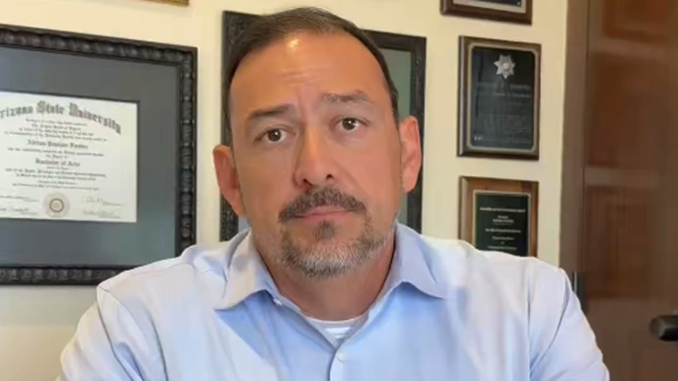
Voters’ personal information was exposed after Arizona Secretary of State Adrian Fontes’ office accidentally publicized them in violation of the law.
For nearly two years, Fontes’ office avoided publicization of the mishap. Their communications remained limited to the victims of the accidental publicization.
It was Votebeat who first found and reported on secretary of state records detailing the blunder this week. Fontes didn’t provide comment for the article. However, his chief of staff did go on the record.
Nearly 400 voters were impacted in the unintended disclosure in 2024. These voters were part of Arizona’s Address Confidentiality Program (ACP), which promises confidentiality for certain individuals with court orders of protection from the publicization of personal information like home addresses and phone numbers.
ACP members are often victims of domestic violence, sexual offenses, or stalking. Some are members of the justice system, including police officers.
According to these email records uncovered by Votebeat, Fontes staffers failed to notice their accidental publicization of protected voters’ information for nearly nine months. It was only by chance at a meeting that one keen-eyed staffer realized the mistake.
Fontes’ office said the former director of voter registration, administration, and technology, Craig Stender, was to blame. Stender passed away in March.
Stender denied wrongdoing immediately around the time of the office’s discovery of the error, which occurred in October 2024. Email correspondence from Stender indicated a breakdown in communication between the analyst who pulled the data and Stender.
Fontes’ chief of staff, Keely Varvel, told the secretary of state’s human resources department in an email that Stender had incorrectly instructed an analyst on pulling voter records. Stender was fired in October 2024.
Varvel told Votebeat that the records, properly pulled, would have been redacted automatically.
Staffers responded to impacted voters with information detailing what entities received their confidential records. This included a researcher at the University of Arizona and four out-of-state political data firms. One recipient passed along the protected voter records to another out-of-state political data firm.
While Fontes has publicly declared his commitment to protecting voter information, he never publicly announced this breach in trust concerning his office’s handling of confidential voter data.
Much of that rhetoric has centered around Fontes’ fight with the Trump administration over voter records. A federal court ruled that the Trump administration didn’t have justification to require Fontes to turn over voter registration records.
The Department of Justice sought Arizona’s entire voter registration list, which includes the full name, date of birth, home address, and driver’s license number or last four digits of a Social Security number.
Fontes has also been very public in his criticisms of attempts to go after noncitizen voters.
Fontes has asked Maricopa County Recorder Justin Heap to send him the information on the alleged hundreds of noncitizen voters discovered in Heap’s county. Heap opted to go to the Maricopa County Attorney’s Office with the information, much to the chagrin of Fontes and Attorney General Kris Mayes. (Following two warning letters from Mayes, Heap did comply and submit the noncitizen voter list to Mayes’ office for investigation).
Fontes cast doubt on the accuracy of Heap’s noncitizen voter list, arguing that the federal database used by election officials to confirm citizenship had a high error rate and couldn’t be trusted without further verification.
AZ Free News is your #1 source for Arizona news and politics. You can send us news tips using this link.
Congressman Abraham Hamadeh (R-AZ-08) has introduced the Military and Veterans Fuel Discount Act of 2026, a bipartisan measure designed to deliver direct financial relief to service members, veterans, and their families by providing discounts on fuel purchased at military exchange stores.
The legislation, H.R. 9027, is co-sponsored by Representatives Don Bacon (R-NE-02), Eugene Vindman (D-VA-07), Don Davis (D-NC-01), and Jimmy Panetta (D-CA-19). It authorizes the Secretary of Defense to implement a program offering discounts on motor fuel sold at exchange stores and dispensed directly into vehicles owned by eligible patrons.
“As part of my unwavering commitment to America’s military heroes and keeping my promise to improve service members’ lives, I introduced legislation authorizing a fuel discount at military exchange pumps to lower living costs for our troops, veterans, and dependents,” stated Congressman Hamadeh.
The bill would allow the Secretary of Defense to provide a base discount on gasoline and diesel fuel equal to the federal fuel tax rate, which is at least 18.4 cents per gallon for gasoline and 24.4 cents per gallon for diesel. It also authorizes supplemental discounts to help offset state and local fuel taxes when applicable.
These costs disproportionately impact military families, veterans, and retirees, who often face long commutes to bases, training facilities, work, or VA medical appointments. With inflation and rising transportation costs continuing to strain household budgets, many service members spend a significant portion of their income on fuel.
Discounts would be applied automatically at the time of sale to the maximum extent practicable. The authority for the program would terminate on September 30, 2029.
The legislation includes safeguards to prevent fraud or abuse, prohibits the resale of commercial use of discounted fuel, and requires the Secretary of Defense to submit annual reports to Congress detailing program usage, costs, gallons sold, and any implementation issues.
“Fuel is one of the few products sold by exchanges still subject to tax,” added Hamadeh. “This discount, equal to the federal fuel tax, shows profound gratitude to our nation’s heroes who have borne the heavy costs of war defending our freedoms. This common-sense step delivers real relief to our selfless service members and their families.”
Ethan Faverino is a reporter for AZ Free News. You can send him news tips using this link.
Retail sales increased for the seventh consecutive month in April, highlighting the resilience of American consumers despite rising gas prices and elevated inflation.
According to the CNBC/NRF Retail Monitor, total retail sales excluding automobile dealers and gas stations increased 0.34% seasonally adjusted from March and rose 5.73% unadjusted from April of 2025. That follows gains of 0.4% month-over-month and 6.59% year-over-year in March.
“Retail sales continued to grow in April despite higher gas prices driven by the ongoing conflict in Iran, cautious consumer sentiment and the persistent concerns about sustained inflation,” stated NRF President and CEO Matthew Shay.
Core retail sales, which also exclude restaurants, posted a smilier 0.34% month-over-month gain and climbed 5.53% year-over-year. For the first four months of 2026, total sales were up 6.07% year-over-year, while core sales rose 5.99%.
Sales growth was broad-based, rising in eight of nine major categories on a yearly basis and in all but one category on a monthly basis. Clothing and accessories stores led the way with a 0.59% month-over-month increase and a strong 9.75% year-over-year gain.
Sporting goods, hobby, music and book stores advanced 0.12% month-over-month and 8.55% year-over-year, while health and personal care stores rose 0.45% and 8.42% respectively. Digital products, including electronic books and games, posted the strongest monthly gain at 1.11% and climbed 8.09% annually.
Other categories showing positive momentum included general merchandise stores (up 0.15% month-over-month and 6.19% year-over-year), electronics and appliance stores (up 0.16% and 4.03%), and grocery and beverage stores (up 0.36% and 3.21%).
Furniture and homes furnishings stores saw a slight 0.06% monthly decline but still posted a 2.58% annual increase. Building and garden supply stores edged up 0.009% for the month but were down 2.74% from the prior year.
“Spending on household priorities remains solid, supported by a steady labor market, wage growth and a significant influx of cash from tax refunds,” added Shay. “While consumers are mindful on costs, retailers are working hard to keep everyday goods affordable for American families.”
Ethan Faverino is a reporter for AZ Free News. You can send him news tips using this link.