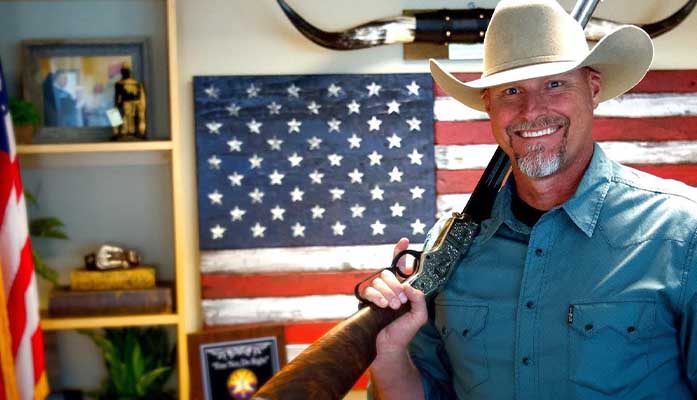
The Pinal County Attorney’s Office has closed its review of allegations involving former Pinal County Sheriff Mark Lamb after determining that the evidence reviewed did not establish a violation of Arizona criminal law.
Pinal County Attorney Brad Miller announced Monday that his office completed its review of allegations and materials submitted regarding Lamb and concluded that “no abuse of power or other crime occurred.” The matter is now closed.
The review followed allegations involving Lamb that were submitted to the Pinal County Board of Supervisors in 2020. According to the preliminary inquiry released by Miller’s office, Tim Gustafson delivered a packet of information to the Board of Supervisors on Jan. 29, 2020, regarding allegations against Lamb, who was then serving as Pinal County sheriff.
🚨NEWS RELEASE: Pinal County Attorney Closes Mark Lamb Matter; Preliminary Inquiry Finds No Abuse of Power or Criminal Violation pic.twitter.com/Se7O8ALnuB
— Pinal County Attorney's Office (@PCAOAZ) June 23, 2026
“Public officials are entitled to the same due process and the same scrutiny as every other citizen. Not more. Not less,” Miller said. “When allegations are presented to this office, our responsibility is to determine whether a crime occurred, not whether a narrative is politically convenient. This office does not prosecute rumors, politics, social media campaigns, or headlines. We prosecute crimes. We follow the facts, we follow the law, and we follow the evidence. In this case, the evidence does not establish that any law was broken.”
The inquiry states that in May 2026, former Pinal County Attorney Kent Volkmer told the media that he had conducted a cursory investigation into the Lamb matter from 2020. Miller said he directed staff to locate the investigation so he could review it, but no investigation was found.
“No investigation was found, and not a single investigator at the Pinal County Attorney’s Office, including the former Chief of Investigations, could recall that such an investigation had ever been conducted,” the preliminary inquiry states.
Chief Hank Mueller then requested the materials provided by Gustafson, or any other individual, to the Pinal County Board of Supervisors. Those materials were provided on May 29, according to the inquiry.
On June 3, an alleged victim came forward and provided more than 3 gigabytes of additional materials for review, including audio, video, documents, and social media materials. Miller said he reviewed all of the materials in preparation for the preliminary inquiry.
The Pinal County Attorney’s Office said it reviewed records, witness statements, text messages, social media posts, recorded calls, and other communications before concluding that the evidence did not establish criminal conduct.
The inquiry listed three conclusions: that there was no evidence Lamb acted in a criminal manner; that there was no evidence Volkmer performed any investigation into the matter despite what he told the Arizona Republic in May; and that there was no evidence Lamb was a victim of a crime or asked Volkmer to investigate a crime on his behalf.
“Based upon all the materials provided I find that Mark Lamb committed no acts that would be considered criminal under Arizona law,” Miller wrote. “This matter is concluded.”
Lamb served as Pinal County sheriff from 2017 through 2024 and is now running for Congress in Arizona’s 5th Congressional District.
A recent graduate of Glendale Prep has earned one of the nation’s most prestigious military appointments, securing admission to the United States Naval Academy in Annapolis, Maryland.
David Vosekalns, a member of Glendale Prep’s Class of 2026, will officially join the Naval Academy’s class of 2030 when he is inducted on June 25, 2026.
His appointment comes after a highly competitive selection process that saw approximately 16,000 applicants nationwide compete for roughly 1,200 available spots.
🇺🇸WATCH🇺🇸
Recently, our office welcomed David & his family. We celebrated his outstanding achievement, & he sat down for an interview with Great Hearts to discuss the opportunity
The official appointment was presented by Blue & Gold Officer Sue Wester (Arizona Area… pic.twitter.com/59jUDTJuty
— Office of Congressman Abe Hamadeh (@RepAbeHamadeh) June 22, 2026
“David was one of about 16,000 students from throughout the nation who applied for one of the approximately 1,200 appointments to the Naval Academy’s Class of 2030,” explained Blue and Gold Officer and volunteer field representative for the Naval Academy Admissions Office, Sue Wester. “In receiving his appointment, David was recognized for his citizenship, athleticism, scholarship, and moral character as being worthy to join the Brigade of Midshipmen and become a U.S. military officer.”
Vosekalns received a digital offer of appointment on May 20, 2026 but his official certificate of appointment was formally presented by Wester during a ceremony held at the office of Congressman Abe Hamadeh in Surprise, Arizona.
Congressman Hamadeh, who nominated Vosekalns for admission to the Naval Academy, played an important role in his journey to Annapolis. Earlier this year, Vosekalns had the opportunity to meet Hamadeh during a senior trip to Washington, D.C., with his classmates from Glendale Prep.
“Today, we’re in Congressman Abraham Hamadeh’s office, said Vosekalns at his appointment ceremony. “He gave me my nomination to the Naval Academy. On the senior trip to Washington, D.C., I was fortunate enough to work with Congressman Hamadeh’s office to meet him with some of my other friends in his Washington office.”
Reflecting on his acceptance, Vosekalns expressed both gratitude and humility.
“I received the digital offer of appointment on May 20th, and I’m just dumbstruck, still processing it,” he said. “I just know that this is where the Lord’s led me, and I’m still processing it.”
As part of the Naval Academy’s freshman class, known as “plebes”, Vosekalns will participate in Plebe Summer, an intensive six-week military training program designed to prepare incoming midshipmen for academy life.
During the training, plebes have no access to television, movies, music, or the internet and are only allowed two phone calls during the six weeks.
Vosekalns plans to study engineering while attending the academy and credits Glendale Prep with helping him for the opportunity.
“Without Glendale Prep, I would not be here in a lot of ways,” he said. “All my letters of recommendation were written by the teachers at Glendale Prep, and the college counselor, Mrs. Sarbacker, was extremely helpful in the process.”
The appointment has also drawn praise from Congressman Hamadeh’s office.
We are incredibly proud of David Vosekalns, a recent Glendale Prep graduate who has been accepted to the United States Naval Academy in Annapolis, Maryland.
David’s exceptional character, scholarship, and leadership so impressed Congressman Hamadeh that this appointment was an…
— Office of Congressman Abe Hamadeh (@RepAbeHamadeh) June 22, 2026
In a statement posted on X, the office said:
“We are incredibly proud of David Vosekalns, a recent Glendale Prep graduate who has been accepted to the United States Naval Academy in Annapolis, Maryland. David’s exceptional character, scholarship, and leadership so impressed Congressman Hamadeh that this appointment was an easy decision. Congratulations, David! We know you are destined for great things.”
As Vosekalns prepares to report for Plebe Summer and begin his journey toward becoming a naval officer, he joins a select group of future military leaders entrusted with serving the nation.
Ethan Faverino is a reporter for AZ Free News. You can send him news tips using this link.
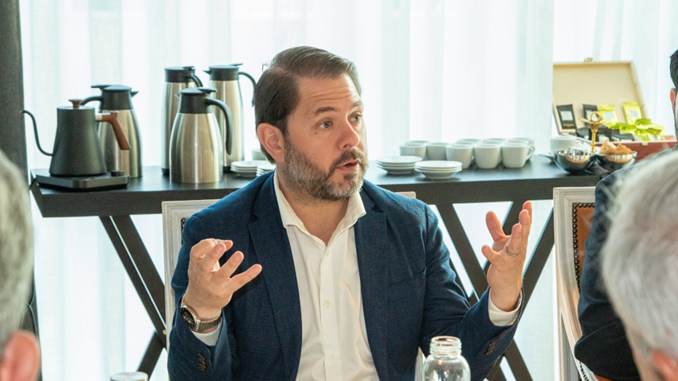
Federal campaign finance records revealed that Sen. Ruben Gallego spent campaign cash for game tickets, child care, and luxury outings for the 2023 Super Bowl in Arizona.
Gallego tapped a joint campaign accord with former California Rep. Eric Swalwell to attend the Super Bowl, according to Federal Election Commission (FEC) records and an anonymous source reported on by Politico.
Gallego and Swalwell were best friends for about a decade, but that relationship ended with the sexual misconduct and assault claims raised against Swalwell earlier this year amid his short-lived campaign for California governor.
That anonymous source claimed that Gallego treated campaign money like “his personal slush fund […] to live a luxury lifestyle.”
The Super Bowl took place several weeks after Gallego announced his campaign to take over for then-departing Sen. Kyrsten Sinema. Gallego and Swalwell gathered up key staff and donors to attend the game, claiming it as a fundraising party for their newly formed (now defunct) joint fundraising committee, “Swallego Victory Fund.”
The highest donations to that fund were all made in the days leading up to Gallego’s Super Bowl watch party.
Top donors gave $5,000 to $10,000 each: Patrick Smith, Axon CEO; Glen Fuller, Mackenzie Capital managing director and COO; Karl OBergh, former Ardurra civil engineer, current director of engineering with True North Studio; David Shimmon, Ichor Systems CEO; Julio Fuentes, SSA executive director based out of Puerto Rico; Miguel Colom-Mena, Nagnoi co-founder; and Wendy and Dina Lapolt, RCA vice president of promotion and attorney, respectively.
FOIAzona outlined campaign finance activity by Swalwell that further elaborated the nature of that Super Bowl party. FOIAzona has been building a timeline of Gallego and Swalwell’s relationship going back to the beginning about a decade ago.
In the days leading up to the Super Bowl, Swalwell purchased two $3,300 fundraising event tickets for Ian Lev, founder and CEO of Apollo Labs, an independent third-party laboratory for licensed cannabis operators based out of Scottsdale, and Scott Rouillard, director of global payroll at Graebel Companies, a relocation management company based out of Cave Creek.
Tickets to the joining committee fundraiser cost $5,000, and another $1,000 for a brunch, per an invitation reviewed by Politico.
Of the $56,500 the two raised, over $37,000 went to event tickets and brunch, leaving the joint fundraising committee with about $19,000.
In addition to the 2023 Super Bowl spending, Gallego has spent campaign cash in other ways that critics argue violate FEC rules. Gallego has spent more than $18,000 in funds from his political action committee and campaign on child care since 2019.
Gallego blamed his spending choices on inflation.
“With the rising costs of child care and the burden it has on the budgets of American families, Democrats and Republicans in Congress and the White House alike regularly travel with their wives and children, as is permitted by the FEC,” said Gallego.
Earlier this month the senator hired Andrew Bates, former deputy press secretary for former President Joe Biden, to handle crisis communications concerning his longtime friendship with Swalwell and a sexual misconduct complaint against him filed with the Ethics Committee.
Gallego has publicly expressed a desire to run for president in 2028, and has been traveling across the country in what appears to be early preparations for a campaign announcement.
AZ Free News is your #1 source for Arizona news and politics. You can send us news tips using this link.
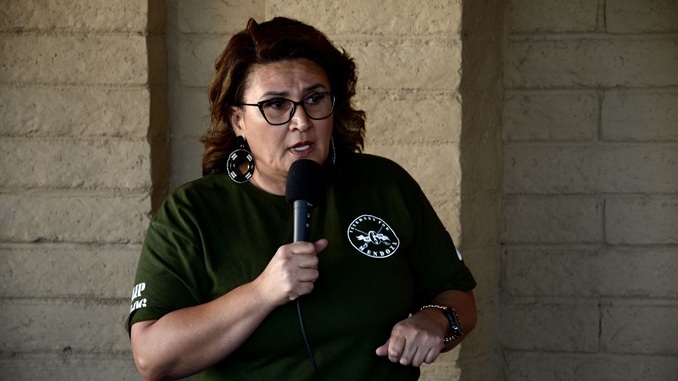
The Republican National Committee is targeting Democratic congressional candidate JoAnna Mendoza over salary payments from her campaign account, arguing the payments, combined with her other reported income and assets, undercut her campaign messaging as a working-class anti-corruption candidate. Federal rules allow nonincumbent candidates to receive compensation from campaign funds under certain conditions.
Mendoza is running for Arizona’s 6th Congressional District seat held by Republican U.S. Rep. Juan Ciscomani. The FEC identifies Mendoza as a Democratic House candidate in Arizona’s 6th District and lists Mendoza for Congress as her principal campaign committee.
“JoAnna Mendoza lines her own pockets instead of thinking about Arizonans,” RNC Western Regional Communications Director Nick Poché told AZ Free News. “The only person Mendoza cares about is herself, and it’s clear as day that she can’t be trusted to not abuse her position to enrich herself.”
According to her 2026 candidate financial disclosure filed June 15, Mendoza reported receiving $35,602.50 in salary from her campaign committee, Mendoza for Congress, during the reporting period spanning Jan. 1, 2025, through May 15, 2026.
The RNC pointed to campaign finance filings showing regular payroll payments to Mendoza, estimating her compensation at approximately $102,000 annually before taxes. Separately, federal campaign finance data compiled by OpenPolitical show Mendoza for Congress reported payroll-related expenditures, including $298,781 paid to Gusto Payroll Services.
Her campaign’s FEC summary shows that Mendoza for Congress reported $5,341,037.68 in total receipts, $1,830,458.04 in total disbursements, and $3,510,579.64 in cash on hand through March 31.
The Federal Election Commission states that a federal officeholder may not receive compensation as a candidate from campaign funds, but a nonincumbent candidate may receive compensation from the candidate’s principal campaign committee if the payments meet FEC limits and conditions.
The FEC’s candidate salary guidance says the campaign committee must reduce the maximum amount of permissible candidate compensation from campaign funds by the amount of income earned by the candidate from outside sources after the candidate files a Statement of Candidacy. Mendoza filed her Statement of Candidacy on Feb. 3, 2025, according to the FEC.
Mendoza’s 2026 disclosure lists other income sources in addition to her campaign salary. The filing reports $34,736 in current-year-to-filing military retired pay from the Defense Finance and Accounting Service, $28,350 in salary from VetsForward in the preceding year, and $506 from Poderoza Strategies LLC in the preceding year.
The disclosure also lists a Tucson rental property valued between $250,001 and $500,000, with current-year-to-filing rent of $5,001 to $15,000 and $15,001 to $50,000 in rent for the preceding year. Mendoza’s 2025 candidate financial disclosure, filed Aug. 13, 2025, listed rental property income from Genesis Real Estate & Management, but did not list a real property asset in Schedule A.
Mendoza’s business disclosures also changed between the two filings, as reported by The Washington Free Beacon. Her 2025 disclosure listed Radar Strategies LLC as an asset valued between $1,000,001 and $5,000,000. Her 2026 disclosure listed Radar Strategies LLC as an asset valued between $50,001 and $100,000 and included a note stating that Mendoza was a partner in Radar Strategies from February 2024 to April 2025, that “ownership was forfeited back to partner stakeholders,” and that the “valuation updated to reflect prior year and as of partnership exit.”
Millionaire JoAnna Mendoza now claims she voluntarily gave up her millions (yeah sure) to her business partners. Mendoza was also forced to reveal half a million in assets she was hiding from the public.
The change was noted by Poché in a post to X on June 18. He wrote, “Millionaire JoAnna Mendoza now claims she voluntarily gave up her millions (yeah sure) to her business partners. Mendoza was also forced to reveal half a million in assets she was hiding from the public. Oh, & she’s paying herself from her campaign.”
The RNC argued that the salary payments and financial disclosures conflict with Mendoza’s public campaign messaging. Mendoza’s campaign website says she believes “public service is about accountability, integrity, and looking out for ordinary people,” and that she has “zero tolerance for corruption.” The same campaign page says she supports banning members of Congress, their families, and other top government officials from trading individual stocks while in office.
In an April interview with the American Journal News, Mendoza said she wanted to “fight corruption and get our money back.” She also said, “We need to make sure that money isn’t being mishandled, or find out if there’s corruption there.”
Mendoza’s campaign biography describes her as a retired Marine, single mother, and rural Arizonan raised in a farmworker family in Pinal County. Her campaign says she “experienced firsthand the realities of rural poverty,” and later served in the Navy and Marine Corps before returning to Arizona to raise her son.
Mendoza announced in April that her campaign raised more than $2.3 million in the first quarter of 2026, calling it an “impressive fundraising quarter for a first-time congressional candidate.” Her campaign said the fundraising came as she joined the Democratic Congressional Campaign Committee’s “Red to Blue” program and built momentum against Ciscomani.
Census Reporter lists Arizona’s 6th Congressional District at a median household income of $80,251. The RNC compared Mendoza’s estimated annualized campaign salary to district income levels and said the salary issue is likely to become part of the broader campaign over trust and accountability in the competitive district.
The Arizona State Board of Education (ASBE) revealed in its latest enforcement action report that sexual misconduct cases involving teachers increased.
ASBE did note that, out of the hundreds of thousands of educators serving nearly 1.5 million students in public schools across the state, 98 percent of the education workforce didn’t appear in a disciplinary action (97 percent of certificated personnel and 99 percent of non-certificated personnel).
“These findings reinforce that Board discipline remains uncommon relative to the size of Arizona’s education workforce and affects only a small fraction of persons working in Arizona schools,” stated ASBE.
The findings of the ASBE report were limited to adjudicated cases, and excluded those pending or active cases.
Multiple steps must take place prior to any enforcement action occurring. ASBE’s Investigation Unit intakes a report, then investigators work in parallel with law enforcement investigators to review the report. The board then adjudicates the case through several avenues offered to the respondent prior to taking a vote.
Per ASBE data of adjudicated cases, the number of sexual misconduct cases increased by 40 percent over the last two years: there were 94 cases in 2024 and 133 cases in 2025.
In other words, about one-third of the cases that ASBE adjudicated in 2025 (about 380) were related to sexual misconduct. Sexual misconduct cases represented 30 percent of the total cases adjudicated in 2025.
Those findings were consistent with the totals for cases adjudicated from 2016 to 2025. 34 percent of all cases over that time were sexual misconduct cases.
📢2025 AZ Teacher Discipline Report presented to SBE today: ▶️Sexual misconduct: 133 cases, up from 94 prior year, 30% of total ▶️Assault cases – continues 2-year spike – 203 cases (53%) in 2025, up from 143 cases last year. From 2016-25, sexual misconduct still #1 reason 1/n pic.twitter.com/iiQJBwh7sZ
— TheLegalProcess (v3.0 | Instruction Not Therapy) (@ALegalProcess) June 22, 2026
ASBE reported that 670 cases involving sexual offenses occurred from 2016 to 2025.
ASBE stated in its report that it continues to prioritize the investigation of sexual misconduct allegations due to impacts to student safety.
The total cases adjudicated by ASBE in 2025 exceeded the board’s forecasting by about 60 cases.
ASBE said the increased number of cases reflected investments by the state to strengthen ASBE’s educator discipline system by increasing investigation and adjudication resources.
Approximately half of all reports to ASBE came from school officials, followed by less than one-quarter from the Department of Public Safety fingerprint clearance cards.
Applications and records from the National Association of State Directors of Teacher Education and Certification made up seven percent of reports; parents and statements of allegations made up four percent of reports; news media made up five percent of reports; and State Board of Education or another state made up five percent of reports.
Assault cases also increased: there were 42 percent more cases in 2025 (203) compared to 2024 (143).
53 percent of total cases adjudicated were assault cases.
Substance use, fraud, and breaches of contract collectively made up 17 percent of total cases adjudicated.
“Despite year-to-year fluctuations, sexual misconduct and assaultive behaviors consistently comprise the majority of cases reviewed by the board,” stated the report.
The report also noted that sexual misconduct and assaultive behaviors shared historically similar rates of occurrence, however assault-related cases increased dramatically from 2023 to 2025.
AZ Free News is your #1 source for Arizona news and politics. You can send us news tips using this link.
Arizona Senate Republicans attended a White House State Leadership Conference in Washington, D.C., where they met with senior Trump administration officials and Cabinet leaders. Discussions focused on key issues impacting Arizona, including border security, economic development, healthcare accountability, energy independence, and government reform.
The conference, hosted by the White House Office of Intergovernmental Affairs, brought together state leaders and federal officials for discussions on national and state policy priorities.
Arizona lawmakers spent approximately 42 hours in the nation’s capital engaging directly with administration leaders on issues impacting Arizona families, businesses, and communities.
🇺🇸The people making decisions in Washington heard directly from Arizona.🌵🏔️🚜
Border security. Public safety. Water. Energy. Healthcare accountability.
Here's a quick look at what Arizona Senate Republicans discussed with White House and Cabinet leaders this week. ⬇️… pic.twitter.com/lcjgXIYUEu
Among the federal officials participating in the conference were Department of Homeland Security Secretary Markwayne Mullin, Environmental Protection Agency Administrator Lee Zeldin, Centers for Medicare & Medicaid Services administrator Dr. Mehmet Oz, National Cyber Director Sean Cairncross, Interior Secretary Doug Burgum, Energy Secretary Chris Wright, White House Faith Director Jennifer Korn, Council of Economic Advisor representative Aaron Hedlund, and White House Office of Intergovernmental Affairs Director Ashely Walukevich.
The trip comes as Arizona lawmakers continue implementing several policy initiatives aligned with President Donald Trump’s federal agenda.
Republican legislative leaders noted that Arizona is currently the only state implementing the full package of tax relief provisions included in the One Big Beautiful Bill, including eliminating taxes on tips and overtime pay while expanding tax relief for families, seniors, and small businesses.
During the conference, Arizona lawmakers also received a letter from the White House Office of Intergovernmental Affairs expressing support for Arizona’s Fiscal Year 2027 budget.
✅ The White House is applauding the conservative budget delivered by Arizona Republicans.
— Arizona House Republicans (@AZHouseGOP) June 17, 2026
“The White House Office of Intergovernmental Affairs strongly supports Arizona’s Fiscal Year 2027 Budget and commends Speaker Steve Montenegro and Senate President Warren Petersen for Arizona’s republican leadership in advancing a fiscally responsible budget that strengthens government accountability while implementing key reforms enacted through the Working Families Tax Cuts Act,” wrote Walukevich in the June 15, letter.
The White House specifically highlighted provisions aimed at strengthening oversight of public assistance programs. According to the letter, the FY 2027 budget includes measures requiring the Arizona Health Care Cost Containment System (AHCCCS) and the Arizona Department of Economic Security (DES) to enhance eligibility verification, improve income validation procedures, reduce reliance on self-attestation, and strengthen program oversight for Medicaid and Supplemental Nutrition Assistance Program (SNAP) benefits.
The administration stated that the reforms are intended to ensure taxpayer-funded benefits are directed to eligible recipients while reducing waste, fraud, and abuse.
“Arizona’s inclusion of these reforms reflects a commitment not only to complying with federal law, but to delivering better outcomes for taxpayers and beneficiaries alike,” added Walukevich. “These measures will improve program integrity, reduce error rates, and help preserve resources for the individuals and families these programs are intended to serve.”
Senate President Warren Petersen (R-LD14) said the conference provided an opportunity for Arizona Lawmakers to strengthen relationships with federal officials while ensuring Arizona’s priorities are represented in federal policymaking discussions.
🚨FOR IMMEDIATE RELEASE: Arizona Senate Republicans Advance Arizona Priorities at White House State Leadership Conference with Trump Cabinet Leaders
“Arizona families are best served when leaders focus on solutions instead of political theater,” stated Petersen. “This conference provided a valuable opportunity to strengthen relationships with White House officials and Cabinet leaders who understand that states are often closest to the people and the challenges they face. They were genuinely interested in hearing Arizona’s perspective and incorporating feedback from state leaders as federal policies are developed and implemented.”
According to Arizona Senate Republicans, discussions throughout the conference covered a wide variety of issues, including border security, fentanyl and human trafficking, law enforcement cooperation, regulatory reform, fuel affordability, Medicaid integrity, hospice fraud, mental health, homelessness, cybersecurity, artificial intelligence, domestic mineral production, religious liberty, economic growth, grid reliability, nuclear energy, and Arizona’s long-term energy needs.
Lawmakers also highlighted state priorities including water security and Colorado River management, transportation infrastructure, support for veterans and first responders, election administration, public safety, healthcare accountability, financial crimes targeting seniors, and energy infrastructure development.
Arizona Senators attending the conference included Senate President Warren Petersen (LD14), President Pro Tempore T.J. Shope (LD16), Majority Leader John Kavanagh (LD3), Majority Whip Frank Carroll (LD28), Tim Dunn (LD25), Wendy Rogers (LD7), David Gowan (LD19), Carine Werner (LD4), Hildy Angius (LD30), David Farnsworth (LD10), and Mark Finchem (LD1).
“Arizona has become a model for the nation on issues ranging from economic growth and tax relief to public safety and government accountability,” concluded Petersen. “Maintaining those open lines of communication helps ensure Arizona remains a strong voice in shaping policies that benefit both our state and the country.”
Ethan Faverino is a reporter for AZ Free News. You can send him news tips using this link.