Arizona communities are preparing for one of the most widespread Independence Day celebrations in recent years as cities across the state host fireworks, drone shows, and family festivals in honor of America’s 250th year since the signing of the Declaration of Independence.
From major metro hubs to rural towns, residents will gather July 3-4 for coordinated events that highlight both patriotic tradition and modern light displays.
West Valley Celebrations
In Avondale, “Light Up the Sky” returns on Saturday July 4, at 7602 Jimmie Johnson Dr. Gates open at 6 p.m., with fireworks launching at 8:25 p.m. Admission is free.
Buckeye will hosts its Independence Day Celebration, July 4, at Buckeye Airport from 6-9 p.m., culminating in an 8:30 p.m. fireworks show. Admission is free.
Goodyear’s “Star Spangled 4th” runs from 6-9 p.m. at Goodyear Ballpark, July 4, featuring a drone show at 8:45 p.m. Admission is free.
Peoria will host its All-American Festival at Peoria Sports Complex, July 4, from 5-9 p.m. Fireworks will follow the concert lineup. Free admission with VIP tickets available
Surprise will hold firework displays at Surprise Community Park and Mark Coronado Park beginning at 8:45 p.m. Gates open at 6 p.m. and the event is free.
Glendale kicks off Independence Day weekend early with “Firework Fest” on Friday, July 3 at Westgate Entertainment District from 6-9 p.m., with fireworks at 9 p.m.
Tolleson will hold its Fourth of July Celebration on Friday, July 3 at Tolleson Veterans Park from 4-9 p.m., with fireworks at 9 p.m. Admission is Free
Central and East Valley
Phoenix hosts “Fabulous Phoenix 4th” at Steele Indian School Park from 6-10 p.m., featuring one of the largest free fireworks shows in the state. Fireworks show time TBD
Chandler presents “Chandler’s All-American Bash”, July 4, at Dr. A.J. Chandler Park from 7-9:30 p.m., with fireworks at 8:15 p.m. Admission is free.
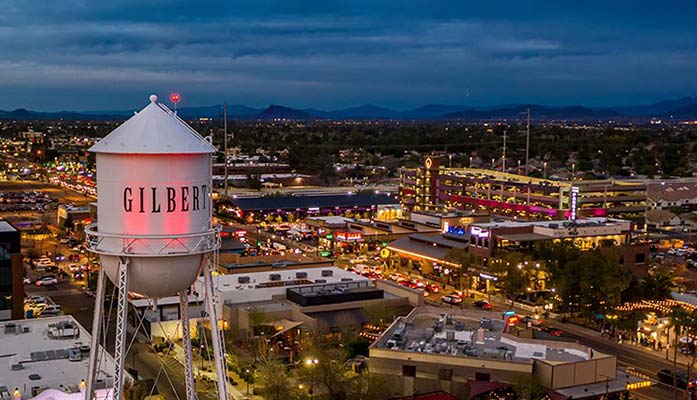
Gilbert hosts its 4th of July Celebration at Gilbert Regional Park from 5-9:30 p.m., featuring fireworks and a drone show. Free admission with VIP tickets available.
Mesa will hold the Arizona Celebration of Freedom in downtown Mesa from 6-10 p.m., with fireworks and a drone show at 9:25 p.m.
Tempe hosts its Fourth of July Celebration at Tempe Diablo Stadium from 6-10 p.m. Fireworks are scheduled for 9 p.m. Admission is $2.50
Scottsdale will host its celebration at WestWorld from 5-9 p.m., on July 4, with fireworks starting at 9 p.m. Admission ranges from $25-$50
Queen Creek presents “Hometown 4th at Schnepf Farms” from 2-10 p.m., featuring live entertainment and fireworks later in the evening. Admission ranges from $22.80 – $161.74.
Fountain Hills will host “Fourth at the Fountain”, July 4, from 6:30-9:30 p.m. at 12925 N. Saguaro Blvd. Fireworks will begin at 9 p.m with free admission.
Northern Arizona
Flagstaff will host a Fourth of July Drone Show at Foxglenn Park from 4-9 p.m., with the drone display beginning at 9 p.m. Admission is free
Cottonwood offers the “Fantastic Family Fourth of July” at Cottonwood Kids Park from 4-9:30 p.m., with fireworks at 9 p.m. Parking is $1
Wickenburg hosts its Independence Day Celebration at Sunset Park from 6-9 p.m., with fireworks at 9 p.m. Admission is free.
Kingman holds an “Old Fashion 4th of July” morning celebration, July 4, from 8:30 a.m. – 12:30 p.m., with evening fireworks at 9 p.m. at 3333 Harrison Street. Admission is free
Southern and Western Arizona
Tucson hosts “Diamonds in the Sky: 4th of July Celebration”, July 4, at Kino Sports Complex from 5:30 -9:30 p.m., with fireworks at 9 p.m. Admission is a $1 donation or one canned food item.
Marana presents its Star Spangled Spectacular at Crossroads at Silverbell District Park from 5-9:30 p.m., with fireworks at 9 p.m. Admission is free.
Casa Grande hosts its 4th of July Celebration at Paul Mason Sports Complex from 7-10 p.m., with fireworks at 9 p.m. Admission is free.
Yuma presents the “4th of July Spectacular” at Desert Sun Stadium from 6-10 p.m., with fireworks at 9 p.m. Admission is free.
Oro Valley hosts its July 4th Celebration at James D. Kriegh Park from 6-9:20 p.m. with fireworks at 9 p.m. Admission is free
Wellton will host a community Fourth of July Celebration at Butterfield Park. Fireworks timing will be announced. Admission is free.
Across Arizona, most Independence Day events remain free to the public, with select communities offering VIP seating or premium access options.
Organizers across the state encourage attendees to arrive early, plan for high temperatures, and check local city websites for parking updates and event advisories.
Ethan Faverino is a reporter for AZ Free News. You can send him news tips using this link.
State Representatives Quang Nguyen and Selina Bliss (R-LD1) met Sunday with Pocket Fire incident command at the Sedona Airport air operations base as the wind-driven wildfire north of Sedona continued to grow and threaten nearby communities.
The Pocket Fire had burned 5,547 acres as of Sunday morning, with 871 personnel assigned to the incident. The fire was first reported June 19 about seven miles north of Sedona and is burning in steep, rugged terrain that limits where crews can safely attack it directly. By mid-Monday, the fire had grown to 11,192 acres with zero percent containment.
The fire more than doubled in size between Saturday evening and Sunday morning as strong winds pushed it northeast. Fire crews shifted resources toward threatened communities and continued using bulldozers and other heavy equipment to build defensive lines. By Monday, the blaze had roughly doubled again.
Coconino County’s Pocket Fire information page said the fire began on June 19 on the Coconino National Forest, is burning in difficult-to-access terrain, and is expected to remain active for several weeks. The county listed Oak Creek Canyon, Kachina Village, Forest Highlands and Pine Del under SET evacuation status and encouraged residents susceptible to smoke to take precautions.
As of Sunday afternoon, Oak Creek Canyon Zones 14 and 15, Kachina Village and Forest Highlands remained under SET status. State Route 89A remained closed to nonlocal traffic between Sedona and Interstate 17, and portions of the Coconino National Forest remained closed.
Nguyen and Bliss requested the briefing to hear directly from incident command, determine whether additional state assistance is needed, and provide residents with current information. Fire officials thanked Yavapai County, Coconino County, the Arizona Department of Transportation, the Arizona Department of Public Safety, and other agencies assisting with the response.
“This is our district, and we have a duty to know where the threat is moving, what crews need and whether the state can do more,” Nguyen said. “We came to hear directly from incident command and see the operation firsthand. The men and women fighting this fire are working in dangerous conditions, and we stand ready to help secure any state resources they need.”
Bliss urged residents in SET areas to prepare before conditions worsen.
“SET means prepare now, not later,” Bliss said. “Pack medications, important documents and supplies. Account for family members and pets. Know where you will go, monitor official alerts and leave immediately if ordered. Do not wait for GO status to start preparing.”
Coconino County Emergency Management ordered activation of the county Emergency Operations Center (EOC) on Friday due to critical fire weather in connection with the Pocket Fire and to assist with an APS Public Safety Power Shutoff. The county said the EOC provides support and coordination for multi-agency and multi-jurisdictional emergencies affecting residents, businesses, property, and infrastructure.
The U.S. Forest Service said earlier in the incident that resources assigned to the Pocket Fire included Hotshot crews, engines, helicopters, air attack, and other firefighting assets, with the Southwest Area Incident Management Team 2 ordered to assume command after initial response by a Northern Arizona Type 3 Incident Management Team.
Nguyen and Bliss also honored three federal firefighters killed Saturday in a burnover incident while assigned to the Knowles and Gore fires near the Colorado-Utah border. Two other firefighters were injured.
“The deaths of three firefighters this weekend are a painful reminder of the dangers wildland firefighters face to protect others,” Nguyen and Bliss said. “We mourn them, pray for the injured and remember the six lost in the Dude Fire and the 19 Granite Mountain Hotshots. At the height of fire season, the public must do its part: obey restrictions, prepare early and never interfere with crews on the line.”
Coconino County has activated a Pocket Fire call center for questions about the fire, shelters or evacuation stages at 928-679-8525. County officials also said areas of Coconino County within and adjacent to the Coconino National Forest moved to Stage 2 fire restrictions effective Tuesday, June 30, at 8 a.m..
Officials urged residents to monitor Coconino County Emergency Management, Coconino National Forest, InciWeb, and AZ511 for current fire, evacuation, closure, and road information. They also warned the public not to fly drones near the fire because unauthorized aircraft can ground firefighting planes and helicopters.
A series of public safety reforms will go into effect after Gov. Katie Hobbs signed them into law over the past week.
State Sen. Kevin Payne (R-LD27), chairman of the Senate Public Safety Committee, sponsored the bills. Payne’s press release announcing the reforms said the state’s approach to public safety should be proactive, not just reactive.
“Public safety is about more than responding after a crime has occurred,” said Payne. “It’s about stopping criminal organizations before they victimize more people and making sure the men and women who protect our communities have the support they need to do their jobs.”
The bills in this bipartisan public safety reform package — Senate Bills 1215, 1400, 1452, and 1493 — represent changes to cargo theft investigations and prosecutions, wellness and crisis response for first responder employees, and workers’ compensation claims for cancer-stricken firefighters.
SB 1215 represented a fix to something Payne called a “drafting error” in the state’s presumptive cancer law which enabled challenges to workers’ compensation claims filed by first responders diagnosed with certain cancers contracted while in the line of duty.
Workers’ compensation providers have reportedly denied claims based on what critics of the original legislation called a “punctuation problem” with missing commas that created ambiguous meaning and purportedly allowed providers to reject certain claims.
These latest legislative fixes are retroactive to July 1, 2021.
“Firefighters put their lives on the line for complete strangers every day,” said Payne. “When they develop cancer linked to years of service, they shouldn’t have to fight insurance companies over a misplaced comma in state law.”
SB 1400 permits first responder entities to establish wellness and crisis response programs for those employees exposed to traumatic events in the line of duty. Programs would offer employees access to certain resources including counseling, peer support, and crisis intervention services. Part of that legislation, Payne noted, created confidentiality protections for participating employees’ communications.
“Our firefighters, police officers, dispatchers, and public safety professionals witness things most people will never experience,” said Payne. “Too often, the culture of these professions tells them to carry those burdens alone.”
SB 1452 creates the Cargo Theft Task Force under the attorney general, dedicated specifically to investigating and prosecuting organized cargo theft operations: the theft, diversion, embezzlement, unlawful taking, or fraudulent acquisition of cargo or freight.
The bill requires the attorney general to invite federal, state, and local law enforcement agencies to participate in the task force.
Task force membership will include one full-time prosecutor, one full-time paralegal, one full-time support staff member, six investigators, and any additional law enforcement personnel designated by the attorney general.
In addition to their investigatory duties, the task force will be required to meet regularly to review investigations and intelligence and share case updates, and to coordinate with local, state, or federal law enforcement on case referrals and the latest developments in the illicit cargo theft industry.
The attorney general will be required to submit an annual report on the task force’s activities, intelligence gathered, and any recommendations for legislative or policy action.
“Organized cargo theft has become a sophisticated criminal enterprise that impacts far more than warehouses and trucking companies,” said Payne. When criminals steal products moving through the supply chain, Arizona families ultimately pay the price at the checkout counter.”
SB1493 would require employers of wrongfully terminated law enforcement officers to cover any appeal costs and fees.
“When an officer is wrongly terminated and later proven right, justice shouldn’t stop at reinstatement,” said Payne. “No one should have to drain their savings or jeopardize their family’s financial future simply to clear their name.”
AZ Free News is your #1 source for Arizona news and politics. You can send us news tips using this link.
Andrew Costanzo, a Republican candidate for the 7th legislative district, still believes public education is key to Arizona’s future. But Costanzo says Arizona has serious need for reform — and that’s why public schools continue to decline.
Costanzo has proposed remedying low student proficiency rates by increasing school choice competition, mirroring Mississippi law, and implementing merit-based bonuses for educators.
He has also proposed growing the state’s universal school choice program by allowing property taxes to follow the child rather than according to the geographical predeterminations that fund school districts.
Costanzo is also very much against the proposed ballot initiative to end universal school choice. He said opportunity for educational freedom should be afforded to all, regardless of economic status. He also said educators would benefit from greater competition because they would be marketable on merit.
“How will these children reach their full potential as adults if they can’t read? We’re causing them a lifetime of pain,” said Costanzo in an interview last month. “The schools need something that benefits all businesses, and that’s competition.”
Costanzo also proposed enacting legislation similar to Mississippi’s Literacy-Based Promotion Act in Arizona, which policy experts have credited with a dramatic turnaround in student outcomes.
The lifelong Republican, who operates a family business near Payson, views freedom as the result of individuals taking on personal responsibilities and risks.
“Security, which is typically imagined, requires minimal personal responsibility and risk,” stated Costanzo’s website. “The alleged security is always provided at the loss of freedom.”
Beyond those philosophical takes on political matters, Costanzo presented a platform heavy on reducing government regulations through serious bureaucratic downsizing and greater deference to local governments, while increasing election security measures, resisting increased gun restrictions and abortion freedoms, retaining protections for law enforcement, and rolling back renewable energies.
Costanzo said in an interview last month that the legislature must “economically strangle” cartels and further scrutinize state agencies to recover what he says are sizable amounts of taxpayer funds being lost.
“It is so evident that there is waste, fraud, and abuse [in Arizona],” said Costanzo.
Costanzo’s platform also addressed at length the ongoing consequences of mass illegal immigration.
He described opposition to the present government handling of the illegal immigration crisis. According to Costanzo, the status quo victimizes both the illegal aliens and Americans. Illegal aliens face exploitation due to their vulnerable status as noncitizens, while Americans face the burdens of increased crime and strained public resources.
“Illegal aliens are often exploited financially, physically, or sexually. These people become part of an underclass of humans, a new form of slavery,” said Costanzo. “Whomever the victim, law enforcement resources must be implemented, the legal system is burdened, and incarcerations are applied. All paid for by the American taxpayer. […] [And t]he children of illegal aliens only put more pressure on an already failing [public school] system. Children who do not speak English must receive additional attention and resources, depriving the same from American students.”
Costanzo has been involved with the Arizona Republican Party, Gila County Republican Committee, Maricopa County Republican Committee, and Arizona Law Enforcement Emerald Society. He served as a precinct committeeman as well as a chairman, first vice chairman, and secretary for his legislative district.
This year marks Costanzo’s second time running for this office. He failed to secure the nomination in the 2024 Republican primary, which proved to be more crowded than this year’s primary: six candidates fought for two seats.
The 7th legislative district has fewer contenders in the Republican primary this time around.
State Rep. Walt Blackman is running to retain his seat, the other vacated by the April resignation of former lawmaker David Marshall. Three candidates are fighting for that spot vacated by a would-be incumbent: Costanzo and fellow 2024 primary candidate, Barby Ingle, and former state representative David Cook.
AZ Free News is your #1 source for Arizona news and politics. You can send us news tips using this link.
U.S. Rep. David Schweikert (R-AZ01), chairman of the Joint Economic Committee (JEC), warned that the United States faces growing fiscal risk unless Congress acts sooner to stabilize the federal debt-to-GDP ratio.
Schweikert sent the committee’s latest Views and Estimates letter to House Budget Committee Chairman Jodey Arrington in a letter earlier this month.
“There is great uncertainty about when and how the debt will switch from sustainable, business as-usual, to an unsustainable, market-unraveling nightmare,” Schweikert wrote. “Every year we wait to change course increases leverage, and the higher the debt-to-GDP ratio the easier it is for bad headwinds—such as crisis spending or interest rate fragility—to lock us into a debt spiral. In short, allowing the debt burden to increase is a levered bet, and the downside risks are already enormous.”
JEC Chairman @RepDavid sent @HouseBudgetGOP Chairman @RepArrington the latest Views & Estimates. “There is great uncertainty about when & how the debt will switch from sustainable, business as-usual, to an unsustainable, market-unraveling nightmare. https://t.co/pPMp4K17EP
— Joint Economic Committee Republicans (@JECRepublicans) June 8, 2026
The committee’s Republican staff found that rising federal debt is structurally unsustainable and that stabilizing the debt-to-GDP ratio will require large early policy changes. The letter states that delaying action materially increases the risk of severe economic and financial consequences.
According to the letter, federal debt has recently reached 100 percent of gross domestic product, meaning the federal debt is now roughly the size of the economy’s total annual output. The Congressional Budget Office projects debt held by the public will reach 118 percent of GDP by 2035, 142 percent by 2045, and 172 percent by 2055. Treasury projections cited in the letter are higher, estimating 129 percent by 2035, 183 percent by 2045, and 245 percent by 2055.
The JEC letter describes the current debt path as a “levered bet on stability” that depends on avoiding major crises requiring substantial fiscal headroom and on future interest rates remaining favorable relative to economic growth. The letter warns that the damage to the nation’s fiscal position and status as a world power could be “catastrophic and irreversible” if those conditions deteriorate.
The committee cited estimates from the Committee for a Responsible Federal Budget indicating that a fiscal adjustment of about $9.5 trillion over ten years would be needed to stabilize the debt-to-GDP ratio at about 100 percent. The JEC letter used a similar ballpark estimate of about $9.2 trillion to close the primary deficit over a ten-year window, while noting that the exact adjustment would depend on interest rates, economic growth, the timing of policy changes, and the path of the primary deficit.
“In any case, these are magnitudes of adjustment virtually absent from current policy debates,” the letter states.
The letter recommended reforms in Medicare, international taxation, and immigration that it estimated would produce about $3.6 trillion in deficit reduction over ten years, or roughly 40 percent of the adjustment identified as necessary to stabilize the debt-to-GDP ratio.
The largest proposed savings would come from Medicare Advantage reform. The letter states that Medicare Advantage now covers 55 percent of all Medicare beneficiaries and that flawed payment policies, excessive coding practices, insufficient enforcement, and federal inaction have driven up costs. According to the JEC, Medicare Advantage beneficiaries are now estimated to cost roughly 14 percent more than they would under traditional Medicare, amounting to an estimated $76 billion in excess federal spending in 2025.
The letter cites H.R. 3467, the Better Medicare Act, as a proposal to realign Medicare Advantage incentives. The JEC estimated the legislation would reduce federal spending by approximately $1.8 trillion over ten years.
In a Fox Business appearance posted to X by Schweikert’s office, Schweikert described what he called “institutional design fraud,” citing his team’s investigations into New York and California “where they’re exploiting part of the Medicaid system for billions and billions and billions of dollars.”
Federal prosecutors say a $30 million Medicaid scheme meant for children’s mental health services helped pay for a fleet of luxury vehicles. That is bad actor fraud.
But the real bleeding is coming from New York and California exploiting parts of Medicaid for billions and… pic.twitter.com/jFyGJr3JAC
“If New York actually had the same cost in their Medicaid system,” he continued, “it would be a $50 billion savings a year if they had the same costs as other states. That’s actually where the tremendous amount of money is, because remember, we’re borrowing about a million dollars every 15 seconds. So, the scale is what’s just so hard to get your head around.”
The committee also recommended a border adjustment tax policy, which would tax business income based on where products are sold rather than where they are produced. Under the proposal, export receipts would be excluded from the tax base and import deductions would be disallowed. The JEC estimated the policy could raise approximately $1.5 trillion over ten years.
On immigration, the committee recommended shifting employment-based admissions toward higher-producing applicants through a points-based, industry-targeted framework. The letter states that an aging population and a shrinking pool of younger workers are reducing the labor force needed to grow the economy and service the debt. The JEC estimated that such a reform could produce a net fiscal benefit of $335 billion over ten years and $1.34 trillion over twenty years, assuming annual immigration remains at current levels.
Schweikert has raised the alarm regarding demographic decline as a driver of fiscal collapse, citing three unassailable facts: “debt, deficits and demographics,” in March 2025.
The letter also credited H.R. 1, commonly known as the One Big Beautiful Bill Act, with pro-growth tax provisions. The JEC said policymakers should redirect their focus toward “transparently pro-growth reforms” and cited federal land sales, reforms of the Jones Act, and policy related to port automation as examples of areas that could support growth.
Schweikert’s letter concluded that growth alone should not be counted on to resolve the federal government’s fiscal problems.
“I have highlighted fiscal reforms that would bring us about 40 percent of the way to stability of the debt-to-GDP ratio,” Schweikert concluded in the letter. “While there is strong potential for increasing economic growth as a partial solution, we should not count on growth alone to address our fiscal problems.”
The town of Gilbert’s vice mayor is one of the biggest individual donors to an effort to end universal school choice in the state.
Councilman Charles “Chuck” Bongiovanni was one of a small number to provide funding to Protect Education, Accountability Now (PEAN), the political action committee behind a ballot initiative to limit access to the Empowerment Scholarship Account (ESA) program.
A majority of PEAN’s funds have come from national and local teachers’ unions: the D.C.-based National Education Association gave $2.5 million, and the Arizona Education Association gave $10,000.
As of this report, only three others donated more to PEAN than Bongiovanni: former PetSmart CEO Phil Francis and his wife, former Valleywise Health Foundation board member Nita Francis, donated $25,000; and a retired Avondale computer software author and frequent donor to Democrats, Roxton Baker, donated $1,000.
Bongiovanni donated $500 to the cause. Excluding Bongiovanni and the other top three individual donors, the median of total donations from individual donors reported so far — about 100 in total — was about $20.
After Bongiovanni, the next-highest donation was in the amount of $250 from Linda Thor, at-large member of the Maricopa County Community College District Governing Board.
Bongiovanni has also laid claim to being the largest donor for the LD14 Democrats, though he has donated to some Republicans.
Bongiovanni, who is running for reelection to the council, is the CEO of Majestic Residences: claimed as the second-largest franchised residential assisted living provider in the country and the largest in its main state of operations, North Carolina.
Bongiovanni’s reelection platform focused on the likelihood of increasing costs to residents in order to address aging infrastructure, which he defined as water, sewer, and road.
However, Bongiovanni has taken a less strict approach to defining infrastructure for the purposes of justifying increased costs and taxes.
In October 2024, Bongiovanni and other council members voted to raise sales taxes on all goods and services sold in Gilbert. The tax raise was controversial beyond the increased financial burden to property owners and businesses: it earned the nickname “the pickleball tax” because the revenue would go to projects not traditionally defined as critical infrastructure, but so defined by the council, like pickleball courts, splash pads, a ropes course, and a statement bridge.
The Goldwater Institute sued the town over the tax in December 2024. The lawsuit accused the council of pushing an illegal tax hike on services. That lawsuit is still active.
What’s more, just last year, the town council approved its third water rate hike since 2024.
The backlash incited the ire of some Gilbert residents, and even one man who was arrested for threatening violence against council members in retaliation over the rate increase.
Bongiovanni also took credit for establishing the town’s hiring of a police officer dedicated to preventing teen violence, and the establishment of the Dementia-Friendly City Program.
In the Gilbert Chamber of Commerce candidate forum in April, Bongiovanni proposed expanding the size of town government to expedite the town’s turnaround times, specifically citing the permitting department.
Bongiovanni didn’t look to accomplish that this year. In the fiscal year 2027 budget passed earlier this month, Bongiovanni and the council approved $2.7 billion representing a commitment to maintenance of present operations, not expansion.
Bongiovanni also hinted at inviting a greater corporate presence into Gilbert, though he declined to elaborate on which entities he has been courting.
“I’m also looking for Disneyland — I don’t mean Disneyland itself, I’m looking for a big project,” said Bongiovanni. “[S]ome very huge projects that bring in, like, $200 million into our tax base. That’s all we’re going to need forever.”
AZ Free News is your #1 source for Arizona news and politics. You can send us news tips using this link.