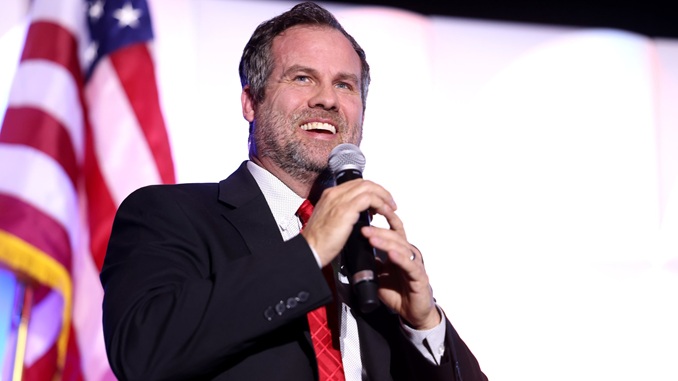
Democratic state Rep. Lydia Hernandez (D-LD24) endorsed Republican Arizona Senate President Warren Petersen (R-LD14) for attorney general Friday, backing him over incumbent Democratic Attorney General Kris Mayes.
Petersen’s campaign announced the endorsement on X, presenting it as evidence of support for his candidacy across party lines.
“I’m a legislator and Democrat, and I’m supporting Warren Petersen for Attorney General,” said Hernandez. “The Attorney General must keep our families safe, protect our students, and stand up for our schools — and Warren Petersen is the only candidate for the job.”
“As a lifelong Democrat and public school advocate, I’m voting for the only candidate that can protect our community,” Hernandez added.
Hernandez’s public education work includes service on the Cartwright School District Governing Board, where she has served since 2003.
Hernandez is set to leave the Legislature in January after finishing third in July’s four-candidate Democratic primary for the two House seats in LD24. The Legislative District 24 Democratic Party had previously censured her, citing her votes with Republicans and earlier endorsements of Republican candidates, including former Gov. Doug Ducey and former Secretary of State Michele Reagan. Hernandez’s endorsement of Petersen follows that history of crossing party lines.
Hernandez also sponsored HB 4109, legislation known as “Michael’s Law.” The measure would have required school districts to adopt public safety policies addressing life-threatening violence, threats involving weapons, parental notification, and contact with law enforcement.
HB 4109 passed the Arizona House in April but was held in the Senate.
Petersen said his working relationship with Hernandez showed that officeholders from opposing parties can cooperate on issues affecting their constituents.
“Throughout my time in the Legislature, I’ve been privileged to work with legislators on both sides of the aisle,” Petersen said. “Lydia Hernandez and I may be from different parties, but we know how to work together in the best interest of the people we represent.”
“That kind of cooperation is often missing from our political discourse today,” he continued. “As Attorney General, I will bring that same approach to the office to uphold our laws and protect Arizonans, not put political allies above the rule of law.”
Petersen thanked Hernandez for her support and said he looked forward to working with her on school and community safety.
The Petersen campaign said Hernandez joins a coalition of supporters that includes law enforcement officials, business representatives, rural leaders, and community advocates.
Arizona’s general election is scheduled for Nov. 3. The voter registration deadline is Oct. 5, and early voting begins Oct. 7.
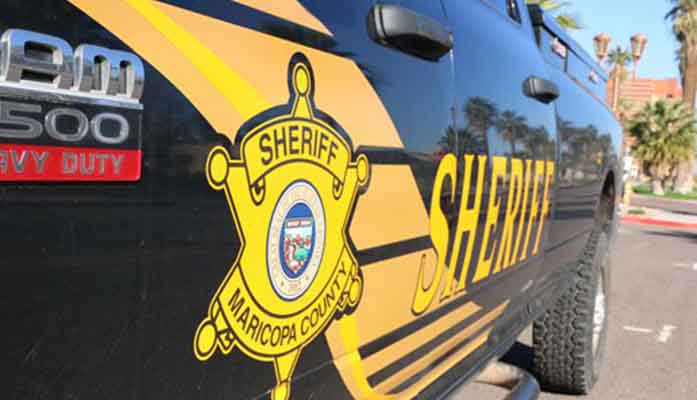
The Maricopa County Sheriff’s Office (MCSO) will continue to have a federal court monitor for the time being.
Arizona District Court Judge G. Murray Snow ruled last week that MCSO still needs federal oversight to prevent racial profiling by its officers, namely during traffic stops.
Snow based his denial on the department’s elevated rate of investigations and arrests of Hispanic individuals.
Snow said that MCSO hadn’t provided compelling evidence that it wouldn’t impose higher rates of searches and arrests and longer stops for Hispanic drivers.
“[There is] significant, probative evidence that racial bias may continue to affect MCSO’s traffic stop operations,” stated Snow. “To be clear, evidence of racial disparities does not, by itself, establish intentional racial discrimination. Nor must MCSO eliminate every statistical disparity before it can establish that prospective enforcement of the First Order is no longer warranted. But further explanation is needed.”
MCSO first received a court monitor 13 years ago following a lawsuit alleging unconstitutional racial profiling amid immigration enforcement operations that took place under former Sheriff Joe Arpaio. Local and state leaders have petitioned for an end to the monitor, citing the cost to taxpayers: nearly $350 million to date.
Rep. Andy Biggs (AZ-05), the Republican nominee for governor, issued a statement saying the ruling had “disturbed” him. Biggs claimed the court monitor had exacerbated existing deputy attrition and recruitment challenges.
“The monitor’s continued existence in our county and propensity for moving the goalposts from his original charge exploits taxpayers and undermines the brave work of law enforcement,” said Biggs. “This most-recent ruling underscores the need for the Senate to pass my Monitor Accountability Act, which sets common-sense and clear rules for courts’ use of federal monitors. I stand with the people and law enforcement officers of Maricopa County!”
Congress is considering the Monitor Accountability Act: legislation from Biggs that would reform federal standards governing court-appointed monitors. The House passed the bill in May, and it is currently before the Senate.
The legislation would impose a five-year term limit on court monitors and prohibit reappointments under the same court order, bar successive monitors from the same law firm or employer, cap monitor compensation fees, require public comment on court monitors prior to appointment, limit monitorship extension to cases exhibiting insubstantial and unsustained compliance, and reassign cases after six years.
The legislation would be retroactive, meaning MCSO would have the monitor and judge on its case replaced.
MCSO Sheriff Jerry Sheridan told KTAR that the judge’s order had provided him with enough structure to make him optimistic for a future relief effort.
“The positive thing that I got out of it: he recognized that there are many paragraphs the sheriff’s office is in compliance with,” said Sheridan.
MCSO issued a statement expressing disappointment with the court ruling but, like Sheridan, acknowledging a silver lining.
“We are disappointed by the Court’s decision because we believe MCSO has implemented durable remedies for violations that occurred 19 years and three administrations ago,” said MCSO. “At the same time, we are encouraged that the Court has provided a framework on eliminating portions of the Order that are no longer necessary and focusing compliance efforts on the remaining issues to be addressed. This will allow MCSO to focus its resources on achieving full and effective compliance with the remaining requirements. MCSO looks forward to working with the Parties on this process.”
AZ Free News is your #1 source for Arizona news and politics. You can send us news tips using this link.
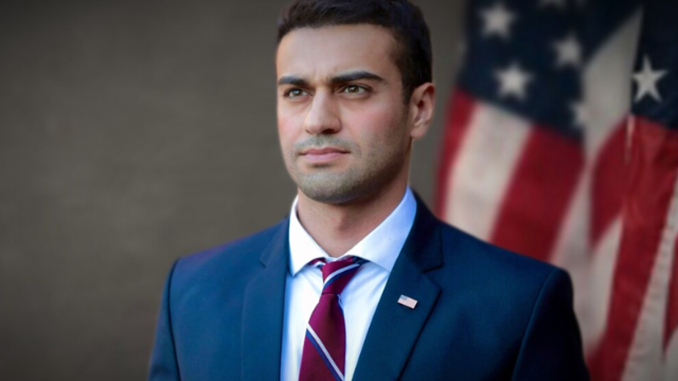
Legislation cosponsored by Arizona Congressman Abe Hamadeh (R-AZ08) that would establish a permanent fraud enforcement division within the U.S. Department of Justice passed the House last week.
The House approved H.R. 9576, the National Fraud Enforcement Division Act of 2026, in a 352-72 vote.
The legislation, sponsored by Rep. Brad Finstad (R-MN), would formally establish the National Fraud Enforcement Division within the Justice Department and place it under the leadership of an assistant attorney general appointed by the President and confirmed by the Senate.
Hamadeh is one of four cosponsors of the legislation, alongside Reps. Derek Schmidt (R-KS-02), Harriet Hageman (R-WY-At Large), and Michelle Fischbach (R-MN-07).
“I want to thank my colleagues for passing this critical legislation,” said Hamadeh. “The criminals, who have created the need for this enforcement effort, have not only stolen taxpayer dollars, but have victimized the most vulnerable in our society by depleting the resources allocated for their needs.”
The legislation would give the division responsibility for leading DOJ efforts to investigate, prosecute, and remedy fraud affecting the federal government, federally funded programs, and U.S. citizens.
The division would also oversee multi-district and multi-agency fraud investigations, assist U.S. Attorneys’ Offices with fraud-related cases, coordinate with federal agencies to identify organized fraud schemes, and develop national fraud enforcement priorities.
Under the bill, the assistant attorney general leading the division could also propose legislative and regulatory changes intended to address vulnerabilities that allow fraud to occur and advise the attorney general and deputy attorney general on significant fraud investigations and prosecutions.
The Justice Department established the National Fraud Enforcement Division earlier this year as part of a broader federal effort to combat fraud involving taxpayer-funded programs.
Acting Attorney General Todd Blanche issued a memorandum in April directing the division to coordinate with agencies administering benefit programs and with federal, tribal, state, territorial, and local law enforcement.
The House legislation would give the division a statutory basis rather than leaving its existence solely to executive branch action.
Hamadeh pointed to a recently announced Arizona Medicaid fraud case as an example of the type of alleged fraud federal authorities are targeting.
Federal prosecutors announced in early September that a Peoria man was charged with health care fraud and money laundering after allegedly billing the Arizona Health Care Cost Containment System (AHCCCS) more than $33 million between May 2022 and May 2023.
This week, an Arizona man was charged with fraudulently billing AHCCCS more than $33 million in a single year. He targeted American Indian Health Care Program enrollees and spent the money on property and luxury items.
That money was meant for people who need care, not a…
According to the U.S. Attorney’s Office for the District of Arizona, Maurice Marcell Williams, 48, owned and operated a behavioral treatment provider and allegedly submitted claims to AHCCCS for services that were never provided.
Prosecutors allege Williams targeted members enrolled in the American Indian Health Care Program.
Although more than $33 million was billed, federal prosecutors said AHCCCS actually paid approximately $19.7 million on the allegedly fraudulent claims.
The indictment also seeks forfeiture of two residential properties, a Rolls-Royce Cullinan, and brokerage accounts.
Williams has been charged but not convicted.
Hamadeh said the case demonstrated how fraud involving federal benefit programs can affect resources intended for vulnerable populations.
“He specifically targeted AHCCCS enrollees who were covered under the American Indian Health Care Program,” said Hamadeh. “He exploited vulnerable people to buy expensive property and luxury items. These federal funds are finite, so not only did he target a vulnerable population, but his thievery also serves to weaken the crucial safety net Americans need for education, medical care, retirement, and more.”
The DOJ says the National Fraud Enforcement Division uses data-driven investigative methods and coordinates with government agencies and law enforcement partners to identify and prosecute fraud.
Its work also supports the Trump administration’s Task Force to Eliminate Fraud, chaired by Vice President J.D. Vance.
H.R. 9576 was introduced by Finstad on July 2. Following Wednesday’s House Passage, the legislation would need Senate approval before it could be sent to the President.
Ethan Faverino is a reporter for AZ Free News. You can send him news tips using this link.
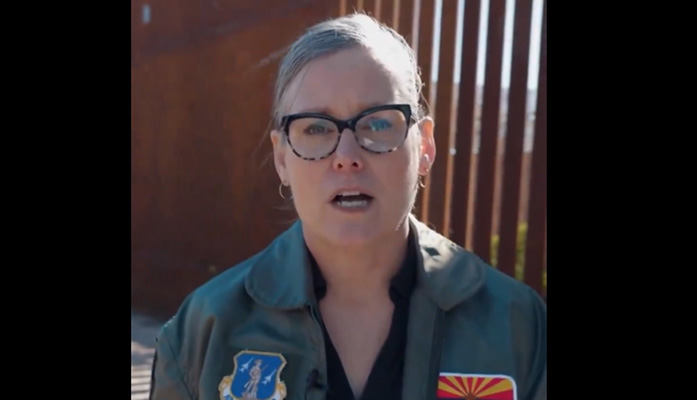
A top federal health official is scheduled to testify before Arizona lawmakers on September 21 as the state faces scrutiny over repeated delays in completing a federally required audit and potential consequences for federal funding.
The Joint Legislative Audit Committee, chaired by State Rep. Matt Gress (R-LD4), will hold a public hearing to examine Arizona’s failure to submit its required Single Audit by federal deadlines and what steps are being taken to return the state to compliance.
Gustav Chiarello, Assistant Secretary for Financial Resources at the U.S. Department of Health and Human Services (HHS), is scheduled to testify before the committee. HHS notified Governor Katie Hobbs in July that Arizona was not in compliance with federal Single Audit requirements.
A Single Audit is an annual examination of a government entity’s financial statements and its compliance with requirements governing federal awards.
Under federal rules, entities that meet the applicable threshold for federal expenditures are required to undergo a Single Audit, which serves as an oversight mechanism for the use of federal funds.
According to the Arizona House of Representatives, the state has missed its federal Single Audit deadline for four consecutive fiscal years.
Arizona’s fiscal year 2025 audit was due March 31, 2026 but remains outstanding. The Arizona Auditor General has projected the audit may not be issued until March 5, 2027, less than a month before the fiscal year 2026 audit is due.
HHS has warned that continued noncompliance could result in federal enforcement measures, including additional conditions on federal awards, temporarily withheld payments, disallowed costs, or the suspension or termination of federal awards.
HHS has recently increased its focus on Single Audit compliance nationwide.
The department announced an initiative earlier this year examining years of Single Audit information from states and federal grantees, saying its initial review identified repeated unresolved findings and hundreds of grantees that had failed to submit required audits.
According to the PHX Reporter, Gress said the continuing delays have moved beyond a paperwork issue and require greater attention to management and accountability.
“I’m deeply concerned,” Chairman Gress said. “This is something we’ve been raising since I became Chairman of the Joint Legislative Audit Committee in 2023, and the Auditor General has now made clear that the State’s current timeline is not realistic.”
Gress said that addressing the delays will require greater accountability from state agencies responsible for Arizona’s financial reporting.
“The Governor should be driving a coordinated corrective plan across the agencies the Auditor General identified, with clear deadlines and accountability for each one,” said Gress.
“The Auditor General has laid out what has to happen for the audit to be completed by March 5, 2027, so the administration should be treating those milestones as an urgent management priority and doing everything possible to protect federal funding,” he added.
Other Republican lawmakers have also publicly questioned the state’s failure to complete the audit on time.
State Senator Janae Shamp (R-LD29) questioned the delays publicly on X, saying, “@HHSGov just put it in writing: Arizona is NOT compliant on the FY25 Single Audit. Due March 31. Not filed. Why? Hiding something? @katiehobbs @GovernorHobbs what is your action plan to ensure vulnerable, innocent Arizonas do not suffer from your administration’s incompetence?”
@HHSGov just put it in writing: Arizona is NOT compliant on the FY25 Single Audit. Due March 31. Not filed. Why? Hiding something?
@katiehobbs@GovernorHobbs what is your action plan to ensure vulnerable, innocent Arizonas do not suffer from your administration's incompetence? pic.twitter.com/wZhOweLqnB
— Former Majority Leader of the AZ State Senate (@AZSenatorShamp) September 12, 2026
State Representative John Gillette responded to Shamp’s post, alleging problems involving the commingling of funds, noncompliant spending and unauthorized payments.
Gress, however, told the PHX Reporter that he would not speculate about whether the delays indicated information was being concealed without evidence.
“I’m not going to speculate that something is being hidden without evidence,” he said. “But the Auditor General documented inaccurate financial information, delayed responses, significant errors requiring revised financial statements, and unresolved reconciliation issues.”
“So there are legitimate questions that deserve rigorous oversight and clear answers,” he added.
The September 21 hearing is expected to examine the causes of the delays, Arizona’s corrective action plan, which federal funding could potentially be affected, and what changes are necessary to prevent another missed deadline.
In addition to Chiarello, lawmakers are scheduled to hear from the Arizona Auditor General, representatives from Arizona’s three public universities, the Arizona Health Care Cost Containment System, the Arizona Department of Education, the Department of Economic Security, the Department of Administration, and the Governor’s Office.
The hearing is scheduled for 9 a.m. Monday in House Hearing Room 1 at the Arizona State Capitol.
Ethan Faverino is a reporter for AZ Free News. You can send him news tips using this link.
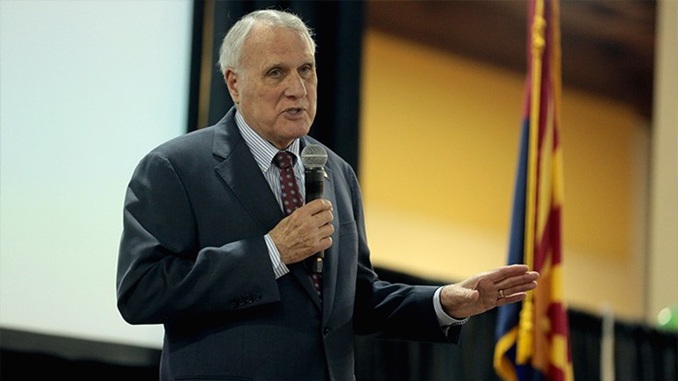
Former U.S. Senator Jon Kyl, a lifelong Republican, passed away on Thursday at the age of 84.
The Kyl family said the former senator died due to complications following his dementia diagnosis in December 2025.
Kyl was born and raised in Nebraska before coming to Arizona to attend the University of Arizona, where he earned his bachelor’s and law degrees.
Kyl served in the Senate from 1995 to 2013, and later by appointment in 2018 following the passing of former Sen. John McCain. Kyl was the Senate Minority Whip from 2007 to 2013.
Prior to the Senate, Kyl represented the 4th District in the House of Representatives from 1987 to 1995.
During Kyl’s 26 years in Congress, 18 of his bills became law.
Prior to joining elected office, Kyl’s efforts as an attorney for the Salt River Project laid the groundwork for the Arizona Groundwater Management Act and the creation of the Arizona Department of Water Resources.
Other bills included legislation that authorized funding for crime victims, authorized land exchanges allowing the cities of Yuma and Sedona to develop property, arranged for prisoner copays for certain healthcare services, and barred nepotism within the federal court appointments.
Kyl is survived by his wife of 62 years, Caryll Collins, their two children, John Kyl and Kristine Kyl Gavin, and four grandchildren.
Kyl’s legacy as an effective leader, lawmaker, and lawyer has inspired widespread bipartisan mourning over his passing.
Rep. Andy Biggs (AZ-05), the Republican nominee for governor, issued a statement describing Kyl as a man of distinction, integrity, and unwavering dedication to Arizona who had deep understanding of the issues plaguing the state.
“He was an exemplary public servant who understood Arizona, fought tirelessly for our interests, and approached his responsibilities with humility and conviction,” said Biggs. “May Senator Kyl always be remembered as a servant leader who loved Arizona and dedicated so much of his life to making our state and country stronger.”
Arizona Senate President Warren Petersen, the Republican nominee for attorney general, called Kyl “a work horse not a show horse.”
“He was always working big projects and solutions for Arizona,” said Petersen. “Arizona could use another Senator like him.”
Former Gov. Doug Ducey commended Kyl for his “principled, thoughtful leadership” and said Kyl was a mentor and friend to him. Both Kyl and Ducey were members of the Pi Kappa Alpha fraternity.
“I’ll miss him deeply,” said Ducey.
Gov. Katie Hobbs described Kyl as a “dedicated statesman who always cared deeply for our state.”
Rep. Yassamin Ansari, a Democrat, commended Kyl for his work on securing Arizona water rights.
“A true public servant who understood Arizona water better than anyone, Jon Kyl was devoted to the people he served, acted selflessly on their behalf, and went — simply — where he was most needed. His legacy will endure in Arizona,” said Ansari.
Sen. Mark Kelly, a Democrat, also praised Kyl for his water rights work.
“His landmark work securing historic tribal water settlements defined this state in ways that will last long after his passing. He was a true public servant who loved this state,” said Kelly.
Cardinals owner Michael Bidwell also issued a statement.
“His quiet, principled and impactful leadership left a lasting remark on our state and our nation and for that we are forever grateful,” said Bidwell.
In one of his final interviews near the end of his life, Kyl told KTAR that the most important thing Arizonans can do is exercise their civic duty.
“If you really care about your future, if you care about your kids and your grandkids and so on, make a little time for participating in one of the political parties or some other way where you can say at the end of your life ‘Yeah, I did something,’” said Kyl.
Rep. Abe Hamadeh (AZ-08) recalled some wisdom imparted by Kyl.
“Jon once said that ‘real leadership means tackling tough problems ourselves and not leaving them to our children,’” said Hamadeh. “That is a standard worth remembering as we mark his passing and keep his family in our thoughts.”
AZ Free News is your #1 source for Arizona news and politics. You can send us news tips using this link.
A former Arizona Supreme Court justice will be leading the pay-to-play investigation into Gov. Katie Hobbs.
Arizona Senate Republicans announced on Monday that it had appointed Andrew Gould, a justice on the Arizona Supreme Court from 2016 to 2021, as part of the next phase of their investigation regarding allegations that Hobbs arranged for Sunshine Residential Homes, a group home operator and one of her top donors, to receive a special rate increase from the Arizona Department of Child Safety.
As a result of the transfer to another committee, Senate Republicans postponed the hearing for an indeterminate date in the future. The hearing was scheduled to take place on Tuesday, Sept. 29, 2026, at 11 a.m.
Gould also served on the Arizona Court of Appeals and Yuma County Superior Court, and served as a prosecutor in Maricopa and Yuma counties.
In a press release, Gould pledged to carry out an impartial and dispassionate investigation into the matter.
“My responsibility will be to help the committee establish a complete factual record, evaluate testimony and documents objectively, and ensure its work is thorough, fair, and legally sound,” said Gould. “No factual or policy conclusion should be predetermined. The evidence will determine where this investigation leads, and which reforms if any are ultimately recommended to the Committee.”
🚨FOR IMMEDIATE RELEASE: Former Arizona Supreme Court Justice Andrew Gould Appointed to Lead Senate Investigation into Hobbs Pay-to-Play Scandal
The Senate GOP also transferred the investigation from the Senate Government Committee to the Senate Committee on Appropriations. State Sen. Jake Hoffman (R-LD15), the chair of the Government Committee, said the media was to blame for the transfer.
During a press conference last week announcing a special hearing and subpoenas concerning the pay-to-play allegations, Stacey Barchenger, the Arizona Republic reporter who first reported on the alleged connection between Hobbs and Sunshine Residential Homes, asked Hoffman about the more than $1 million his advertising agency received from Turning Point PAC in support of Republican gubernatorial nominee Andy Biggs’s candidacy.
In this latest press release, Hoffman said the transfer of the investigation to another committee was necessary to keep the focus on the allegations against Hobbs.
“The crooked political media decided what this investigation was before it even began, because running cover for Katie Hobbs and Kris Mayes is more important to them than exposing potential corruption,” said Hoffman. “Transferring the proceedings and placing former Justice Andrew Gould at the center takes away their excuses for non-cooperation, strengthens the investigation, and ensures the evidence, not their predetermined political narrative, drives any resulting legislative reforms.”
Sen. David Farnsworth (R-LD10), chair of the Senate Committee on Appropriations, stated in the same press release that the scope of the investigation enabled it to fit comfortably within his committee.
“This transfer does not narrow the issues under investigation or diminish the Senate’s resolve. It places the investigation where the money can be examined directly and adds an experienced former prosecutor and Supreme Court justice to lead that work,” said Farnsworth. “We will follow the evidence, examine how these decisions were made, and give every witness a fair opportunity to explain the events at issue. Only after that process is complete can we reliably identify gaps in current Arizona law and determine which statutory changes are most appropriate to help prevent future misappropriation of taxpayer dollars.”
Along with Hobbs, the Senate subpoenaed Sunshine Residential Homes CEO Simon Kottoor and his wife, Elizabeth; Attorney General Kris Mayes; Christian Slater, Hobbs’ communications director; Hobbs’ inaugural and defense funds; Dan Barr, Mayes’ chief deputy attorney general; Bill Mundell, Mayes’ chief deputy of police and administration; Nicholas Klingerman, Mayes’ criminal division chief; Michael Faust, former DCS director and current city of Peoria manager; Shalom Jacobs, former DCS deputy director and current CGI director; Alex Ong, DCS deputy director; Robert Navarro, former DCS deputy director; and David Lujan, former DCS director.
AZ Free News is your #1 source for Arizona news and politics. You can send us news tips using this link.