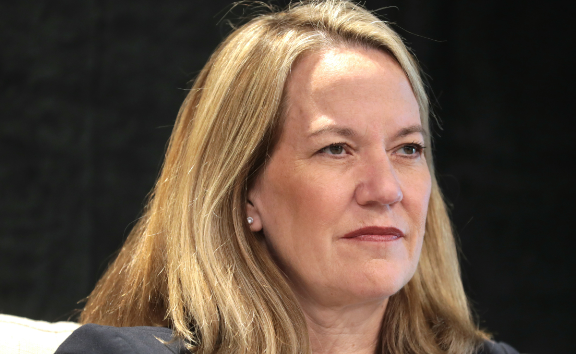
Arizona Attorney General Kris Mayes secured an internship for the son of one of her campaign donors who was also behind Wednesday’s debate, new records revealed.
Mayes’ campaign aide arranged for the son of Tim Riester, a donor, to receive an internship this past summer following a request from Riester, according to records reported by The California Globe.
Riester is the founder and CEO of RIESTER, an advertising and public relations firm with operations in Los Angeles, California and Park City, Utah in addition to Arizona.
Riester donated nearly $1,400 over two installments to the Mayes campaign. Riester asked Grace Forster, a campaign aide, about an internship for his son, Jim Riester, allegedly promised to him by Mayes herself the day after he made his second donation.
“When I was with Kris at her event on November 18th, she met my son Finn who is in law school and offered him an internship with the AG’s office this summer,” wrote Riester in an email to Forster.
Forster forwarded Riester’s email to several undisclosed recipients, then followed up days later on the internship request in an email to Mayes and multiple members of Mayes’ office: Bill Mundell, chief deputy attorney general; Emily McConnico, executive assistant; and Delaney Corcoran, who was Mayes’ deputy communications manager at the time and is now her campaign manager.
Mundell responded to Forster with a promise that an officer member would contact Riester. His son interned with Mayes’ Tobacco Enforcement Unit over the summer.
Riester was one of the principal partners behind Wednesday’s debate between Mayes and her Republican opponent, Senate President Warren Petersen.
Riester took over as a contractor for Arizona Citizens Clean Elections Commission (CCEC) candidate debates in January 2024 alongside the Arizona Media Association after CCEC parted ways with Arizona PBS.
During the pandemic, Riester achieved significant public attention as one of the principal creative minds behind Arizona’s COVID-19 campaign advising masks under the direction of former Gov. Doug Ducey in 2020, according to reporting from the Arizona Mirror. The state spent somewhere around $3 million on the campaign. Riester gave $10,000 to Ducey’s reelection campaign in 2018, though a vast majority of his thousands in donations to state-level and federal-level candidates in recent years have gone to Democrats.
Last year, Riester and his wife, Mirja, also donated $11,000 to Secretary of State Adrian Fontes, the Democratic incumbent, and $1,000 to Nick Mansour, Democratic candidate for Arizona State Treasurer.
The pair also donated $10,800 to Gov. Katie Hobbs’ reelection campaign in October 2024. Mirja donated $10,000 to ActBlue Arizona and $10,000 to the Arizona Democratic Party in December 2022.
Last June, KJZZ interviewed Riester on President Donald Trump’s tariffs. Riester dismissed the “Made in America” movement as rooted in white prejudice, not patriotism.
“The first documented usage was in [1800s] San Francisco, in the cigar industry, and Americans were concerned because of the mass immigration of Chinese residents who were moving to the United States. And they were afraid they were going to be able to make the products much more quickly and inexpensively,” said Riester. “So they created a label that, really, was about prejudice. It was a white label, and it meant that the cigars were made by white people instead of by Chinese people. And that evolved into the Made in America brand that over the years we’ve seen used periodically.”
AZ Free News is your #1 source for Arizona news and politics. You can send us news tips using this link.
Years after losing a primary election to State Rep. Walt Blackman (R-LD7), Steve Slaton is still finding ways to challenge him — even if it means deriding Black Americans as “apes” on social media.
Blackman issued a press release on Friday calling on his fellow elected officials and community leaders to condemn the rhetoric.
“Depicting Black Americans as apes and portraying an entire race as a societal problem is racist and dehumanizing. Leaders should have no difficulty saying so,” said Blackman. “Political considerations must never become an excuse for tolerating racial degradation. Our children are learning from what adults say and what leaders tolerate. They deserve to see courage expressed through respect for others and a willingness to speak when silence would be easier.”
I once served under a Army Command Sergeant Major who drilled one lesson into his soldiers:
“Choose the hard right over the easy wrong.”
I challenge my colleagues to live by that wisdom. Leadership demands the courage to do what is right—even when it comes at a political cost. pic.twitter.com/W78hYxlKd3
— Chairman Walt Blackman LD7 Representative (@BlackmanForAZ) September 25, 2026
Slaton’s social media posts in recent months have characterized Blackman and other Black Americans as “North American Pavement Ape[s]” who are a “problem” for the country.
Slaton unsuccessfully challenged Blackman in the Republican primary for the Legislative District 7 seat in the 2024 election. During that messy primary, the Navajo County GOP discovered evidence that Slaton was committing stolen valor.
Slaton claimed to be a decorated combat veteran who served in the Vietnam War, but service records reflect that he enlisted after the war. Slaton reportedly provided an altered DD-214, the official government discharge papers reflecting a service member’s military service, to portray himself as an attack pilot and Special Forces member.
Slaton initially defended his false claims of military service but has since deleted that commentary.
“I am a Vietnam combat veteran – no left wing smear campaign will ever deny that fact. These people doing this are doing to me what the liberals did to my fellow Vietnam veterans decades ago when they returned – spitting on them and mocking them,” said Slaton.
Slaton lost that primary, but he didn’t quit the race. He issued advertisements seeking voter support as a write-in candidate for the November 2024 ballot. Arizona law prohibits primary election losers from qualifying as write-in candidates in a general election.
The 2024 showdown between Slaton and Blackman was years in the making. Blackman unsuccessfully sought an injunction against Slaton in court in 2023, alleging Slaton had harassed him, his family, his donors, and his legislative staff for more than six years.
After winning the election, Blackman introduced the Stolen Valor Act to make it a criminal offense in Arizona to impersonate a veteran for benefits. That act passed the legislature and was signed into law in April 2025.
Slaton then turned around and accused Blackman of stolen valor.
In social media posts last fall, Slaton and his wife, Karen MacKean-Slaton, accused Blackman of lying about receiving a Bronze Star Medal with valor designation. Military records confirm that Blackman did receive a Bronze Star Medal for meritorious service during Operation Iraqi Freedom II; Blackman denies that he ever claimed to have received the individual valor designation with that award.
Blackman sued Slaton last December for defamation.
Slaton returned the favor with a lawsuit of his own that sought to disqualify Blackman from the ballot.
Slaton sued Blackman over unpaid fees for late or missing campaign finance reports.
The 17 most recent campaign finance reports due for the Committee to Elect Walt Blackman are late and have not been filed. These missing reports range from 51 to 1,624 days late, beginning with this most recent post-primary election report due in August all the way back to the 2022 – Quarter 1 report due in April 2022. Blackman’s candidate committee is currently suspended.
Only six of the absent campaign finance reports reflect fines incurred. Blackman currently owes more than $221,000 in late fines for these missing reports.
On Blackman’s other campaign finance profile, six reports were filed anywhere from one to 14 days late but are not missing. All six have late fines due, totaling $310.
The Maricopa County Superior Court quickly dismissed Slaton’s case due to procedural defects.
AZ Free News is your #1 source for Arizona news and politics. You can send us news tips using this link.
Crime in Tucson has reached an alarming level, but federal prosecutors are trying to keep up with lock ups.
A Tucson gang member was sentenced to nearly 28 years in federal prison following over a decade-long investigation into a criminal street gang tied to murders, drug trafficking, firearms, and witness intimidation in southern Arizona.
David Kapone Williams, 36, of Tucson, was sentenced on September 16 by U.S. District Judge James A. Soto to 335 months in prison, followed by five years of supervised release.
Williams previously pleaded guilty to conspiracy to participate in a pattern of racketeering activity.
Williams admitted to being a member of the Western Hills Bloods (WHB), a criminal street gang that operated in Tucson.
According to federal prosecutors, the Western Hills Bloods engaged in a pattern of criminal activity that included narcotics trafficking, firearms possession, witness intimidation, and violent crimes, including murder.
Court records tied Williams and other gang members to deadly violence in Tucson dating back more than a decade.
On May 15, 2015, Williams and other Western Hills Bloods members murdered a rival gang member in the parking lot of a La Quinta hotel near Tucson International Airport, according to the U.S. Attorney’s Office.
Members of the gang also participated in an October 2014 homicide near Fremont Street in Tucson.
Williams also trafficked narcotics in Tucson and across the United States on behalf of the gang.
“With Williams’ sentence, this long-fought battle to bring members of the violent Western Hills Bloods to justice finally comes to an end,” stated U.S. Attorney Timothy Courchaine. “But that doesn’t mean we are anywhere close to ending our mission to bring safety to Tucson’s streets.”
Courchaine said the case should serve as a warning to other gangs that federal prosecutors and law enforcement will continue pursuing them.
“The persistence of law enforcement and prosecutors in this case should stand as a warning to other gangs and violent offenders out there – we won’t tire in seeking justice,” he added.
TUCSON, Ariz. – David Kapone Williams, 36, of Tucson, was sentenced last Wednesday to 335 months in prison for a RICO conspiracy. Williams, a member of the Western Hills Bloods murdered a rival gang member in the parking lot of the La Quinta Hotel near the Tucson International… pic.twitter.com/fymi0at4jd
Williams was the latest of several Western Hills Bloods defendants to receive lengthy federal prison sentences.
Marcell Demetrius Gray was sentenced in May to 335 months in prison after pleading guilty to conspiracy to participate in a pattern of racketeering activity.
Michael Anthony Williams received a 262-month sentence in March 2025, while Shawmaine Eustace Ardell Moore, Samuel Lee Berrelle Rakestraw III, and Jermaine Lamar Maxwell each received 240-month prison sentences for racketeering conspiracy.
Two other defendants were convicted on firearms and narcotics charges.
Cliffton Martinez was sentenced to 78 months in prison for possession of a firearm by a prohibited person, while Labarr Martinez received 50 months for possession with intent to distribute cocaine.
Federal authorities described the prosecution as the culmination of more than a decade of efforts to hold members of the Tucson gang accountable for violence and intimidation.
“This significant sentence is part of an over ten-year effort to hold members of the Western Hills Bloods, a violent criminal street gang, accountable for their acts of violence and intimidation which they inflicted on the citizens of Tucson,” said A.J. Gibes, Special Agent in Charge for the ATF Phoenix Field Division.
“This years-long effort by ATF and our partners with the Tucson Police Department and Arizona Department of Public Safety is indicative of our unwavering commitment to protecting the public from violent armed offenders and armed drug traffickers,” Gibes added.
The investigation was conducted as part of Project Safe Neighborhoods, a Department of Justice initiative that coordinates federal, state, local, and tribal law enforcement efforts to address violent crime.
The program allows U.S. Attorney’s offices to tailor enforcement efforts to local violent crime and public safety concerns, with an emphasis on federal prosecution of violent offenders, coordination among law enforcement agencies, and deterrence.
Federal authorities said that while Williams’ sentencing brings the Western Hills Bloods prosecution to an end, efforts targeting gangs and violent offenders in Tucson will continue.
Ethan Faverino is a reporter for AZ Free News. You can send him news tips using this link.
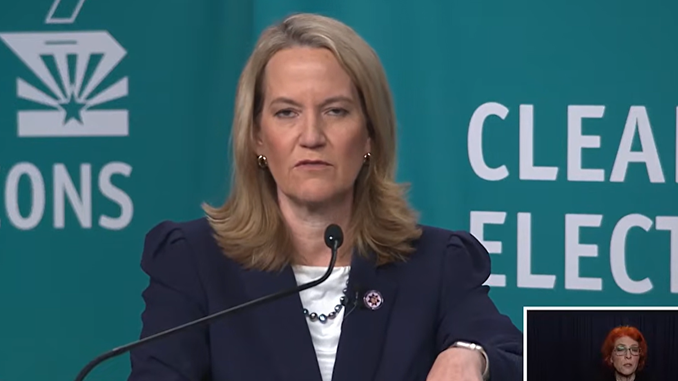
Wednesday night’s debate between the Democratic and Republican candidates for Arizona attorney general grew heated, with outbursts from the incumbent and repeated accusations of lies and coverups.
Attorney General Kris Mayes, the incumbent and Democratic nominee, initially focused on presenting herself as apolitical.
Mayes emphasized her prosecutions of fraud, waste, and abuse in the state’s Medicaid and school choice programs. She explained away the disproportionate number of lawsuits she’s filed against the Trump administration as justified, claiming that the actions of the Biden administration didn’t warrant lawsuits.
“Whether it was a Republican president or a Democratic president, our criteria is the same: has the Constitution been violated? Has the state been harmed?” said Mayes. “And that has happened all too often over the past two years.”
I’ve prosecuted Democrats and Republicans alike for crimes and corruption, and I don’t care what someone’s party is when it comes to enforcing the law. I removed from office and prosecuted a Democratic county attorney in the most Democratic county in AZ for alleged corruption. I…
Senate President Warren Petersen, the Republican nominee, focused on Mayes’ controversial administration of the office, and accused her of focusing office resources on political lawfare.
“Kris Mayes is the most political and partisan AG that this state has ever had,” said Petersen. “She’s got [more than] 50 lawsuits against her political opponents. She has weaponized the office.”
One of the sponsors for the debate was Riester, whose CEO Tim Riester secured an internship in Mayes’ office this summer for his son after contributing to her campaign, as reported by The California Globe on Thursday.
Most Heated Points of the Debate
Mayes interrupted Petersen multiple times during the debate.
One interruption came when Petersen brought up that Mayes hired Vanessa Daily (Hickman), her former division chief who committed felony mail theft, despite warnings from the city of Peoria, her prior employer, about allegations against Hickman of fraud, conversion, and breach of fiduciary duty.
“Her office is in total disarray,” said Petersen. “Mayes was warned about a specific hire, red flags. She hired her anyway as her division chief. That hire ended up committing a felony.”
Mayes immediately jumped in with a demand that she be allowed to provide a response while Petersen still had time remaining to speak.
“Am I going to get a rebuttal for this?” said Mayes. “This is outrageous.”
Mayes again interrupted Petersen when he alluded to reports that she “is known for having meltdowns” to include “yelling, screaming, pounding her fist on the table, shouting the ‘F’ word” in office. Petersen read a statement from one witness to her behavior. Mayes accused Petersen of making false and defamatory statements.
“This is outrageous. I can’t believe you’re allowing this to be aired,” said Mayes.
Following the debate, however, Mayes admitted to a press gaggle that what Petersen said was true — she has engaged in that behavior while in office.
“If I’m passionate about something? Yeah,” said Mayes. “Do I, you know, drop an F-bomb every once in a while? I do. I’m passionate about protecting the funds that the people of Arizona deserve.”
Mayes looked straight into the camera and lied about this at the debate. What else is she lying to us about. Disturbing to see an AG this corrupt and dishonest. https://t.co/T389LH3cSV
Mayes also went over her time, shouting over moderators to blame Petersen for her unsuccessful lawsuit to stop opioid settlement funds from being taken from her office to cover budget shortfalls, something to which Gov. Katie Hobbs, a fellow Democrat, agreed. The reallocated funds were given to the Department of Corrections to assist individuals impacted by opioids.
On Supporting Law Enforcement
Mayes and Petersen each claimed that they were more supportive of law enforcement than the other. Mayes claimed to have “great relationships” with federal law enforcement agencies.
Petersen has received the endorsement of every law enforcement organization in the state, whereas Mayes has received none.
For the first time in AZ history, a challenger to the sitting AG has the overwhelming support from law enforcement. As your next attorney general I will fight crime, defend the laws and the Constitution and root out fraud, waste and corruption. pic.twitter.com/wDXRHpFDom
Mayes said Petersen voted against increased burial benefits for widows of fallen officers, and accused her opponent of putting forth a ballot initiative, HCR 2040, to prevent collective bargaining for first responders.
Petersen countered that HCR 2040 had “nothing to do” with first responders. The proposed constitutional amendment would have prohibited school districts from using public funds to support union operations; a court struck down the ballot proposition over the summer.
Petersen referenced Mayes’ recent remarks issued in January, when she advised Arizonans that they have a legal justification to shoot certain law enforcement officers.
“[The] law says that if you reasonably believe your life is in danger and you’re in your house or your car or on your property that you could defend yourself with lethal force,” said Mayes.
In response, Mayes’ law enforcement liaison resigned. Both the Arizona House and Senate called on Mayes to resign from office, an unprecedented action that the legislature had never taken prior to Mayes. Gov. Hobbs broke party rank and condemned Mayes for her remarks.
On Immigrant Enforcement
Mayes said she wants deportations to end and instead would like to require immigration enforcement to work on cartel cases. Mayes clarified that she doesn’t support illegal immigration.
“I think we need ICE to go back to what it normally does, which is to help state AGs go after Mexican drug cartels,” said Mayes. “Arizonans don’t believe in mass deportation, they believe in immigration enforcement.”
Petersen, whose wife immigrated legally from Mexico, said he supports legal immigration and opposes illegal immigration because it renders illegal aliens vulnerable to crime.
“We know this nation was built and strengthened by people who came here the right way,” said Petersen. “When someone enters into the country illegally, they become vulnerable to human traffickers and criminal organizations.”
Mayes claimed that Petersen supported deportations for Dreamers: illegal aliens residing in the country on deferred deportation who entered the country illegally as minors. When Petersen responded that was untrue, Mayes interrupted him to claim he had made that statement.
Petersen said that those who are here illegally in the country shouldn’t be surprised if they are deported, not that they should be deported.
Petersen said the community members should have input on the establishment and expansion of immigration detention centers, including the recent $1.2 billion expansion plans for the detention center in Florence.
Mayes reminded the public that she successfully sued to stop the Trump administration from establishing a new immigration detention center in Surprise.
On Green Energy
Petersen said his first action in office would be to allow the Arizona Corporation Commission’s (ACC) Renewable Energy Standard and Tariff (REST) Rules to be repealed. The REST Rules require electric utilities to generate 15% of their energy from renewable resources by 2025. Mayes helped to enact those rules while on the ACC and is currently challenging the repeal.
Petersen accused Mayes of imposing green energy rules and approving rate increases under the justification that ratepayers would be willing to pay more to implement renewable energy.
Mayes claimed that her policies passed on the ACC have saved residents money, not cost them more over time.
The REST Rules resulted in more than $2.3 billion being collected via surcharges to customers.
On Data Centers
Petersen said that he supports data centers to a point, but that they need to be governed and decided on by the community.
Mayes backs a moratorium for all data centers. She said utility rate increases were caused by data centers, not renewables as Petersen claimed.
AZ Free News is your #1 source for Arizona news and politics. You can send us news tips using this link.
Congressman Juan Ciscomani (R-AZ-06) joined a bipartisan group of lawmakers calling for a federal investigation into the Bureau of Land Management’s (BLM) Wild Horse and Burro Sale Program. The lawmakers cited concerns that federally protected animals are entering the slaughter pipeline.
Ciscomani, co-chair of the Congressional Wild Horse Caucus, co-led 17 congressional colleagues in requesting that the Government Accountability Office (GAO) conduct an independent review of the program.
The lawmakers are asking the GAO to examine how the BLM uses its authority to sell wild horses and burros, including how prospective buyers are screened, what happens to animals after they are sold, and how the agency responds when animals appear at auctions or facilities associated with the slaughter industry.
“It’s long past time to fix the ongoing failures in how America’s wild horses are managed,” stated Ciscomani. “For years, across both Republican and Democrat administrations, we’ve seen alarming reports of hostility toward these animals and serious questions about how the Bureau of Land Management is carrying out its responsibilities. This cannot be a partisan issue. It’s a stewardship issue. I’m proud to join this bipartisan effort to demand accountability, protect our wild horses, and push for real solutions that address the problem head-on.”
The request follows recent reporting raising questions about whether existing BLM safeguards are sufficient to prevent federally protected horses and burros from eventually being transferred to slaughter.
In their letter to the GAO, lawmakers pointed to a sharp increase in the number of animals sold through the program. According to figures cited in the letter, the BLM sold 3,718 horses and burros in 2025, compared with 268 in 2015.
The lawmakers also highlighted the distinction between animals placed through adoption and those sold by the federal government.
Under the adoption process, animals remain under BLM jurisdiction for at least one year before title is transferred, during which the agency may conduct compliance checks. Animals purchased through the Sale Program become private property upon purchase and are no longer under BLM jurisdiction.
Rep. Dina Titus (D-NV), another co-chair of the Congressional Wild Horse Caucus, said the reports warrant further investigation.
“We now know what we have long suspected—that the BLM has been selling off wild horses that end up in slaughterhouses,” said Titus. “This practice must end now. I am leading my Congressional colleagues in demanding an investigation of the Wild Horse and Burro Sale Program to ensure wild horses and burros received the protections they are guaranteed by federal law.”
The congressional letter cited previous problems involving the program, including a 2012 case in which approximately 1,700 wild horses were sold to a single buyer despite warning signs that lawmakers say indicated many could be destined for slaughter.
The lawmakers are now asking the GAO to determine how effectively the BLM screens high-volume or repeat purchasers, whether it tracks buyers with connections to livestock auctions or slaughter-related businesses, and how often the agency has repossessed animals or restricted purchasers following sales.
Rep. Mark Pocan (D-WI) said congressional protections for the animals require greater oversight of the program.
“Our laws demand that we protect wild horses, not send them to slaughter,” said Pocan. “Congress has always worked in a bipartisan manner to protect these animals, and we need accountability and oversight at the Bureau of Land Management immediately. We hope this request will force the Administration to do the right thing.”
The lawmakers also want investigators to determine whether the BLM’s current practices comply with congressional restrictions intended to prevent healthy federally protected wild horses and burros from being destroyed or sold for processing into commercial products.
Patricia Miller, chair of the board of directors and executive director of American Wild Horse Conservation, called the requested investigation an opportunity to examine the program and its safeguards.
“The GAO investigation is a critical step toward uncovering and eliminating abuses within the Sale Authority Program, abuses documented through AWHC’s longstanding investigation and recently brought to national attention by The New York Times,” stated Miller. “No federal program should allow America’s treasured and legally protected wild horses and burros to be funneled into the slaughter pipeline.”
“We are deeply grateful to Representative Dina Titus and her fellow Congressional Wild Horse Caucus co-chairs, Representatives Ciscomani, Cohen, and Pocan, for leading this essential oversight effort and advancing the agency accountability and lasting reform necessary to ensure these animals receive the protections promised to them under federal law,” she added.
Manda Kalimian, founder and president of Rewilding America Now, also backed the requested review.
“America’s wild horses are an irreplaceable part of our nation’s heritage and belong to the American people. Slaughter is not a management tool, and Congress has made clear these iconic animals are to be protected, not destroyed with taxpayer dollars,” said Kalimian. “We are grateful to Congresswoman Dina Titus for her leadership, and to her colleagues for requesting a GAO audit of the BLM’s Wild Horse and Burro Program. This review will help bring greater transparency and accountability to the Sale Authority Program and move us toward humane, effective solutions. Slaughter is never the answer, and we must work together to find a better path forward.”
The oversight request is part of Ciscomani’s broader work on federal wild horse policy.
The legislation would require the federal government to phase out the use of helicopters and fixed-wing aircraft for wild horse and burro roundups over two years.
The bill would also require cameras on aircraft used during the transition period and direct the GAO to report to Congress on humane alternatives to aircraft-based roundups, potential job opportunities associated with those alternatives, and the effects of aircraft on wild horse and burro populations.
The legislation was referred to the House Committee on Natural Resources.
Ethan Faverino is a reporter for AZ Free News. You can send him news tips using this link.
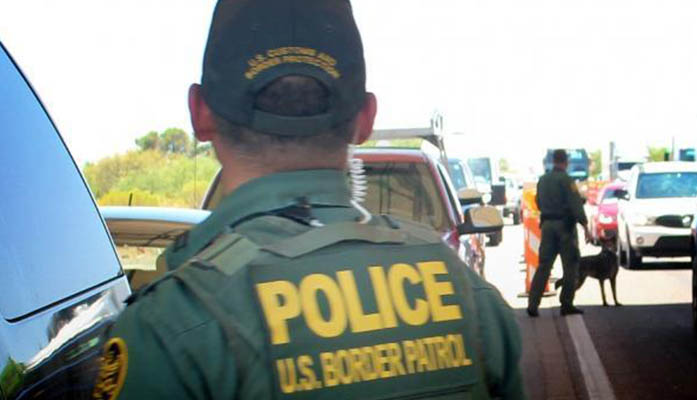
Federal officials are planning new Border Patrol station projects in Three Points, Casa Grande, and Sonoita-Elgin. U.S. Customs and Border Protection (CBP) is also preparing to build checkpoints in southern and southwestern Arizona using funding from the 2025 federal reconciliation law.
The three station proposals would accommodate a combined 1,000 agents, with each estimated to cost more than $100 million. CBP told the outlet the projects remain in early planning.
CBP said the projects would be funded through the 2025 reconciliation law commonly known as the One Big Beautiful Bill Act. Section 90002(a)(4) appropriated $5 billion nationally for expenses related to leasing, acquiring, constructing, designing, or improving CBP facilities and checkpoints.
At Three Points, a Sept. 11 forecast called for designing and building a station sized for 500 agents. The project was estimated to cost more than $100 million, with Sept. 25 listed as the projected solicitation date.
That forecast projected a contract award between October and December 2026, the first quarter of federal fiscal year 2027, and listed Sept. 1, 2029, as the anticipated contract completion date.
In an Aug. 21 letter to Pima County, CBP described a proposed site of approximately 87 acres about four miles east of the existing Three Points station and requested input for an environmental assessment.
In the letter, CBP specialist John Petrilla wrote, “The purpose of the new BPS is to accommodate the addition of new agents and personnel intended to enhance border security within the U.S. Border Patrol Tucson Area of Responsibility, with an ultimate objective of increasing the probability of apprehension of those that have entered into the U.S. illegally.”
The Casa Grande forecast describes a station for 300 agents and personnel, along with support space and other infrastructure. Its estimated cost also exceeds $100 million, with the same anticipated award quarter and September 2029 completion date. The listing identifies Casa Grande as the project location without specifying a street address.
The Sonoita-Elgin proposal would accommodate 200 agents and also exceed $100 million. The projected capacities describe the size of the facilities, rather than a confirmed increase of 1,000 agents assigned to Arizona.
CBP’s letter also identifies an alternative site along State Routes 82 and 83. The preferred Sonoita-area alternative involves an undeveloped 40-acre parcel approximately four miles southeast of the Sonoita crossroads. County officials said the location appeared to be near Elgin Elementary School.
Santa Cruz County Board of Supervisors Chairman John Fanning said that the county had requested details about site selection and the proposal’s economic, social, and environmental effects. CBP said it would seek community input as it evaluates potential locations.
CBP has not clarified whether the proposed facility would supplement or replace the existing station.
Separate federal forecasts outline two checkpoint projects, each estimated at $50 million to $100 million. The Nogales I-19 checkpoint proposal calls for a new checkpoint and supporting facilities at a preferred location adjacent to the existing checkpoint in Amado. The Wellton I-8 checkpoint proposal describes a new checkpoint and supporting facilities just west of the Dateland offramp in Yuma County. Both forecasts list anticipated contract completion on Sept. 30, 2029.
CBP said that the broader station and checkpoint investments are intended to replace aging facilities, strengthen operations, and support agents confronting human and drug smuggling. In a statement, the agency noted, “As potential locations are evaluated, CBP will seek input from local communities before projects move forward.”