by Staff Reporter | Sep 25, 2026 | Education, News
By Staff Reporter |
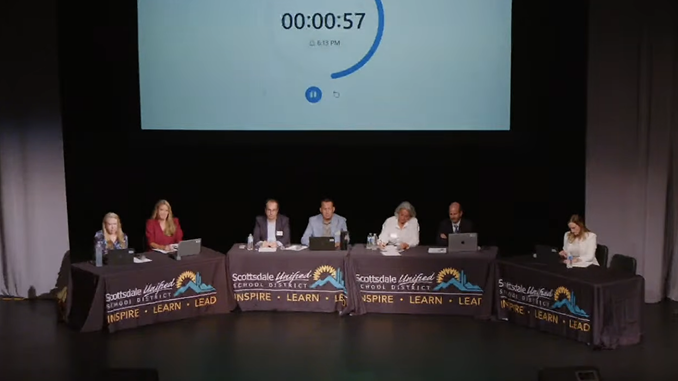
Scottsdale Unified School District (SUSD) violated the law with its school closure and consolidation committee, but the county attorney says it’s too late to stop them.
The complaint was filed originally with Attorney General Kris Mayes back in April, claiming that SUSD’s Phase II Design Advisory Team, an advisory committee responsible for coming up with school closure and consolidation options, violated Open Meeting Law because it prohibited the public from attending meetings.
Mayes waited nearly three months to refer the complaint to the Maricopa County Attorney’s Office (MCAO); she cited a conflict of interest as the basis for not taking on the investigation herself.
MCAO told AZ Free News that Mayes didn’t refer the complaint to their office until July 17.
By then, SUSD’s Phase II Design Advisory Team had held all five of its Phase A meetings and three out of five of its Phase B meetings. The final meeting for this illicit advisory committee occurred on August 17.
Since all of the meetings have already occurred, MCAO Deputy County Attorney Caitlyn Mitchell said in a disposition letter on Tuesday that nothing could be done beyond recommending to SUSD that they not recommit a similar Open Meeting Law violation in the future and acknowledge their wrongdoing at the special meeting scheduled to occur that day.
“[I]t is too late to require SUSD to take corrective action concerning future Phase II Team meetings,” stated Mitchell. “MCAO has informed SUSD of its findings and conclusions, recommended that SUSD revise its future use of superintendent appointed committees, and requested that the SUSD Governing Board acknowledge the results of this investigation publicly at the open meeting to discuss the Phase II Team’s recommendations.”
Arizona law requires any legal action taken in a meeting that violates Open Meeting Law to be rendered null and void, unless ratification occurs under certain parameters during a public meeting within 30 days of discovery of the violation.
Non-public advisory committees have been a recurring problem for SUSD. Mayes has previously found SUSD in violation of Open Meeting Law for its use of non-public advisory committees.
During the SUSD special meeting on Tuesday, the governing board didn’t advise the public of the MCAO letter or the fact that the advisory committee responsible for creating the school closure and consolidation options had been conducted in violation of the law. It also stopped the community from making any mention of the letter.
Mike Bengert, the community member who filed the complaint, attempted to speak about the disposition letter during public comment, but Governing Board President Donna Lewis interrupted him.
SUSD counsel Renee Osipov told Bengert that he could only talk about the proposed options for school closures and consolidations.
“We’re not talking about Open Meeting Law. That’s not what we’re agendized to do,” said Osipov.
Lewis had advised at the beginning of the special meeting that public comments not addressing school closure and consolidation options were only permitted for the next meeting scheduled for October 6 — the day that SUSD is anticipated to vote on school closures.
During Tuesday’s meeting, public comment on the school closure and consolidation options lasted more than three hours.
The Phase II Design Advisory Team operated as part of three phases to close, consolidate, and repurpose schools within the district. Phase III has another non-public advisory committee: the Coronado Learning Community committee.
Bengert told AZ Free News that he filed a new Open Meeting Law complaint over Tuesday’s special meeting.
AZ Free News is your #1 source for Arizona news and politics. You can send us news tips using this link.
by Staff Reporter | Sep 25, 2026 | News
By Staff Reporter |
There is just over one month left before the midterm elections in early November.
With just weeks to go, the Maricopa County Recorder’s Office has issued reminders of upcoming deadlines for voters to keep in mind.
October 5 is the deadline to register to vote for the election.
Early voting begins on October 7, and early ballots will be mailed out on this date.
Voters who choose to vote in person must have a valid government-issued ID that includes their name, photo, and address matching the one provided on their voter registration.
Voters with IDs that are expired or featuring an address differing from the one on their voter registration must provide two alternative forms of identification. Alternative forms of ID include a paper or digital Voter Registration Card, utility bill issued within 90 days of the election, bank or credit union statement issued within 90 days of the election, vehicle registration card or form, property tax statement, tribal identification, vehicle insurance card, non-photo government ID, or official election mail.
Voters who choose to vote via a mail ballot may turn in their ballot by mailing it or dropping it off at a secure drop box or Vote Center.
Voters may locate a drop box or voting location using the Maricopa County website.
There are 254 Vote Centers throughout the county, 26 drop box locations without in-person voting, and two 24-hour drop box locations. Certain Vote Center locations are subject to opening as drop box-only sites on certain days. Approximately 90 of the Vote Centers are non-electioneering sites.
October 23 is the deadline for requesting a replacement ballot by mail.
Mail ballots come with a green affidavit envelope. Voters must sign that envelope prior to mailing or dropping off their ballot at a drop box or Vote Center.
The Maricopa County Recorder’s Office recommends mailing back early ballots by October 27 at the latest.
7 p.m. is the time to remember for Election Day on November 3.
On Election Day, all ballots must be received by 7 p.m. Postmarks do not count toward this deadline. Voters may also drop off their ballot at any ballot drop box until 7 p.m. Voters who are in line at a Vote Center before 7 p.m. will still be permitted to vote.
Maricopa County voters also have the option to expedite the tabulation of their ballot through ID Verify.
Through ID Verify, voters who show a valid ID while checking in at a Vote Center may have their ballot envelope stamped with an “ID Verified” marker. The stamp allows voters to bypass the signature verification process.
Voters impacted by signature verification issues have until 5 p.m. on Nov. 8, 2026, to verify their signature.
Voters may track their ballot by texting “JOIN” to 628-683. The county will provide real-time updates via text and/or email. Voters may also visit BeBallotReady.Vote to check the status of their ballot, as well as review their voter information and sign up for ballot tracking text or email alerts.
As of the primary election, Maricopa County has more than 2.5 million registered voters: more than 900,000 independents, 880,000 Republicans, 700,000 Democrats, 28,000 No Labels voters, 18,000 Libertarians, and 2,000 Green voters.
There are more than 4.3 million voters total in Arizona.
The county reported that the primary election went smoothly this year. More than 676,000 ballots were cast across more than 250 voting locations.
AZ Free News is your #1 source for Arizona news and politics. You can send us news tips using this link.
by Ethan Faverino | Sep 25, 2026 | Education, News
By Ethan Faverino |
Arizona Superintendent of Public Instruction Tom Horne announced that the Arizona Department of Education (ADE) has secured a $5 million federal grant to expand teacher apprenticeship opportunities focused on special education.
The five-year grant will support the expansion of the Arizona Teacher Registered Apprenticeship Program and create additional paid, job-embedded pathways for aspiring special education teachers to earn certification while working in Arizona schools.
“The grant will expand a program that currently serves more than 90 apprentices statewide, has doubled enrollment in the past year, and maintains a 97 percent apprentice retention rate,” stated Horne. “Nearly half of current apprentices are pursuing special education certification, demonstrating the strong demand for these pathways.”
The existing Arizona Teacher Registered Apprenticeship Program combines paid classroom experience with coursework through an approved educator preparation program.
Apprentices work for a participating school district or charter school under the mentorship of an experienced educator while completing requirements toward teacher certification.
The federal funding was awarded through the U.S. Department of Education’s Expanding Career Pathways and Workforce Readiness of Special Education Teachers and Early Intervention Personnel Through Registered Apprenticeships program.
The federal program supports registered apprenticeships aimed at attracting, preparing, and retaining special eduction teachers and early intervention personnel.
According to the U.S. Department of Education, the initiative is intended to help address workforce shortages by expanding work-based pathways into those professions.
As part of the expansion, ADE will support the Arizona Special Eduction Teacher Registered Apprenticeship Program, providing aspiring educators with paid, school-based experience as they complete the requirements necessary to earn special education teacher certification.
The initiative will involve partnerships among local education agencies, educator preparation providers, and workforce organizations.
The Arizona Department of Education sponsors the apprenticeship program in partnership with the Arizona Apprenticeship Office and the National Center for Grow Your Own.
Ethan Faverino is a reporter for AZ Free News. You can send him news tips using this link.
by Staff Reporter | Sep 24, 2026 | Education, News
By Staff Reporter |
Progressive activist group leaders were charged and one was trespassed from Northern Arizona University (NAU) in connection with an anti-Immigration and Customs Enforcement (ICE) protest.
The penalties resulted from the conduct of members from Students for a Democratic Society (SDS) Flagstaff during their ICE OUT protest earlier this month.
SDS Flagstaff is not a registered club on campus, and NAU does not recognize it as an official club on campus. The organization was founded in January 2026 and immediately began holding protests against ICE.
Kimberly Ott, associate vice president of University Strategic Communications, told The Lumberjack that SDS Flagstaff may register as an official club but has declined to take the necessary steps to fulfill registration requirements.
SDS Flagstaff Vice President Sarah Rogala and member Judah “Jay” Francabandera face allegations of code of conduct violations. Student Gio Alvarez also faces allegations. The students reportedly face penalties that may include suspension or expulsion.
The allegations include failure to comply with university officials and disrupting campus.
Rogala and Francabandera are scheduled to have their hearings on the charges later this month.
The organization held another protest opposing the charges against Rogala and Francabandera.
SDS is also accused of posting flyers and tabling on campus property, and using sound amplification without NAU permission.
Rogala was charged with code of conduct violations last semester and received probation set to expire Nov. 1, 2026.
NAU also trespassed Claire Wagoner, who is the SDS Flagstaff president, a member of Freedom Road Socialist Organization in Flagstaff, and a former NAU student.
Wagoner was also charged with code of conduct violations last semester as well. Those violations resulted in her receiving a deferred suspension set to expire May 1, 2028.
SDS Flagstaff is also demanding that NAU turn itself into a “sanctuary campus,” meaning that law enforcement could not detain illegal aliens on the property. SDS Flagstaff renewed their demands to the university in a statement following an ICE enforcement action that occurred on September 16.
“On Wednesday, September 16th, ICE agents kidnapped someone from Flagstaff, and these terrorists threatened to raid his home and kidnap his wife and children if they did not ‘self deport,’” stated SDS Flagstaff. “[ICE] is terrorizing anyone and everyone these fascist agents deem not white enough to be ‘legal.’”
In February, the organization held a sit-in protest and submitted more than 400 petition signatures as part of demands that NAU implement sanctuary campus policies. Justin Mallett, NAU’s vice president of Inclusive Excellence, and Bernadine Lewis, program director of Inclusive Excellence, met with Wagoner and Rogala but ultimately denied their demands.
That month, SDS Flagstaff also successfully protested against campus visits by the CIA, Border Patrol, and ICE. The CIA was scheduled to answer student questions, and all three agencies were anticipated to appear for the university’s Career Fair programming.
In March, SDS Flagstaff members demanded the Flagstaff City Council approve an ordinance from Keep Flagstaff Together banning ICE from operating on city property. The council rejected the proposed ordinance.
AZ Free News is your #1 source for Arizona news and politics. You can send us news tips using this link.
by Matthew Holloway | Sep 24, 2026 | News
By Matthew Holloway |
Democratic congressional nominee Amish Shah did not participate in a second candidate appearance in less than a month, leaving Republican nominee Jay Feely to address voters at AMAC Action’s September 22 forum. The host said Shah did not respond to the AMAC invitation. His absence followed his decision to decline an August 26 Arizona PBS appearance.
“Please note that Democrat candidate Amish Shah was invited to participate but did not respond to our request,” the host said in the forum introduction, before introducing Feely.
Feely addressed Shah’s absence in a statement posted to X Tuesday.
“Arizonans deserve to hear from the candidates running to represent them. I’m disappointed that my opponent continues to hide from the public. But when you align yourself with Democratic Socialists, dodging questions is easier than answering for your policies,” Feely wrote.
AMAC Action’s announcement listed both First Congressional District candidates as invitees to the virtual event. The organization described the forum as a nonpartisan educational program offering participating candidates equal opportunities to discuss their priorities and answer questions.
The appearance followed Arizona PBS’ August 26 “Candidates in Conversation” program, during which Feely answered questions without Shah participating. Arizona PBS confirmed that Shah declined its invitation.
At the AMAC forum, Feely discussed immigration enforcement, economic policy, and congressional stock trading.
“This election comes down to two choices. On one side you have myself who believes in free market principles, that believes in capitalism…on the other side, the Democrat party has embraced this big government, socialist belief,” Feely said.
On immigration, Feely added, “If you come into this country illegally, you should not participate in any of our welfare programs.”
Feely also advocated for people who entered illegally to leave the country and pursue legal entry. And he endorsed restrictions on lawmakers’ financial activities.
“We should have a congressional ban on stock trading,” he said.
The National Republican Congressional Committee (NRCC) said Feely also addressed lowering costs for seniors, protecting Social Security and Medicare, and combating fraud. The committee criticized Shah’s absence and his health care positions.
“For seniors wanting answers about his socialist healthcare record, socialist Amish Shah was nowhere to be found. Socialist Shah would rather hide than defend the Bernie Sanders-AOC policies he praised,” NRCC spokesman Ben Petersen said.
Republican National Committee spokesman Nick Poche also criticized Shah in a statement provided to AZ Free News.
“Shah won’t debate because the second he opens his mouth, everyone in Arizona will know he’s an extremely far-left socialist who supports transgender surgeries for minors, soft-on-crime policies, and opening the border,” Poche said.
The Republican statements attributed Shah’s absence to his policy positions. The AMAC host’s introduction said Shah had not responded to the invitation but provided no explanation for his nonparticipation.
Health care has been a recurring subject in Republican criticism of Shah. Shah spoke in support of Sen. Bernie Sanders (I-VT) and a universal, single-payer Medicare for All system during an April 2019 Arizona for Bernie town hall.
Shah’s current campaign platform describes him as a supporter of universal health care and calls for expanding coverage, protecting Medicare, reducing premiums, and lowering prescription drug prices. His public safety platform calls for fully funding police and stopping fentanyl trafficking across the border.
Both candidates are listed for a separate First Congressional District debate scheduled for October 7 at 6 p.m. That event is part of the debate series organized by the Arizona Citizens Clean Elections Commission and the Arizona Media Association.
Feely, a former NFL kicker and broadcaster, and Shah, an emergency physician and former state lawmaker, are competing for the seat being vacated by Rep. David Schweikert (R-AZ-01). The district includes northeast Phoenix, Scottsdale, Fountain Hills, and Paradise Valley.
Matthew Holloway is a senior reporter for AZ Free News. Follow him on X for his latest stories, or email tips to Matthew@azfreenews.com.
by Ethan Faverino | Sep 24, 2026 | News
By Ethan Faverino |
Congressman Andy Biggs (R-AZ-05) joined dozens of members of Congress in filing an amicus brief with the U.S. Supreme Court in a case involving an Orthodox Jewish man who was ordered by local officials to stop hosting prayer gatherings in his Ohio home without zoning approval.
The brief, filed in Grand v. City of University Heights, supports Daniel Grand in his legal challenge against University Heights, Ohio, and argues that protections under the Religious Land Use and Institutionalized Persons Act of 2000 (RLUIPA) allow individuals to seek relief in federal court once government action substantially burdens their religious exercise.
The dispute dates back to 2021, when Grand sought to host an informal Jewish prayer group at his home. City officials sent Grand a cease-and-desist letter after learning about the gatherings, maintaining that the use required approval under the city’s zoning rules.
Grand applied for a special-use permit but later withdrew the application.
According to Biggs’ office, Grand learned during the process that obtaining approval as a house of worship would require his family to move out of the residence.
Grand subsequently sued the city and several officials, raising claims under RLUIPA and the First and Fourteenth Amendments, among other federal and state claims.
The U.S. Court of Appeals for the Sixth Circuit affirmed the dismissal of several of Grand’s claims as unripe, concluding that he had withdrawn his permit application before the city reached a final decision.
The Supreme Court agreed to hear the case, with oral arguments scheduled for December 9, 2026.
Biggs said the case raises broader questions about constitutional protections for religious exercise and the ability of local governments to regulate religious activity through zoning laws.
“Religious liberty was one of the foundational principles our Founders sought to protect when establishing our constitutional system of government,” stated Biggs. “The First Amendment and subsequent federal laws have protected generations of Americans in the free exercise of their faith without government intrusion or interference.”
“No local government should be permitted to undermine or eliminate that fundamental right,” added Biggs. “I am honored to stand with Daniel Grand in his fight to freely exercise his religion within his own home, just as our Founders intended.”
At the center of the case is RLUIPA, a federal law unanimously passed by Congress in 2000 that provides protections for religious exercise in certain land use and institutional settings.
Among other provisions, the law prohibits governments from imposing or implementing land-use regulations that substantially burden religious exercise unless the government can satisfy the statute’s requirements.
RLUIPA also directs courts to construe the law broadly in favor of protecting religious exercise.
The congressional amicus brief argues that the lower courts imposed an additional requirement not contained in the statute by requiring Grand to obtain a final zoning decision before pursuing his RLUIPA claim.
According to lawmakers, Congress designed RLUIPA to make it easier for individuals and religious organizations to challenge government actions burdening religious exercise, particularly in disputes involving local land-use decisions.
“Congress designed RLUIPA to enhance—not restrict—religious freedom,” the lawmakers wrote. “Courts that impose an atextual finality requirement turn that design on its head.”
The brief traces RLUIPA’s origins to earlier Supreme Court decisions concerning the Free Exercise Clause and Congress’ subsequent attempts to establish stronger statutory protections for religious exercise.
The lawmakers argue that Congress specifically intended the law to address problems involving local zoning decisions affecting churches, synagogues, home prayer meetings, and other forms of religious exercise.
They also contend that requiring individuals to complete potentially lengthy local zoning proceedings before going to federal court can leave them subject to the disputed restrictions for months or years.
The brief cites previous cases involving religious organizations in Michigan and California in which courts required additional local zoning proceedings before federal religious liberty claims could move forward.
The lawmakers maintain that RLUIPA instead permits a claim once a government imposes a substantial burden on religious exercise and the ordinary requirements for federal court jurisdiction are satisfied.
The Supreme Court’s eventual ruling could clarify when a RLUIPA land use dispute is sufficiently developed for a federal court to hear it and whether a claimant must first obtain a final decision from local zoning authorities.
Ethan Faverino is a reporter for AZ Free News. You can send him news tips using this link.