Scottsdale Unified School District (SUSD) is contemplating more school closures as enrollment continues to decline.
The SUSD governing board discussed their options going forward during Tuesday’s meeting. Superintendent Scott Menzel said “some very, very difficult decisions need to be made.”
Since 2010, SUSD enrollment has declined by 6,000 students and the district has only closed one school. SUSD also reported rising costs, competition against school choice programs for students, and underutilized facilities as key pressures on district conditions.
“We have far more physical space than we have students to fill that space,” said Menzel.
As part of Phase I of restructuring for “full and thriving schools,” SUSD decided to close Pima Elementary School and Echo Canyon School. The district is now in Phase II, where it will decide the fate of the Desert Mountain Learning Community and Copper Ridge School.
Capacity is below 50% at Laguna Elementary (43%), Desert Canyon Elementary (37%), and Cheyenne Traditional (11%).
SUSD is facing an open meetings violation complaint pertaining to these closed-door Phase II proceedings to determine closures and consolidations.
SUSD’s Phase II Design Advisory Team doesn’t permit the public to attend its meetings under its classification as a Superintendent Advisory Committee, but the complaint against the district contends that the team was formed at the direction of the governing board.
The Maricopa County Attorney’s Office (MCAO) is now handling the complaint after the Arizona Attorney General’s Office cited a potential conflict of interest.
The MCAO told AZ Free News that they just recently received the complaint from the attorney general on July 17, though it was filed back in April. Their office also told us that it couldn’t provide any additional details at this time since it is an open investigation.
The Phase II Design Advisory Team presented three options for further restructuring, in the following order of greatest to least preferences:
First-most preference: close Copper Ridge K-8 and Laguna Prep, redistribute boundaries, and a possible Desert Canyon K-8 merger. This option would impact 773 to 872 students and provide more than $2.7 million in savings.
Second-most preference: move Cheyenne Traditional K-8 to Copper Ridge, move Laguna Prep and Redfield to Cheyenne campus, and a potential Desert Canyon K-8 merger. This option would impact 2,126 to 2,232 students and provide nearly $2.6 million in savings.
Third-most preference: merge Desert Canyon schools into K-8 at Copper Ridge, close Laguna Prep, repurpose Desert Canyon campuses and Laguna Prep. This option would impact 2,132 to 2,153 students and provide nearly $2.7 million in savings.
Impact was measured beyond students moving into schools to include certain students at receiving schools.
All three options were presented with multiple potential models for restructuring boundaries.
Member Amy Carney attempted to explain that she believed closing schools was the “easy option,” to which she objected, but was interrupted multiple times by Governing Board Vice President Mike Sharkey and counsel with cautions that she shouldn’t express opinions about what the board should and shouldn’t do prior to community debate on the options.
Member Carine Werner urged agendizing a board discussion about the options before them prior to the board meeting in October in which they are scheduled to make a vote.
Member Matthew Pittinsky expressed caution against exploring other options beyond what the Phase II Design Advisory Team had presented to them; he characterized Carney’s position as “a very slippery slope.”
The district said it has not yet determined how it would repurpose any closed schools.
SUSD scheduled a special session to receive additional community input on September 22.
AZ Free News is your #1 source for Arizona news and politics. You can send us news tips using this link.
Two candidates are accusing the Arizona Citizens Clean Elections Commission (CCEC) of issuing threats that forced a stop to their campaigns.
Risa Lombardo, the Green Party nominee for governor, and DuWayne Collier, the Green Party nominee for secretary of state, filed the lawsuit in the Maricopa County Superior Court against CCEC last week. CCEC Executive Director Tom Collins was also named in the lawsuit.
Lombardo and Collier were both qualified by Secretary of State Adrian Fontes as having enough signatures and donations to become Clean Elections candidates, meaning they were eligible to receive public funding for their campaigns.
In order to qualify as a Clean Elections candidate and receive that public funding, candidates must collect a specific number of $5 donations from individual donors and then agree to forgo other funding sources once qualified. Any candidates who receive Clean Elections funding may not withdraw from the organization.
Lombardo and Collier alleged in their lawsuit that Collins threatened them with consequences if they continued spending their Clean Elections funding, four months after they were approved for the funds.
Collins told Lombardo and Collier in separate letters that they would be required to repay the funds — $2.8 million in Lombardo’s case, and $739,000 in Collier’s case — pending the outcome of his investigation.
Collins sent the letters on the same day that the Arizona Mirror published an article outlining similar claims of fraud. The media reporting cited six individuals who were listed as donors but claimed they never donated to Lombardo, Collier, or a third candidate for governor, Scott Neely, and that the three candidates contained a significant share of donors that had no other donor history.
Collins accused Lombardo and Collier of falsifying voter identities to manufacture the $5 contributions they needed. His letters to Lombardo included references to a bank statement reflecting a nominal balance around the time she should have had thousands in qualifying contributions, and that those contributions only appeared later in a lump-sum deposit. The lump-sum deposit accusation was also raised in Collins’ letter to Collier.
Collins also told Lombardo that her secretary of state certification had been in error because of sampling requirements: Lombardo had not submitted more than 4,400 qualifying contributions, which would have been the minimum required to meet the statutory 110% qualifier for certification.
Collins advised that he would ask CCEC to initiate repayment order proceedings at their virtual meeting on August 27.
CCEC didn’t issue a repayment order, but did direct Collins to investigate Lombardo and Collier further. CCEC requested that Collins deliver his findings sometime between September 24 and their next meeting, which is not scheduled to occur until October 29 — five days before the general election.
Lombardo and Collier claim these looming threats from Collins spanning the remainder of the months leading up to the election have left them unable to continue their campaigns and therefore violated their free speech rights.
“Restrictions that burden spending for political speech, whether candidate spending or independent spending, get strict scrutiny and usually fail,” stated their lawsuit. “Defendants are trying to bully and intimidate Plaintiffs into effectively dropping their campaigns, campaigns the Commission disapproves of, by depriving them of Commission funding, or threatening to subject each to hundreds of thousands or even millions of dollars in repayment obligations.”
Lombardo and Collier also alleged that Collins and CCEC were acting beyond their statutory authority.
They claimed that the secretary of state, not CCEC, certifies a candidate’s qualification for Clean Elections funding.
“The Commission is without power to subsequently declare, months after the Secretary of State’s certification has been completed, that a candidate should not have qualified for Clean Elections funding in the first instance and must repay their funds back to the Commission,” stated their lawsuit.
Lombardo and Collier are asking the court to enjoin CCEC from decertifying them and undertaking further actions effectively suspending their campaigns.
AZ Free News is your #1 source for Arizona news and politics. You can send us news tips using this link.
Several days after the one-year anniversary of Charlie Kirk’s assassination, his memorial was once again vandalized.
Kirk was assassinated Sept. 10, 2025, while speaking at Utah Valley University. He was the founder and CEO of Turning Point USA (TPUSA), a conservative advocacy organization. Kirk was 31 years old at the time of his death. He left behind Erika, his wife of four years, and their two young children.
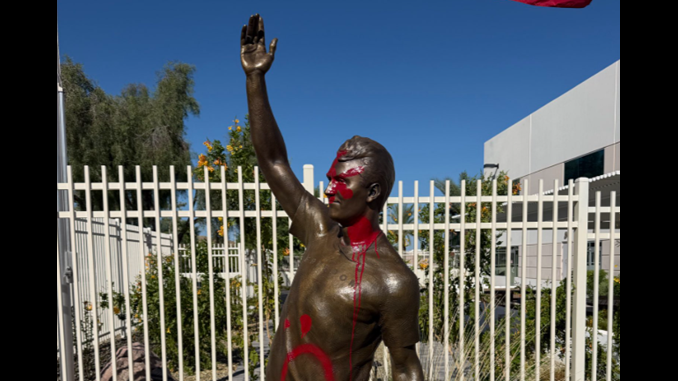
A bronze statue depicting Kirk’s likeness and a sign featuring a picture of Kirk were vandalized with red paint.
The paint was drawn in the pattern of an “X” over the statue’s face, a frowning face was drawn over the statue’s torso, and paint was spattered over the statue’s neck and hat in a similar representation to the gunshot wound that Kirk sustained in the assassination.
Similarly, the paint was drawn in the pattern of an “X” over the face and neck area in Kirk’s picture on the sign. The quote on the sign — “May Charlie be received into the merciful arms of Jesus, our loving Savior” — had the word “Jesus” covered in red paint.
TPUSA advised in a public post that it had camera footage of the incident and that its personnel were working with law enforcement to identify those responsible for the vandalization.
“[V]andalism like this is not funny, it’s diabolical,” stated TPUSA. “The incident happened in the middle of the night because evil never sleeps. Beyond spray painting on the neck and face, they made the intentional decision to cross out the name of Jesus on a nearby sign.”
We will restore the statue and replace the signs, but we are also reviewing the footage of the incident and are working with law enforcement to identify who did this and hold them accountable.
But vandalism like this is not funny, it’s diabolical. The incident happened in the… pic.twitter.com/LSUJn9vYv4
Erika responded that incidents like this latest vandalism have only strengthened her resolve to continue her husband’s work. Erika now serves as the CEO of TPUSA.
“They thought a bullet would silence my husband’s voice but it only made it louder. They think spray paint can obscure his legacy, but it will only spread it further. Every attempt to tear down what Charlie built makes us root deeper and work even harder,” said Erika. “And if you think crossing out the name of Jesus Christ will silence Christians, history has already proved you wrong. We know what it costs to stand firm for Christ and we will stand anyway. God will not be mocked. We’ll put His name right back where it belongs, clean up the mess, restore Charlie’s statue, and keep building. We will never give up and never surrender.”
Charlie once said we should be building two statues for every statue that they tear down. His instinct was always to build, not to destroy.
They thought a bullet would silence my husband’s voice but it only made it louder. They think spray paint can obscure his legacy, but it… https://t.co/nfMlpsSwKd
Another one of Kirk’s memorials was vandalized last year by Mesa resident Ryder Corral, who was dressed similarly to Tyler James Robinson, Kirk’s accused assassin.
Man vandalizes Charlie Kirk memorial outside Turning Point USA headquarters in Phoenix
Phoenix police identified the vandal as 19-year-old Ryder Corral. In the video, he’s wearing a shirt similar to the one worn by Charlie Kirk’s killer. pic.twitter.com/bF7BJWBRTP
Robinson faces seven criminal charges in connection with Kirk’s assassination; prosecutors announced they are seeking the death penalty in his case.
Robinson’s defense attorneys have cost the state of Utah approximately $1.6 million so far, according to reporting from the Salt Lake Tribune.
A trial date has yet to be set in Robinson’s case. The next court date in his case is scheduled for Oct. 23, 2026, during which discussions of proposed trial dates are anticipated to occur.
AZ Free News is your #1 source for Arizona news and politics. You can send us news tips using this link.
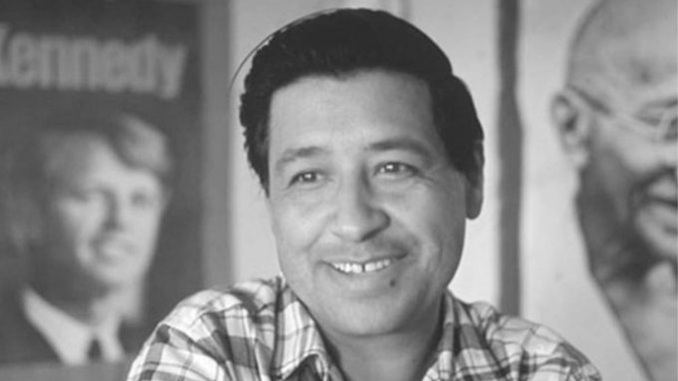
The city of Phoenix has declared Farmworkers Day to replace Cesar Chavez Day.
The replacement holiday will occur on the same day, March 31.
As with many other states and municipalities across the nation, the city of Phoenix ceased honoring once-lauded late civil rights leader Cesar Chavez following recent sexual abuse allegations. The allegations emerged in March of this year in reporting by The New York Times, published nearly 33 years to the day of Chavez’s death in 1993 at 66 years old.
Chavez was born in Yuma and died in San Luis. He served in the U.S. Navy for two years prior to relocating to California where he joined the Community Service Organization and began his career as a labor advocate.
Multiple women alleged to The New York Times that Chavez had sexually abused them when they were children. Other women alleged that Chavez sexually assaulted them, including Dolores Huerta, the woman who co-founded the National Farm Workers Association alongside him.
Huerta alleged that she had been pressured to have sex with Chavez in 1960 and that Chavez raped her in 1966. Huerta later entered a relationship with Chavez’s brother and had four children by him.
Some within the movement that were close to Chavez have denied the allegations against him.
The city of Phoenix will now recognize Farmworkers Day since it occurs in proximity to April 6, the date in 1966 when the National Farm Workers Association reached a historic agreement with Schenley Industries, a major grape grower, to recognize the association as the sole collective bargaining agent for its workers.
In a press release announcing their decision, city of Phoenix leaders directly attributed The New York Times reporting to their decision to swap Cesar Chavez Day for Farmworkers Day.
“While Cesar Chavez was a well-known leader in the fight for labor rights, the movement belonged to so many other individuals who were leaders in their own right,” said Phoenix Mayor Kate Gallego. “We will recognize and honor their collective struggles, sacrifices, and successes on Farmworkers Day.”
Councilwoman Laura Pastor offered sentiments similar to the mayor’s, stating that labor union advocacy was greater than Chavez’s legacy.
“The fight for workers’ rights has always been deeply personal to me. The farmworker movement was built by generations of people who stood together for dignity and fair treatment,” said Pastor. “Permanently recognizing Farmworkers Day allows us to honor that legacy and center the workers whose courage and sacrifice made progress possible.”
Councilwoman Betty Guardado agreed.
“This day belongs to the workers. It belongs to their families. It belongs to everyone who has stood together and said that hard work deserves dignity, respect, and a fair shot,” said Guardado.
The city has also initiated other efforts to rename street signs, facilities, and public amenities bearing Chavez’s name.
Earlier this year, Gov. Katie Hobbs repealed the state law recognizing Cesar Chavez Day through a bipartisan emergency measure advanced by the state legislature. State Sen. Sally Ann Gonzales (D-LD20) was the sole dissenting vote against the measure.
Gonzales wrote a letter to Hobbs arguing that a veto was necessary because the measure was unconstitutional. Gonzales urged Hobbs to allow voters to decide on the fate of Cesar Chavez Day via referendum.
AZ Free News is your #1 source for Arizona news and politics. You can send us news tips using this link.
Approximately 150,000 voters across Maricopa County should have received notices to confirm their voter registration addresses.
The Maricopa County Recorder’s Office sent two batches of notices between late July and mid-August.
Nearly 142,200 notices were sent July 31 or August 1, and more than 7,400 were sent August 14 or 15.
These voters received notices because their address on file in the Access Voter Information Database differed from the address on file with the Motor Vehicle Department (MVD).
The state’s address-comparison process and AVID reportedly could use some improvement.
At present, Arizona law requires the secretary of state’s office to compare AVID records against the MVD’s driver license database, then have the county recorders issue notices of discrepancies to voters.
Recorder Justin Heap toldThe Center Square that he and other county recorders have petitioned Secretary of State Adrian Fontes about improving its address-comparison process and AVID.
Address discrepancies don’t result in registration limitations or cancellations. However, it could result in the delivery of mail ballots to incorrect addresses. Voters who received a notice that contained the correct information need not reply to the county.
“It simply advises the voter of the information provided to us so they can verify it and update their registration if necessary,” said Heap. “Their voter registration remains active, and any ballot requests — including Active Early Voting List ballots — will be fulfilled as normal.”
Voters have until the voter registration deadline to act, which is October 5. Maricopa County residents may register to vote at Register.Maricopa.Vote, and check or update their voter information at BeBallotReady.Vote.
Other deadlines and critical dates are fast approaching as well.
Military and overseas ballots will be mailed out on September 19. Following the voter registration deadline on October 5, ballots will be mailed and early voting will begin on October 7.
The last day to request a replacement ballot by mail is October 23, and the last day to mail back a ballot is October 27. Election Day is on November 3.
🗳️ IMPORTANT REMINDER!
October 5, 2026, is the last day to register for the November 3, 2026 General Election in Maricopa County!
— Maricopa County Recorder's Office (@RecordersOffice) September 11, 2026
The county is also looking for part-time and full-time election workers for the upcoming election. Interested residents may apply at GetInvolved.Maricopa.Vote. A full list of available opportunities are also available through Maricopa County Careers.
Last week, the Maricopa County Board of Supervisors approved 254 vote centers for the election during their regular meeting. The board noted that the ballots were streamlined to one single page — one piece of paper with content on the front and back — rather than two pages as in past years.
As of the primary election in July, there were more than 2.5 million voters registered in Maricopa County; more than 901,500 registered as “other,” nearly 884,000 registered as Republicans, nearly 705,300 registered as Democrats, nearly 29,000 registered as No Labels, more than 18,200 registered as Libertarians, and nearly 3,000 registered as Green Party.
There were more than 4.3 million voters total in the state as of the primary election.
AZ Free News is your #1 source for Arizona news and politics. You can send us news tips using this link.