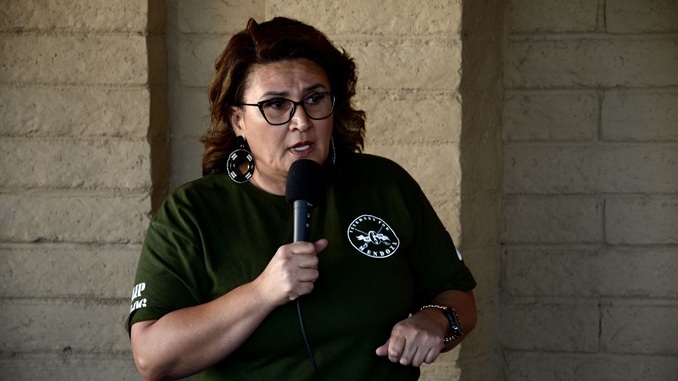
An event hosted by an anti-police group featuring 6th Congressional District candidate JoAnna Mendoza was canceled after a media outlet inquired about it.
The Washington Free Beacon had inquired about the virtual town hall event, which was scheduled to take place last Thursday night.
The canceled event was hosted by the program CareWins and paid for by its parent organization, MomsRising PAC. Mendoza was scheduled to appear virtually alongside Manny Rutinel, a Democratic candidate for a congressional seat in Colorado.
The organization has referred to law enforcement as rampant with “a deadly mix of white supremacy and violence.”
The epidemic of police violence must be stopped. We call on our elected leaders to immediately invest in communities and shift resources away from policing, where a deadly mix of white supremacy and violence remains unchecked. https://t.co/lTMIXsEO1tpic.twitter.com/87i6i2lusd
The Washington Free Beacon noted in its report that the MomsRising network has also advocated for the closure of immigration detention centers and prohibiting police from working with Immigration and Customs Enforcement.
In 2020, the first and strongest year of Black Lives Matter-led violence and advocacy, MomsRising called for defunding of the police.
"The idea of defunding the police is not new or naive, nor did it start with disconnected liberal elites." Black women, like @MonifaBandele, have meticulously organized and amplified this call for why police reform isn't a viable option. #BREATHEActhttps://t.co/GOdFO25yRnpic.twitter.com/p19IG3LKBa
That same year, Mendoza had expressed support for reducing police funding in favor of social welfare programs during her campaign for Arizona State Senate District 11.
“I support the reallocation of funding to programs that would allow people to live their best lives, such as the social service programs such as housing, public education, health care, ensuring that we’re addressing economic stability and environmental safety,” said Mendoza.
However, Mendoza opposed calls for total defunding of the police. She made that clear during a Clean Elections debate in September 2020.
“I do not support the defunding of police,” said Mendoza. “You know, police officers take an oath to protect and serve their communities much like military service members.”
Rather, Mendoza said she supported investing in other social welfare resources and additional funding into body cameras, deescalation training, and investigations into deadly force.
“Police officers are being asked to do too much, they’re being asked to address issues because of the lack of resources in our communities,” said Mendoza. “I support ensuring they have the resources but there also needs to be some accountability.”
Mendoza reiterated that position in a March 2026 opinion piece published by the Arizona Daily Star.
“The answer is not to defund law enforcement – it’s to fund law enforcement with intention. That includes ICE,” said Mendoza. “That means supporting the officers who serve honorably while insisting on training, body cameras, clear identification, lawful conduct, and meaningful oversight.”
Mendoza has raised more than $7.3 million according to Federal Election Commission data; no donations have come from MomsRising or Care in Action PAC, the political action committee affiliated with the CareWins program.
Approximately $665,000 of funds raised came from House Victory Project 2026, a joint Democratic fundraising committee. Most of the other funds have been reported as pooled donations from ActBlue, the main fundraising platform for Democratic candidates.
Rep. Juan Ciscomani, the incumbent and Mendoza’s opponent, has raised less. Ciscomani has raised just over $6.1 million this election cycle.
AZ Free News is your #1 source for Arizona news and politics. You can send us news tips using this link.
The Arizona Department of Health Services (ADHS) has issued standing orders for access to the latest COVID-19 and influenza vaccines.
These standing orders grant authority to authorized healthcare professionals to administer the vaccines to all individuals aged six months and older, including pregnant women.
These authorized healthcare professionals include physicians, physician assistants, advanced practice registered nurses or nurse practitioners, and pharmacists. Additionally, pharmacists may delegate the administration of both vaccines to an active, licensed, trained intern and pharmacy technicians under pharmacist supervision.
ADHS explained in a press release that it issued the standing orders amid uncertainty with the schedule and timing of the next meeting by the Centers for Disease Control’s Advisory Committee on Immunization Practices (ACIP), the entity responsible for developing vaccine schedule recommendations.
ACIP canceled the first two of three meetings scheduled for this year, one in March and one in June, due to ongoing litigation. The third meeting is scheduled to take place from October 21-23. The American Academy of Pediatrics (AAP) sued the Department of Health and Human Services over ACIP appointments made by Secretary Robert F. Kennedy Jr. and the new childhood immunization schedule.
ADHS identified COVID-19 and influenza as “major” and “significant” causes of morbidity in its respective standing orders.
Dr. Richard Carmona, ADHS public health medical advisor and the nation’s former surgeon general, said the standing orders ensured “safe and timely access” to the vaccines necessary for preventing severe illness and death.
The American Academy of Family Physicians (AAFP) and AAP recommend the influenza vaccine once or twice per year for children aged six months to approximately nine years old, and once per year for minors from approximately nine to 18 years old. For adults, the AAFP recommends the influenza vaccine between the ages of 19 and 64 years old; the recommended schedule did not provide a specific dosage amount.
The AAFP and the AAP recommend the COVID-19 vaccine once or more per year for children aged six months to 18 years old. For adults, the AAFP recommends one or more doses of the COVID-19 vaccine for individuals between the ages of 19 to 64 years, and two or more doses for those aged 65 years or older.
The American College of Obstetricians & Gynecologists recommends that all pregnant and lactating women receive the COVID-19 vaccine and booster shots.
So far for the ADHS 2025-2026 respiratory illness reporting season — which runs from November 2025 through October 2026 — there have been more than 19,000 confirmed cases of COVID-19 and approximately 49,700 confirmed influenza cases.
The latest ADHS data on the leading causes of mortality in Arizona from 2023 reported that COVID-19 was the 11th leading cause of death and influenza and pneumonia were the 13th leading cause of death; just over 950 deaths were attributed to COVID-19 and slightly more than 900 deaths were attributed to influenza and pneumonia.
COVID-19, influenza, and pneumonia accounted for approximately 3% collectively of the 16 leading causes of death identified in 2023.
The top three identified leading causes of death — heart disease, malignant neoplasms, and accidents — accounted for approximately 62% of deaths that year.
AZ Free News is your #1 source for Arizona news and politics. You can send us news tips using this link.
Two men were arrested this week for allegedly drugging, kidnapping, and sexually assaulting a woman earlier this summer.
Zabdiel “Zab” Kofi Echie, 24, and Joaquin Corona Borboa, 21, face sexual assault and kidnapping charges. The two are alleged to have conspired to commit the crimes.
Echie is a Border Patrol agent in training who had served until recently in the Marine Corps. Public records indicate that Echie lived in the Virginia/Washington, D.C. area throughout his high school years, and in the Tucson area for at least the last several months.
Borboa is a college student on hiatus at the University of Arizona (U of A) who works as a handyman with his uncle and is an aspiring fitness influencer according to his social media activity. Unlike Echie, Borboa’s attorney described him as a lifelong Tucson resident dating back to four months old. Borboa’s attorney mentioned that his parents were present for the initial hearing and willing to house him should the judge permit him to be released on his own recognizance. The judge did not.
Court documents revealed that the alleged victim, an 18-year-old woman, told investigators that Echie and Borboa gave her alcohol and then, to her surprise, put an “unknown white powdery substance” in her mouth while driving her from Tucson to Echie’s home in Sahuarita on June 19.
The victim alleged that she became disoriented during the 30-minute drive, and further alleged that Borboa digitally penetrated her.
Once at Echie’s home, the victim claimed that she passed out and later awoke to Echie having sex with her in his bed. She alleged that she attempted to stop Echie but that he held her down with Borboa’s help.
The victim also alleged that Borboa forced her to perform oral sex on him before taking her to his apartment and having sex with her there for several more hours.
The interim complaint reported that Echie’s cell phone contained a short video of the sexual encounter. Investigators noted that the victim was crying on the video, and that Borboa was visibly holding her down as Echie had sex with her.
Investigators also discovered text messages between Echie and Borboa that allegedly reflect they planned the sexual assault.
The judge who oversaw Borboa’s initial court appearance called the data discovered on Borboa’s phone “concerning.”
Echie posted his $150,000 bond; Borboa is being held at the Pima County Adult Detention Complex on a $350,000 bond.
Neither Echie nor Borboa have any criminal history. Attorneys for both men negotiated for lowered bonds, arguing that neither presented a threat to the community based on their lack of criminal history.
Customs and Border Protection (CBP) told 13 News that Echie was an off-duty employee and confirmed that its Office of Professional Responsibility is investigating Echie over the allegations.
“CBP stresses honor and integrity in every aspect of our mission, and the overwhelming majority of CBP employees and officers perform their duties with honor and distinction, working tirelessly every day to keep our country safe,” stated CBP.
AZ Free News is your #1 source for Arizona news and politics. You can send us news tips using this link.
A captain for the U.S. Navy will be inducted into his high school’s hall of fame on September 11.
Navy Captain Kurt Astroth will be in attendance for the induction ceremony in his honor at Mountain Pointe High School.
Astroth serves at U.S. Fleet Forces Command, headquartered in Norfolk, Virginia. He joined the Navy 22 years ago.
Previously, Astroth served as commanding officer of the USS Donald Cook. Astroth has served as a surface warfare officer aboard multiple ships: the USSs Boxer, Essex, Chief, Gladiator, Scout, Lake Champlain, and Underwood.
Astroth was inspired by the men in his family to join the military. His grandfather served in the Army Air Corps during World War II, his father in the Army during the Korean War era, and his uncle served as a naval aviator in Vietnam.
His family has continued to be a positive source of support in his life.
Of his service, Astroth said that he has grown to appreciate it as having a meaning deeper than serving his country.
“When I joined the Navy as a young man, I understood service largely in terms of serving my country,” said Astroth. “After more than two decades, my understanding of service has become much more personal. Service requires sacrifice. When you are young, it is difficult to fully appreciate what that means. Over a career, sacrifice becomes time away from family, missed events and milestones, deployments, and accepting that you will not always have complete control over where you go or when you will return.”
Astroth also stated that his service has rewarded him with the unparalleled opportunity to lead and develop the younger generations coming into service.
“For me, one of the greatest rewards of service has been the opportunity to lead and develop sailors, and to know that, for a period of time, I had the opportunity and responsibility to make a positive difference in their lives,” said Astroth. “I have served around the world, led sailors at sea, commanded a warship and watched young men and women grow into capable professionals and leaders themselves.”
Astroth was raised in Phoenix and graduated from Mountain Pointe High School in 1999, approximately eight years after the school had first opened. While at Mountain Pointe, Astroth lettered in football, track, and band. Astroth was a percussionist in the high school concert band for all four years.
Additionally, Astroth participated in the school’s German exchange program and, in turn, hosted three exchange students from Germany.
Astroth graduated from Mountain Pointe as a member of the National Honor Society. He was also a member of the Boy Scouts, and achieved the Eagle Scout rank.
Astroth credited his Mountain Pointe High School teachers and coaches, his Boy Scout troop leaders and fellow scouts, and his community at Dayspring United Methodist Church in Tempe for setting him up for success in his youth.
“Each of those communities gave me opportunities to grow, challenged me in different ways and helped establish values that I carried with me into the Navy,” said Astroth.
Tomika Banks, Mountain Pointe High School principal, told Astroth in a letter that his leadership and service to the community warranted his memorialization within the halls he once walked.
“This is a well-deserved recognition of your years of outstanding leadership and service to the Mountain Pointe Community, and an acknowledgment that you exemplified exceptional commitment to our school and students,” said Banks.
Astroth’s induction ceremony is scheduled to occur on Friday, Sept. 11, 2026, at 5:15 p.m. in the gym lobby. Astroth will also be recognized at 6:30 p.m. on the football field prior to the school’s varsity football game.
AZ Free News is your #1 source for Arizona news and politics. You can send us news tips using this link.
A shooting outside a Tucson gay bar earlier this week by a Muslim immigrant took the lives of two men, one of whom happened to be a sympathizer to the Palestinian cause.
The victims were Cameron Davis Capara, 33, and Vincent Anthony Siqueiros, 42.
Capara was an active Antifa activist who worked with the Arizona Palestine Solidarity Alliance and regularly protested against immigration enforcement, the pro-life movement, and President Donald Trump.
Although Siqueiros had a smaller online presence, he did share posts that indicated contempt for those to the right of the political spectrum, including one AI-generated video depicting President Donald Trump being knocked out from a punch to the head.
The shooter, Ousman Ceesay, 44, had moved recently to Tucson. Ceesay shot Siqueiros and Capara outside the Venture-N, a gay bar, at approximately 12:30 a.m. on August 31 prior to turning the gun on himself.
Recovered among Ceesay’s possessions was a list of LGBTQIA+ establishments.
Ceesay was a naturalized citizen and practicing Muslim who immigrated from West Africa to Oklahoma on a student visa approximately 16 years ago.
Democratic and Republican leaders have divergent viewpoints about the nature of the attack.
Arizona’s top Democrats have referred to the shooting as a hate crime rooted in anti-LGBTQ+ sentiments.
Reps. Adelita Grijalva (D-AZ-07), Greg Stanton (D-AZ-04), and Yassamin Ansari (D-AZ-03) conducted a moment of silence for the shooting victims alongside the Congressional Equality Caucus on the House floor on Wednesday.
Tonight I joined @Rep_Grijalva, the AZ delegation, and the @EqualityCaucus for a moment of silence on the House Floor for Vincent Siqueiros and Cameron Capara, who were murdered at a Tucson bar this week in a hate crime targeting the LGBTQ+ community. pic.twitter.com/JiSkbz8V5N
Grijalva, who organized the observance, preceded the moment of silence with a House floor speech advocating for stricter gun control and railing against Republican-led laws impacting the LGBTQ+ community.
“This type of targeted violence does not happen in a vacuum. It is cultivated by anti-LGBTQ+ rhetoric, laws, policies, and executive orders. And it is the direct consequence of this body’s failure to act on gun violence. Cameron and Vincent should still be alive today,” said Grijalva. “Mr. Speaker, how many more parents need to bury their children before Congress takes action to address the gun violence epidemic? How many more people need to die before this chamber stands up to the gun lobby? Our communities are sick and tired of hearing our ‘thoughts and prayers.’ We should be acting today to pass commonsense gun safety laws and to combat hate and violence targeting LGBTQ+ folks.”
Although investigators have not tied Ceesay’s attack to his religion, some Arizona Republicans are arguing the attack was more than a hate crime — they allege it was motivated by radical Islamic beliefs.
State Rep. John Gillette (R-LD30) said it was “radical Islamic terrorism” that occurred earlier this week, and that Democratic policies were to blame.
“The democrats invited these terrorists to the US that we were sent to their country to kill, so we would not have these attacks,” said Gillette. “You invited, support and have Partnerships with the enemy. Start supporting Americans! Not terrorism!”
Disgusting, you mourn the death of a person that is gay and call it equality. You are bunch of pandering idiots.
We mourn the death of an American citizen, killed by radical Islamic terrorism on our own soil.
The democrats invited these terrorists to the US that we were sent…
— Rep. John Gillette AZ House LD30 (@AzRepGillette) September 3, 2026
AZ Free News is your #1 source for Arizona news and politics. You can send us news tips using this link.