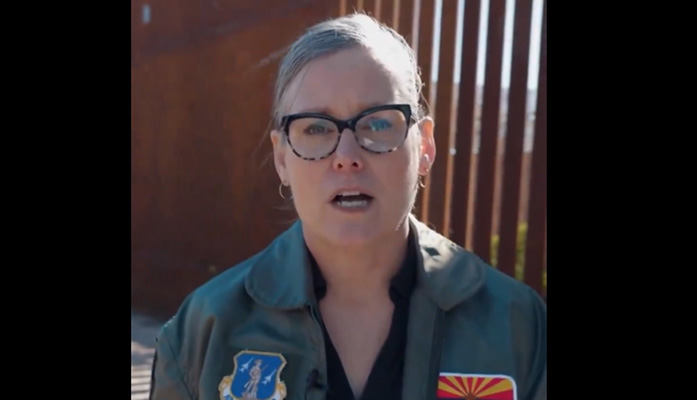
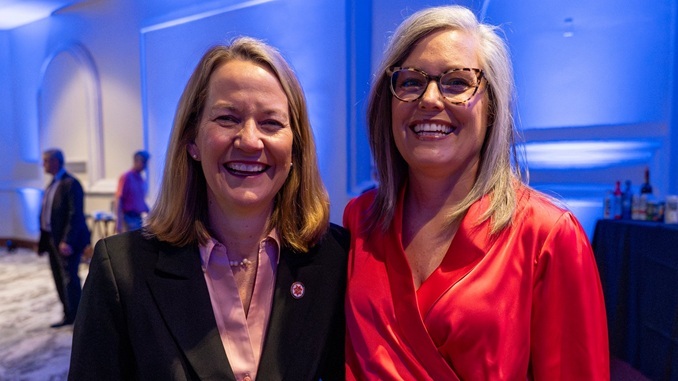
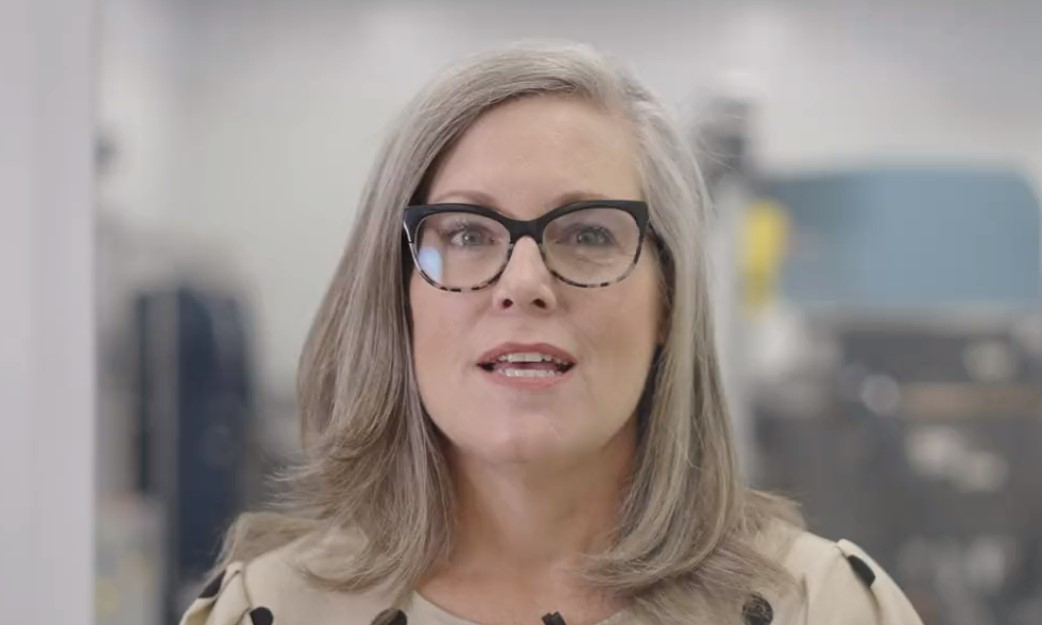
A former Arizona Supreme Court justice will be leading the pay-to-play investigation into Gov. Katie Hobbs.
ArizonaSenate Republicans announced on Monday that it had appointed Andrew Gould, a justice on the Arizona Supreme Court from 2016 to 2021, as part of the next phase of their investigation regarding allegations that Hobbs arranged for Sunshine Residential Homes, a group home operator and one of her top donors, to receive a special rate increase from the Arizona Department of Child Safety.
As a result of the transfer to another committee, Senate Republicans postponed the hearing for an indeterminate date in the future. The hearing was scheduled to take place on Tuesday, Sept. 29, 2026, at 11 a.m.
Gould also served on the Arizona Court of Appeals and Yuma County Superior Court, and served as a prosecutor in Maricopa and Yuma counties.
In a press release, Gould pledged to carry out an impartial and dispassionate investigation into the matter.
“My responsibility will be to help the committee establish a complete factual record, evaluate testimony and documents objectively, and ensure its work is thorough, fair, and legally sound,” said Gould. “No factual or policy conclusion should be predetermined. The evidence will determine where this investigation leads, and which reforms if any are ultimately recommended to the Committee.”
🚨FOR IMMEDIATE RELEASE: Former Arizona Supreme Court Justice Andrew Gould Appointed to Lead Senate Investigation into Hobbs Pay-to-Play Scandal
The Senate GOP also transferred the investigation from the Senate Government Committee to the Senate Committee on Appropriations. State Sen. Jake Hoffman (R-LD15), the chair of the Government Committee, said the media was to blame for the transfer.
During a press conference last week announcing a special hearing and subpoenas concerning the pay-to-play allegations, Stacey Barchenger, the Arizona Republic reporter who first reported on the alleged connection between Hobbs and Sunshine Residential Homes, asked Hoffman about the more than $1 million his advertising agency received from Turning Point PAC in support of Republican gubernatorial nominee Andy Biggs’s candidacy.
In this latest press release, Hoffman said the transfer of the investigation to another committee was necessary to keep the focus on the allegations against Hobbs.
“The crooked political media decided what this investigation was before it even began, because running cover for Katie Hobbs and Kris Mayes is more important to them than exposing potential corruption,” said Hoffman. “Transferring the proceedings and placing former Justice Andrew Gould at the center takes away their excuses for non-cooperation, strengthens the investigation, and ensures the evidence, not their predetermined political narrative, drives any resulting legislative reforms.”
Sen. David Farnsworth (R-LD10), chair of the Senate Committee on Appropriations, stated in the same press release that the scope of the investigation enabled it to fit comfortably within his committee.
“This transfer does not narrow the issues under investigation or diminish the Senate’s resolve. It places the investigation where the money can be examined directly and adds an experienced former prosecutor and Supreme Court justice to lead that work,” said Farnsworth. “We will follow the evidence, examine how these decisions were made, and give every witness a fair opportunity to explain the events at issue. Only after that process is complete can we reliably identify gaps in current Arizona law and determine which statutory changes are most appropriate to help prevent future misappropriation of taxpayer dollars.”
Along with Hobbs, the Senate subpoenaed Sunshine Residential Homes CEO Simon Kottoor and his wife, Elizabeth; Attorney General Kris Mayes; Christian Slater, Hobbs’ communications director; Hobbs’ inaugural and defense funds; Dan Barr, Mayes’ chief deputy attorney general; Bill Mundell, Mayes’ chief deputy of police and administration; Nicholas Klingerman, Mayes’ criminal division chief; Michael Faust, former DCS director and current city of Peoria manager; Shalom Jacobs, former DCS deputy director and current CGI director; Alex Ong, DCS deputy director; Robert Navarro, former DCS deputy director; and David Lujan, former DCS director.
The city of Tempe held the first meeting for its Public Safety and Community Oversight Council Subcommittee on Monday.
Councilmember Bobby Nichols is chairing the subcommittee. Mayor Corey Woods and Councilmember Brooke St. George are also members of the subcommittee.
The subcommittee is focused on reviewing progress on implementation of recommendations made by the city’s 2020-2021 Public Safety Advisory Task Force. Additionally, the subcommittee plans to review and evaluate policies, data, and procedures related to 911 response, police deescalation, and police use of force.
Woods created the task force following the summer of Black Lives Matter-led riots initiated by the death of George Floyd while in police custody.
The task force issued seven pages of recommendations for police reform in Tempe. Recommendations included:
Creating an unarmed unit to respond to nonviolent crimes and situations, with a suggestion for police to base call response on the interpretation of the threat level and consideration of how beliefs around race, gender, or class may influence threat level interpretations.
Restructuring the 911 Emergency Call Center to be modeled after a now-defunct program in Oregon which provided mobile crisis intervention services for mental health issues, conflicts, homelessness, and first aid.
Conducting a diversity audit of the 911 Emergency Call Center.
Establishing a civilian-based investigative body for police use of force violations or complaints.
Providing families with body-worn camera footage and reports within 48 hours of officer-involved shootings.
Establishing a settlement fund for victims of police brutality within the police department’s budget.
Shifting resources from police to social services, including expanding and increasing funds for CARE 7, which houses the city’s crisis response team and victims services advocacy.
Ceasing police hiring and recruitment until task force recommendations and “a culture shift” occur.
The subcommittee plans to explore further the city’s progress with implementing these recommendations at their next meeting on September 28.
The recent arrest over the summer of Arizona State University (ASU) student Eryn Bonner prompted the council to create the subcommittee. Surveillance footage and police body camera video reflect that Bonner was arrested after refusing to comply with law enforcement orders to remain at a distance during the arrest of two men. Bonner approached arresting officers twice while yelling and grabbing at them. She then approached a third time, attacking the officer who had twice pushed her away from the other arresting officers.
According to police records and as indicated by body camera footage, Bonner struck the arresting officer multiple times in the head as he attempted to arrest her. It appears that only after Bonner attacked the officer that he struck Bonner to subdue her.
Police have filed misdemeanor charges against Bonner including assault, disorderly conduct, obstruction, and resisting arrest.
Community stakeholders present at this first meeting included Casey Clowes, an SRP board member; DeAnna Alvarez, advocacy director for AANHPI for Equity; Kema Charles with the Scottsdale chapter of Black Lives Matter; Michelle Ivette Ponce and Raquel Britain, program manager with the Phoenix Metro chapter of Black Lives Matter; and Nicole Gutierrez-Miller, governing board member with Tempe Union High School District.
One item of particular focus at this meeting was the Tempe Citizens’ Review Panel for Police Complaints and Use of Force. The city established the panel in 1999 to provide civilian oversight over police use of force, similar to one of the recommendation items posed by the 2020-2021 Public Safety Advisory Task Force.
The subcommittee plans to discuss whether other municipalities have civilian oversight bodies that have proven effective at securing accountability, restoring public trust, and offering resolutions to incidents.
AZ Free News is your #1 source for Arizona news and politics. You can send us news tips using this link.
Republican lawmakers are investigating Arizona Governor Katie Hobbs for allegedly securing a unique rate increase from the Arizona Department of Child Safety (DCS) for one of her top donors, Sunshine Residential Homes, a group home operator.
Sunshine Residential Homes, its CEO Simon Kottoor, and his wife Elizabeth contributed more than $500,000 to Hobbs and the Arizona Democratic Party.
Attorney General Kris Mayes cleared Hobbs of wrongdoing last month.
Arizona State Senator Jake Hoffman (R-LD15) has called on Mayes to release the documents from her investigation.
Arizona Senate Republicans claim that “the underlying evidence remains hidden” in Hobbs’ case.
Hoffman said that the evidence presented so far has created a clear appearance of pay-to-play corruption. Hoffman accused Mayes of having a political alliance with Hobbs that compelled her to decline to charge the governor of wrongdoing.
“The money, the favors, and the secrecy form a pattern that cannot be ignored,” said Hoffman. “The confluence of events here renders these allegations extremely credible and worth investigating.”
Lawmakers have subpoenaed materials concerning donations to Hobbs’ inaugural or legal defense funds by Sunshine Residential Homes, the Kottoors, or any executive of the group home operator.
Sunshine Residential Homes and both Kottoors were also subpoenaed, along with Abi Saifi, the director of programs at Sunshine Residential Homes.
They also requested materials concerning contracts or agreements between any state agency and Sunshine Residential Homes, and changes to compensation or reimbursement rates, formulas, or amounts paid by any state agency to Sunshine Residential Homes.
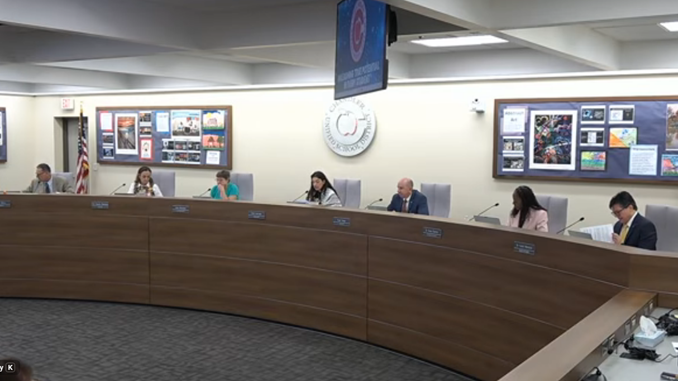
Chandler Unified School District (CUSD) narrowly approved a land acknowledgment statement for Native Americans during its regular meeting last week.
The board approved the land acknowledgment statement 3-2. The governing board will read a land acknowledgment statement at every meeting and at all graduation ceremony programs.
Board President Patti Serrano, donned in a pro-Palestine keffiyeh scarf and MEChA t-shirt, joined Member Claudia Mendoza and Vice President Barb Mozden in voting to require the land acknowledgment statement. Members Kurt Rohrs and Ryan Heap voted against the measure.
Serrano said this land acknowledgement statement was necessary to make Native American students feel “safe” to show up and learn at CUSD schools.
Serrano also claimed that a land acknowledgment statement did not mean that the district would be required to accept requests for acknowledgments for other identity groups.
CUSD has posted a land acknowledgment statement and accompanying video on its Indigenous Education Program page since 2025.
That land acknowledgment statement reads that the district exists on lands previously occupied by the Piipaash, Akimel O’odham, Gila River, Salt River, Pima, Maricopa, and Yaqui tribes.
Board member Rohrs questioned whether there would be future efforts to expand the requirement to read a land acknowledgment statement throughout other aspects of district activities, such as student functions like football games, CUSD staff meetings, and the beginning of classes.
Rohrs also said that land acknowledgement statements signaled bias and favoritism toward certain groups. He warned that the board’s approval would lead to demands by countless other identity groups: Holocaust recognition for Jewish students, acknowledgments for the various religious groups, or commemorations of veterans for students in military families.
Rohrs contended that the statement was rooted in “identity politics” that would further cause division in the CUSD community.
“Despite denials, this is clearly a political statement that reveals a preferential and exclusive bias towards a certain point of view of a certain identity group. The district must remain neutral in these matters,” said Rohrs. “For practical matters, this unnecessarily politicizes our board meetings. It has no real purpose in addressing our primary mission of improving academic performance for our students. This statement is an empty performance gesture of wokeness which really doesn’t accomplish anything and distracts from our core mission.”
Board member Heap remarked that the district faces much more pressing matters concerning student outcomes, citing an example of two more students who left the district for homeschooling due to the district ignoring or dismissing requests to curtail teacher and student usage of vulgar language. Heap also remarked that reading scores have declined to the lower 50th percentile.
Heap expressed doubt that the lack of a land acknowledgment statement was having negative impacts on the district, especially the current pressing issues of declining enrollment. According to the board, less than 2% of students will be directly impacted by the land acknowledgement statement.
Heap questioned why there were acknowledgments for certain identity groups but not others, which prompted laughter from the pro-land acknowledgment statement audience in attendance.
“Any time when we choose to highlight a group of students only based on their identity, nationality, heritage, we indirectly eschew — that means, you ignore — other people. We have a Hispanic heritage month. Do we have an Irish month? Do we have an Anglo-Saxon month?” asked Heap. “I don’t think that it’s appropriate for us to engage in that activity, either, because we are now wandering in areas that even if it’s right or wrong, I believe this statement ends up [having] a political connotation. Anytime you do that, you show bias, and that’s going to end up driving away students.”
Mendoza said that the statement was necessary for respecting diversity and belonging.
“By doing this, we are demonstrating that every story matters and every voice has value,” said Mendoza.
Mozden predicted the statement would improve Native American students’ academic performance.
“We have to start somewhere to try to raise our academic performance for some of our subgroups,” said Mozden.
The land acknowledgment incited some community members to call on Serrano to step down from the board, since Serrano led on the effort of its adoption.
Serrano has been accused of imposing a land acknowledgment without board concurrence at board meetings and graduation ceremonies.
Serrano has historically declined to participate in recitation of the Pledge of Allegiance, and took her oath of office on a fiction book written by Arizona State University professor David Boyle describing the gay sexual fantasies of a boy and his peers and the boy’s rejection of the values held by his conservative, Christian parents.
AZ Free News is your #1 source for Arizona news and politics. You can send us news tips using this link.
The federal government may withhold Medicaid payments to Arizona for failure to comply with annual audit requirements.
Arizona failed to file its Fiscal Year 2025 Single Audit Report by the March 31 due date. As of this report, the audit report has yet to be filed.
The Department of Health & Human Services (HHS) sent a letter to Gov. Katie Hobbs in mid-July notifying her of the state’s noncompliance.
As mentioned by HHS Assistant Secretary for Financial Resources Gustav Chiarello in that notification letter, Arizona has failed every year under the Hobbs administration to file its annual audits on time. The fiscal year 2024 report was filed more than a year late, and the fiscal year 2023 and 2022 reports were both filed nearly nine months late.
“These substantially late submissions leave Arizona’s Federally funded programs with significant gaps in oversight, heightening the risks to program integrity and to the individuals and families who depend on these critical health and human services programs,” stated Chiarello.
HHS gave Hobbs until July 31 to either provide proof of the audit report submission or a proposed corrective action plan. The latter would require HHS approval in order for the agency to release payments.
The Arizona Health Care Cost Containment System (AHCCCS) manages Medicaid in the state. AHCCCS has operated without stable leadership since Hobbs took office. Hobbs appointed Carmen Heredia to serve as director shortly after she took office, but Heredia resigned in April 2025 amid a legislative dispute over her appointment.
Lawmakers accused Heredia of mismanaging AHCCCS regarding Medicaid contracts. Hobbs maintained that Heredia’s directorship was a success, citing nearly $1 billion in Medicaid fraud recoveries in addition to years of cost savings.
Hobbs appointed Virginia “Ginny” Rountree late last September, but Rountree resigned just five months later in early February of this year.
AHCCCS is led currently by interim director Roberta Harrison.
AHCCCS has undergone intense scrutiny by lawmakers regarding Medicaid waste, fraud, and abuse, as well as testimonies of program disruptions impacting providers and services since Hobbs took office.
State Sen. Janae Shamp, former senate majority leader who has focused heavily on oversight of Arizona’s Medicaid program, questioned the history of audit report delays under Hobbs and whether the governor had submitted an acceptable action plan to HHS.
@HHSGov just put it in writing: Arizona is NOT compliant on the FY25 Single Audit. Due March 31. Not filed. Why? Hiding something?
@katiehobbs@GovernorHobbs what is your action plan to ensure vulnerable, innocent Arizonas do not suffer from your administration's incompetence? pic.twitter.com/wZhOweLqnB
— Former Majority Leader of the AZ State Senate (@AZSenatorShamp) September 12, 2026
Shamp hosted a press conference last summer warning of Medicaid waste, fraud, and abuse under the Hobbs administration. Shamp revealed that only 23% of enrollees in recent years underwent proper eligibility vetting. One-third of that 23% failed verification, and more than 49,000 enrollees were also enrolled in other states’ programs.
“More than three-quarters of Arizonans enrolled to receive this public benefit did not get the necessary review to determine if they were qualified to receive it,” said Shamp.
Why did Arizona check only 23% of Medicaid enrollees for assets?
Over a third of Medicaid enrollees were too rich to qualify.
— Former Majority Leader of the AZ State Senate (@AZSenatorShamp) June 17, 2025
In a statement, Shamp said that her three years of Medicaid scrutiny relating to the state budget have only incurred ire from the Ninth Floor.
“Last time I pressed it during budget discussions, I was accused of trying to sabotage the budget process even though a whistleblower confirmed billions in improper payments in the same programs these audits are supposed to oversee,” said Shamp.
Last week, Treasury Secretary Scott Bessent announced that its Financial Crimes Enforcement Network had identified approximately $17.5 billion in potential healthcare fraud spanning all 50 states as well as Puerto Rico, Guam, and the Virgin Islands.
AZ Free News is your #1 source for Arizona news and politics. You can send us news tips using this link.