by Staff Reporter | Sep 26, 2026 | News
By Staff Reporter |
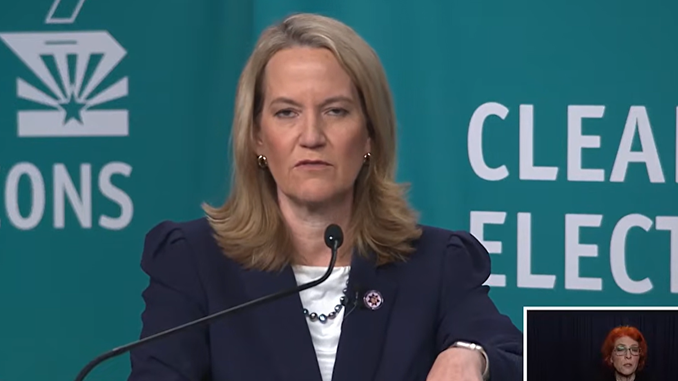
Wednesday night’s debate between the Democratic and Republican candidates for Arizona attorney general grew heated, with outbursts from the incumbent and repeated accusations of lies and coverups.
Attorney General Kris Mayes, the incumbent and Democratic nominee, initially focused on presenting herself as apolitical.
Mayes emphasized her prosecutions of fraud, waste, and abuse in the state’s Medicaid and school choice programs. She explained away the disproportionate number of lawsuits she’s filed against the Trump administration as justified, claiming that the actions of the Biden administration didn’t warrant lawsuits.
“Whether it was a Republican president or a Democratic president, our criteria is the same: has the Constitution been violated? Has the state been harmed?” said Mayes. “And that has happened all too often over the past two years.”
Senate President Warren Petersen, the Republican nominee, focused on Mayes’ controversial administration of the office, and accused her of focusing office resources on political lawfare.
“Kris Mayes is the most political and partisan AG that this state has ever had,” said Petersen. “She’s got [more than] 50 lawsuits against her political opponents. She has weaponized the office.”
One of the sponsors for the debate was Riester, whose CEO Tim Riester secured an internship in Mayes’ office this summer for his son after contributing to her campaign, as reported by The California Globe on Thursday.
Most Heated Points of the Debate
Mayes interrupted Petersen multiple times during the debate.
One interruption came when Petersen brought up that Mayes hired Vanessa Daily (Hickman), her former division chief who committed felony mail theft, despite warnings from the city of Peoria, her prior employer, about allegations against Hickman of fraud, conversion, and breach of fiduciary duty.
“Her office is in total disarray,” said Petersen. “Mayes was warned about a specific hire, red flags. She hired her anyway as her division chief. That hire ended up committing a felony.”
Mayes immediately jumped in with a demand that she be allowed to provide a response while Petersen still had time remaining to speak.
“Am I going to get a rebuttal for this?” said Mayes. “This is outrageous.”
Mayes again interrupted Petersen when he alluded to reports that she “is known for having meltdowns” to include “yelling, screaming, pounding her fist on the table, shouting the ‘F’ word” in office. Petersen read a statement from one witness to her behavior. Mayes accused Petersen of making false and defamatory statements.
“This is outrageous. I can’t believe you’re allowing this to be aired,” said Mayes.
Following the debate, however, Mayes admitted to a press gaggle that what Petersen said was true — she has engaged in that behavior while in office.
“If I’m passionate about something? Yeah,” said Mayes. “Do I, you know, drop an F-bomb every once in a while? I do. I’m passionate about protecting the funds that the people of Arizona deserve.”
Mayes also went over her time, shouting over moderators to blame Petersen for her unsuccessful lawsuit to stop opioid settlement funds from being taken from her office to cover budget shortfalls, something to which Gov. Katie Hobbs, a fellow Democrat, agreed. The reallocated funds were given to the Department of Corrections to assist individuals impacted by opioids.
On Supporting Law Enforcement
Mayes and Petersen each claimed that they were more supportive of law enforcement than the other. Mayes claimed to have “great relationships” with federal law enforcement agencies.
Petersen has received the endorsement of every law enforcement organization in the state, whereas Mayes has received none.
Mayes said Petersen voted against increased burial benefits for widows of fallen officers, and accused her opponent of putting forth a ballot initiative, HCR 2040, to prevent collective bargaining for first responders.
Petersen countered that HCR 2040 had “nothing to do” with first responders. The proposed constitutional amendment would have prohibited school districts from using public funds to support union operations; a court struck down the ballot proposition over the summer.
Petersen referenced Mayes’ recent remarks issued in January, when she advised Arizonans that they have a legal justification to shoot certain law enforcement officers.
“[The] law says that if you reasonably believe your life is in danger and you’re in your house or your car or on your property that you could defend yourself with lethal force,” said Mayes.
In response, Mayes’ law enforcement liaison resigned. Both the Arizona House and Senate called on Mayes to resign from office, an unprecedented action that the legislature had never taken prior to Mayes. Gov. Hobbs broke party rank and condemned Mayes for her remarks.
On Immigrant Enforcement
Mayes said she wants deportations to end and instead would like to require immigration enforcement to work on cartel cases. Mayes clarified that she doesn’t support illegal immigration.
“I think we need ICE to go back to what it normally does, which is to help state AGs go after Mexican drug cartels,” said Mayes. “Arizonans don’t believe in mass deportation, they believe in immigration enforcement.”
Petersen, whose wife immigrated legally from Mexico, said he supports legal immigration and opposes illegal immigration because it renders illegal aliens vulnerable to crime.
“We know this nation was built and strengthened by people who came here the right way,” said Petersen. “When someone enters into the country illegally, they become vulnerable to human traffickers and criminal organizations.”
Mayes claimed that Petersen supported deportations for Dreamers: illegal aliens residing in the country on deferred deportation who entered the country illegally as minors. When Petersen responded that was untrue, Mayes interrupted him to claim he had made that statement.
Petersen said that those who are here illegally in the country shouldn’t be surprised if they are deported, not that they should be deported.
Petersen said the community members should have input on the establishment and expansion of immigration detention centers, including the recent $1.2 billion expansion plans for the detention center in Florence.
Mayes reminded the public that she successfully sued to stop the Trump administration from establishing a new immigration detention center in Surprise.
On Green Energy
Petersen said his first action in office would be to allow the Arizona Corporation Commission’s (ACC) Renewable Energy Standard and Tariff (REST) Rules to be repealed. The REST Rules require electric utilities to generate 15% of their energy from renewable resources by 2025. Mayes helped to enact those rules while on the ACC and is currently challenging the repeal.
Petersen accused Mayes of imposing green energy rules and approving rate increases under the justification that ratepayers would be willing to pay more to implement renewable energy.
Mayes claimed that her policies passed on the ACC have saved residents money, not cost them more over time.
The REST Rules resulted in more than $2.3 billion being collected via surcharges to customers.
On Data Centers
Petersen said that he supports data centers to a point, but that they need to be governed and decided on by the community.
Mayes backs a moratorium for all data centers. She said utility rate increases were caused by data centers, not renewables as Petersen claimed.
AZ Free News is your #1 source for Arizona news and politics. You can send us news tips using this link.
by Staff Reporter | Sep 25, 2026 | Education, News
By Staff Reporter |
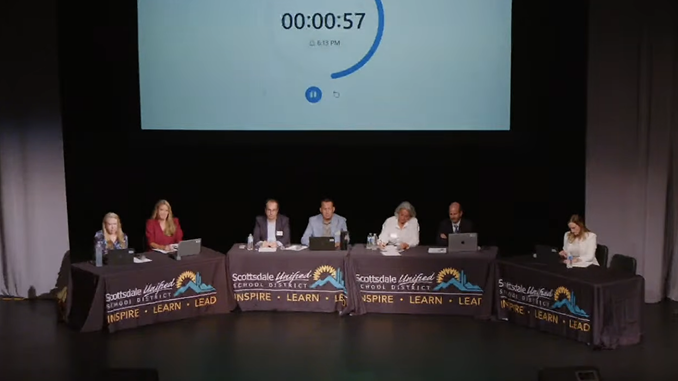
Scottsdale Unified School District (SUSD) violated the law with its school closure and consolidation committee, but the county attorney says it’s too late to stop them.
The complaint was filed originally with Attorney General Kris Mayes back in April, claiming that SUSD’s Phase II Design Advisory Team, an advisory committee responsible for coming up with school closure and consolidation options, violated Open Meeting Law because it prohibited the public from attending meetings.
Mayes waited nearly three months to refer the complaint to the Maricopa County Attorney’s Office (MCAO); she cited a conflict of interest as the basis for not taking on the investigation herself.
MCAO told AZ Free News that Mayes didn’t refer the complaint to their office until July 17.
By then, SUSD’s Phase II Design Advisory Team had held all five of its Phase A meetings and three out of five of its Phase B meetings. The final meeting for this illicit advisory committee occurred on August 17.
Since all of the meetings have already occurred, MCAO Deputy County Attorney Caitlyn Mitchell said in a disposition letter on Tuesday that nothing could be done beyond recommending to SUSD that they not recommit a similar Open Meeting Law violation in the future and acknowledge their wrongdoing at the special meeting scheduled to occur that day.
“[I]t is too late to require SUSD to take corrective action concerning future Phase II Team meetings,” stated Mitchell. “MCAO has informed SUSD of its findings and conclusions, recommended that SUSD revise its future use of superintendent appointed committees, and requested that the SUSD Governing Board acknowledge the results of this investigation publicly at the open meeting to discuss the Phase II Team’s recommendations.”
Arizona law requires any legal action taken in a meeting that violates Open Meeting Law to be rendered null and void, unless ratification occurs under certain parameters during a public meeting within 30 days of discovery of the violation.
Non-public advisory committees have been a recurring problem for SUSD. Mayes has previously found SUSD in violation of Open Meeting Law for its use of non-public advisory committees.
During the SUSD special meeting on Tuesday, the governing board didn’t advise the public of the MCAO letter or the fact that the advisory committee responsible for creating the school closure and consolidation options had been conducted in violation of the law. It also stopped the community from making any mention of the letter.
Mike Bengert, the community member who filed the complaint, attempted to speak about the disposition letter during public comment, but Governing Board President Donna Lewis interrupted him.
SUSD counsel Renee Osipov told Bengert that he could only talk about the proposed options for school closures and consolidations.
“We’re not talking about Open Meeting Law. That’s not what we’re agendized to do,” said Osipov.
Lewis had advised at the beginning of the special meeting that public comments not addressing school closure and consolidation options were only permitted for the next meeting scheduled for October 6 — the day that SUSD is anticipated to vote on school closures.
During Tuesday’s meeting, public comment on the school closure and consolidation options lasted more than three hours.
The Phase II Design Advisory Team operated as part of three phases to close, consolidate, and repurpose schools within the district. Phase III has another non-public advisory committee: the Coronado Learning Community committee.
Bengert told AZ Free News that he filed a new Open Meeting Law complaint over Tuesday’s special meeting.
AZ Free News is your #1 source for Arizona news and politics. You can send us news tips using this link.
by Staff Reporter | Sep 25, 2026 | News
By Staff Reporter |
There is just over one month left before the midterm elections in early November.
With just weeks to go, the Maricopa County Recorder’s Office has issued reminders of upcoming deadlines for voters to keep in mind.
October 5 is the deadline to register to vote for the election.
Early voting begins on October 7, and early ballots will be mailed out on this date.
Voters who choose to vote in person must have a valid government-issued ID that includes their name, photo, and address matching the one provided on their voter registration.
Voters with IDs that are expired or featuring an address differing from the one on their voter registration must provide two alternative forms of identification. Alternative forms of ID include a paper or digital Voter Registration Card, utility bill issued within 90 days of the election, bank or credit union statement issued within 90 days of the election, vehicle registration card or form, property tax statement, tribal identification, vehicle insurance card, non-photo government ID, or official election mail.
Voters who choose to vote via a mail ballot may turn in their ballot by mailing it or dropping it off at a secure drop box or Vote Center.
Voters may locate a drop box or voting location using the Maricopa County website.
There are 254 Vote Centers throughout the county, 26 drop box locations without in-person voting, and two 24-hour drop box locations. Certain Vote Center locations are subject to opening as drop box-only sites on certain days. Approximately 90 of the Vote Centers are non-electioneering sites.
October 23 is the deadline for requesting a replacement ballot by mail.
Mail ballots come with a green affidavit envelope. Voters must sign that envelope prior to mailing or dropping off their ballot at a drop box or Vote Center.
The Maricopa County Recorder’s Office recommends mailing back early ballots by October 27 at the latest.
7 p.m. is the time to remember for Election Day on November 3.
On Election Day, all ballots must be received by 7 p.m. Postmarks do not count toward this deadline. Voters may also drop off their ballot at any ballot drop box until 7 p.m. Voters who are in line at a Vote Center before 7 p.m. will still be permitted to vote.
Maricopa County voters also have the option to expedite the tabulation of their ballot through ID Verify.
Through ID Verify, voters who show a valid ID while checking in at a Vote Center may have their ballot envelope stamped with an “ID Verified” marker. The stamp allows voters to bypass the signature verification process.
Voters impacted by signature verification issues have until 5 p.m. on Nov. 8, 2026, to verify their signature.
Voters may track their ballot by texting “JOIN” to 628-683. The county will provide real-time updates via text and/or email. Voters may also visit BeBallotReady.Vote to check the status of their ballot, as well as review their voter information and sign up for ballot tracking text or email alerts.
As of the primary election, Maricopa County has more than 2.5 million registered voters: more than 900,000 independents, 880,000 Republicans, 700,000 Democrats, 28,000 No Labels voters, 18,000 Libertarians, and 2,000 Green voters.
There are more than 4.3 million voters total in Arizona.
The county reported that the primary election went smoothly this year. More than 676,000 ballots were cast across more than 250 voting locations.
AZ Free News is your #1 source for Arizona news and politics. You can send us news tips using this link.
by Staff Reporter | Sep 24, 2026 | Education, News
By Staff Reporter |
Progressive activist group leaders were charged and one was trespassed from Northern Arizona University (NAU) in connection with an anti-Immigration and Customs Enforcement (ICE) protest.
The penalties resulted from the conduct of members from Students for a Democratic Society (SDS) Flagstaff during their ICE OUT protest earlier this month.
SDS Flagstaff is not a registered club on campus, and NAU does not recognize it as an official club on campus. The organization was founded in January 2026 and immediately began holding protests against ICE.
Kimberly Ott, associate vice president of University Strategic Communications, told The Lumberjack that SDS Flagstaff may register as an official club but has declined to take the necessary steps to fulfill registration requirements.
SDS Flagstaff Vice President Sarah Rogala and member Judah “Jay” Francabandera face allegations of code of conduct violations. Student Gio Alvarez also faces allegations. The students reportedly face penalties that may include suspension or expulsion.
The allegations include failure to comply with university officials and disrupting campus.
Rogala and Francabandera are scheduled to have their hearings on the charges later this month.
The organization held another protest opposing the charges against Rogala and Francabandera.
SDS is also accused of posting flyers and tabling on campus property, and using sound amplification without NAU permission.
Rogala was charged with code of conduct violations last semester and received probation set to expire Nov. 1, 2026.
NAU also trespassed Claire Wagoner, who is the SDS Flagstaff president, a member of Freedom Road Socialist Organization in Flagstaff, and a former NAU student.
Wagoner was also charged with code of conduct violations last semester as well. Those violations resulted in her receiving a deferred suspension set to expire May 1, 2028.
SDS Flagstaff is also demanding that NAU turn itself into a “sanctuary campus,” meaning that law enforcement could not detain illegal aliens on the property. SDS Flagstaff renewed their demands to the university in a statement following an ICE enforcement action that occurred on September 16.
“On Wednesday, September 16th, ICE agents kidnapped someone from Flagstaff, and these terrorists threatened to raid his home and kidnap his wife and children if they did not ‘self deport,’” stated SDS Flagstaff. “[ICE] is terrorizing anyone and everyone these fascist agents deem not white enough to be ‘legal.’”
In February, the organization held a sit-in protest and submitted more than 400 petition signatures as part of demands that NAU implement sanctuary campus policies. Justin Mallett, NAU’s vice president of Inclusive Excellence, and Bernadine Lewis, program director of Inclusive Excellence, met with Wagoner and Rogala but ultimately denied their demands.
That month, SDS Flagstaff also successfully protested against campus visits by the CIA, Border Patrol, and ICE. The CIA was scheduled to answer student questions, and all three agencies were anticipated to appear for the university’s Career Fair programming.
In March, SDS Flagstaff members demanded the Flagstaff City Council approve an ordinance from Keep Flagstaff Together banning ICE from operating on city property. The council rejected the proposed ordinance.
AZ Free News is your #1 source for Arizona news and politics. You can send us news tips using this link.
by Staff Reporter | Sep 23, 2026 | News
By Staff Reporter |
Earlier this summer, State Sen. Kiana Sears (D-LD9) attempted to scam a restaurant out of more than $1,500 worth of fried chicken.
Now, Sears is part of the inaugural “Black Leaders for Katie” coalition, launched by Gov. Katie Hobbs on Monday as part of her reelection campaign. Sears was named second in a list of 35.
Members of the media referred to the ordeal as “Chickengate,” so dubbed by the Arizona Agenda who retrieved the emails involving the restaurant, lawmakers, senate staff, and lobbyists that shed light on Sears’s conduct.
The ordeal began after a Republican lawmaker and bipartisan lobbyist group organized an event celebrating the 100th anniversary of Route 66. That event included more than $1,500 worth of catering from the Gus’s World Famous Hot & Spicy Fried Chicken location in downtown Phoenix. The order included chicken, mac and cheese, coleslaw, sweet tea, and lemonade.
Following the event, Sears contacted the caterer purporting to be one of the individuals in charge. Sears did not coordinate or pay for the event. According to an email from the restaurant’s general manager, Sears claimed in a call that the chicken was “overcooked, dry, and not enjoyed by most” — directly contradicting positive feedback the restaurant had received from event coordinators.
The general manager also revealed that Sears demanded the $1,500 catering order be remade on Saturday, June 27 at 5:30 p.m. Those who coordinated the event urged the restaurant to ignore Sears’s request.
Sears later dismissed questions from the media about the scam attempt as a “distraction” from her work as a lawmaker, and refused to answer other questions regarding where the catering order would have gone if the restaurant had fulfilled it.
As part of Hobbs’ launch of Black Leaders for Katie, the governor hosted a roundtable pledging her commitment to minority-owned businesses.
Gus’s World Famous Hot & Spicy Fried Chicken began with a little operation founded by a Black family, originally called Maggie’s Short Orders by Napoleon “Na” and Maggie Vanderbilt when they first opened in Tennessee in 1973, and then renamed to the current branding after their son, Vernon “Gus” Bonner, who took over the business in the 1980s. The Bonner family has since sold the franchising rights to these restaurants.
There are four Gus’s locations in Arizona, and 38 locations across 13 states.
Other Black Leaders for Katie members are:
- Corey Woods, Tempe Mayor
- Quantá Crews, State Representative
- Kesha Hodge Washington, Phoenix Vice-Mayor
- Kevin Robinson, Phoenix Councilmember
- Henry Wade, Maricopa Councilmember
- Max White, Avondale Councilmember
- Khara House, Flagstaff City Councilmember
- Coral Evans, former Flagstaff Mayor
- Cloves Campbell Jr., former State Representative
- Berdetta Hodge, former Tempe Councilmember
- Rev. Sheriolyn Curry Hodge, Community & Business Leader
- Rev. Andre Miller, Faith and Community Leader
- Pastor David Wade, Mt. Calvary Baptist church
- Rev. Brian Wright, The Citadel of Praise, Overseer
- Connie DeLarge, Arizona Democratic African American Caucus, Chair
- Briona Parkinson, Maricopa Area Labor Federation, Chair
- Carla Gentles, Gentles Agency, Partner
- Karl Gentles, Gentles Agency, Partner
- Rosiland Moore, Business Leader
- Kent O’Jon, Business Leader
- Sasha Simmons, Business Leader
- Shannon Tolbert, Business Leader
- Ashley Anderson, Community Leader
- Dr. Edmon Baker, MD
- Dr. George Barnes, Education Leader
- Carla Boatner, Community Leader
- Dr. Joanne Curry
- Dr. Karen Hardin, Ed.D Faculty Emeritus
- Jackie Johnson, Community Leader
- Dr. Kenja Kassan
- Dr. Gail Knight, Community and Education Leader
- Dr. Matthew C. Whitaker, Community Leader
- Donna Williams, Attorney and Community Leader
- Rohn Ragland, Student Leader
[Photo courtesy of Gage Skidmore via Creative Commons]
AZ Free News is your #1 source for Arizona news and politics. You can send us news tips using this link.