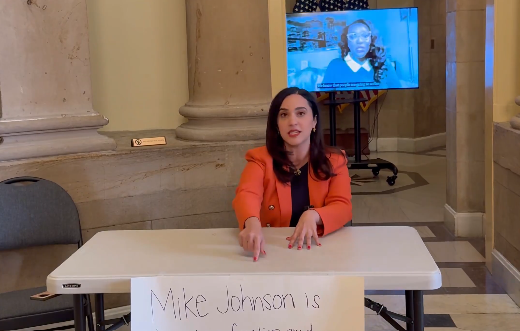
Democratic Rep. Yassamin Ansari (AZ-03) made another oversight visit to an immigration detention facility this week.
Wednesday’s visit marked the 13th since Ansari took office. Ansari’s latest visit took place at the ICE Phoenix Field Office, which contains a temporary hold facility.
Ansari claimed that she was concerned about detainees experiencing medical neglect and prolonged stays in overcrowded Immigration and Customs Enforcement (ICE) facilities.
One progressive outlet reported that the average length of detainment increased from eight to 10 hours up to 20 hours while the Department of Homeland Security (DHS) strongly disputed that claim, maintaining that detainees are held for no longer than 12 hours.
Ansari rebutted the DHS claim, alluding to an outdated waiver issued last summer under former DHS Secretary Kristi Noem allowing holding facilities to expand the 12-hour limit to 72 hours. That waiver was removed in recent months around the time that the new DHS secretary, Markwayne Mullin, took office.
“Up until a couple of months ago, DHS from the highest levels had sent down a waiver to every single ICE facility across the United States to say that it’s okay if the time limit for someone being held somewhere, the capacity limits are broken, and that waiver no longer exists,” said Ansari.
I’m on my way to the Phoenix ICE Field Office to continue demanding transparency and accountability about what’s going on in these holding facilities, especially when it comes to how our friends and neighbors are being treated in federal custody. pic.twitter.com/ahTAAz6mUT
Ansari told a press gaggle outside the field office that she was barred from speaking to detainees. Ansari accused the detention centers of treating detainees “incredibly inhumanely,” conditions she says are exacerbated by alleged excessive detention times.
“We know that there is really no access to quality food. There are no access to showers for people here,” said Ansari in a post. “The conditions are not meant for people to be sleeping here. There are no beds.”
Critics say it only makes sense that there aren’t any beds in the facility since detainees stay for relatively short periods.
This morning, I conducted an unannounced oversight visit at the ICE Field Office in downtown Phoenix. This is often the first place people are taken before being transferred to a more long-term detention center like Eloy or Florence, where the conditions are horrific.
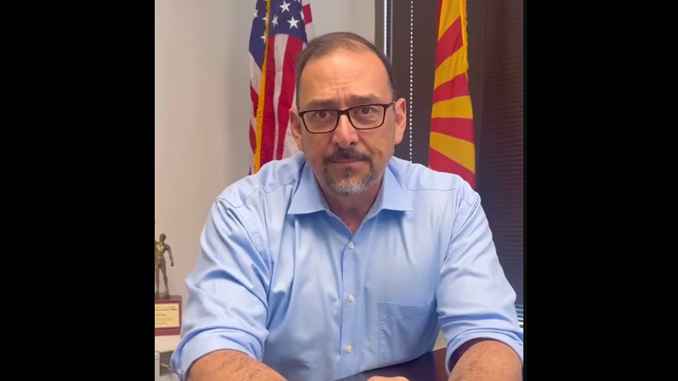
The secretary of state’s office is promoting a website newly launched this year aiming to debunk misinformation concerning Arizona elections.
Secretary of State Adrian Fontes, who has earned a reputation for dispensing misinformation himself, launched the website, arizona.vote, earlier this year ahead of the primary election.
The secretary of state’s office also maintains social media accounts on X, Instagram, and Threads. On these three platforms, the office is posting election-related information aimed at “misinformation inoculation” as part of a new campaign.
Fontes told Capitol Media Services that some among the election systems skeptics and critics are acting based on bad intentions, and not out of genuine concern for election integrity.
“The problem is there are people out there who are motivated to sow distrust even if the little issue that might pop up is minor and easily explained,” said Fontes. “Their goal is to capitalize on mistrust. And our goal is to make sure the public is inoculated against the potential mistrust.”
Fontes’ representation of critical election-related issues has been contested and, in some cases, overruled in court.
Last month, the Maricopa County Superior Court separately ruled that Fontes’ proposed ballot language for Propositions 212 and 145 had violated the law. In both cases, the court found that Fontes’ writing would have misled voters on critical decisions impacting school choice.
The secretary of state stated that the new website offers more than just misinformation debunking, but the remainder of the content only offers links to external webpages on voter registration and verification, ballot tracking, and information on voting and election deadlines.
Since taking office, Fontes has worked to defeat narratives advanced by election skeptics and critics, mainly coming from the Republican Party.
Last month, President Donald Trump issued an address to the nation in which he announced the declassification of documents purportedly revealing “shocking vulnerabilities” opening up the nation’s election infrastructure to hacking and foreign interference. Trump also alleged that members of “the deep state” worked to suppress both public and elected official knowledge of election meddling.
These documents were released by the White House Government Transparency Task Force. In part, the document dump revealed intelligence community assessments that the interference from foreign adversaries had the potential to alter data to prevent voting, delay voting on election day, or force voters to use provisional ballots.
Fontes immediately countered with a statement defending the integrity of Arizona’s election system, and challenged the Trump administration to share what, if any, credible evidence of criminal activity or unlawful voting in Arizona it had found.
“Arizona has some of the strongest election laws in the nation,” said Fontes. “We verify voter eligibility, enforce voter identification requirements, maintain clean voter rolls, protect voters’ personal information, and conduct transparent, auditable elections in partnership with our county recorders.”
Fontes has also defended the practice of mail-in voting. A whistleblower recently alleged that USPS has begun work to implement Trump’s executive order limiting mail voting in spite of a preliminary federal injunction. Fontes filed a declaration in California’s case challenging Trump’s executive order, citing the prevalence of mail voting in the state. Approximately 80% of registered voters receive a mail ballot according to the secretary of state’s latest count.
Along with voicing his opposition to Republican-led election reforms in his official capacity, Fontes has also positioned himself within his reelection campaign as a defender of Arizona elections against skeptics and critics.
Fontes is defending his seat from his opponent, Republican lawmaker Alexander Kolodin, whose is responsible for legislation that is credited for vastly improving the election process this year.
AZ Free News is your #1 source for Arizona news and politics. You can send us news tips using this link.
Pima County and the city of Tucson have entered an agreement to use nearly $1 million in federal funds to provide legal services to those facing evictions.
The council approved the initiative as part of the consent agenda during their regular meeting on Wednesday.
Up to 250 households at risk of eviction may receive legal services through Pima County’s Emergency Eviction Legal Services (EELS) as set forth by an intergovernmental agreement with Pima County. The agreement has a retroactive start date of July 1, 2026.
EELS will rely on $976,399 in federal funds from the U.S. Department of Housing and Urban Development (HUD). Those funds may also cover short-term financial assistance and utility assistance, with the county targeting four neighborhoods with high concentrations of manufactured housing when allocating the funds.
These HUD funds are part of a larger $11.5 million Community Development Block Grant awarded to the city of Tucson through the Preservation and Reinvestment Initiative for Community Enhancement (PRICE), a program launched in December 2024 under the Biden-Harris administration.
While HUD primarily marketed the PRICE program as financial assistance for manufactured housing repair and accessibility, the agency also allowed for funds to go to other services like eviction prevention, housing counseling, and planning activities for transitioning to resident-managed communities. HUD awarded a total of $225 million to 17 applicants, including the city of Tucson, in an announcement last April.
EELS began in March 2021 as a result of the COVID-19 pandemic. The Pima County Board of Supervisors ordered allocation of federal pandemic relief funds to provide free legal services to residents facing eviction.
Per its latest report covering fiscal years 2022-2023, Pima County EELS reported providing services to 6,000 households from 2021 through 2023: 2,048 residents received free legal services and 2,308 rent-assistance payments were made to landlords.
Pima County EELS exhausted its pandemic-relief funds in 2024. With the HUD grant, Pima County has replenished the EELS coffers with more federal funding of a different sort.
According to the intergovernmental agreement establishing the resurrected version of EELS, Pima County will submit a monthly invoice for reimbursement of costs containing a summary report of expenditures by budget line item.
As reported last month, the city of Phoenix is also exploring pathways to continue with their provision of free legal services to residents facing eviction. The city has so far relied on approximately $1.2 million in federal pandemic funds to pilot the Eviction Legal Services program, which is anticipated to continue through June 2027.
The city has also been distributing $3 million in emergency financial assistance since earlier this summer. Certain residents are eligible to receive up to $2,500, which may be spent on a variety of “needs” that city staff loosely define as anything from utilities, rent, and transportation to continuing education or work credentials.
Other counties currently provide similar eviction prevention services rooted in financial aid: Coconino, Gila, and Maricopa counties provide programs to provide funding help for rent and utilities.
AZ Free News is your #1 source for Arizona news and politics. You can send us news tips using this link.
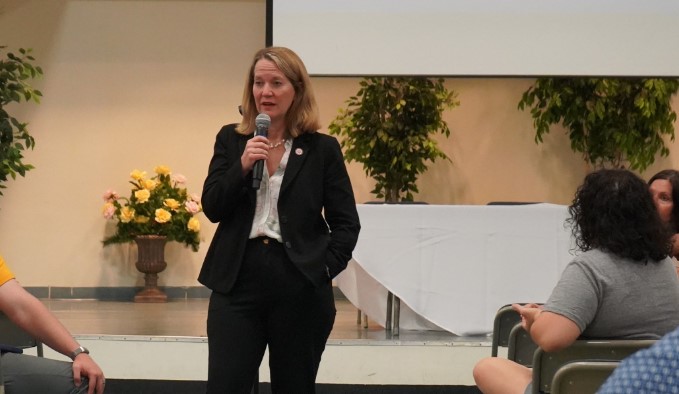
Another campaign finance violation complaint has been filed against Arizona Attorney General Kris Mayes.
This latest complaint concerned a $500 donation from District 14 Democrats in April. State law permits political party committees to contribute to party nominees, but not candidates. At the time of the April donation, well before the July primary, Mayes was a candidate but had not yet become the Democratic nominee.
Although Mayes ran unopposed in her primary, the complaint made the case that she could have faced a write-in candidate.
“A.R.S. § 16-645 permits qualified write-in candidates to compete in a primary election,” stated the complaint. “As a result, even an unopposed candidate has not definitively secured the nomination before the primary election because, at least in theory, a qualified write-in candidate could prevail.”
Timothy La Sota, a Phoenix attorney who filed the complaint, urged Secretary of State Adrian Fontes to respond more urgently to the allegations. La Sota stated that Fontes had taken nearly a month to provide acknowledgment of receipt of a prior complaint he filed against Gov. Katie Hobbs.
Concerning that complaint against Hobbs, filed in July, La Sota said nothing has come of it to his knowledge.
“Please take appropriate action, and in a timely fashion. On the last complaint I filed, against your political ally Katie Hobbs, you took twenty-five days simply to send an acknowledgement of receipt of the complaint,” said La Sota. “Since then I have heard nothing. I hope you act with more urgency here.”
That complaint against Hobbs accused her of illegally commingling millions in funds to subsidize her campaign.
In this recent complaint against Mayes, the attorney general was also characterized as displaying “a pattern of remarkable ignorance of basic campaign finance laws.” Supplementing this claim were two examples of refunds given to individual donors for excess contributions.
“[A]s the attorney for the State of Arizona, [she] clearly should know better,” stated the complaint. “Ms. Mayes was apparently unaware of campaign contribution limits applicable in state law to individual contributors, as she had to refund multiple excess contributions this last cycle[.]”
The complaint cited two instances of similar violations: one in the amount of $3,000, and the other in the amount of $500.
Mayes has raised more than $4.6 million this election cycle for her reelection campaign. Republican nominee Warren Petersen, her general election opponent, has raised more than $1.7 million. Petersen didn’t report receiving any contributions from political parties prior to the primary election.
Since state law requires the referral of substantiated campaign finance violations to the attorney general’s office, the complaint suggested any referral for enforcement actions be made elsewhere.
Another complaint filed against Mayes last month on a separate matter accused her, Hobbs, and Secretary of State Adrian Fontes of engaging in a straw donor scheme.
The campaigns for the three candidates enjoyed a sizable number of donations from donors who reported that they were not employed, tens of thousands of times greater in number than the unemployed donor donations received by their general election opponents across the aisle.
AZ Free News is your #1 source for Arizona news and politics. You can send us news tips using this link.
On a Friday in July 2022, the Department of Justice (DOJ), under President Joe Biden, arrested a man for a bomb threat he’d made a year and a half earlier to the Arizona secretary of state at the time, Katie Hobbs.
According to the DOJ’s public announcement of that arrest, that threat was sent online in mid-February 2021 through the secretary of state’s Elections Division contact form. Yet, it took law enforcement more than a year to nab the perpetrator: a Massachusetts man named James Clark.
Media outlets promptly picked up the news of Clark’s arrest, framing it as the latest in what was then an ongoing scourge of threats to election officials following the contentious 2020 election.
Hobbs was reaffirmed in the public eye as a face of resistance to former President Donald Trump’s purported election denialism. And she was deep into a contentious race of her own for the governor’s office against Trump-backed candidate Kari Lake.
“Election officials across the country are being threatened regularly for doing their jobs,’’ said Hobbs in a prepared statement at the time. “It’s unconscionable and undermines our democracy. This harassment won’t be tolerated and can’t be normalized. We thank the FBI for their persistence on further investigating this incident.”
The one detail that never received much attention was the timing of Clark’s arrest.
On the same day that the DOJ sparked a flurry of media coverage on their delayed arrest of a Trump-defying Democrat’s would-be assassin, a Hobbs campaign operative quietly registered Will of the People, a political action committee (PAC) that would go on to raise more than $5 million from dark money and labor union heavyweights across the nation.
The listed address for the PAC is a virtual office in downtown Phoenix. Its treasurer from day one was Dacey Montoya, founder and president of The Money Wheel, a well-known political and nonprofit compliance firm in Democratic circles. Montoya is currently the treasurer for both Gov. Katie Hobbs’ campaign and Hobbs’ alleged campaign finance fund-washing fund.
Montoya has offered her Money Wheel services to numerous Democratic candidates, party organizations, and progressive dark money operations both in Arizona and nationally over the years. Past clientele include Gov. Katie Hobbs, Secretary of State Adrian Fontes, Rep. Yassamin Ansari, Sen. Mark Kelly, Jevin D. Hodge, Kirsten Engel, Reginald Bolding, Arizona Democratic Party, Maricopa County Democratic Party, Progress Now Arizona/Progress Arizona, Our Voice Our Vote Arizona, Copper State Victory, and the Arizona Education Association.
The Money Wheel has received more than $5.2 million since 2017 at the federal level according to Federal Election Commission records, and more than $1.9 million since 2017 at the state level according to secretary of state campaign finance records. Since 2022, Montoya’s company has received more than $119,000 from the PAC.
Will of the People PAC
Most of Will of the People PAC’s millions came in 2022 and 2024.
$2.3 million from SEIU-UHW and SEIU-COPE, the nation’s largest labor union and a PAC
$1 million from Open Society Action Fund, an organization by the Soros family, who are top Democratic dark money donors
$680,000 from ProgressNow AZ
$600,000 from the National Education Association
$360,000 from the Fairness Project
$200,000 from the American Civil Liberties Union (ACLU) of Arizona
The PAC has not reported any income this year, and the only significant reported expenditures so far have been $8,000 from January through April given to The Money Wheel.
The PAC has spent an undisclosed amount of funding on lawfare to kill Republican-led ballot initiatives; in recent months, they filed two lawsuits to stop Propositions 142 (called the “Prohibit Mandatory Support for Discrimination or Preferential Treatment by Government Entities Amendment”) and 318 (called the “Require All Schools and Athletic Associations to Restrict Sports Participation and Access to Private Spaces Based on Sex Measure”).
Prop 142 would prohibit the state and government agencies from compelling, promoting, or implementing practices rooted in preferential treatment or discrimination based on race or ethnicity.
Prop 318 would restrict access to private spaces like restrooms and locker rooms based on biological sex, bar male students from participating in female sports, and establish a definition of sex rooted in biology.
In the case of Prop 318, the PAC also created a website called “Vote No on Prop 318.” However, per media coverage and the website itself, the PAC is now claiming to be a program under Progress Arizona, a progressive 501(c)(4) nonprofit. This website has not been disclosed under the PAC’s campaign finance reporting as of this report. The PAC’s logo is displayed on the website.
“Will of the People is a program of Progress Arizona,” states the website. “Email info@progressarizona.org. Paid for by Will of the People.”
Concerning the media — as previously reported, the PAC once identified The Arizona Republic as an endorser of their efforts.
It appears that the PAC may have failed to file some of its required expenditure disclosures. Four television advertisements urging Arizonans to vote “no” on Prop 132 (called the “60% Vote Requirement for Ballot Measures to Approve Taxes Amendment”) weren’t reflected in the PAC’s ballot measure expenditures for 2022, because none were issued.
Voters approved Prop 132 in 2022, which established a 60% vote threshold for ballot measures approving taxes.
Will of the People Is Also a Nonprofit
The PAC also has a similarly named nonprofit, “Will of the People Arizona.” The two share a launch year, an address, and leadership.
One of the first leaders of the nonprofit arm, Betsy Boggia, was not listed on PAC documentation. Boggia served as the director/secretary from 2022 through 2024, based on Arizona Corporation Commission records.
Boggia is a League of Women Voters board member and a recent former president of its Tucson chapter, according to her active and up-to-date LinkedIn profile. Notably missing from her work history and posts were any references to her leading a nonprofit that raised more than $5.5 million in three years.
Boggia’s silence on the matter may be explained by the nonprofit’s tax filings, which reported that Boggia spent an average of just one hour per week running the multi-million dollar operation.
Between the nonprofit and PAC, the two apparently affiliated entities have raised and spent approximately $11 million in four years.
The nonprofit didn’t disclose its revenue sources on its available tax filings from 2022, 2023, and 2024. Only four contributions totaling $2.1 million were publicly available through other organizations’ tax filings:
$1 million from Open Society Policy Center in 2024
Only the ACLU provided a detailed explanation for the purpose of their contribution: paid communications to defeat Propositions 128, 129, and 132.
Propositions Targeted by Will of the People PAC and Nonprofit
Based on various sources, the PAC and nonprofit together targeted at least 14 Republican-led propositions from 2022 through this year.
Nine were defeated and five passed. Five are to be determined this year.
The PAC and nonprofit also successfully advocated for the passage of Prop 139 in 2024, which made abortion a constitutional right in Arizona.
On publicly available archived versions of the PAC’s site from 2024 through 2025, the PAC clearly disclosed which propositions it opposed: Props 134, 136, 137, and 139.
Prop 134 would have set a signature distribution requirement in all 30 legislative districts for citizen-led initiatives: 10% for statewide initiatives, 15% for constitutional amendments, and 5% for statewide referenda.
Prop 136 would have allowed individuals to sue to stop voter-proposed initiatives from being put on the ballot if they believe them to be unconstitutional.
Prop 137 would have ended term limits for state supreme court justices and superior court judges.
Then, earlier this year, the PAC changed its website to offer a ballot proposal guide in exchange for donations. The linked donation button led to a donation page hosted by ActBlue Civics, which disclosed that the donated funds would be given to Progress Arizona, a 501(c)(4) nonprofit, not the Will of the People PAC.
In 2024, the PAC disclosed giving $8,000 to Progress Arizona’s policy and research director, Casey Clowes, in 2024 to run digital ads opposed to multiple propositions and in favor of one proposition, Prop 139, which created a constitutional right to abortion.
The PAC has also paid $55,000 to ProgressNow AZ and Progress Arizona PAC, and $706,000 to the Arizona Democratic Party.
The current version of the site as of this report no longer includes the promise of a ballot proposal guide in exchange for fundraising. Instead, the PAC website now urges individuals to endorse a “no” vote on Props 142, 144, 318, and 320.
“A group of power-hungry politicians have voted to put a set of highly deceptive propositions on your ballot this November,” states the present version of the site. “They are aiming to make voting more difficult for Arizonans, hollow out our schools with funding cuts, and institute blanket discrimination in youth sports. You can help stop these propositions by adding your name to the list of Arizonans endorsing a NO vote on these dangerous measures.”
Despite its grassroots-sounding name, Will of the People has been funded by millions of dollars from national labor unions, progressive organizations, and Democratic-aligned dark-money groups, while its leadership and vendors have extensive ties to Arizona’s Democratic political establishment.
The organization has opposed numerous Republican-led ballot measures. With five targeted measures still awaiting a vote, its influence over Arizona’s ballot initiatives remains active heading into November.
AZ Free News is your #1 source for Arizona news and politics. You can send us news tips using this link.