by Staff Reporter | Mar 12, 2025 | News
By Staff Reporter |
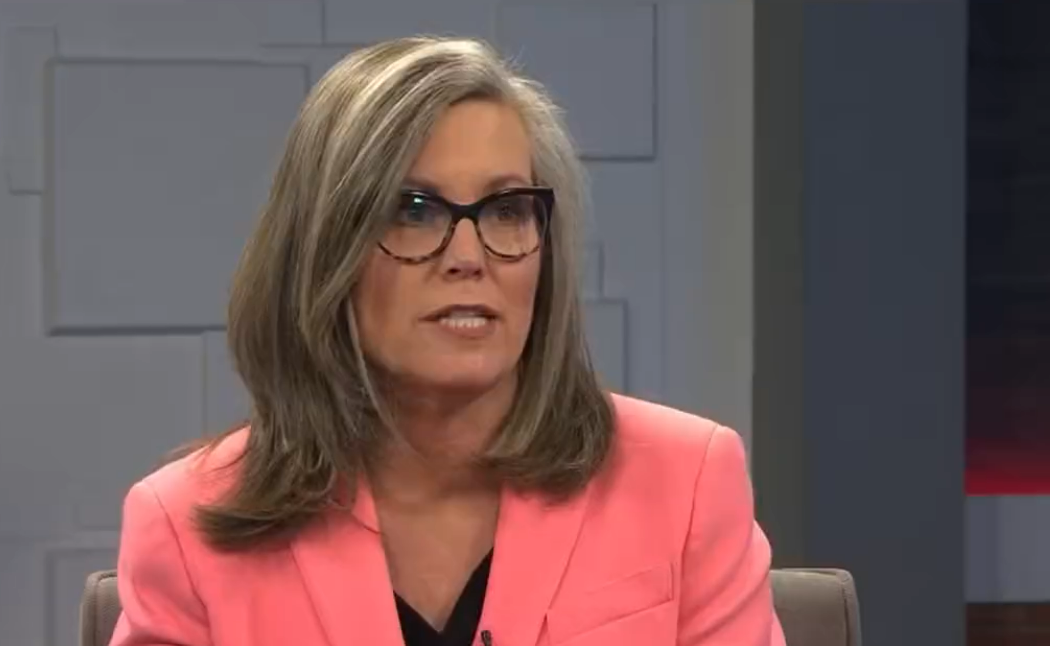
Governor Katie Hobbs, or the staffers running her social media accounts, appear to lack mastery of the vocabulary known to native Arizonans.
The misspelling attributed to Hobbs occurred within a post announcing her support for Read Across America week.
“Reading opens doors, minds, and possibilities,” said Hobbs. “Thanks to the students at Chapparral [sic] Elementary for inviting me to be a part of your Read Across America Week.”
Hobbs visited Chaparral Elementary School and read aloud “A Walk in the Words” by Hudson Talbott to students.
Dan Coulson, former press secretary to Hobbs’ predecessor Doug Ducey, brought attention to the governor’s error.
“Please tell me Katie Hobbs isn’t teaching those kids spelling too!” posted Coulson. “Only one ‘P,’ Katie! It’s literally in the sign right behind you!”
Read Across America Week originated with the National Education Association (NEA) in 1998 through Read Across America Day to encourage childhood literacy. The celebration was originally scheduled to take place on and around the birthday of Theodore Seuss Geisel — more commonly known by his pen name, “Dr. Seuss.” However, the NEA moved away from Dr. Seuss associations with the uproar over a handful of his books deemed racist in recent years: “And to Think That I Saw It on Mulberry Street,” “If I Ran the Zoo,” “McElligot’s Pool,” “On Beyond Zebra,” “Scrambled Eggs Super!” and “The Cat’s Quizzer.” These books are no longer published.
“Chaparral” defines lands predominantly consisting of dense shrubbery at high altitudes. Arizona contains approximately 3.5 million acres of chaparral habitat, or about four percent of the entire state’s nearly 73 million acres. Arizona’s chaparral species include those within the manzanita, acacia, juniper, and shrub live oak families, such as the birchleaf mountain-mahogany, skunkbush sumac, silktassels, hollyleaf buckhorn, cliffrose, desert olive, Palmer oak, Arizona white oak, Emory oak, pinyon pine, juniper, and desert ceanothus. Arizona chaparral also commonly contains succulents and wildlife found commonly within woodland or grassland habitats as well (certain night lizards and sparrows).
Monday’s post served as the latest public misstep by Hobbs.
Earlier this month, a clip of the governor venting her frustrations to the media over her inability to lead or control the state legislature went viral. Hobbs was unable to convince GOP lawmakers of her pick for the Arizona Department of Housing (ADOH). Hobbs’ lamentations to the press were directed at one of the key lawmakers behind rejecting her nominations, State Senator Jake Hoffman. A significant reason for the rejection of Hobbs’ latest pick concerned an auditor general sunset review last fall which reported serious and expensive issues with the ADOH under Hobbs’ nominee. Hoffman criticized Hobbs’ behavior as a “full blown temper tantrum.”
Last month, state legislative leaders confronted Hobbs over the $122 million shortfall within the Arizona State Developmental Disabilities Program. GOP leaders and the state treasurer accused the governor of “gross financial mismanagement.”
In an effort to counteract the struggles of her administration and improve her public image ahead of her reelection bid next year, Hobbs has adopted GOP-leaning policies and stances as of late.
AZ Free News is your #1 source for Arizona news and politics. You can send us news tips using this link.
by Staff Reporter | Mar 9, 2025 | News
By Staff Reporter |
Governor Katie Hobbs vented her frustrations to the media while discussing the latest rejection of another appointment of hers last week.
The day prior, the Arizona Senate voted against Hobbs’ pick, Joan Serviss, to be the director of the Arizona Department of Housing (DOH). In a viral media interview, Hobbs said she had the right to have her appointments confirmed on the basis of her being the governor.
“They’re using her to get this political agenda out that makes no sense. And it holds Arizonans hostage,” said Hobbs. “And if Jake Hoffman, unindicted fake elector Jake Hoffman, wants to decide everyone that gets hired at every state agency, then I welcome him into the governor’s race because that is my job — I get to run state agencies. I won the governor’s race. I get to run state agencies and I get to decide how they’re run and according to the agenda that Arizonans elected me on.”
The subject of Hobbs’ ire, State Senator Jake Hoffman, characterized Hobbs’ remarks as a “full blown temper tantrum.” Hoffman said he wasn’t interested in running for governor, but he did endorse another active candidate, Congressman Andy Biggs.
Serviss blamed partisanship for her rejection, claiming criticisms of her work were “unconscionable and politicized scrutiny.”
“The current political climate at the Legislature, particularly the relentless attacks of public servants like me, creates an environment where, frankly, it’s hard to imagine how qualified individuals stepping up to lead a state agency can endure what amounts to a political circus,” said Serviss in a LinkedIn post. “At the end of the day, whether I hold the Director title or not, I’m still a leader in the fight to end homelessness and address our state’s affordable housing crisis.”
The auditor general also discovered in a sunset review last October that, during Serviss’ first year with ADOH as its cabinet executive officer and executive deputy director, the agency transferred $2 million to scammers posing as an existing nonprofit organization ADOH coordinated with to purchase property for affordable housing. The transfer took place in June 2023 but ADOH didn’t discover the fraud until that December. ADOH also failed to notify the auditor general in the time frame required by statute, and then took nearly 80 days to respond to requests for information from the Arizona Department of Administration. The state covered the $2 million loss with its self-insurance (other state funds).
The auditor general also determined in its summary ADOH “lacks a comprehensive process to evaluate program performance” for the over $1 billion it oversees in housing funds, therefore “limiting its ability to ensure and demonstrate its programs are effectively addressing the state’s housing problems[.]”
The Senate previously found Serviss unfit to lead ADOH, but for different reasons. In September 2023, the Senate rejected Serviss based on her alleged plagiarism perpetrated while leading the Arizona Housing Coalition.
Serviss had served in the role of ADOH director since last September. She now serves as deputy director.
AZ Free News is your #1 source for Arizona news and politics. You can send us news tips using this link.
by Staff Reporter | Mar 9, 2025 | News
By Staff Reporter |
The Arizona Court of Appeals ruled against the Elections Procedures Manual (EPM) produced by Secretary of State Adrian Fontes.
Judge Lacey Gard reversed and remanded a lower court decision dismissing the case, Republican National Committee, et al. vs. Adrian Fontes, et al., last summer. Gard ruled the EPM fell under the Arizona Administrative Procedure Act (APA), a “plain reading” of the statute contrary to what the lower court ruled. Gard also dismissed Fontes’ arguments for his right to not comply with the APA because the APA and EPM statutes conflict.
“[The APA] unambiguously states that all agencies are subject to the APA’s rulemaking procedures unless ‘expressly exempted,’” stated Gard. “The APA and EPM statutes impose duties on the Secretary that may require him to begin promulgating the EPM earlier, but they are not inconsistent, do not directly conflict, and do not create impossible barriers to complying with both.”
Gard further ruled Fontes violated the APA by not allowing public comment on the proposed EPM for the full 30 days, instead only opening up review for 15 days.
Gard noted at the end of her ruling that she wouldn’t address other claims by the Republican National Committee challenging eight specific provisions of the EPM, since she arrived at the conclusion that Fontes’ promulgation of the 2023 EPM failed to “substantially comply” with requirements set forth by the APA for the rulemaking process.
The Republican Party of Arizona (AZGOP) sued Fontes over the EPM last February, along with the Arizona legislature leadership at the time (Senate President Warren Petersen and then-House Speaker Ben Toma) and the Arizona Free Enterprise Club. In a statement on Thursday’s ruling, the AZGOP claimed the appeals court found the EPM to be unconstitutional.
AZGOP Chair Gina Swoboda said the ruling confirmed the extent of the unlawfulness of Fontes’ EPM in the Thursday statement. Swoboda characterized Fontes and his EPM as an attempt “from the radical left to illegally assume control” of Arizona elections.
“This opinion from the court shows just how much Secretary Fontes and his allies in the Governor’s and Attorney General’s offices overreached in their partisan efforts to hijack our elections through this blatantly political manual,” said Swoboda. “As we have highlighted to the court, the most-recent elections manual contained many provisions that ran utterly contrary to Arizona law, giving the Democrat machine a clear advantage at the ballot box for years to come.”
Beyond the lack of compliance with APA, GOP leaders’ objections to the Fontes EPM concerned conflicts with state election law: accepting voters who declared themselves noncitizens on juror questionnaires; allowing voters who failed to submit or couldn’t achieve verification of their Documentary Proof of Citizenship (DPOC); allowing first-time, federal-only voters to provide only an ID and not DPOC for mail-in voting; not requiring county recorders to check federal databases for citizenship reviews; restricting public review of voter signatures on mail ballots; allowing Active Early Voting List voters to receive ballots outside the state for certain elections; requiring denial of early ballot challenges received prior to the return of an early ballot; and allowing out-of-precinct voters to cast provisional ballots.
AZ Free News is your #1 source for Arizona news and politics. You can send us news tips using this link.
by Staff Reporter | Mar 8, 2025 | News
By Staff Reporter |
One Arizona town recently pledged cooperation with Immigration and Customs Enforcement (ICE).
On Tuesday, the town of Fountain Hills passed a resolution (6-1) pledging cooperation with ICE’s mass deportation efforts under the Trump administration.
The resolution cited the existence of over 647,000 illegal immigrants with pending charges or convictions for violent crimes within the U.S. as justification for the town’s support.
“[T]he Town remains steadfast in its commitment to protecting the safety and well-being of its residents, particularly those most vulnerable to criminal activities such as human trafficking and drug distribution,” stated the resolution. “[T]he Town will continue to comply with all applicable federal and state laws, recognizing that there can be conflicts between federal and state laws.”
The resolution also committed the town to not becoming a sanctuary town as others in the state have done, and pledged to seek assistance from the U.S. Attorney General’s office to indemnify the town and employees for any assistance or cooperation provided to federal immigration authorities.
According to a press release also issued on Tuesday, Fountain Hills Town Council member Allen Skillicorn drafted and introduced the resolution. Skillicorn cited his past experience as an Illinois state lawmaker as the impetus for presenting the policy.
“Not long ago I was a state legislator. I had to solve problems, both present and in the future,” Skillicorn said. “My commitment is to our town and keeping our town safe from crime.”
The resolution didn’t pass unanimously.
Councilwoman Peggy McMahon questioned whether Skillicorn was accusing town council members, staff, and community members of impeding law enforcement. McMahon further alleged the resolution would encourage racial profiling.
“Are you saying they’re not doing their job in enforcing the laws? Are you implying the town and the sheriffs are not committed to cooperating with enforcing laws to protect the health, the welfare, and the safety of our community?” asked McMahon. “Accordingly, the resolution to me is moot and legally unenforceable. So I don’t even know why we’re talking about it.”
McMahon also argued that illegal immigrants were responsible for just a small fraction of crimes committed in their town and the state as a whole.
Councilman Brenda Kalivianakis, who voted for the resolution, asked why the resolution was necessary. Kalivianakis criticized the resolution as another “time-sink” designed to further other council members’ political careers and not the town’s priorities.
“This seems like a solution looking for a problem. This isn’t a problem we have in this community. It seems like a case of just virtue signaling. Here I am, I’m going to lead the way on DEI and all these nationally divisive issues and then I’m going to appear in some small newspaper tomorrow and be called a hero,” said Kalivianakis. “Why are we talking about things that don’t matter?”
During the same meeting on Tuesday, the town council passed a resolution (5-2) banning Diversity, Equity, and Inclusion (DEI) and the usage of gender identity-based pronouns.
AZ Free News is your #1 source for Arizona news and politics. You can send us news tips using this link.
by Staff Reporter | Mar 6, 2025 | News
By Staff Reporter |
Legal experts are concerned over Attorney General Pam Bondi’s pick for Interim Attorney for the United States Attorney’s Office for the District of Arizona.
The Justice Department (DOJ) announced the swearing in of Timothy Courchaine on Monday, effectively opting for an internal promotion to the assistant U.S. attorney of nearly five years rather than bringing in new leadership. Bondi appointed Courchaine last week.
The appointment came shortly after the termination of the former U.S. Attorney Gary Restaino, appointed to the position by President Joe Biden in November 2021. Restaino’s term earned a general reputation for not accomplishing as much as possible.
An insider at the Arizona legislature expressed concern to AZ Free News that this selection would continue the status quo within the legal world, not prompt greater activity or usher in the desired overhaul of an office scrutinized for its caseload in recent years.
“The U.S. attorney’s office here in Arizona has earned a reputation for being ineffective and deliberately so. You cannot clean it up from the inside. You must have someone come in and see just what a mess it is,” said the source. “Anyone who has been on the inside and who has not publicly come forward to talk about what a disaster it is does not deserve to lead the place.”
Cleaning house within the DOJ was one of the clear mandates set forth by President Donald Trump.
“Over the past four years, the Department of Justice has been politicized like never before,” posted Trump on TruthSocial. “Therefore, I have instructed the termination of ALL remaining ‘Biden Era’ U.S. Attorneys. We must ‘clean house’ immediately, and restore confidence. America’s Golden Age must have a fair Justice System — THAT BEGINS TODAY!”
Prior to joining the United States Attorney’s Office for the District of Arizona, Courchaine clerked for Arizona Supreme Court Justice William Montgomery. Courchaine began his career with the Arizona Attorney General’s Office back in 2015 as a special projects manager prior to joining the Marine Corps as a judge advocate and attaining the rank of captain. Courchaine was also a Blackstone Legal Fellow for the Claremont Institute’s Center for Constitutional Jurisprudence before clerking for Biola University’s Office of General Counsel.
As the interim Arizona district attorney, Courchaine supervises prosecution of all federal crimes and litigation of all civil matters in which the U.S. has an interest. The DOJ reported that Courchaine leads a staff of about 350 prosecutors, civil litigators, and support personnel across the state. The office also handles one of the larger Indian Country dockets in the nation, serving as the felony prosecutor for nearly all the 22 federally recognized tribes within the state.
The DOJ also credited Courchaine with the handling of cases concerning border crimes and Mexican-based cartels.
Per reporting from the Arizona Daily Independent, potential appointees to the permanent slot include Tim La Sota, Dennis Wilinchek, Jennifer Wright, Anthony Martin, James Rogers, and potentially former Arizona Supreme Court Justice Andrew Gould.
AZ Free News is your #1 source for Arizona news and politics. You can send us news tips using this link.