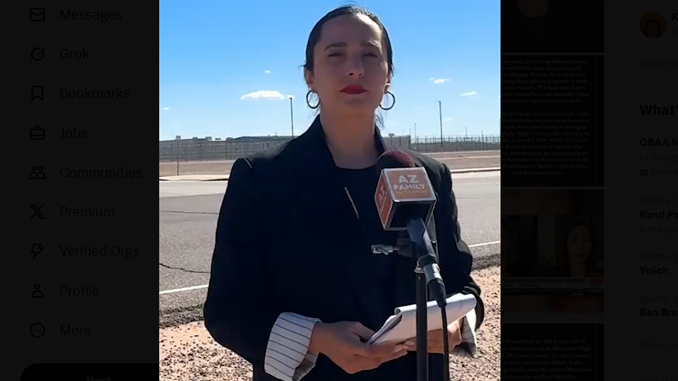
A media mouthpiece for the Islamic regime is praising Rep. Yassamin Ansari (D-AZ-03) for her actions in support of Iran.
Ansari was featured on the front page of an Islamic Republic newspaper, Sazandegi, for her efforts to resist President Donald Trump’s approach to Iran.
🚨 The regime is now openly promoting a NIAC-aligned American congresswoman.
Yassamin Ansari is being praised by an Islamic Republic newspaper, Sazandegi, for opposing U.S. pressure on the regime – pushing no real pressure, no regime change, just “diplomacy” that keeps it in… pic.twitter.com/7ZrpV6cvcd
The congresswoman filed Articles of Impeachment against Secretary of War Pete Hegseth earlier this month. (This title is Hegseth’s preferred alternate, authorized in an executive order last September as an unofficial secondary title; along those lines, the “Department of War” is another option for “Department of Defense.”)
In a statement, Ansari accused Hegseth of high crimes and misdemeanors against Iranians. She also accused Hegseth of abuse of office and undignified conduct, unlawful military actions, and unauthorized disclosure of classified information.
Ansari’s parents came to the U.S. from Iran. As many did, Ansari’s father overstayed a student visa to escape the Islamic Revolution. That visa was initially awarded to him in the early 1970s to attend the University of Oregon for engineering.
Ansari’s mother came approximately a decade later; Ansari told The Guardian that her mother entered as a citizen since her grandfather had completed a medical residency in the U.S. several decades prior. One of Ansari’s grandfathers was imprisoned by the regime, Ansari told The New York Times.
Ansari also told The Times that she desires a secular democracy for Iran. She has condemned the present regime for its terrorism and treatment of women.
“I can say wholeheartedly: I want to see an actual democratic state, a secular state, a state where the people have decided who their leader is,” said Ansari. “Ultimately, I do think there needs to be an internationally monitored referendum, free and fair elections, because Iran is also a very diverse country. There’s 90 million people, and it’s not just Persians. There’s, you know, Armenians, Kurds. There’s different Jews, Baha’is, Muslims. Many people are secular. There’s got to be a coalition, and there’s got to be a model that is representative of everyone.”
Despite those remarks and her parents’ backgrounds, Ansari has proven through her resistance to Trump and stalwart defense of Iran to be a favorite of the Islamic regime.
The National Iranian American Council (NIAC) and Public Affairs Alliance of Iranian-Americans (PAAIA), both pro-Iran lobbyist groups, endorsed Ansari throughout her campaign for Congress.
Ansari has voiced continual opposition to U.S. involvement in the ongoing conflict in the Middle East.
In an interview with The Guardian several weeks ago, Ansari called Trump a mentally ill, evil man that deserved to be removed from office over dragging the U.S. into the war.
“There is no doubt in my mind he is mentally unstable and not all there but I also believe he is a deeply troubled, evil human being that only cares about himself and his family,” said Ansari. “He has shown that throughout his entire life. He has shown that throughout his presidency by ripping away healthcare and basic necessities from the average American, while he and his family have made billions of dollars.”
AZ Free News is your #1 source for Arizona news and politics. You can send us news tips using this link.
A Pima County supervisor wants the sheriff out of office after details of his past misconduct came to light.
Pima County Supervisor Matt Heinz is accusing Nanos of “perpetrat[ing] a fraud” on the Pima County community for decades. Heinz has been calling for Nanos’ ouster for over a month now.
Nanos, no stranger to controversy, came under fire again for his alleged mishandling of the investigation into the apparent kidnapping of Nancy Guthrie, 84. Guthrie disappeared from her Tucson home nearly three months ago. As of this report, no leads about her kidnapper(s) have been made public.
Doubts over his administration of the high-profile disappearance prompted further scrutiny into Nanos’ past. The Arizona Republic reported on records indicating that Nanos falsified his resume in order to be hired by the Pima County Sheriff’s Department (PCSD) over 40 years ago.
Nanos is accused of failing to disclose the alleged misconduct that led to his resignation while working for the El Paso Police Department in New Mexico back in the 1980s.
Nanos received 37 days of suspension or leave for eight misconduct incidents, ranging from poor behaviors to violence. One incident yielded a 15-day suspension for allegedly beating a handcuffed robbery suspect seated in the back of a cop car with a flashlight.
According to reports, it was that latter incident that caused the El Paso Police Department to be sued and forced Nanos to resign in 1982 in lieu of termination. However, Nanos claimed on his resume that he left the El Paso Police Department in 1984.
“He’s a bad cop. He made really bad decisions, and then lied about his past to convince then-Pima County officials to hire him back in 1984. He also lied about that gap in time. He used to say 1982,” said Heinz in an interview with NewsNation. “We shouldn’t even know his name. We should not know the name Nanos.”
Sheriff Chris Nanos, who is overseeing the investigation into Nancy Guthrie’s disappearance, faces renewed scrutiny from local officials who are reviewing his past suspensions while working as a cop in El Paso, Texas. “He’s a bad cop. He made really bad decisions and then lied… pic.twitter.com/4ZDIbEKlx6
PCSD said in a press release issued last month that the date discrepancies were “administrative in nature” and weren’t part of an intentional effort to mislead or misrepresent Nanos’ work history.
Heinz also accused Nanos of holding a grudge against the Federal Bureau of Investigations (FBI) over a 2015-2016 investigation into his department over the possible misuse of around $500,000 in Racketeer Influenced and Corrupt Organizations (RICO) funds. That investigation ended up costing Nanos his chief deputy, who was indicted, and ultimately the sheriff’s race.
“He has held a grudge against the FBI and refused to fully work with them going forward,” said Heinz.
Heinz said it was possible this potential personal grievance by Nanos had jeopardized Guthrie’s case.
Nanos’s attorney, James Cool, said in a statement that the sheriff’s past has no bearing on his present conduct.
“Whatever the Sheriff did or did not do before being elected is necessarily unrelated to his performance of the duties of his office,” stated Cool.
During their next meeting (May 12), the Pima County Board of Supervisors plan to review a report submitted by Nanos answering questions about his employment history and current administration. The board has entertained considerations of removal proceedings, but hasn’t made any final decisions.
AZ Free News is your #1 source for Arizona news and politics. You can send us news tips using this link.
The housing moratorium crippling new construction in the Valley imposed by Gov. Katie Hobbs’ administration may not go on for much longer.
The Maricopa County Superior Court struck down the moratorium on Tuesday in Home Builders Association of Central Arizona v. Arizona Department of Water Resources, et al.
Under Hobbs, the Arizona Department of Water Resources (ADWR) issued new groundwater regulations rolled out in November 2024 dubbed the “Unmet Demand Rule” and the “Depth-to Water Rule.”
Per the court, these rules went impermissibly beyond the longstanding obligation for builders outlined in Arizona law, which required assurance of sufficient groundwater supply in order for each development to take place (100 years’ worth).
ADWR imposed the rules based on a groundwater model claiming that unmet demand and exceedance of the 1,000-foot depth-to-water limit existed throughout Phoenix. In other words, their regulations meant a developer seeking a certificate for one subdivision had to answer not just for their development area, but for the water status of the entire Valley. This resulted in ADWR’s indefinite suspension on granting certificates to any developers.
The consequence of these regulations brought new home construction to a halt throughout Maricopa County. The Home Builders Association of Central Arizona (HBACA), a trade association for the residential construction and development industry, challenged ADWR’s authority to impose new rules.
ADWR attempted to style the Unmet Demand Rule as a new implementation of an old rule, but the Maricopa Superior Court Judge Scott Blaney rejected that view as an undoing of the necessary limitations of administrative agency powers.
“‘To permit this would neuter all statutory limits on agency rule-making[,]’” stated Blaney in his ruling, quoting HBACA’s argument.
Blaney also found that ADWR didn’t follow state law on agency rulemaking under the Administrative Procedures Act. Blaney invalidated both rules.
“ADWR acted unlawfully by implementing two agency rules without first complying with the mandatory provisions of the APA[,]” wrote Blaney.
The Arizona Free Enterprise Club (AFEC) called the court ruling a win and criticized ADWR’s model justifying the overturned regulations as flawed.
“The Maricopa County Superior Court has struck down the Hobbs Administration’s attempt to impose a sweeping housing moratorium based on its flawed water model — a stinging loss for Katie Hobbs and a ruling that the state failed to follow proper legal procedures,” stated AFEC. “This is a major victory for transparency, accountability, and Arizona homeowners.”
🚨BREAKING🚨: The Maricopa County Superior Court has struck down the Hobbs Administration’s attempt to impose a sweeping housing moratorium based on its FLAWED water model—a STINGING LOSS for Katie Hobbs and a ruling that the state failed to follow proper legal procedures.
Jonathan Riches, vice president for litigation and general counsel for the Goldwater Institute, represented the Home Builders Association of Central Arizona. Goldwater Institute’s vice president for legal affairs, Timothy Sandefur, hailed the ruling as a necessary check on an administrative state attempting to impose greater burdens than that which the law requires.
“The case is also a reminder of the dangerous power that the pervasive ‘administrative state’ wields over our daily lives — as unelected and unaccountable bureaucracies exert authority over every detail of construction, business, and property ownership, to cite just a few examples,” said Sandefur. “The only solution to the arbitrariness and lawlessness of these agencies is to rein in their power — and for courts to ensure that they obey the law.”
AZ Free News is your #1 source for Arizona news and politics. You can send us news tips using this link.
The coalition behind a ballot initiative to roll back the universality of Arizona’s school choice program is facing a campaign finance complaint.
On Thursday, the Protect Education Accountability Act Now Committee (PEANC) was made subject to a complaint, reviewed by AZ Free News. PEANC was accused of falsely claiming that out-of-state contributors amounted to a mere nine percent of funding.
PEANC filed the ballot initiative, “Protect Education Act” last month. If approved, the initiative would impose an income cap on enrollment in the Empowerment Scholarship Account Program, among other restrictions to include an elimination of funding rollover. The Protect Education Act superseded an earlier version, the “Protect Education, Accountability Now Act.”
In order to make the ballot, the initiative will need nearly 256,000 signatures. PEANC reported gathering over 150,000 signatures during a virtual press conference on Friday.
The complainant, Jack Johnson Pannell, cited a disclaimer posted to the bottom of PEANC’s website. That disclaimer reflects PEANC’s total out-of-state contributors account for only nine percent of its total funding.
Arizona law requires political action committee advertisements to disclose the aggregate percentage of out-of-state contributors as calculated at the time the advertisement was produced for publication, display, delivery, or broadcast.
Pannell’s complaint called for a declaration that PEANC violated Arizona campaign finance disclosure law and an action against the committee.
Pannell said on X that Arizona families deserve the truth behind PEANC. Pannell is the founder of Trinity Arch Prep School for Boys, a microschool.
“More than 100,000 families are choosing great options for educating their children,” said Pannell. “It’s a cheap shot to accuse hardworking people of cheating the system. It just ain’t true.”
I’m proud to file this complaint because AZ families deserve the truth. More than 100,000 families are choosing great options for educating their children. It’s a cheap shot to accuse hardworking people of cheating the system. It just ain’t true. #schoolchoicehttps://t.co/FFz9MkTWLh
Contrary to this disclaimer, campaign finance records reveal that 98 percent — $4.5 million, or nearly all of PEANC’s $4.6 million in funding — have come from special interest groups in Washington, D.C.
That $4.5 million came from the National Education Association in four allotments delivered throughout February and March. The first payments from the NEA (over $2.3 million) came on February 13 — exactly a week after PEANC registered their website domain.
The earliest available archived version of the site captured on February 12 reflected an out-of-state contributions disclosure totaled at 50 percent.
Other major donors included the Arizonans For Quality Education ($50,000), Nita and Phil Francis ($25,000), and Arizona Education Association ($10,000).
99 percent of AFQE’s funding has come from “shadow sponsors”: unnamed corporations and LLCs. The remainder of the funding, less than half of a percent, came from Christopher Kotterman on behalf of the Friends of ASBA.
Kotterman became a senior policy advisor for Gov. Katie Hobbs in late 2024.
Phil Francis is the retired chairman and CEO of PetSmart; Nita Francis formerly chaired the Valleywise Health Foundation board.
Correction: A previous version of this story incorrectly listed Justan Rice as the current chairman of Arizonans For Quality Education (AFQE). Rice left AFQE in June 2025 before the donation to PEANC was made.
AZ Free News is your #1 source for Arizona news and politics. You can send us news tips using this link.
With Arizona’s legislative session scheduled to close this week, small business owners are still left in a lurch over a lack of tax conformity.
Twice this year Gov. Katie Hobbs has vetoed legislation that would have provided full conformity in the tax code with the One Big Beautiful Bill Act passed last summer. The governor maintains that the best path forward would not be full conformity, but rather partial.
Gov. Hobbs wanted the Republican-led legislature to get on board with the Democratic minority’s Middle Class Tax Cuts Package.
The Arizona Free Enterprise Club, a free market policy organization, said Hobbs’ preferred conformity package would require Arizonans to file taxes twice and increase taxes by $200 million.
File your taxes twice. Pay more. Welcome to Katie Hobbs’ Arizona.
After vetoing two full conformity bills, Hobbs helped turn what should have been a routine tax update into a full-blown mess in the middle of filing season. Her administration issued forms based on full… pic.twitter.com/eS5n6tiWfm
That threat of double-filing, per Senate President Warren Petersen (R-LD14), has been mitigated because the tax forms sent out by the state aligned with what the Republicans brought to the table (and Hobbs rejected).
Prior to the first veto, the Arizona Department of Revenue issued its advice on filing under the new changes to federal tax law.
Republican leadership in the legislature urged Arizonans to file their taxes, promising to not support any conformity package that would effectively “punish Arizona taxpayers” and require refiling.
“For tax year 2025 we will not support anything that forces Arizonans to refile,” said Petersen.
“Any outcome that requires you to amend your return or pay more is a nonstarter,” said House Speaker Steve Montenegro (R-LD29).
Gov. Hobbs justified her vetoes under the claim that Trump’s One Big Beautiful Bill would require poorer Arizonans to shoulder more of the tax burden.
“We should not hold tax cuts for over 88 percent of Arizonans hostage in order to force through tax breaks for special interests,” said Hobbs. “Other questions of tax conformity must be decided through budget negotiations, following the precedent set by Governor Ducey.”
Sen. Petersen rejected Hobbs’ view of the federal tax changes.
Petersen dismissed Hobbs’ claim as “a nice talking point” that ignored what he says is the reality of how the federal legislation impacts an overwhelming majority of the state’s business transactions.
“That’s just not true,” said Petersen. “We’re talking about tax on tips, we’re talking about tax on car interest loans, we’re talking about no overtime. These are not rich people. These are small business owners. 90 percent of business transactions are small business owners.”
“It’s a nice talking point, but it’s really not true.”
Arizona Senate President Warren Petersen joined @AZMorningNews to push back on Gov. Katie Hobbs after she vetoed Arizona tax conformity and tax-cut bills tied to federal changes.
Chad Heinrich, Arizona director of the National Federation of Independent Business (NFIB), toldThe Phoenix Business Journal that the lack of conformity will cause increased taxes on over 700,000 small businesses in Arizona. Heinrich blamed Hobbs.
“Not conforming with the key business provisions is, in practical effect, a tax increase on the Arizonans who can least absorb it — those who own and operate Arizona’s small businesses,” said Heinrich. “The Legislature has done its part. Governor Hobbs should finish the job, now, before one more small business owner has to guess about their future.”
AZ Free News is your #1 source for Arizona news and politics. You can send us news tips using this link.