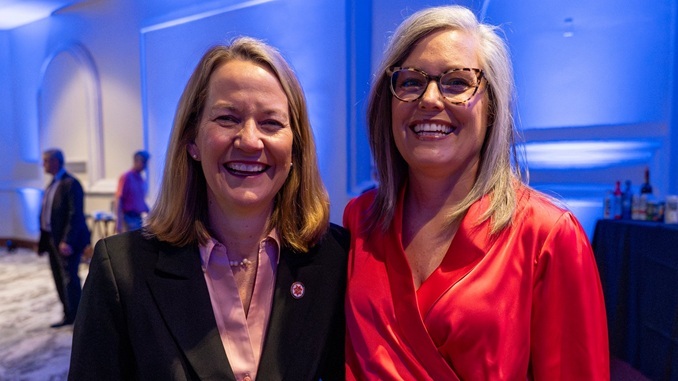
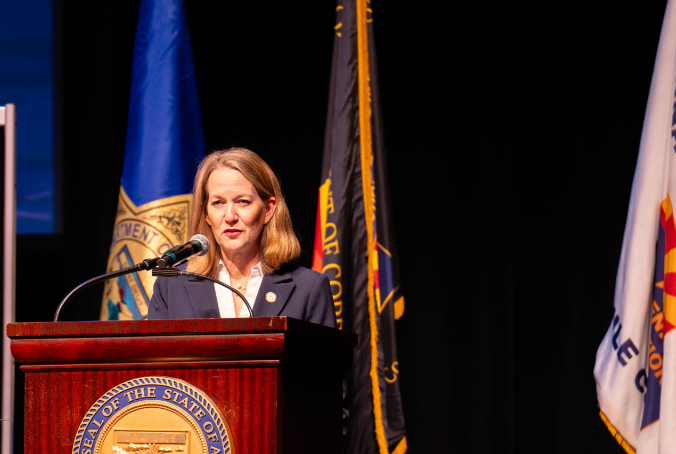
The Arizona Republican Party is questioning why Attorney General Kris Mayes hasn’t taken action against her fellow Democrat, Gov. Katie Hobbs, over an alleged pay-to-play arrangement.
Mayes is investigating Hobbs over allegations that she awarded a unique rate increase by the Department of Children Services (DCS) to Sunshine Residential Homes, a group home operator, following sizable donations to her gubernatorial campaign and the Arizona Democratic Party. Mayes asked to interview Hobbs this week, but it appears the governor may decline that invitation.
Republican support for Mayes investigating Hobbs has been a whiplash; certain lawmakers and state leaders contended it was best for Mayes to recuse herself given their close party ties.
Hobbs spokesman Christian Slater told the Arizona Republic that Hobbs declined to comment on her decision to sit for an interview. Slater said the lack of evidence proving Hobbs’ knowledge of the rate increase meant there was no proof of her guilt.
Sunshine Residential Homes donated more than $400,000 to Hobbs and the Arizona Democratic Party. After Hobbs took office, DCS awarded the operator a 30% rate increase. Officials say the details of DCS actions surrounding the rate increase were suspicious: no other group homes received rate increases; other group homes’ rate averages fell below Sunshine Residential Homes; and DCS ended state contracts with 16 group homes.
In a new statement released on Wednesday, the Arizona Republican Party called on Mayes to keep up the pressure on Hobbs by putting aside any political favoritism. The party also urged the governor to cooperate with investigators.
The party’s chairman, Sergio Arellano, said Hobbs’ actions were consistent with corruption.
“Governor Hobbs has spent years lecturing Arizonans about ethics while her own administration was allegedly steering millions in taxpayer dollars to a generous donor,” said Arellano. “The fact that her campaign manager was dining with the contractor’s CEO as the deal was finalized only adds to the stench of a pay-to-play scheme that puts special interests ahead of Arizona’s most vulnerable children in state care. Hobbs owes the people of Arizona full transparency and cooperation with this criminal probe, not more stonewalling and self-serving denials.”
The Republican-led Arizona House launched an independent investigation into the pay-to-play allegations earlier this year. They are working with Mayes and Maricopa County Attorney Rachel Mitchell on the investigation; Mayes and Mitchell began investigating nearly two years ago.
The results of the legislature’s investigation will go to the advisory team created in the aftermath of 2024 investigative reporting that outlined the alleged pay-to-play scheme. The advisory team will coordinate the parallel investigations from Mitchell and Mayes to work out a conclusion on the matter.
Hobbs derided the legislative investigation in a statement to The Center Square as the “same old partisan games” by “extremist legislators” spreading misinformation. The governor has repeatedly denied any involvement with the DCS decision.
“I’m looking forward to the conclusion of this investigation which I know will show what reporting has confirmed that I was not involved in the decision and that DCS acted in the best interest of Arizona’s foster children,” said Hobbs in a Tuesday statement.
AZ Free News is your #1 source for Arizona news and politics. You can send us news tips using this link.
Arizona Superintendent of Public Instruction Tom Horne is pleading with the state legislature to approve an additional $40 million for school safety.
Horne said in a Monday press release that those proposed millions are just the minimum that hardly reflects the outsized need on Arizona’s campuses for security.
Superintendent Horne said the latest deadline for school safety grant requests yielded a demand of over 800 counselors or social workers and over 700 officers. He said the funding needed to fulfill the cost of these requests would amount to nearly $187 million.
Under Horne’s administration, the number of armed officers under the School Safety Program (SSP) grew from just over 100 to nearly 500—nearly five times the size in just three years. SSP determines the distribution of resources through competitive, state-funded grants lasting three-year cycles.
Horne said that the best model for the SSP is to have officers present to work alongside the certified mental health counselors. There are nearly 600 counselors and social workers that work alongside the nearly 500 armed officers at over 1,100 locations statewide.
There are over 1,500 district public schools and over 500 public charter schools in the state. Over 1 million students attend these schools, and nearly 60,700 educators that teach in them.
The average SSO salary according to the fiscal year 2027 FAQ runs at about $157,000.
“If the funding isn’t there to provide for them, and then a tragedy happens in one of those schools, that would be a terrible occurrence,” said Horne. “Any school that asks for a police officer should be able to get one to defend the students, to defend the staff and the teachers.”
Superintendent Horne cited the recent near-tragedy that occurred in Oklahoma earlier this month. An unarmed high school principal, Kirk Moore, confronted and stopped an adult former student, Victor Lee Hawkins, who was attempting to shoot up the school. Moore survived the encounter with a gunshot wound to the leg; no fatalities occurred.
He also cited the 2012 tragedy out of New England, where another principal made a similar attempt to stop a gunman and lost her life in the infamous Sandy Hook Elementary School shooting. An elementary school principal, Dawn Hochsprung, was shot and killed by gunman Adam Lanza as she confronted him.
Both cases, Horne says, justified his argument that every Arizona school requires an armed officer to prevent injuries or deaths.
“My biggest nightmare is that an armed maniac gets onto a school campus and kills people. Just a few weeks ago, a heroic principal in Oklahoma subdued an armed gunman at a school and was wounded in the process. While we praise his actions, having unarmed teachers be the first line of defense is not acceptable,” said Horne.
Horne said that current law will ensure those 500 armed officers remain funded, but that no new funding will mean no additional officers and, further, will mean a loss of funding for the nearly 600 counselors and social workers.
AZ Free News is your #1 source for Arizona news and politics. You can send us news tips using this link.
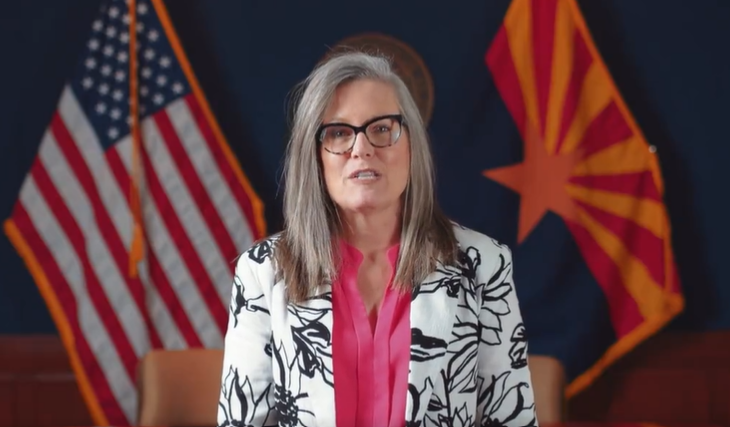
On Monday, House Republicans put forth what they called a balanced budget of $17.9 billion.
By Tuesday, Gov. Katie Hobbs said the proposal was all but dead.
The leaders of both chambers characterized their budget as uniquely reflective of total conformity with federal tax law — no other states adopted the entire slate of tax cuts — which Hobbs doubted could be accomplished. They estimated tax relief would amount to $1.5 billion over the next three years, and Republicans claim working families would feel the most benefit from the cuts.
“Politics are easy; governing is harder. We chose governing,” said Sen. President Warren Petersen (R-LD14). “We’re moving a budget that cuts taxes, funds core services, shrinks government, includes priorities both sides have raised, and gives Arizona a full path to finish the session.”
As budget talks have failed to progress in a meaningful way, the legislature stagnates under the weight of a bill moratorium.
In a statement issued Tuesday, Hobbs did acknowledge Republicans for working with her to adopt certain components of her preferred budget like middle class tax cuts and reductions to childcare cost. However, she disputed Republican leaders on their claims of fiscal responsibility.
She accused Republicans of siding with “billionaires, data centers, and special interests” as well as “kicking Arizonans off their healthcare and taking food off their tables.” The governor said she won’t engage in negotiations further unless they adopt her preferred budget.
Contentious aspects of the Republican-proposed budget included cuts to state agency budgets, and SNAP and Medicaid program funding.
“Until they also engage in good-faith negotiations rather than attempting to force through a partisan budget, I will be closely monitoring the situation in the coming days to determine whether the legislative majority is willing to negotiate in good-faith bipartisan negotiations and have the bill moratorium lifted,” said Hobbs.
NEW: @GovernorHobbs reacts to the newly released Republican budget: “Just like in Washington, they’re paying for tax breaks for billionaires, data centers and special interests by kicking Arizonans off their healthcare and taking food off their tables.” pic.twitter.com/8UlFIqa5S1
Hobbs also discussed the budget talks during a press conference for a separate topic on Tuesday, Reentry 2030. Hobbs tentatively praised Republicans for some concessions on their part, but generally was critical of them for balking at her $18.7 billion spending plan. A key part of that plan Hobbs hopes to win through in budget talks concerns draining the public land trust to boost K-12 education funding.
“I’m glad to see the Republicans have shown their budget proposal, there’s some things I’m encouraged about in their proposal, but across-the-board agency cuts is not one of them,” said Hobbs. “I’m hopeful that we can get back to the table and start having real conversations about a budget that works for Arizona.”
Legislative leaders have said Hobbs’ proposal is a nonstarter because the Public Land Trust was intended for long-term funding. Hobbs’ plan intends to renew funding through the yet-approved Proposition 123. Senate President Petersen said Hobbs’ plan wasn’t feasible and would push the state $1.5 million further into debt.
“We’re spending about $800 million less than what the governor has proposed, and the governor has proposed to raise taxes,” said House Speaker Montenegro (R-LD29) in an interview with Fox News.
“[H]er math doesn’t work,” said Petersen.
Hobbs has vetoed tax conformity efforts and walked away from budget negotiations multiple times since the start of the year.
The legislature began hearing budget bills on Tuesday during a joint hearing of the Senate and House Appropriations Committees.
AZ Free News is your #1 source for Arizona news and politics. You can send us news tips using this link.
Rep. Andy Biggs (R-AZ-05) introduced legislation this week to create stronger rules on court-ordered federal oversight of police.
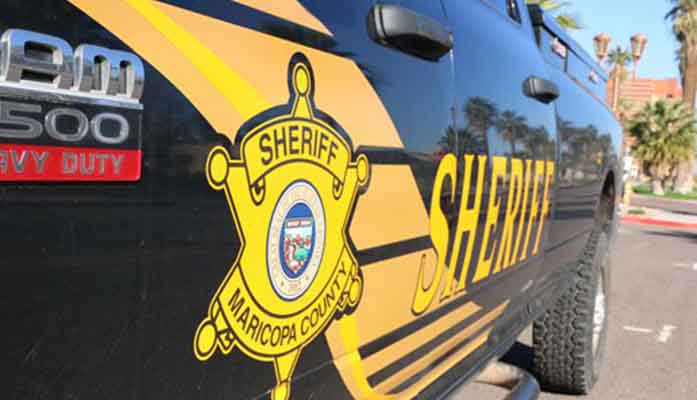
The proposed bill is a direct response to the ongoing monitorship of the Maricopa County Sheriff’s Office (MCSO), which began well over a decade ago following racial profiling allegations under the administration of former Sheriff Joe Arpaio.
Biggs’ Monitor Accountability Act would further limit federal district courts’ discretion on monitor selection and duration.
The bill as written would limit monitors to five years of service, prohibit courts from reappointing the same monitors under the same court order, prohibit monitors from coming from the same law firm or employer, cap monitor compensation and encourage courts to require pro bono or reduced-cost work, require public comment on proposed monitors prior to court appointment, limit extensions of monitorship to those without substantial and sustained compliance, and require case reassignment to a different judge after six years.
Additionally, the Monitor Accountability Act would apply retroactively to monitorships older than six years. This would ensure Maricopa County — Biggs’ impetus for the bill — secures a new monitor and judge.
The costs associated with the monitorship have neared $350 million according to Biggs and the county, about a tenth of which has gone to the court-appointed monitor and his firm. Proponents of continued monitorship counter that the actual cost of the monitorship amounts closer to $60 million.
Biggs, who is running to unseat Gov. Katie Hobbs this November, released a statement claiming that the MCSO monitorship, among others, has become exploitative.
“The federal monitor’s continued existence in our county and propensity for moving the goalposts from his original charge only serves to exploit taxpayers and undermine the brave work of the men and women who serve our communities — and this is only one of dozens of similar arrangements across the country,” said Biggs. “It’s time for Congress to take back the reins from rogue judges and monitors who have exceeded appropriate bounds.”
Cochise County Sheriff Mark Dannels joined Biggs’ statement with support for the bill as a corrective measure to prevent further exploitation of the monitor system.
“We’ve seen this problem first-hand in Arizona: Maricopa County has been the victim of a rogue monitor for more than 13 years, costing taxpayers hundreds of millions of dollars and shifting resources away from keeping the community safe,” said Dannels.
The Maricopa County Board of Supervisors filed a motion to end the monitorship last December, and in February testified to a House Judiciary Committee hearing on their effort in court. Biggs led that subcommittee hearing.
The board has pleaded for relief from what it claims to be indefinite taxpayer spending to keep up with ever-moving goalposts.
The Goldwater Institute has also requested the court to publicize the invoices associated with MCSO’s monitorship.
“[T]he government should not be allowed to keep such information secret unless there’s good reason, and even then, they’re required to specify what those reasons are,” stated the organization’s vice president of legal affairs, Timothy Sandefur.
The Department of Justice, who initially filed the lawsuit under former President Barack Obama along with the ACLU, signaled support for an end to MCSO’s monitorship.
AZ Free News is your #1 source for Arizona news and politics. You can send us news tips using this link.
Attorney General Kris Mayes is suing to stop the construction of a new Immigration and Customs Enforcement (ICE) detention facility in Surprise.
Mayes announced the lawsuit on Friday. The Department of Homeland Security (DHS) plans to renovate a vacant warehouse it purchased in January for about $70 million into an immigration detention facility.
Mayes also hosted a press conference to announce the lawsuit. Present with her were Senate Assistant Minority Leader Catherine Miranda (D-LD11) and State Sen. Analise Ortiz (D-LD24).
Mayes claimed the federal government failed to hold public forums and conduct the proper environmental reviews.
The attorney general also argued the federal government needed permission prior to acting on this immigration enforcement initiative.
“The federal government did not ask the people of Surprise whether they wanted this,” said Mayes. “They did not ask the parents of the students that attend any of the schools near this site if they were okay with this. They did not ask the firefighters and paramedics, who would be the first to respond if something went wrong, if this was a good idea.”
Mayes accused the Trump administration of violating federal laws, to include the National Environmental Policy Act (NEPA) and the Administrative Procedures Act (APA).
“The Trump administration has run roughshod over federal law in its rush to expand detention capacity across the country,” said Mayes. “The federal government did not ask the people of Surprise whether they wanted this facility in their backyards. They simply bought a warehouse, handed a $300 million contract to a private company and told the City to deal with it.”
The city of Surprise issued a public statement saying the DHS purchase of the facility was news to them. The city also emphasized that it didn’t have the power to assist or interfere with federal immigration enforcement.
“The City was not aware that there were efforts underway to purchase the building, was not notified of the transaction by any of the parties involved and has not been contacted by DHS or any federal agency about the intended use of the building. It’s important to note, Federal projects are not subject to local regulations, such as zoning,” said the city. “When it comes to immigration enforcement, local law enforcement does not enforce federal immigration laws; Surprise Police Department enforces local and state laws. While we do not participate in ICE operations, we also cannot interrupt or prevent their operations.”
The lawsuit filed in the Arizona District Court alleges the facility is unsuitable for mass detainment based on claims that the location lacks the appropriate water and wastewater infrastructure, and the location exists across the street from a chemical storage facility as well as two public schools.
Several hundred followed up the attorney general’s lawsuit with a protest over the weekend. An ICE spokesperson said in a statement that they had evaluated the use of existing facilities to minimize potential impacts on the environment, including protected species, natural resources, and cultural resources.
“Let’s be honest about what is happening. This isn’t about the environment,” said the spokesperson. “It’s about trying to stop President Trump from making America safe.”
AZ Free News is your #1 source for Arizona news and politics. You can send us news tips using this link.