Congressman Juan Ciscomani (R-AZ-06) has once again been ranked as Arizona’s most bipartisan member of Congress, earning an “A” grade and a 97.5 Bridge Score in the latest Bridge Grades report evaluating members of Congress.
The score, based on data through June 30 2026, places Ciscomani among the top 20 most bipartisan members of the entire House. His 97.5 score is more than double the House average of 44.9.
Bridge Grades, a nonpartisan project of the Mediators Foundation, evaluates members of Congress based on how collaboratively or divisively they govern.
The organization uses third-party data examining legislative records, bipartisan bill sponsorship and co-sponsorship, public statements, rhetoric, and other measures of congressional collaboration.
According to the organization, “bridgers” are lawmakers who build bipartisan consensus and coalitions, while “dividers” pursue more partisan approaches to governing.
For Ciscomani, the latest recognition marks the second consecutive time he has received an “A” grade from the Bridge Grades.
“Getting results for Arizona families means working with anyone willing to find solutions, regardless of party,” stated Ciscomani. “I was sent to Congress to deliver common-sense, lasting results for Arizonans, and I will keep fighting to deliver real, tangible outcomes for our local communities. This recognition again reflects the hard work of my team and our commitment to ensuring Southern Arizona has a seat at the table in Washington.”
Ciscomani’s bipartisan ranking comes alongside his record of legislative activity during the 119th Congress.
According to data cited by the congressman, he has introduced 32 bills, with 10 passing the House of Representatives, as well as bringing tens of millions of dollars in federal investment back into Arizona.
The congressman has also been recognized for his legislative effectiveness. The nonpartisan Center for Effective Lawmaking previously ranked Ciscomani as the most effective member of Arizona’s congressional delegation during the 118th Congress.
As a member of the House Appropriations and Veterans’ Affairs Committees, Ciscomani has focused on issues including national security, veterans’ services, border security, Arizona’s water resources, and federal investments in local communities.
The latest Bridge Grades recognition adds another national bipartisan distinction to Ciscomani’s record as he prepares for another general election campaign in Arizona’s Sixth Congressional District, where he faces Democratic nominee JoAnna Mendoza.
“Voters who want lower costs, safer communities and funding for local priorities trust Representative Juan Ciscomani to break through the D.C. noise and get results,” stated NRCC Spokesperson Ben Petersen. “But far-left lobbyist Joanna Mendoza would jeopardize Arizonans’ priorities for her extreme agenda, raising taxes and risking their safety.”
“Working down the aisle” has remained a central theme of Ciscomani’s congressional record with his office pointing to bipartisan legislation, federal funding for Arizona communities, and legislation addressing issues ranging from veterans and critical mineral to economic development.
Ethan Faverino is a reporter for AZ Free News. You can send him news tips using this link.
The Joint Economic Committee released its Monthly Inflation Update for July 2026, showing that consumer prices continued to rise, while real earnings remained mostly steady during the month.
According to the report, the headline Consumer Price Index for All Urban Consumers (CPI-U) increased 0.07% from June to July and rose 3.36% over the previous year.
Core CPI, which excludes food and energy prices, increased 0.22% in July and was up 2.48% from July 2025.
Energy prices declined 1.48% in July but remained significantly higher than a year earlier, with energy price inflation increasing 14.73% over the past 12 months. Food prices increased 0.08% during July and were up 2.98% compared with July 2025.
CPI-U increased 0.07% in July & rose to 3.36% over the past year. Core CPI increased 0.22% & rose to 2.48% over the past year. Energy price inflation was down by 1.48% in July & was up 14.73% over the past year. Food price inflation rose 0.08% & was up 2.98% over the past year.…
— Joint Economic Committee Republicans (@JECRepublicans) August 12, 2026
Inflation also varied across the country. Annual headline CPI inflation was highest in the Northeast at 4.1%, followed by the Midwest at 3.5%. The South recorded annual inflation of 3.2%, while the West had the lowest rate among the four regions at 3.0%.
The inflation report comes less than a week after a disappointing jobs report that showed the U.S. economy unexpectedly lost 23,000 jobs in July. Economists had expected employers to add jobs during the month.
The Bureau of Labor Statistics also sharply revised employment gains for May and June downward by a combined 103,000 jobs, providing a weaker picture of the labor market than previously reported.
The July employment report also showed an unemployment rate of 4.1%, down slightly from June. However, the decline was accompanied by a reduction in labor-force participation, while employment fell in areas including local government, education, and retail trade sectors. Healthcare continued to trend upward.
The combination of persistent inflation and signs of a weakening labor market leaves the Federal Reserve facing a difficult balancing act as it considers its next interest-rate decision.
The Federal Reserve previously voted 9-3 to maintain the benchmark interest rate, and the latest inflation and employment data could further reduce pressure on the central bank to raise rates at its September meeting.
While inflation remains above the Fed’s 2% target, the weaker-than-expected jobs numbers and downward revisions to previous employment gains could give policymakers additional reason to exercise caution.
The Federal Reserve will receive another round of inflation and employment data before its September meeting, giving policymakers a final set of economic data to consider as they weigh continued price pressures against growing signs of a cooling labor market.
The July report also examined changes in workers’ real earnings, which account for the effects of inflation. For all employees on private, non-farm payrolls, real average weekly earnings decreased 0.02% from June to July, while real average hourly earnings declined 0.09%.
Among production and nonsupervisory employees on private non-farm payrolls, real average weekly earnings increased 0.06% during the month. Real average hourly earnings for the group remained unchanged, with a net change of 0.00%.
Ethan Faverino is a reporter for AZ Free News. You can send him news tips using this link.
A Maricopa County Superior Court judge has ruled that Secretary of State Adrian Fontes’ proposed ballot language for Proposition 145 violates Arizona law, blocking Fontes from using the language on the November ballot.
The ruling came in a lawsuit filed by Arizona House Speaker Steve Montenegro (R-LD29) and Senate President Warren Petersen (R-LD14), who challenged the ballot language for the proposed constitutional amendment concerning Empowerment Scholarship Accounts (ESA) for children of military families.
Montenegro and Petersen alleged that Fontes’ proposed language improperly characterized Proposition 145 by informing voters that approving the measure would also nullify Proposition 212, a separate ballot initiative that would make changes to Arizona’s ESA program.
Petersen and Montenegro sought an injunction preventing Fontes from using the proposed descriptive title and “yes/no” language on the official ballot.
Fontes’ proposed language stated that a “yes” vote would amend the Arizona Constitution to “nullify Proposition 212, which imposes spending and income limits” on ESAs.
Maricopa County Superior Court Judge David McDowell ruled that the language did not comply with A.R.S. § 19-125(D), which requires ballot descriptions to explain the effect a measure would have on existing law.
“The reference to Proposition 212 in the title and the ‘yes/no’ language is not a reference to existing law,” McDowell wrote in his ruling.
Because Proposition 212 is a proposed initiative that voters will consider in November, rather than an existing law, McDowell determined that Fontes could not include a reference to its potential nullification in the official ballot language for Proposition 145.
The court therefore enjoined the Secretary of State from using the proposed title and “yes/no” language for Proposition 145 on the official ballot.
Ethan Faverino is a reporter for AZ Free News. You can send him news tips using this link.
Congressman Juan Ciscomani (R-AZ-06) applauded two major announcements he said further solidify Arizona’s position as a national leader in copper production and critical minerals. The announcements include a $1 billion investment in the Ivanhoe Santa Cruz Copper Project near Casa Grande and $180 million in grants to strengthen mining education programs, including at the University of Arizona.
✅$180 MILLION to strengthen mining education, including at @uarizona.
Arizona has the resources, workforce, and expertise to lead America’s mining future 🇺🇸 ⛏️ pic.twitter.com/lDPDKuWmtv
— Congressman Juan Ciscomani (@RepCiscomani) August 7, 2026
Arizona is home to some of the world’s largest copper deposits, as well as an abundance of other critical minerals essential to the nation’s energy, manufacturing, defense, and technology sectors.
The University of Arizona is consistently ranked among the nation’s top mining engineering programs and reports a 100% job placement rate for its graduates, helping prepare the workforce needed to meet growing demand for domestic mining and mineral production.
Two Arizona mining and eduction leaders attended the announcements at the White House and praised the investments.
Kray Luxbacher, Executive Director and Head of the School of Mining Engineering & Mineral Resources at the University of Arizona, highlighted the significance of the investment in mining eduction.
“This was a historic investment in American mining engineering schools, and we’re really grateful, said Luxbacher. “I also want to say thank you for what you’ve already done toward accelerating permitting for mining in the United States. It’s really been unbelievable.”
Proud to see Kray Luxbacher representing the University of Arizona's world-class mining program at the White House today!
UofA's leadership in mining education is second to none and today's federal investment in developing the workforce will power America's future. Thank you,… https://t.co/qvLJt1BQar
— Congressman Juan Ciscomani (@RepCiscomani) August 7, 2026
Vicky Peacey, President and General Manager of Resolution Copper, also praised the administration’s efforts to revitalize the domestic mining industry.
“Mr. President, you have brought mining back to America, single-handedly,” said Peacey.
Ciscomani called the announcements a landmark investment in Arizona’s mining industry and workforce.
“From a $1 billion investment in the Santa Cruz Copper Project to $180 million to strengthen mining education, including at the University of Arizona, these are major wins for Arizona,” said Congressman Ciscomani. “Arizona is leading America’s effort to produce the critical minerals our economy and national security depend on.”
“These once-in-a-generation investments by President Trump and the administration will create good-paying mining jobs, strengthen our workforce, and train the next generation of miners and engineers right here in Arizona,” added Ciscomani. “I am proud to see Arizona’s local leaders Vicky and Kray at the table. They are leaders in this industry and this is a transformational moment for Arizona and America’s mining future.”
Ciscomani has made strengthening America’s domestic critical materials supply chain a legislative priority.
He championed the Critical Mineral Consistency Act (H.R. 755), legislation designed to align the Department of Energy’s and U.S. Geological Survey’s separate lists of critical minerals and materials, making copper a critical mineral.
The legislation would establish a more consistent federal framework for identifying critical minerals, with the goal of reducing regulatory uncertainty, streamlining permitting, attracting investments, and accelerating domestic mining and processing projects.
For Arizona, the legislation could help facilitate the development of copper projects by ensuring federal agencies use consistent standards when determining which minerals qualify as critical.
Ethan Faverino is a reporter for AZ Free News. You can send him news tips using this link.
U.S. Representative Eli Crane (R-AZ-02) spent the last week of July traveling across Arizona’s Second Congressional District, meeting with constituents, educators, ranchers, business leaders, and local officials while highlighting legislative priorities ranging from agriculture and energy to education and public lands.
The weeklong tour included stops in Douglas, Show Low, Holbrook, Williams, Camp Verde, and other communities where Crane promoted recent federal investments, discussed ongoing policy initiatives, and gathered feedback from residents on issues affecting rural Arizona.
One of the week’s most significant announcements came Wednesday, July 29 in Douglas, where Crane joined fellow Republican Representatives Andy Biggs (AZ-05) and Juan Ciscomani (AZ-06) alongside Secretary Brooke Rollins as the U.S. Department of Agriculture (USDA) unveiled a $25 million investment to construct a new sterile fly production facility in Douglas.
The project is intended to strengthen the nation’s defenses against the New World screwworm, a destructive livestock pest that has prompted growing concern among ranchers across the Southwest.
The announcement followed a letter signed by Crane, Biggs, and Ciscomani along with Rep. David Schweikert (R-AZ01) and Rep. Paul Gosar (R-AZ09), urging the USDA to modernize the Douglas facility to improve the nation’s long-term response capabilities.
Following the announcement, the congressmen toured livestock inspection facilities at the Douglas Port of Entry, which is scheduled to re-open to livestock trade on August 24th after preparations aimed at safeguarding American agriculture.
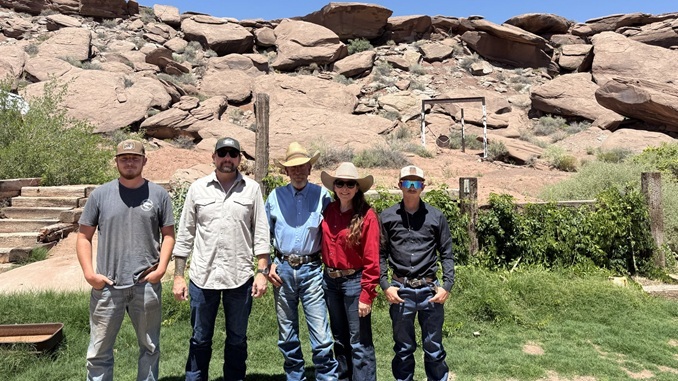
Crane later traveled to Show Low, where he visited Linden Valley Arena, a well known destination within Arizona’s roping community that has been owned and operated by the Perkins family since 2010.
The following morning, Crane addressed teachers and staff with the Show Low Unified School District ahead of the upcoming school year, sharing lessons on leadership and teamwork drawn from his experience as a Navy SEAL and small business owners.
He also thanked educators for their commitment to students while highlighting what he described as a recent legislative victory for rural schools.
Last year, Crane helped build congressional support for a three-year reauthorization of the Secure Rural Schools program, legislation that was ultimately signed into law and continues funding for education and essential county services in communities located near national forests throughout Arizona’s Second Congressional District.
After leaving Show Low, Crane visited Northland Pioneer College in Holbrook, where he met with administrators to discuss the college’s Commercial Driver’s License (CDL) program.
The visit coincided with the Trump administration’s recently announced Freedom Haulers Initiative, a federal effort designed to expand career opportunities for veterans entering the trucking industry.
Crane praised the initiative while recognizing the college’s work to strengthen workforce development through its CDL program.
Later that day, Crane met with the Murph family at H Bar and Y Ranch in Holbrook. The Murph family, whose cattle operation pre-dates Arizona statehood, faces uncertainty over long-held Arizona State Land Department grazing leases because of a proposed solar development by a foreign company.
Crane said he has been working behind the scenes to help resolve the dispute. The meeting also followed last month’s signing of a memorandum of understanding between the USDA and the Small Business Administration (SBA) establishing cooperation between the USDA Lawfare Portal and the SBA’s Office of National Ombudsman.
The agreement is intended to ensure complaints from farmers, ranchers, and agricultural producers alleging legal harassment are investigated and resolved.
According to the USDA, the Lawfare Portal has received more than 400 complaints from 47 states over the past two years.
Crane also toured the Cholla Power Plant, which stopped burning coal in March 2025 after more than six decades of operation. Arizona Public Service is pursuing plans to convert the facility to natural gas, a transition expected to generate approximately 380 megawatts of capacity while preserving jobs and maintaining reliable power generation for the region.
On Saturday, August 1, Crane attended the annual Coconino County Farm Bureau and Cattle Growers Association banquet in Williams, where he updated attendees on several legislative priorities pending before Congress.
Among the measures discussed was the House-passed Farm Bill which includes Buy American requirements for school meal programs, increased reporting requirements for agricultural land purchases by foreign adversaries, and strengthened farm credit and crop insurance programs.
Crane also highlighted his amendment intended to accelerate recovery efforts following the White Sage Fire, while noting his support for proposals removing pesticide liability protections and ensuring compensation for livestock losses caused by Mexican wolves.
The measures seek to improve forest management through expanded technology and reduced litigation while accelerating reconstruction efforts at the Grand Canyon’s North Rim following the Dragon Bravo Fire. Both bills have passed the House but remain pending in the Senate.
The congressman’s final stop took him to Camp Verde, where he met with ranchers to discuss ongoing concerns involving the U.S. Forest Service.
Crane said he is developing legislation aimed at simplifying fence repairs following natural disasters while also addressing what he characterized as abuses of the Equal Access to Justice Act.
The district also received additional federal infrastructure support during the week as the U.S. Department of Transportation awarded more than $5 million in airport improvement grants throughout Arizona’s Second Congressional District.
The funding Includes:
Bagdad: $90,389 for design work to expand terminal parking.
Chinle: $339,000 to reconstruct aircraft apron pavement.
Cottonwood: $536,876 to reconstruct portions of Taxiway A.
Page: $679.031 for design of a new aircraft rescue and firefighting facility.
Springerville: $443,000 to construct a new taxilane serving future hanger development.
Prescott: $2.97 million to construct a new aircraft storage hanger designed to improve airport self-sufficiency.
ICYMI – The @USDOT awarded more than $5 million to improve airport infrastructure in #AZ02.
The latest awards follow additional federal grants announced last month totaling approximately $10 million for improvements at Polacca Airport and Coolidge Municipal Airport.
Reflecting on the week’s events, Crane emphasized the importance of maintaining close ties with constituents while Congress remains out of session.
“Last week, I had the privilege of visiting with constituents, industry leaders, and remarkable institutions within Arizona’s Second Congressional District,” said Rep. Crane. “While there is much work to be done in Washington, D.C., it’s refreshing to get back home and meet face to face with the people I’m honored to represent. I look forward to building on these relationships and delivering principled and effective solutions for all Arizonans.”
Ethan Faverino is a reporter for AZ Free News. You can send him news tips using this link.