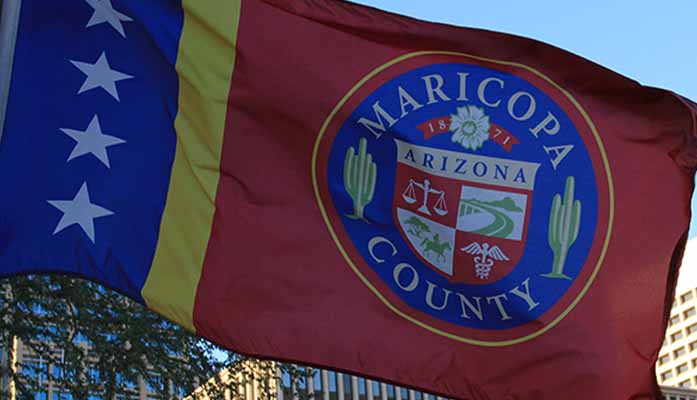
The Maricopa County Board of Supervisors unanimously approved a new policy this week, prohibiting county employees from using confidential, nonpublic information obtained through their public service to personally profit from prediction markets.
County officials said the policy is intended to strengthen public trust by ensuring government decisions are made in the best interest of residents rather than for personal financial gain.
Maricopa County officials also said the measure makes the county the first major county in the United States to adopt a formal policy specifically addressing prediction markets.
Public employees often have access to sensitive information before it becomes publicly available. Under the newly adopted resolution, county employees are prohibited from using or disclosing nonpublic information to profit from, avoid losses in, or assist others in profiting from prediction markets.
Violations of the policy may result in disciplinary action, including termination, and may also be referred to law enforcement.
The resolution builds upon existing Arizona law, including A.R.S. § 38-504(B), which prohibits public officers and employees from using or disclosing confidential, nonpublic information obtained through their official duties.
County leaders noted that prediction markets allow participants to wager on the likelihood of future events across a wide range of topics, including government actions, elections, politics, military conflicts, weather events, wildfires, sports, and other state, national, and global affairs.
The resolution states that the public’s confidence in government is undermined when officials use privileged information learned through public service for personal financial benefits.
Arizona law already prohibits wagering on the outcome of elections. Under A.R.S. § 16-1015, knowingly making, offering, accepting, or participating in a bet or wager on any contingency arising from an election before or during the election is classified as a class 2 misdemeanor.
In addition to prohibiting the use of nonpublic information for financial gain, the Board’s resolution formally designates such information as confidential, where it has not already been classified as such.
The policy also clarifies that it does not create new legal rights or remedies, does not conflict with federal or state law, and does not alter the statutory authority of any elected office or county department.
The policy applies to all Maricopa County employees, including those working in appointed departments, the Flood Control District of Maricopa County, and the Maricopa County Library District.
The resolution took effect immediately upon its unanimous approval by the Board of Supervisors and will remain in force until it is repealed, replaced, or rescinded.
Ethan Faverino is a reporter for AZ Free News. You can send him news tips using this link.
Congressman Abe Hamadeh (R-AZ-08) was recognized last week by the Institute for Legislative Analysis (ILA), receiving the organization’s Defender of Limited Government Award for his voting record in Congress.
The award was presented by ILA Chief Executive Officer Ryan McGowan and President Fred McGrath in recognition of Hamadeh’s support for what the organization described as the limited government principles of the U.S. Constitution.
According to the ILA, Hamadeh earned an A+ rating with an overall score of 86%, exceeding the projected district estimate of 81%.
The freshman congressman also received perfect scores in several policy areas including energy, national security, free speech, healthcare, and government accountability.
Congratulations to @RepAbeHamadeh on earning ILA's Defender of Limited Government Award!
His voting record reflects a commitment to constitutional limited government and a more accountable, responsive federal government. By demanding accountability in Washington, he's standing… https://t.co/ImupOKolmD
— Institute for Legislative Analysis (@leganalysis) July 24, 2026
“The Institute for Legislative Analysis is proud to present Congressman Abraham Hamadeh with the Defender of Limited Government Award for a voting record closely aligned with the limited government principles of the U.S. Constitution,” announced Ryan McGowan.
McGowan praised Hamadeh’s work during his first term in Congress, highlighting his focus on national security, public safety, government accountability, and improving access to benefits and support for veterans.
“We especially appreciate his work to improve veterans’ access to the programs and support they have earned, while demanding a federal government that is more responsive, accountable, and focused on results,” added McGowan. “Congressman Hamadeh and the team he has assembled deserve credit for standing with taxpayers, service members, veterans, and Arizona families who expect Washington to do its job and stay within its proper limits.”
Hamadeh said the recognition reflects the principles he pledged to uphold when elected to represent Arizona’s Eighth Congressional District.
“It is an honor to receive the Defender of Limited Government Award,” said Congressman Hamadeh. “The people of Arizona’s Eighth District elected me to defend the Constitution, protect their freedoms, and stand against government overreach. I will continue fighting for policies that preserve individual liberty, strengthen our economy, secure our border, and ensure that our government remains accountable to the people, not the other way around.”
Ethan Faverino is a reporter for AZ Free News. You can send him news tips using this link.
The U.S. Attorney’s Office for the District of Arizona announced that it filed immigration-related criminal charges against 310 individuals during a week of enforcement operations conducted between July 18 and July 24, 2026.
According to federal officials, prosecutors filed 114 cases involving individuals accused of illegally re-entering the United States after removal and charged another 175 individuals with illegally entering the country.
The office also brought 20 human smuggling cases against 21 individuals accused of transporting illegal aliens into and throughout Arizona.
The cases were investigated or supported by several federal law enforcement agencies, including U.S. Immigration and Customs Enforcement’s Enforcement and Removal Operations (ICE-ERO), Homeland Security Investigations (ICE-HSI), U.S. Border Patrol, the Drug Enforcement Administration (DEA), the Federal Bureau of Investigation (FBI), the U.S. Marshals Service (USMS), and the Bureau of Alcohol, Tobacco, Firearms, and Explosives (ATF).
Among the cases highlighted by the U.S. Attorney’s Office was that of Rubicel Nunez-Sanchez, who was charged by criminal complaint on July 20 with Transportation of an Illegal Alien for Profit.
According to documents, Border Patrol agents observed Nunez-Sanchez driving a Ford F-150 with North Carolina license plates near the U.S.-Mexico border in the San Rafael Valley, an area known for human smuggling activity.
When agents attempted to conduct an immigration inspection, officials said Nunez-Sanchez failed to stop. After eventually pulling over, five passengers reportedly fled from the vehicle before Nunez-Sanchez drove away again.
Border Patrol agents later disabled the truck using a vehicle immobilization device and took him into custody.
Authorities subsequently located the five passengers, identified as citizens of Mexico and Columbia who were allegedly unlawfully present in the United States.
Federal prosecutors also announced charges against Jose Raul Ahumada-Lugo and Rony Ramirez-Valenzuela following a July 21 traffic stop conducted by the Pinal County Sheriff’s Office.
According to investigators, a deputy stopped Ahumada-Lugo while he was driving a Ford F-150 carrying four passengers. After observing camouflage clothing and backpacks inside the vehicle, the deputy requested assistance from Border Patrol agents.
Officials determined that all five occupants were Mexican citizens unlawfully present in the United States.
Ramirez-Valenzuela, who was riding in the front passenger seat, was additionally charged with Reentry of a Removed Alien after authorities determined he had previously been removed from the United States in August of 2017.
Federal officials alleged he was assisting in the transportation of the other passengers.
The enforcement actions are part of Operation Take Back America, a nationwide Department of Justice initiative aimed at combating illegal immigration, dismantling cartels and transnational criminal organizations, and prosecuting individuals accused of violent crimes and human smuggling.
Ethan Faverino is a reporter for AZ Free News. You can send him news tips using this link.
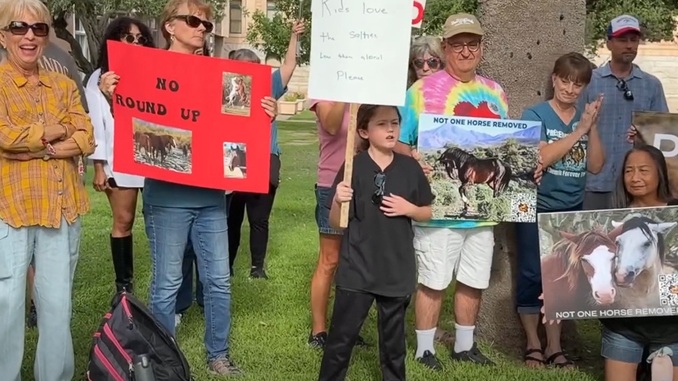
Approximately 100 wild horse advocates gathered at the Arizona State Capitol last week to urge Governor Katie Hobbs and the Arizona Department of Agriculture (AZDA) to pause planned removals of Salt River wild horses until an independent scientific review confirms the remaining herd will remain genetically healthy and self-sustaining.
The “Preserve the Herd — Follow the Science” rally brought together conservation advocates, elected officials, wildlife experts and supporters from across Arizona who argued that the state’s current management plan should be guided by independent scientific analysis before any permanent removals occur.
Under AZDA’s current management plan, the Salt River wild horse population would be reduced from approximately 271 horses today to between 120 and 125 by the end of 2030 through continued fertility control and permanent removals to sanctuaries.
Advocates said they support responsible management of the herd but contend that the proposed population target has not been supported by publicly available, independent scientific research.
“Today was not about opposing responsible management,” stated Susie Bell of Friends of the Salt River Wild Horses. “It was about demanding that irreversible decisions be supported by credible, independent science. Arizona should not remove a single healthy horse until the public is shown that the remaining herd will be genetically viable.”
Wildlife ecologist and author Craig C. Downer, who has studied the Salt River herd and its habitat, cautioned that reducing the herd to the proposed level could permanently affect its long-term health.
“It would be a big mistake for Arizona to reduce this herd to 120 horses without independent science showing that the population can remain genetically healthy and self-sustaining,” Downer said. “The total number of horses does not necessarily reflect the herd’s true reproductive strength. Managers must consider how many unrelated breeding animals would remain, whether family lines are adequately represented, the herd’s age and sex distribution, foal recruitment and the continuing effects of fertility control.”
“Once genetic diversity is lost, it can be extremely difficult — if not impossible — to restore,” Downer added. “Before any removals begin, Arizona should require an independent, transparent scientific review demonstrating that the proposed population target will preserve the herd for generations, rather than merely keeping a small number of horses on the landscape.”
Advocates also pointed to the work of Dr. E. Gus Cothran, professor emeritus at Texas A&M University and a nationally recognized equine population geneticist, who has stated that 150 to 200 horses is generally considered the minimum population necessary to help preserve long-term genetic health.
According to organizers, Cothran has also emphasized that herd viability depends on factors beyond total population size, including genetic diversity, breeding-age animals, age and sex distribution, and mortality and reproductive rates.
As a result, rally organizers are calling for herd-specific genetic testing, a population viability analysis, and an independent scientific review before permanent removals move forward.
Supporters noted that the Salt River herd has already declined by more than 40% over the past five years, dropping from approximately 450 horses to around 271, largely through fertility control and natural attrition.
Organizers argued that maintaining the current management strategy could reduce the herd to approximately 165 to 168 horses over the next five years without permanently removing healthy horses or disrupting established family bands.
“There is no emergency that justifies abandoning a management program that is already working,” said Susie Bell. “The herd is declining, fertility control is working and natural mortality is occurring. Why would Arizona choose removals before completing the science?”
Advocates also questioned how the state’s current population target was established.
According to public records cited by organizers, an initial proposal to reduce the heard to approximately 100 horses originated from what they described as an informal straw poll rather than an independent scientific population study.
Although the target was later increased to 120 to 125 horses, advocates said no independent scientific analysis supporting that figure has been publicly released.
“You should not manage a protected Arizona treasure through a straw poll conducted among cattlemen and other interests within AZDA,” Bell added. “A negotiated number is not a scientific number.”
Supporters additionally pointed to public polling indicating widespread backing for preserving the heard. Organizers cited a 2023 Public Policy Polling survey that found 78% of Arizonans opposed removing Salt River wild horses from their habitat, even when respondents were presented with environmental concerns.
Other horse advocacy organizations have reported public support protecting the herd as high as 88%.
The rally also highlighted the Salt River Horse Act (HB 2340), legislation approved overwhelmingly by the Arizona Legislature and signed into law in 2016 to provide legal protections for the herd. Governor Katie Hobbs voted in favor of the measure while serving in the Arizona Senate.
The law prohibits individuals from interfering with, capturing, or euthanizing Salt River horses without written authorization and specifies that such authorization may be granted only for humane purposes. It also clarifies that the horses are not considered stray livestock subject to standard livestock removal laws.
State Rep. Cody Reim (R-LD3), who attended the rally, said the law’s original purpose was to protect the horses — not to justify reducing the herd.
“The Salt River Horse Act was never intended to justify removing these horses,” said Reim. “It was enacted to protect the herd and prevent exactly this from happening.”
Reim also announced plans to introduce legislation that would require science-based protections for the Salt River herd.
Organizers said they have repeatedly requested meetings with Governor Hobbs and asked her administration to temporarily pause removals while independent experts evaluate the state’s proposed population target. According to advocates, those requests have gone unanswered.
During the rally, supporters displayed more than 50 written requests submitted to the governor’s office seeking meetings or assistance, alongside the response they received which organizers said demonstrated the administration’s unwillingness to engage on the issue.
Friends of the Salt River Wild Horses is asking Governor Hobbs to:
Pause permanent removals of Salt River wild horses.
Order an independent genetic study and population viability analysis.
Require AZDA to publicly release the scientific data supporting the 120 to 125 horse population target.
Continue evaluating fertility control as an alternative to permanent removals.
Allow independent wildlife and genetics experts to review the findings before irreversible management decisions are made.
Advocates said a temporary pause would not end responsible management of the herd but would instead ensure that permanent decisions are based on transparent science and long-term genetic viability.
Ethan Faverino is a reporter for AZ Free News. You can send him news tips using this link.
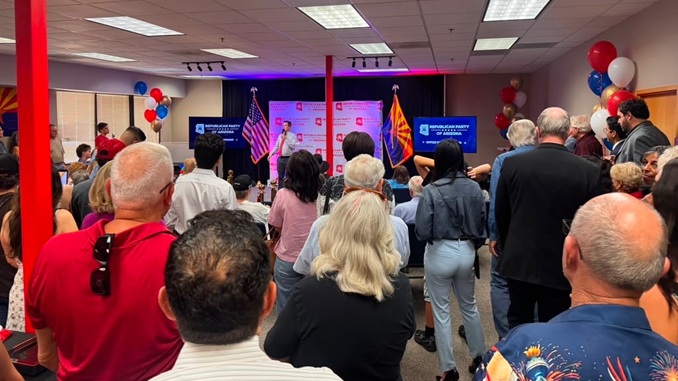
Republicans from across Arizona gathered on Friday to celebrate the grand opening of the Arizona Republican Party’s new headquarters. During the celebration, party leaders emphasized unity and looked ahead to the 2026 general election.
The new headquarters is located at 4531 N. 16th st., Suite 114, in Phoenix.
Despite Friday’s record-breaking heat, the event drew an over-capacity crowd, where attendees welcomed the Republican Party’s newly nominated statewide candidates following the primary election.
Arizona Republican Party Chairman Sergio Arellano opened the celebration alongside Republican National Committee Chairman Joe Gruters, Arizona House Speaker Steve Montenegro, Republican gubernatorial nominee Congressman Andy Biggs, Republican Attorney General nominee Arizona Senate President Warren Petersen, and conservative radio host James T. Harris.
Both Biggs and Petersen received great support from attendees after securing their respective Republican nominations earlier in the week.
“It is very clear by today’s turnout that Republicans understand how important this election is and the only way we win is with a united front,” stated Chairman Arellano. “Governor Hobbs has been a disaster. From awarding government contracts to cronies, to appointing unqualified individuals to lead various state agencies, she has made a mess of things. We know that we must get Andy Biggs elected before it’s too late for Arizona and we become California.”
Arellano also contrasted the Arizona Republican Party’s approach to the primary election with what he described as divisions among Democrats, arguing that party leadership intentionally remained neutral throughout the nomination process.
“Primaries can take a toll and often fray relationships and create distrust among party members like the schism the DCCC created this cycle in Congressional District 1 with their cockeyed endorsement of losing candidate Marlene Galan-Woods,” added Arellano. “However, we didn’t play that way. I was determined that the Party would not put its thumb on the scale for one of our candidates or another. As a result, there is a real sense of unity – of trust.”
.@SurgeShow is doing great! Really got the party in a good shape in record time ❤
— Merissa Caldwell 🗳 ⛽ 🗽🔥 (@MerissaCaldwell) July 25, 2026
With the primary election concluded, party leaders used the event to rally supporters and signal the beginning of the Republican Party’s statewide general election campaign, emphasizing party unity as candidates prepare to challenge Democratic incumbents in November.
Ethan Faverino is a reporter for AZ Free News. You can send him news tips using this link.