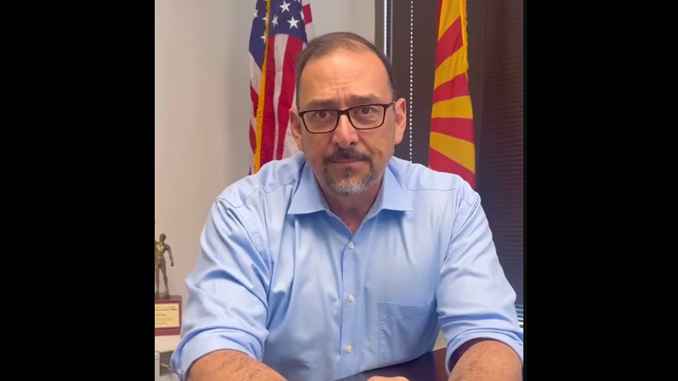
America First Legal (AFL) has filed a lawsuit in Maricopa County Superior Court challenging the official ballot language prepared by Arizona Secretary of State Adrian Fontes for Proposition 144. The lawsuit argues the description violates state law by failing to provide voters with a neutral and accurate summary of the election integrity measure.
The lawsuit asks the court to require the Secretary of State’s Office to revise the ballot language before early voting begins in October.
Proposition 144, referred to the ballot by the Arizona Legislature, would amend the Arizona Constitution to require proof of citizenship to register and vote, require voter identification for all forms of voting, prohibit foreign money from being used to influence Arizona elections, and affirm the authority of the people and the Legislature to enact election laws while clarifying the legal standard for court challenges involving those laws.
According to AFL’s complaint, Arizona law requires the Secretary of State to provide voters with an impartial, objective, and accurate description of ballot measures.
The organization alleges the current description fails to meet those standards by omitting major provisions of the measure, inserting political commentary, and making unsupported claims about its legal effect.
🚨BREAKING — AFL just filed an important election integrity lawsuit in Maricopa County, Arizona.
Adrian Fontes is trying to manipulate and sabotage ballot language to stop election integrity initiatives.
One of the lawsuit’s primary claims is that the official ballot language does not mention Proposition 144’s citizenship requirements, which AFL describes as the measure’s central purpose.
The complaint notes that while Arizona law allows for a 50-word descriptive title, Secretary Fontes allegedly used only about 28 words and did not reference the amendment’s provisions requiring citizenship to register to vote.
“Free and fair elections start with an honest ballot,” stated James Rogers, Senior Counsel at America First Legal. “Secretary Fontes had one job here: tell Arizona voters the truth about what’s on their ballot.”
The lawsuit also challenges language describing the measure’s prohibition on foreign election spending. The official “yes” vote explanation states that the provision is “similar to prohibitions that already exist in federal law.”
AFL argues that statement is misleading because federal law does not prohibit foreign money from being spent to influence ballot measures, and contends Proposition 144 would close that gap.
Additionally, AFL disputes the ballot language stating that the measure would “lower the legal standard for judicial review of election laws, making it harder to challenge election laws in state court.”
The organization argues that Proposition 144 contains no such language and that the statement represents a speculative legal conclusion rather than a neutral explanation of the amendment’s text.
“Arizona law requires official ballot language to be impartial, accurate, and free from advocacy,” added Rogers. “Secretary Fontes’s description of Proposition 144 fails all of these requirements. AFL will fight in court to ensure that every voter in Arizona gets the truth before they cast their ballot. That is what the law demands and what democracy requires.”
Ethan Faverino is a reporter for AZ Free News. You can send him news tips using this link.
The National Border Patrol Council (NBPC) has officially endorsed Republican Congressman Juan Ciscomani for re-election in Arizona’s Sixth Congressional District. The organization cited Ciscomani’s continued support for Border Patrol agents, commitment to border security, and record for delivering resources and legislative action to strengthen enforcement efforts.
The endorsement highlights Ciscomani’s work advocating for border security and comes as Arizona’s Sixth Congressional District remains one of the nation’s most closely watched House races, with immigration and border security continuing to be major issues for voters across Southern Arizona.
“We’ve had the pleasure of working with Congressman Ciscomani for years, dating back to his work with Governor Doug Ducey on southern Arizona border operations, long before he ever ran for Congress,” stated President of the National Border Patrol Council, Hector Andujo. “Over the years, Juan has proven that he’ll show up, listen, and deliver results.”
“During the government shutdown, he even withheld his own pay to stand with Border Patrol agents who weren’t getting paid through no fault of their own,” added Andujo. “That’s why we know we can count on Juan to stand with us when it matters most. We’re proud to endorse him for re-election to a third term.”
Honored to once again earn the endorsement of the National Border Patrol Council @BPUnion.
Today's event felt more like being surrounded by longtime friends than a campaign event. I've had the privilege of working with many of these agents for years, long before I came to… pic.twitter.com/qZJJyOxjbQ
Ciscomani, who immigrated to Tucson from Mexico at the age of five and later became the first naturalized U.S. citizen from Mexico elected to Congress from Arizona, has built his congressional record around working directly with law enforcement officials and border communities to address challenges facing the southern border.
As Vice Chair of the Homeland Security Appropriations Subcommittee and the only member of Arizona’s congressional delegation from either party or chamber serving on the Appropriations Committee, Ciscomani has played an important role in securing federal resources for Border Patrol agents operating throughout Arizona’s Sixth District.
During his time is Congress, Ciscomani led passage of the Pay Our Homeland Defenders Act, legislation designed to ensure Border Patrol agents and Department of Homeland Security employees continue receiving pay during government funding lapses.
He also helped secure additional resources for agents, retention bonuses, and equipment funding through the Working Families Tax Cuts Act.
Ciscomani has also introduced the FLASH Act, legislation aimed at improving public safety on federal lands along the southern border. It establishes Joint Operations Centers to improve coordination among federal, state, local, and tribal law enforcement agencies, and supported efforts to combat fentanyl trafficking and strengthen border interdiction operations.
“Maintaining a secure border is one of my highest responsibilities as the representative of a border district, and it’s something I work on every single day I’m in Congress,” said Congressman Juan Ciscomani. “I’m honored to once again earn the trust and support of the National Border Patrol Council. This is the third campaign they’ve had my back, and I don’t take that lightly.”
Ciscomani said his continued visits with Border Patrol agents in the field have shaped his approach to border policy and reinforced the need to provide agents with what they need to carry out their mission.
“I’ve spent countless hours with Border Patrol agents in the field, from the middle of the night to the hottest part of the day, listening to what they face and what they need to succeed,” added Ciscomani. “Every visit leaves me with an even greater appreciation for their service. I’ll continue fighting to ensure they have the resources, tools, and support they need to protect our communities and keep our nation secure.”
The National Border Patrol Council’s endorsement becomes the sixth organization to endorse Congressman Ciscomani for re-election and adds to the growing list of support from law enforcement, local leaders, and community advocates as he seeks a third term representing Arizona’s Sixth Congressional District.
Ethan Faverino is a reporter for AZ Free News. You can send him news tips using this link.
Three members of a Phoenix family have pleaded guilty in connection with a years-long scheme to fraudulently obtain nearly $2.2 million in federal COVID-19 relief funds, according to the U.S Attorney’s Office, District of Arizona.
Mohammed Maio, 43, of Phoenix pleaded guilty in July to conspiracy to commit wire and bank fraud and conspiracy to commit money laundering.
His parents, Souzan El-Sayed, 66, and Abukar Maio, 70, also of Phoenix pleaded guilty on July 24 to conspiracy to commit wire and bank fraud and conspiracy to commit money laundering.
Mohammed Maio is scheduled to be sentenced on September 28, 2026, before U.S. District Judge Michael T. Liburdi.
El-Sayed and Abukar Maio are scheduled for sentencing on October 5, 2026, before the same judge.
According to a press release, the three family members conspired between May 2020 and March 2024 to fraudulently obtain and misuse loans issued through the federal Paycheck Protection Program and Economic Injury Disaster Loan programs, both which were established to provide financial relief to businesses impacted by the COVID-19 pandemic.
Prosecutors said the family submitted false information to secure nearly $2.2 million on loans for multiple businesses that had no employees. Rather than using the funds for legitimate business purposes the defendants admitted they used the money for personal gain, including the purchase of multiple properties.
In addition to the fraud charges, Mohammad Maio admitted to illegally obtaining a firearm despite being a convicted felon. He pleaded guilty to a felon in possession of a firearm and aiding another in making a materially false statement to purchase a firearm.
According to his plea agreement, he arranged for this mother to purchase the firearm on his behalf in May 2021. He admitted the he directed her to falsely certify on the federal firearms transaction record that the gun was being purchased for her own use when it was actually intended for him. He later unlawfully possessed the firearm.
The conspiracy to commit wire and bank fraud charge carries a maximum sentence for 30 years in federal prison and a fine of up to $1 million.
The conspiracy to commit money laundering charge carries a maximum of 20 years in prison and a $500,000 fine.
The felon in possession of a firearm charge is punishable by up to 10 years in prison and a $250,000 fine, while making a false statement during the purchase of a firearms carries a maximum sentence of five years and a $250,000 fine.
Actual sentences will be determined by the court.
Ethan Faverino is a reporter for AZ Free News. You can send him news tips using this link.
Congressman Paul Gosar (R-AZ-09) is calling on the Department of Veterans Affairs (VA) to implement recommendations from a recent Office of Inspector General (OIG) audit that found widespread failures in the administration of the Veterans Community Care Program (VCCP), including improper eligibility determinations, inadequate documentation, and hundreds of millions of dollars in unnecessary spending.
In a letter to VA Secretary Doug Collins and Acting Under Secretary John Figueroa, Gosar urged the department to fully implement the OIG’s recommendations to improve accountability and ensure veterans receive the care they are entitled to under federal law.
The audit, released by the VA Office of Inspector General on June 17, was mandated by the Senator Elizabeth Dole 21st Century Veterans Healthcare and Benefits Improvement Act.
It examined whether the Veterans Health Administration (VHA) accurately identified veterans eligible for community care and properly informed them of their options under the VA MISSION Act.
The OIG concluded that the VA was “not effectively identifying and informing all eligible veterans about all their care options within and outside VA.”
Investigators found that some veterans who qualified for community care were never informed of their eligibility, while others who did not qualify were improperly referred to outside providers.
According to the audit, nearly one in four community care referrals—approximately 340,000 of 1.4 million consults reviewed during the first quarter of FY25—were made even though veterans did not meet eligibility requirements.
At the same time, an estimated 1.8 million veterans who received care through VA facilities lacked documentation showing they had been evaluated for community care eligibility, with more than one million cases containing no evidence that veterans had voluntarily declined the option.
The OIG estimated that inaccurate eligibility determinations resulted in approximately $440 million in unnecessary spending during the first quarter of FY25 alone. If those issues continue unaddressed, the agency estimated the cost could reach $1.7 billion annually.
The audit attributed many of the problems to inconsistent guidance from the VA’s Office of Integrated Veteran Care, scheduling system limitations that prevented staff from viewing appointment availability across all VA facilities, and a lack of access to community care scheduling data needed to help veterans make informed decisions.
Investigators also found that some veterans referred to community care could have received treatment sooner through VA facilities, while others who qualified for community care were never informed of that option.
The report warned that these shortcomings not only waste taxpayer dollars but also risk delaying medical treatment for veterans by preventing them from accessing the care options that best meet their needs.
The Office of Inspector General issued six recommendations aimed at improving the effectiveness of the Veterans Community Care Program.
The Veterans Health Administration concurred with five recommendations and concurred in principle with the sixth, submitting corrective action plans intended to address the findings.
In his letter, Gosar encouraged Secretary Collins to work with Congress to fully implement the OIG’s recommendations, strengthen oversight of the Veterans Community Care Program, and ensure it is administered with the diligence and integrity America’s veterans deserve.
Ethan Faverino is a reporter for AZ Free News. You can send him news tips using this link.
The Common Sense Institute announced it has promoted Zach Milne to Director of Policy and Research, where he will oversee the organization’s research agenda and continue leading data-driven policy analysis focused on free enterprise and economic issues affecting Arizona.
In his new role, Milne will direct CSI’s research initiatives while continuing to produce analysis intended to inform policymakers and the public on issues related to Arizona’s economy, workforce, fiscal policy, and competitiveness.
Milne joined the Common Sense Institute after serving as an economist in the Arizona Governors Office of Strategic Planning ad Budget.
During his time with the state, he developed Arizona’s revenue forecasts, advised executive leadership on fiscal policy, and analyzed tax and budget legislation.
He earned a bachelors degree in economics and statistics, along with a master’s degree in economics from Arizona State University.
Prior to his career in economics, Milne served more than 20 years in the United States Air Force.
Please join us in congratulating Zach Milne on his promotion to Director of Policy and Research at Common Sense Institute.
As Senior Research Analyst, Zach has played a key role in establishing CSI as a trusted source of independent economic analysis through his work on housing… pic.twitter.com/LEQTq8fUYF
— Common Sense Institute Arizona (@CSInstituteAZ) July 30, 2026
Since joining CSI, Milne has helped expand the organization’s research portfolio, leading several of its signature projects, including the Free Enterprise Report and the Housing Affordability Index.
CSI Executive Director Katie Ratlief praised Milne’s contributions to the organization and expressed confidence in his leadership moving forward.
“Research that makes a difference doesn’t just analyze data. It changes the way people think about important policy issues,” stated Ratlief. “Zach has been instrumental in building both the quality of our research and the reputation CSI has earned as a trusted source of objective economic analysis. His commitment to accuracy and thoughtful approach to every project have helped position CSI as a leading voice on the policy issues that matter most to Arizonans. I look forward to seeing him continue building on that foundation in this new role.”
Ethan Faverino is a reporter for AZ Free News. You can send him news tips using this link.