by Ethan Faverino | May 18, 2026 | News
By Ethan Faverino |
Budget negotiations between Arizona Senate Republicans and Governor Katie Hobbs’ administration are continuing at the Capitol after the Governor vetoed the Senate Republican budget proposal on May 5th.
The Republican plan included one of the largest tax cuts in Arizona history while fully funding education and public safety priorities.
Hobbs described the budget as “unbalanced and reckless.”
In her veto letter she stated, “This budget is unbalanced and reckless. With it, Arizona would default on our debt obligations, endanger vulnerable children, slash critical public safety funding, and pay for tax breaks to billionaires, data centers and special interests by kicking Arizonans off their healthcare and taking food off their tables. Arizonans cannot afford chaotic and dysfunctional Washington-style budgeting in our state government. I have made it clear that I will engage in good-faith negotiation. But I will not sign a budget that brings Washington-style chaos and dysfunction to Arizona’s budget. Let’s get back to the negotiating table and get serious about delivering for Arizonans. I am ready when you are.”
Despite the Governor’s public criticism, her team returned to negotiations almost immediately. On Thursday, May 14th, Governor Hobbs lifted the month-long bill signing moratorium she had imposed on April 13th.
The moratorium had been conditioned on Republicans publicly releasing a budget proposal and engaging in what she described as “good-faith” negotiations. It has severely limited the Senate’s ability to conduct normal floor business for weeks, stalling progress on unrelated legislation and disrupting the regular legislative process.
Senate Republicans noted that work never stopped despite the moratorium and recent media reports. Members have continued meeting with stakeholders, addressing constituent issues, reviewing legislation, and participating in budget discussions nearly every day.
This last week, the Senate Committee on Director Nominations convened to consider Governor Hobbs’ nominee, Brig. Gen. John Conley, to lead the Department of Emergency and Military Affairs.
The Republican budget proposal, unveiled on April 27, fully conformed Arizona’s tax code with federal changes made through President Trump’s “One Big Beautiful Bill.” It funded the tax relief through targeted fund sweeps and reductions to most state agencies outside of core priorities.
Senate Republicans remain focused on completing a responsible budget that controls spending, protects core priorities such as education and public safety, and delivers historic tax relief for Arizona families facing affordability challenges.
The Senate returned last week for additional floor work, committee activity, and ongoing budget negotiations. With the moratorium now lifted, Senate leaders expressed optimism that both the budget process and the broader work of the Legislature can move forward without further delays.
Ethan Faverino is a reporter for AZ Free News. You can send him news tips using this link.
by Ethan Faverino | May 18, 2026 | Education, News
By Ethan Faverino |
The Common Sense Institute (CSI) released the first report in its 2026 Ballot Guide series, examining the fiscal, educational, and family impacts of the proposed “Protect Education Act.” The analysis concludes that the measure would immediately disqualify approximately 20,300 current universal ESA families through a new income cap, while gradually excluding more than half of Arizona families with school-aged children over time as incomes rise faster than the cap’s limited adjustment.
The proposal would also impose new accreditations, testing, and spending restrictions on participating schools, potentially disrupting educational choices for over 100,000 Arizona students currently using Empowerment Scholarship Accounts (ESAs).
Arizona’s K-12 landscape has been shifting for more than a decade, with district enrollment declining since 2008 as families increasingly turned to charter, private, homeschool, and micro school options. District schools lost roughly 50,000 students in 2021-2022 alone—before universal ESA eligibility—and today enroll about 75,000 fewer students than in 2019-2020.
Fewer than 70% of Arizona’s school-aged children now attend district schools, down from 80% a decade ago.
In response to these trends and parent demand for alternatives, lawmakers expanded ESA eligibility in 2022 to all school-aged children, removing prior public-school attendance requirements. Participation surged to more than 100,000 students (nearly 10% of Arizona’s K-12 population), with annual awards totaling around $1.1 billion. One quarter of participants remain in pre-universal categories, including a rapidly growing share of students with disabilities.
Key Impacts of the Proposed Act
The Protect Education Act would limit universal ESA scholarships to households earning under $150,000 annually, require participating private schools to register, accredit, and/or conduct mandatory state testing, and further restrict allowable uses of funds by tightening definitions of “noneducational” and “luxury” items.
CSI’s analysis estimates that 24% of current ESA users have household incomes above the proposed threshold, immediately affecting roughly 20,300 universal-eligibility families.
Statewide, approximately 400,000 school-aged children—potentially up to 40% when accounting for family sizes—could be permanently excluded from universal ESAs based on 2024 income distributions.
Although the cap includes a 2% annual inflation adjustment. Arizona household incomes have historically risen closer to 4% per year, leading CSI to project that more than 52% of families with school-aged children could be income-excluded by 2045.
The restriction could also indirectly reduce participation in other eligibility categories. Growth in ESA usage among students with disabilities accelerated after universal expansion; without it, there might have been roughly 10,000 fewer participants in those targeted groups.
“Arizona’s K-12 system has been evolving for more than a decade as enrollment patterns, family preferences, and educational models continue to diversify,” stated Director of Policy & Research at CSI, Glenn Farley. “This analysis finds the proposed Act would not simply adjust ESA eligibility requirements, but could significantly reshape access to nontraditional education options over time. More families are signaling that one size does not fit all and are seeking educational choices that better meet their children’s needs.”
Fiscal Analysis: ESA Delivers Savings
ESA students receive significantly less funding than their public-school peers. The average universal ESA award is approximately $7,700 per student, compared to nearly $15,000 per public-school student. CSI estimates that shifting 20,000 universal ESA students back into district classrooms would increase annual taxpayers costs by about $115 million.
Despite serving over 100,000 students, the total number of publicly funded K-12 students (district, charter, and ESA) remains consistent with pre-2020 projections. The funding mix has simply shifted to better align with actual enrollment and family preferences, producing net savings for taxpayers. Arizona is also spending 30% more per-public school pupil (inflation-adjusted) than a decade ago, yet the share of funding reaching classrooms has declined slightly while support services have grown.
Academic Performance and Oversight
According to CSI, Arizona district students score low on state assessments with only 39% proficient in reading, 32% in math, and 27% in science. Available data indicate stronger outcomes in private and homeschool settings.
ACT scores show private school students outperforming public school counterparts by 19% and homeschool students by 12%. National Assessment of Educational Progress (NAEP) results similarly suggest private school students outperform roughly 70% of their public peers where comparable data exist.
CSI’s survey of participating private schools revealed that 84% already administer standardized testing and about two-thirds hold accreditation from recognized bodies. All respondents imply background checks and staff qualification standards. Private school leaders warned that the Act’s new requirements would create administrative burdens, with three-quarters indicating possible tuition increases and one in five suggesting they might stop accepting ESA students—potentially displacing over 4,600 reported ESA users.
Oversight mechanisms already exist in the ESA program. Arizona Department of Education audits found only 1.9% of sampled spending “unallowable” and 0.3% “egregious”—rates lower than many other public programs.
“Arizona was one of the first states to broadly expand Empowerment Scholarship Accounts, and a growing number of states have since adopted similar programs as demand for educational flexibility has increased,” added Farley. “If approved by Arizona voters, the proposal could significantly narrow access to options many Arizona families have increasingly turned to as part of the state’s changing education landscape.”
Ethan Faverino is a reporter for AZ Free News. You can send him news tips using this link.
by Ethan Faverino | May 17, 2026 | Economy, News
By Ethan Faverino |
Arizona continues to experience relatively slower inflation than much of the nation, according to a new analysis from the Common Sense Institute (CSI) examining the latest U.S. Bureau of Labor Statistics Consumer Price Index (CPI) data for April 2026.
The Phoenix metro area CPI rose 3% year-over-year in April, up from 1.7% in February. While this marks an acceleration, it remains well below the national rate, which increased from 2.4% to 3.8% over the same period.
The uptick in both local and national figures was driven primarily by surging energy prices amid fallout from the conflict with Iran.
In the Phoenix Metro area, energy costs climbed 22.9% year-over-year, outpacing the national increase of 17.5%. Stripping out this volatile category reveals significantly more moderate underlying price pressures: Phoenix inflation excluding energy stood at 1.7% (down from 1.9% in February), compared to 2.8% nationally (up from 2.6%).
Since April 2019, consumer prices in the Phoenix metro area have risen 34.6%, resulting in an estimated additional $1,647 in monthly costs for a typical Arizona household. Nationally, prices have increased 30.2% over the same seven-year period. In a typical seven-year span, cumulative inflation would be expected to total closer to 14.9%.
More recently, however, Phoenix inflation has tracked below the Federal Reserve’s 2% annual benchmark. Cumulative inflation in the metro area since April 2024 stands at just 3.4%, below the roughly 4% that would align with steady 2% annual growth.
Among the 23 metro areas tracked by the CPI, Phoenix recorded the 8th slowest year-over-year inflation rate in April. For the 14 regions that reported data, it posted the 2nd slowest. A key contributor is the shelter category, where Phoenix inflation measured just 0.8% year-over-year — substantially lower than the national figure of 3.3%.
While headline CPI figures are conventionally used as a proxy for inflation, CSI noted that the metric measures a fixed basket of goods and can be heavily influenced by volatile components like energy.
The recent national spike to 3.8% is largely attributable to relative price increases in energy rather than broad-based inflationary pressure. Core inflation (excluding energy) remains meaningfully lower, though national prices have not returned sustainably to the 2% target.
Sustained inflation above 2% since 2021 reflects structural challenges, including elevated federal deficits. National inflation trends have historically followed federal deficits patterns with a 12 to 24-month lag, and persistent high deficits — averaging $2.2 trillion annually from 2020 to 2024 — continue to complicate efforts to achieve price stability through monetary policy alone.
The annualized federal deficit for early 2026 remains at $2.2 trillion.
Ethan Faverino is a reporter for AZ Free News. You can send him news tips using this link.
by Ethan Faverino | May 15, 2026 | News
By Ethan Faverino |
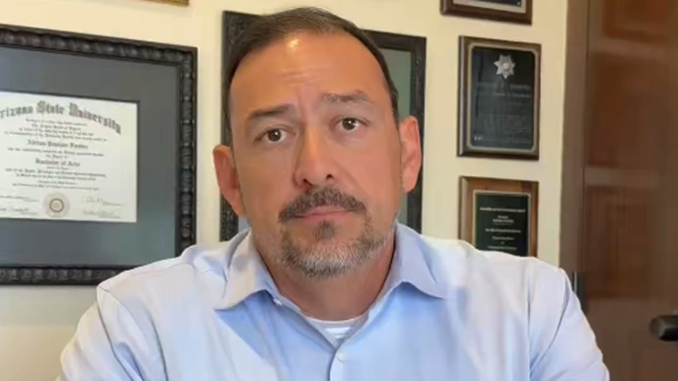
On behalf of the Pima County Republican Party and Chairwoman Kathleen Winn, the Oversight Project, filed suit over the 2025 Arizona Elections Procedures Manual (EPM) that grants election officials broad, vague authority to remove voters and involve law enforcement.
Arizona Secretary of State Adrian Fontes, with the approval of Attorney General Kris Mayes and Governor Katie Hobbs, issued the 2025 EPM through 2027. The document carries the force of law, with violations punishable by up to four months in prison.
The challenged provisions allow election officials to remove voters or summon law enforcement for actions such as wearing clothing, uniforms or official-looking apparel “intended to deter, intimidate, or harass voters”; “aggressive behavior”; “raising repeated frivolous voter challenges”; and electioneering that is “audible” inside a voting location.
Critics argue these standards lack clarity and invite arbitrary or discriminatory enforcement under the pretext of preserving order at polling places.
“The Arizona EPM encourages arbitrary enforcement that results in politically motivated disenfranchisement, stated Oversight Project Director of State Litigation Neal Cornett. “The Oversight Project is always ready to help conservative leaders like Chairwoman Winn challenge government weaponization, especially when it involves such fundamental rights as freedom of speech and voting. The Secretary of State and Attorney General should disavow the challenged provisions and work with Arizona leaders to draft a fair manual that follows Arizona law.”
This is not the first time Arizona officials have faced legal pushback. The Secretary of State and Attorney General were previously enjoined from enforcing similar provisions in the 2023 Manual.
Pima County Republican Party Chairwoman Kathleen Winn emphasized the importance of clear rules for all voters: “Every Arizona voter deserves clear, consistent rules at the polling place that protect their right to vote free from arbitrary enforcement. Vague standards invite abuse, and when election workers are given unchecked discretion to remove voters or call law enforcement based on unclear or unspecified conduct, no voter or vote is truly safe. This lawsuit is about ensuring that the rules governing our elections are written plainly, applied fairly, and consistent with Arizona law, regardless of party.”
The lawsuit contends that the EPM’s vague language unconstitutionally threatens voting rights and free speech by empowering subjective decision-making that could disenfranchise eligible voters.
Ethan Faverino is a reporter for AZ Free News. You can send him news tips using this link.
by Ethan Faverino | May 12, 2026 | News
By Ethan Faverino |
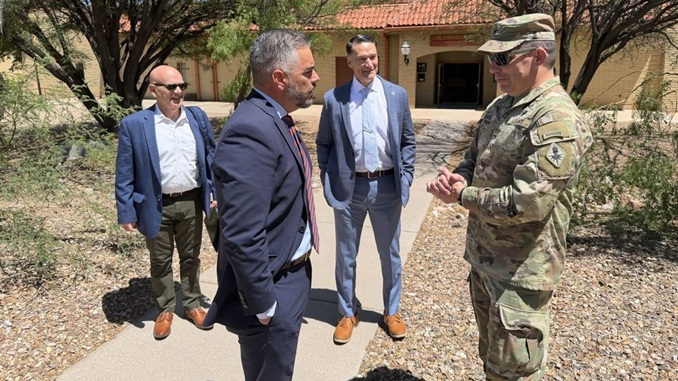
Congressman Juan Ciscomani (R-AZ-06) has secured a significant new mission for Fort Huachuca, marking a major victory for national security, economic growth, and Arizona’s Sixth Congressional District.
The U.S. Department of War has selected Fort Huachuca as the primary site for the new mission and squadron, recognizing the installation’s unique strategic capabilities, advanced infrastructure, and strong regional support.
Local leaders and stakeholders across Cochise County and Southern Arizona are applauding Rep. Ciscomani’s determined advocacy and successful collaboration with the Trump administration and the Department of Defense.
“This new mission is a win for Sierra Vista and Cochise County, a win for Arizona and a win for our national security,” stated Ciscomani. “Most importantly, this a testament to Fort Huachuca and its nationally recognized role as an unequalled strategic asset, not just today, but for the future of our national defense.”
Fort Huachuca, located approximately 15 miles north of the U.S.-Mexico border, is the largest employer in Cochise County. It features 946 square miles of restricted airspace and 2,500 square miles of protected electronic ranges. Its selection was strengthened by a robust regional ecosystem that includes the University of Arizona, along with major defense contractors such as Raytheon, Northrop Grumman, and Honeywell.
Local leaders emphasized the mission’s broad benefits, including high-quality job creation and substantial economic impact.
Dr. Randy Groth, Fort Huachuca 50 said, “The selection of Fort Huachuca as the primary site for the new mission and squadron is a significant achievement for Sierra Vista and Cochise County, solidifying our community’s leadership in homeland defense and national security. I value Congressman Ciscomani’s dedicated advocacy and ongoing collaboration with the Department of War in securing this vital mission, which will create new opportunities and strengthen our region’s commitment to supporting our active duty service members.”
Clea McCaa, Mayor of Sierra Vista, stated, “Bringing this new mission to Fort Huachuca is a game-changer for Sierra Vista and our surrounding region. Not only will it further support American interests by strengthening our national defense posture, but it will also create high-quality jobs, bringing in approximately $3 billion in economic impact and reinforcing our city’s strong partnership with the Department of Defense. I appreciate Congressman Ciscomani’s continued advocacy over the past year in securing Fort Huachuca for this important investment in our future.”
Suresh Garimella, President of University of Arizona added, “The establishment of this mission at Fort Huachuca is a historic win for Arizona and a testament to the tireless advocacy of Congressman Juan Ciscomani. The University of Arizona has a long and storied legacy, and we are eager to bring our world-class research and technical prowess to this vital national security priority. We look forward to supporting the Air Force in Southern Arizona to safeguard our nation’s interests.”
Melany Edwards-Barton, Sky Islands Regional Partnership said, “The fact of the matter is, missions don’t come to an area that is not supported by its community. We have a supportive community down here that is willing to support it. Bringing in another mission adds jobs, adds another level of financial security to our region; the economic impact is going to be fabulous.”
This announcement underscores Fort Huachuca’s continued importance to America’s defense posture and delivers tangible economic benefits to Southern Arizona.
Ethan Faverino is a reporter for AZ Free News. You can send him news tips using this link.