by Ethan Faverino | May 10, 2026 | Economy, News
By Ethan Faverino |
The Joint Economic Committee released its Monthly Employment Update for April 2026, showing the U.S. economy added 115,000 nonfarm payroll jobs, exceeding expectations. The gain was driven entirely by the private sector which added 123,000 jobs, while government employment declined 8,000.
Nonfarm payroll employment now stands at 158.74 million, with private sector payrolls at 135.43 million and government payrolls at 23.31 million. The headline unemployment rate (U-3) held steady at 4.3%, while the broader U-6 measure, which includes underemployment, rose 0.2 percentage points to 8.2%. The labor force participation rate declined 0.1 percentage points to 61.8%.
March’s job gain was revised upward by 8,000 to a total of 185,000, while February’s figure was revised downward by 64,000, resulting in a net loss of 156,000 jobs for that month.
In April, the strongest job gains occurred in trade, transportation, and utilities, which added 60,000 positions, and private education and health services, which added 46,000. Losses were recorded in information (-13,000) and financial activities (-11,000).
Over the past year, from April 2025 to April 2026, private education and health services led with 618,000 new jobs, followed by leisure and hospitality with 142,000. The largest declines came in federal government (-311,00) and information (-92,000).
Wage growth remained moderate over the year. Average nominal weekly and hourly earnings for all employees on private nonfarm payrolls both increased by 3.57%. For production and nonsupervisory employees, average nominal weekly earnings rose 3.97%, while average nominal hourly earnings increased 3.67%.
The Job Openings and Labor Turnover Survey for March 2026 showed job openings declining by 56,000 to 6.87 million, with the rate falling to 4.1%. Private education and health services and financial activities posted gains in openings, while professional and business services experienced the largest drop. Hires increased sharply by 655,000 to 5.55 million, and total separations rose by 356,000 to 5.38 million, with both quits and layoffs and discharges seeing notable increases.
In Arizona, the labor market softened in March as the state lost 2,600 net payroll jobs and the unemployment rate edged up 0.1 percentage points to 4.7%, following a gain of 10,100 jobs the previous month.
Over the past 12 months, Arizona has lost 8,600 net payroll jobs while its unemployment rate has risen 0.5 percentage points from 4.2%. The state’s private sector lost 2,400 jobs in March, and employment overall fell by 19,093 during the month. Arizona’s labor force participation rate declined to 61.4% ranking 34th in the nation.
From February to March 2026, Arizona saw gains in private education and health services and professional and business services, offset by losses in leisure and hospitality and trade, transportation, and utilities. Over the full year, private education and health services rained the strongest performer in the spare, while trade, transportation, and utilizes and financial activities posted the largest declines.
Nationally, the labor force participation rate stood at 61.9% in March.
Ethan Faverino is a reporter for AZ Free News. You can send him news tips using this link.
by Ethan Faverino | May 8, 2026 | News
By Ethan Faverino |
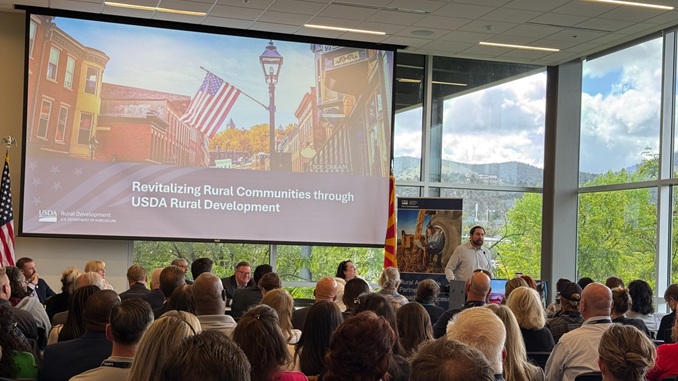
Congressman Eli Crane (R-AZ-02) participated in a Federal Partners Forum focused on addressing the distinct needs of Arizona’s rural communities, joining representatives from the U.S. Department of Agriculture (USDA) Rural Development and other federal agencies.
The event, held on May 5 at Yavapai College’s Center for Learning and Innovation in Prescott, convened more than 120 local and regional leaders alongside state and federal officials.
Senior Representatives from multiple federal agencies attended, including the National Park Service, U.S. Department of Health and Human Services (HHS), U.S. Department of Housing and Urban Development (HUD), U.S. Department of Veterans Affairs (VA), and the U.S. Small Business Administration (SBA).
During the forum, agency officials presented information on available federal resources and programs designed to support rural Arizona. Discussion topics included expanding access to healthcare, boosting small business growth, modernizing infrastructure, increasing affordable housing options, and enhancing broadband connectivity.
Participants were able to engage directly with federal partners to foster relationships, explore partnership opportunities, and identify practical solutions for long-term community development in rural areas.
“While our state faces many unique challenges, including Washington’s longstanding tendency to prioritize urban and coastal areas, we’re grateful to the Trump administration for putting rural interests at the forefront,” stated Rep. Crane. “Yesterday’s forum served as a catalyst for new opportunities and partnerships across local, state, and federal levels. I appreciate Yavapai College for hosting, and I’m thankful to Lori Urban, Lori Corbin, and everyone who helped make this event a success.”
The Federal Partners Forum is part of ongoing efforts to bridge gaps between rural communities and federal resources, ensuring Arizona’s rural priorities receive targeted attention and support.
Ethan Faverino is a reporter for AZ Free News. You can send him news tips using this link.
by Ethan Faverino | May 7, 2026 | Economy, News
By Ethan Faverino |
The U.S. trade deficit widened in March, according to analysis released earlier this week by the Joint Economic Committee based on data from the Bureau of Economic Analysis, U.S Census Bureau, Treasury Department, and Bureau of Labor Statistics.
The total trade deficit reached $60.3 billion in March, an increase of $2.53 billion from February and 3% above the 12-month average. The goods trade deficit stood at $88.71 billion up $4.09 billion from the prior month and also 3% above its 12-month average. This was partially offset by a services trade surplus of $28.41 billion, which rose $1.56 billion from February and was likewise 3% above average.
For the full 12 months through March 2026, the United States recorded a total trade deficit of $700.49 billion. This reflected a goods trade deficit of $1.03 trillion, partially offset by a services trade surplus of $331.39 billion. Total exports over the period reached $3.53 trillion, while total imports totaled $4.23 trillion.
Largest Trade Imbalances by Country
Over the trailing 12 months, the largest goods trade deficits were with Mexico ($194.42 billion, 18.96% of the total goods deficit), Vietnam ($193.35 billion, 18.86%), and Taiwan ($177.28 billion, 17.29%). Additional notable deficits occurred with China, Thailand, Ireland, Germany, Japan, South Korea, and India.
The largest goods trade surpluses were recorded with the Netherlands ($68.49 billion), United Kingdom ($47.42 billion), and Hong Kong ($40.32 billion).
Top Exports and Imports
The leading exported goods by value were civilian aircraft, engines, equipment, and parts; pharmaceutical preparations; and nonmonetary gold. Together these categories accounted for 17.54% of all U.S. goods exports over the 12-month period.
The United States exported the most to Mexico ($347.18 billion), Canada ($327.56 billion), and the United Kingdom ($109.51). These three destinations represented 34.72% of total U.S. exports.
On the import side, the top categories by value were computers; pharmaceutical preparations; and passenger cars, which together made up 19.74% of all imported goods. The largest sources of imports were Mexico ($541.61 billion), Canada ($365.62 billion), and China ($266.59 billion), accounting for 35.74% of total U.S. imports.
Import Duties Decline
In March, the U.S. collected $20.49 billion in import duties—18.40% below the 12-month average—with the average applied duty rate at 6.85%, down 2.45 percentage points from the yearly average. Over the full 12 months, calculated duties totaled $301.30 billion.
The highest duty revenues came from passenger cars, vehicle parts, and electric apparatus, with notably higher average rates applied to certain categories such as iron and steel products. China remained the top source of duty revenue.
Currency Movements and Terms of Trade
From March 2025 to March 2026, the U.S. dollar weakened against several major currencies: by 4.9% against the Chinese yuan, 6.3% against the euro, 2.2% against the British pound, and 11.9% against the Mexican peso. It strengthened 6.1% against the Japanese yen.
A stronger dollar typically improves U.S. terms of trade by reducing the cost of imports, allowing the country to purchase more foreign goods for the same volume of exports.
Export and Import Price Trends
Year-over-year export prices rose 5.57 percent overall, while import prices increased 5.10%. Non-fuel import prices rose 5.85%, with notable variations across categories including industrial supplies and consumer goods.
Ethan Faverino is a reporter for AZ Free News. You can send him news tips using this link.
by Ethan Faverino | May 6, 2026 | News
By Ethan Faverino |
The U.S. House of Representatives unanimously approved an amendment presented by Congressman Eli Crane (R-AZ-02) to accelerate recovery efforts in the Kaibab National Forest following the devastating White Sage Fire.
The amendment, included in the 2026 Farm Bill, grants the U.S. Forest Service critical emergency contracting flexibilities to bypass unnecessary bureaucratic delays and speed up restoration work in the fire-affected areas.
Modeled after the North Rim Restoration Act of 2025, the measure targets nearly 60,000 acres impacted by the wildfire in Northern Arizona.
“Page, Fredonia, the Kaibab Band of Paiute Indians, and other impacted communities were dealt a setback due to the devastating White Sage Fire,” stated Rep. Crane. “In response, I’m honored to have introduced and passed an amendment to help pave the way to a full and timely recovery.”
Key provisions of Rep. Crane’s Amendment (Sec. 8409 – Kaibab National Forest Restoration):
- Authorizes the use of emergency acquisition flexibility under federal regulations to contract for forest management restoration activities, rebuilding, planning, design of structures, ground improvements, and other recovery efforts.
- Removes the need for a Presidential emergency or disaster declaration, allowing immediate action to support local communities.
- Requires robust transparency through detailed reports to Congress every 180 days on expenditures, expected costs, cost overruns, contractor performance, potential conflicts of interest, waste/fraud/abuse, and project timelines.
- Includes a 12-month extension option if new wildfires impact ongoing recovery, subject to congressional approval.
- Sunsets the authority five years after enactment or upon completion of recovery efforts, whichever comes first.
In addition to his own amendment, Rep Crane signed on as the sole cosponsor of an amendment led by Rep. Anna Paulina Luna (R-FL) to eliminate provisions that shielded pesticide companies from accountability while preserving critical public health protections. The measure restores Americans’ right to hold these companies accountable in court when their products cause harm.
He also cosponsored an amendment introduced by Rep. Paul Gosar (R-AZ-09) to reform evidence standards for compensating ranchers for livestock losses caused by Mexican wolves.
“I’m also grateful for the leadership of Representatives Gosar and Luna, who successfully passed provisions that assist our ranchers and help protect our food supply,” added Crane. “These results advance critical priorities for rural Arizonans, and I’m thankful for the positive outcomes.”
The amendments now move forward as part of the broader Farm Bill package.
Ethan Faverino is a reporter for AZ Free News. You can send him news tips using this link.
by Ethan Faverino | May 5, 2026 | News
By Ethan Faverino |
The Arizona Republican Party announced the appointment of Greg Roeberg as its new Legal Counsel last week. An Arizona attorney, with nearly two decades of experience in business and government law, Roeberg has become one of the state’s leading voices on election integrity.
Moving to Arizona during law school, Roeberg established a law practice focused on business law, serving entrepreneurs and small businesses in the early years of his career. He holds an undergraduate degree in Economics and Government and a law degree from Georgetown University. He was admitted to the Arizona Bar in 2008.
Roeberg is a lifelong Republican and became deeply engaged in politics in 2016 serving on the Trump Presidential Inaugural Committee. He went on to support the Trump Campaign in 2020 with a focus on logistics and election law.
Following his recovery from a 2019 lymphoma diagnosis and successful chemotherapy treatment, Roeberg answered the call again in 2024, serving as Election Integrity Attorney for the Trump campaign in Arizona. He has since represented the Republican National Committee, President Trump, and Republican candidates across the state throughout the 2020, 2022, and 2024 election cycles.
“Greg Roeberg is one of the sharpest legal minds in Arizona, and we are incredibly fortunate to have him on our team,” stated AZGOP Chairman Sergio Arellano. “He has spent nearly twenty years building a distinguished legal and business career, and over the last three election cycles he has been on the front lines defending the integrity of our elections — standing up for President Trump, the RNC, and Republican candidates across this state.”
Earlier this cycle, Roeberg launched a campaign for Arizona Attorney General before stepping down to focus on what he called the most urgent priority of the year: protecting the integrity of Arizona’s elections.
“When Greg made the decision to step away from his own campaign for Attorney General to take on this role, it spoke volumes about his character and his commitment to Arizona,” added Arellano. “He is a fighter, a patriot, and exactly the leader our party needs at this moment. I am proud to welcome him as our Legal Counsel.”
“It’s an honor to serve the Arizona Republican Party and the millions of Arizonans who believe in free, fair, and secure elections,” said Roeberg. “After three election cycles in the trenches, I know what’s at stake in this state. I’m grateful to Chairman Arellano for his trust, and I’m ready to get to work alongside him and our grassroots team to protect the voice of every legal voter in Arizona.”
Ethan Faverino is a reporter for AZ Free News. You can send him news tips using this link.