by Daniel Stefanski | May 12, 2023 | News
By Daniel Stefanski |
An Arizona legislator’s persistent efforts to push one of his bills across the finish line appears to be finally paying off.
On Wednesday, Republican Representative Alex Kolodin announced that his chamber had passed HB 2561, which is “an emergency measure that directs a municipality to provide water service through a standpipe until 2026 to up to 750 households that lack access to sufficient water if those households had previously received water service from the municipality, the municipality is reimbursed for providing water service and providing this water does not reduce water available to the municipality or the households.”
The issue stemmed from an action taken by the City of Scottsdale on water hauling operations to Rio Verde Foothills, an unincorporated community of approximately 2,000 homes. According to the Arizona House fact sheet, “Scottsdale ceased providing water for hauling to Rio Verde Foothills in 2023” because the Bureau of Reclamation’s declaration of a Tier 1 shortage on the Colorado River triggered the city’s “Drought Management Plan, which required that when a Tier 1 shortage occurred, any water hauling operations would cease unless the customer could prove the hauled water was being directly supplied to a resident or business within the city’s limits.” Approximately “500-700 households depend on the delivery of hauled water” in this case.
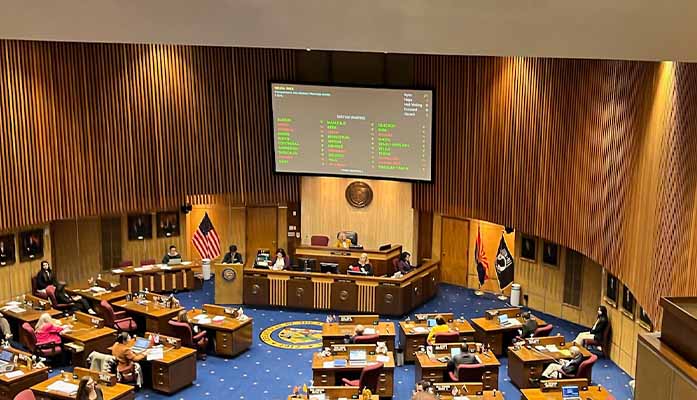
HB 2561 passed the House with a robust bipartisan vote of 46-13 (with one vacant seat).
One of Kolodin’s colleagues shed valuable light on the bill’s slog through the chamber before its passage. Republican Representative Justin Heap reminded Arizonans that the eventual success of HB 2561 occurred on the fourth attempt to pass the bill, tweeting: “Politics is a profession defined by indolence & self-aggrandizement. Because of this, truly remarkable efforts by leaders to help the people they represent often go unnoticed & unrewarded. For this reason, I would like to acclaim my colleague @realAlexKolodin of District 3. No bill has been more fiercely contested or required more effort this year then the task of getting water to the 900 residents of Rio Verde Foothills (“RFV”) who’ve been without reliable access to water since 2022. As their House Rep Alex made it his mission to get them water. It was a herculean task for a freshman legislator, against opposition from cities, the county BofS, the Governor’s Office, even his own party. Alex was undaunted. I share the thin office wall with Kolodin & every day overheard him making calls to residents, experts, & lawmakers. His bill HB2561 failed 3 times on the House floor. Each time it failed Alex went to no votes & worked with them, addressing their concerns & amending the language, to get an agreement. The number of yes votes improved each time it failed & Alex went back to the negotiating table. In order to get an Emergency Clause in the bill & get RVF water before the summer heat, Alex would need 40 votes. So he crossed the isle & worked with House Democrats to craft a bipartisan solution. Alex was still meeting with opponents on the day of the vote to find an agreement. When the final count on HB2561 came in at 46-13 watching Alex collapse back into his chair with relief & exhaustion was one of the most memorable moments of the session for me. Little of what we do as legislators has much real impact on the lives of everyday citizens of Arizona. But 900 people in a district of a quarter million has clean drinking water bc their Rep. cared enough to fight tirelessly for them against all odds & it was inspiring to watch. @realAlexKolodin is an example to what representative government should be & LD3 is lucky to have him. Alex recently reminded me of a verse from the Torah, which is God’s counsel to those chosen to be leaders, ‘Tzedek, tzedek, tirdof’ ‘Follow justice and justice alone’ – Deut. 16:20 You exemplified that calling in this fight, my friend. I’m honored to serve with you!”
In Kolodin’s release, he shared information about the current state of events in the Rio Verde Foothills area and the objectives of his bill, writing, “The EPCOR private water company has agreed to provide a long-term solution to install their own water standpipe but this cannot be accomplished for about two years. In the interim the City of Scottsdale has agreed to provide water to the residents through EPCOR but states that they will only sign a contract with a government entity as the go between party between them and EPCOR. This bill creates a temporary standpipe district that can be that go between entity.”
Per Representative Kolodin, the Senate will have the opportunity to vote on the bill on Monday.
Daniel Stefanski is a reporter for AZ Free News. You can send him news tips using this link.
by AZ Free Enterprise Club | Apr 22, 2023 | Opinion
By the Arizona Free Enterprise Club |
Democrats like to believe they are the party of compassion and kindness, but the reality in most blue cities says otherwise. For years, homeless encampments have been springing up in liberal-run cities like Seattle, Portland, San Francisco, and Los Angeles. And in recent years, this trend made its way into Phoenix.
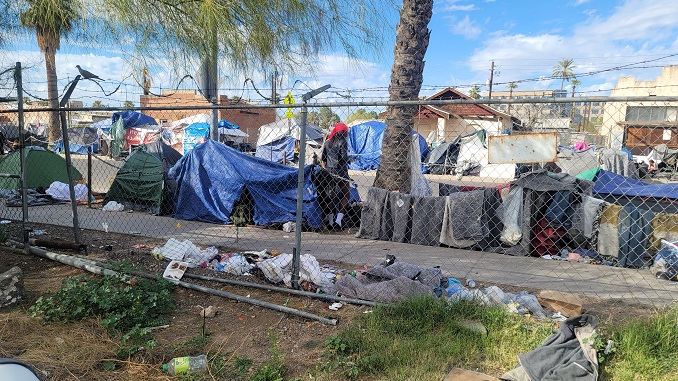
Just blocks from the state capitol, amidst what was once a thriving business district, a sprawling encampment of around 1,000 homeless has come to be known as “The Zone.” It’s a place where drug use, drug deals, defecation, urination, sexual acts, assaults, rape, and murder are frequently committed out in the open—often with little to no consequences. The problem has even gotten so bad that the Phoenix Fire Department won’t respond to calls inside The Zone without assistance from the Phoenix Police Department and assurance that the scene of the incident is secure.
But crime within The Zone is only one part of the problem…
>>> CONTINUE READING >>>
by Daniel Stefanski | Feb 11, 2023 | News
By Daniel Stefanski |
Arizona’s water situation isn’t getting any better, and the next decade will most likely present major challenges to people as cities and towns take additional actions to conserve water for the future. One community has felt the brunt of our state’s drought, and members of the Arizona Legislature may be poised to help bail them out.
HB2561 and SB1093, which deal with requirements for service by city water providers, both cleared legislative committees this week and are one step closer to possible votes in the respective chambers. According to the Arizona House summary, this bill “directs a municipality to provide water service through a standpipe until 2026 to up to 750 households that lack access to sufficient water if those households had previously received water service from the municipality, the municipality is reimbursed for providing water service and providing this water does not reduce water available to the municipality or the households.”
The issue stems from an action taken by the City of Scottsdale on water hauling operations to Rio Verde Foothills, an unincorporated community of approximately 2,000 homes. As the Arizona House fact sheet reports, “Scottsdale ceased providing water for hauling to Rio Verde Foothills in 2023” because the Bureau of Reclamation’s declaration of a Tier 1 shortage on the Colorado River triggered the city’s “Drought Management Plan, which required that when a Tier 1 shortage occurred, any water hauling operations would cease unless the customer could prove the hauled water was being directly supplied to a resident or business within the city’s limits.” It is estimated that about “500-700 households depend on the delivery of hauled water” in this case.
The Rio Verde Foothills’ current standing when it comes to access to water has put some families in dire straits, and many individuals and families have made desperate entreaties for help that have reached the international scene. One reporter uncovered that some residents are now paying around $1,000 a month for water, a substantial increase from $220. This story has even attracted the attention of the New York Times.
One Twitter user from Oxford, England had this comment about the New York Times piece: “I don’t care for an affluent suburb nor do I necessarily think Scottsdale Water is in the wrong here. BUT if the starting position is ‘there’s no way to help,’ that doesn’t bode well for the many other Arizonans who may find themselves without water access in the coming years.”
Enter the Arizona Legislature and the attempts to intervene in the situation. Representative Alex Kolodin was the sponsor of HB2561, and Senator John Kavanagh of SB1093. Both legislators have met with people within the Rio Verde Foothills Community, including one meeting that took place on January 29.
HB2561 passed the House Committee on Natural Resources, Energy & Water with a 6-3-0-0-1 vote. SB1093 passed the Senate Government Committee with a 5-3 vote. Both votes were mostly along party lines (Democrat Representative Travers voted “present”) – a fact that did not escape the attention of one Republican lawmaker.
In an exclusive statement to AZ Free News, Representative Austin Smith, the vice chairman of the Natural Resources, Energy and Water Committee explained his reasoning for his vote to advance this legislation to the full chamber: “There was an issue in Rio Verde and the representatives of that district went right to work and brought it to our committee. I look forward to voting for more bills that go right to work for citizens who need water and conservation efforts.”
The City of Scottsdale has opposed this legislation and issued a statement regarding this matter on January 16. The Office of Communication wrote, “Rio Verde is a separate community governed by Maricopa County, not the city of Scottsdale. Scottsdale has warned and advised that it is not responsible for Rio Verde for many years, especially given the requirements of the city’s mandated drought plan. The city remains firm in that position, and confident it is on the right side of the law. Nothing in the city’s action precludes residents in Rio Verde Foothills from purchasing water from other sources. The water haulers who have previously hauled water from Scottsdale have access to water from other jurisdictions and are still offering to haul water to serve the homes in Rio Verde.”
Daniel Stefanski is a reporter for AZ Free News. You can send him news tips using this link.
by Corinne Murdock | Jan 20, 2023 | News
By Corinne Murdock |
Scottsdale Mayor David Ortega has refused to allow Rio Verde citizens to use canal space to transport their water, effectively forcing them to go without, pay thousands in water bills, or leave their homes.
The Scottsdale canal route would be the short-term solution to save Rio Verde residents time and money until a proposed long-term solution, a stump pipe, can be worked out. In the meantime, Rio Verde residents must be frugal with what water they can obtain. Some have come to rely upon rainwater — a nonviable solution come summer. The trucks that reliably delivered affordable water for years are now expensive: per their 2021 drought plan, Scottsdale prohibited water haulers from taking water from its tanks, forcing truckers to trek through the Valley in search of water. Rio Verde residents face water bills of around $1,000.
During a House Natural Resources, Energy, & Water Committee meeting last week, Rio Verde’s representative, State Rep. Alex Kolodin (R-LD03), questioned Arizona Department of Water Resources (ADWR) Director Tom Buschatzke about Rio Verde residents’ predicament. Kolodin shared that EPCOR, a utility company, had offered to route water to the residents via a stump pipe, but in the meantime must transport it by truck.
Buschatzke said that, to his understanding, Scottsdale cut Rio Verdes’ water access off for preservation efforts. He said ADWR was willing to help as much as they could in obtaining groundwater for those residents via a stump pipe.
“[The city of Scottsdale] thought because of what’s happening on the river with those supplies, they needed to take that action to protect their customers and their own city,” said Buschatzke. “[Rio Verde residents] don’t have groundwater of their own to access, and that’s a big part of the problem.”
Kolodin asked why water purchased and transported from the Harquahala Valley wasn’t a viable idea. Buschatzke responded that EPCOR wasn’t eligible to use that water since they’re a private company, and because that water was considered a “non-groundwater source” under the law.
Kolodin told AZ Free News that EPCOR has had to undertake the costly endeavor of transporting the water by truck because the city of Scottsdale refused to allow access to their canal. Kolodin remarked that he doesn’t understand Ortega’s resistance to helping these communities, which he said was well within Ortega’s ability.
“I get why the city of Scottsdale doesn’t want to give them their water. I don’t understand why the city won’t let them transport other water through their canal until EPCOR can build the stump pipe,” said Kolodin. “I get it. You’re the mayor of Scottsdale, you want to circle the wagons. Why not let them move their water through your canal? That’s pure twisting their arm.”
Kolodin also questioned why Ortega wouldn’t opt to rent canal space for two years. He claimed that Ortega wasn’t happy that Rio Verde residents haven’t set up a water regulation structure yet continue to develop land, chalking it up to a “liberal agenda” of Ortega’s. Ortega was a longtime Democrat before becoming an independent.
“To me, that’s a sign of Mayor Ortega’s liberal agenda. He cares so much about forcing these people into groundwater regulation that he’s willing to hurt thousands of people just to teach them a lesson,” said Kolodin. “He wants to impose his liberal agenda on water regulation on them. He doesn’t like that they don’t live with a governmental structure. In his mind everyone should be regulated.”
Scottsdale has pushed its own citizens to reduce water usage due to the worsening drought over the past few years. The Bureau of Reclamation reclassified the Colorado River’s drought status worsened from Tier 1 last January to Tier 2a. While this would normally mean the city remains in Stage One of its Drought Management Plan issued 2021, the city warned residents that it was anticipating cuts from the federal government. In this first stage, the city issues recommendations and potentially restrictions, as well as shutting down or restricting commercial and residential fill stations.
Time is running out for these Rio Verde residents. In the meantime, Kolodin has busied himself arranging meetings between Rio Verde residents, EPCOR, Scottsdale City Council, the Arizona Corporation Commission, and even Freeport-McMoran for potential solutions.
Few others who speak publicly on the issue seem to empathize with the Rio Verde citizens’ plight. The Arizona State University (ASU) director of the Kyl Center for Water Policy, Sarah Porter, indicated to The New York Times that the homeowners bore some burden for their struggles since they bought an unincorporated area.
“It’s a cautionary tale for home buyers,” said Porter. “We can’t just protect every single person who buys a parcel and builds a home. There isn’t enough money or water.”
Corinne Murdock is a reporter for AZ Free News. Follow her latest on Twitter, or email tips to corinne@azfreenews.com.
by Terri Jo Neff | Jul 9, 2022 | News
By Terri Jo Neff |
In January, Gov. Doug Ducey pledged that securing Arizona’s water future would be a priority during his last year in office, and on Wednesday he delivered a $1 billion investment toward projects that will bring additional water to the state on a long-term basis and change Arizona’s future.
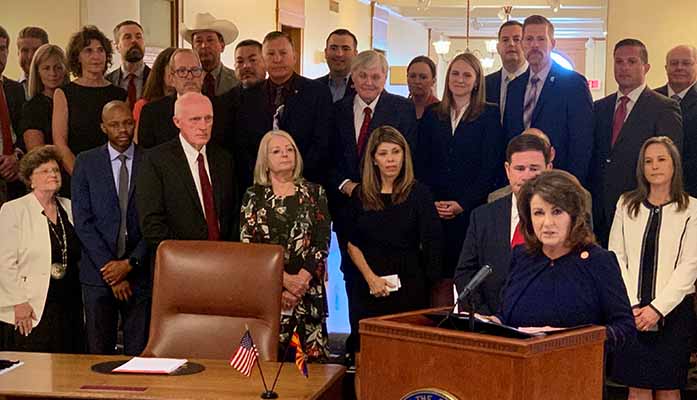
Ducey signed Senate Bill 1740 during a ceremony attended by several lawmakers and stakeholders. The bill, which the governor’s office called “historic legislation,” will allow Arizona to make significant strides in water conservation and innovative technologies such as desalination. It will also provide state officials the opportunity to identify and develop new innovative long-term water sources.
“This legislation is crucial for our continued growth and prosperity,” Ducey said. “As we’ve done over the past seven and a half years, we came together, brought everyone to the table and delivered for the people of this great state. And by doing so, we are leaving Arizona better and stronger than we found it
SB1740 appropriates more than $1 billion over three years to the Water Infrastructure Finance Authority (WIFA) while expanding the agency’s responsibilities to provide loans and grants to water providers and entities. The funding is earmarked to support importation of water into Arizona, conservation, efficiency and reuses, and new technologies.
During the signing ceremony, Ducey recognized Sen. Sine Kerr (R- Buckeye) and Rep. Gail Griffin (R-Hereford) for chairing their respective chamber’s natural resources committee this session.
The governor also lauded Senate President Karen Fann, House Speaker Rusty Bowers, and minority leaders Rep. Reginald Bolding and Sen. Rebecca Rios for ensuring strong bipartisan support, as only two nay votes were cast against SB1740.
Fann noted that Arizona already had a strong commitment to obtaining water security, but acknowledged the state needed to step up its water conservation, efficiency, and reuse projects.
“Arizona’s economy is booming and in order to sustain that growth, we need to look ahead,” she said after the signing. “This water package does just that.”
Sine, who sponsored SB170, sees the signing of the bill as setting in motion a pathway toward reliable future water sources. “Today we celebrate our action to address the water issues our great state faces,” Kerr said. “All Arizonans now and in the future will benefit from this legislation.”
Water legislation has been a longtime priority for Griffin, who saw passage of SB170 as a collaborative effort among multiple stakeholders. “This critical legislation just makes sense. It’s fair and forward-looking,” Griffin said. “I’m glad we’ve come together to find a solution for our water future.”
One of those vital stakeholders was Arizona Farm Bureau.
“More than most, Arizona’s farmers and ranchers know the value of water,” said AFB President Stefanie Smallhouse. “This forward-thinking legislation will be counted among Arizona’s other great successes in water management, and the Arizona Farm Bureau is thankful to the Governor, leadership and staff in the House and Senate, and all those who came together to make this bipartisan bill a reality.”
Another key stakeholder who supported SB1740 was the Arizona Municipal Water Users Association, which has been outspoken about the worsening conditions on the Colorado River which supplies water to much of Arizona.
“This is an important starting point to ensure continual planning and financing of water augmentation, reuse, and conservation,” said Warren Tenney, AMWUA’s executive directors. “Now, we must work together to maximize this historic investment in the wisest ways possible to benefit Arizona now and in the future.”