by Daniel Stefanski | Aug 17, 2023 | Education, News
By Daniel Stefanski |
Arizona’s Superintendent of Public Instruction is continuing his two-front political battle with the state’s attorney general.
On Monday, Republican Superintendent Tom Horne emailed the Office of the Arizona Attorney General about the issue of enforcing the state’s voter-approved English language instruction model.
Horne highlighted that “the voter-protected initiative, formalized as A.R.S. §15-752, specifically states that ‘all children in Arizona public schools shall be taught English by being taught in English, and all children should be placed in English language classrooms.’ ….The voter-protected initiative is not subject to being overruled by the Attorney General, the State Board, or anyone, including me. I must faithfully execute the law as it is written.”
The email from Horne followed correspondence between a Section Chief Counsel in Attorney General Kris Mayes’ Office and Horne’s Office. The Attorney General’s Office (AGO) noted that they had “continued to receive complaints from school districts that claim ADE is requiring Waivers for any ELL students enrolling in Dual Language Immersion (DLI) classes. If that is so, ADE (Arizona Department of Education) is acting contrary to law, as Waivers are not required for Sheltered English Immersion (SEI) Models approved by the State Board of Education.”
The AGO warned that “If the Department continues to place barriers in front of schools and their students trying to register for DLI classes, like requiring Waivers under A.R.S. 15-753, the Department’s actions exposes the Agency (and potentially individuals) to legal liability.”
The Superintendent took issue with the AGO’s use of “barriers” in its email, countering, “It is not erecting a barrier that I have urged school districts to not violate the law. I have pointed out a provision of the statute: Under the initiative, if a parent of any student in Arizona sues and prevails for violation of the statute, the School Board members and Superintendents responsible can be removed from office and unable to run for election again for five years.”
Horne called the AGO’s warning “offensive and unworthy of the Attorney General’s office.” He predicted that Mayes would “not win legal arguments to ignore voter-protected initiatives by making those kind of empty threats.” He promised to remain committed to his duty to uphold state law regardless of the threats made against him and his office.
He then took time to tout the benefits of a structured English immersion model, saying, “When I took office in 2003, bilingual education was common. The one-year rate to become proficient in English was a pathetic 4%. At that rate almost no one would ever become proficient, and they would fail in the economy…After we adopted structured English immersion, and put a lot of emphasis on teaching teachers how to do it, the proficiency rate went up to 31%. At that rate, after three or four years, almost everyone becomes proficient.”
In conclusion, Horne exhorted the AGO to “pay attention to what is in the academic interests of the students, as shown by the data, and what is required by the voter-protected initiative, and stop making threats.”
The schools chief’s release added that “Horne intends to pursue this matter in a legal challenge,” assuring Arizonans that this saga between the two state officials would continue for months to come.
Daniel Stefanski is a reporter for AZ Free News. You can send him news tips using this link.
by Daniel Stefanski | Aug 5, 2023 | Education, News
By Daniel Stefanski |
Arizona’s schools’ chief is laser focused on protecting children in their places of education.
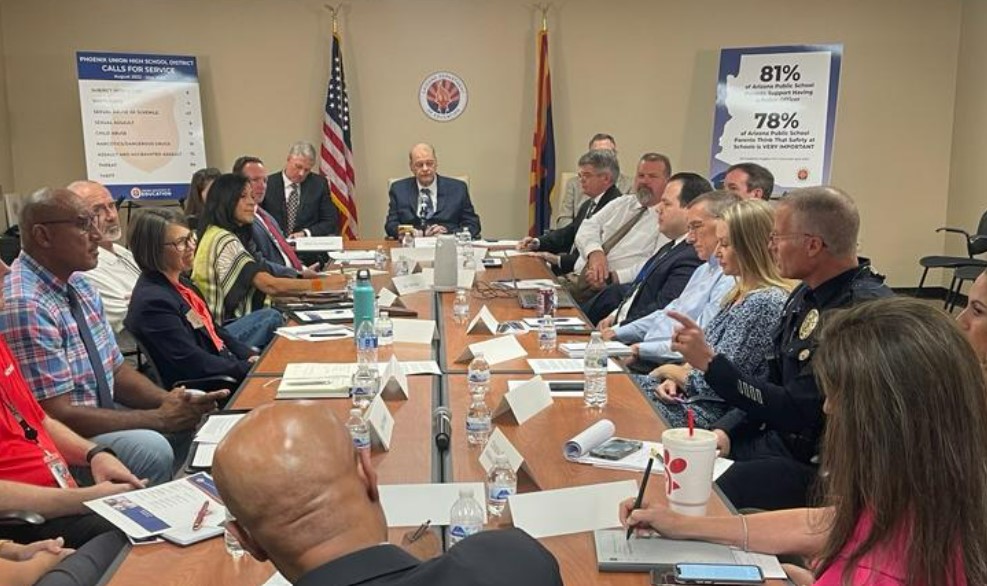
On Wednesday, Arizona Superintendent of Public Instruction Tom Horne announced that he had “convened the first School Safety Task Force with a focus on getting more armed officers in schools in concert with social workers to protect (the state’s) schoolchildren, educators, and staff.”
After the meeting, Horne released a statement, saying, “Protecting the lives of our children is one of the most important issues we face. We hope that the School Safety Task Force will work to increase the number of law enforcement officers and social workers in schools as well as using our role in Career and Technical Education to encourage more people to consider law enforcement as a profession. I am grateful for all of the educators, law enforcement professionals, community leaders and both Democrat and Republican elected officials who have come together in this vital, bipartisan effort.”
Freshman Republican Representative Matthew Gress, one of the participants in the meeting, added his thoughts on Twitter, writing, “As parents send their children to school, they have every right to expect they will come home safely. With experience as a former schoolteacher and school board member, I look forward to this opportunity to productively contribute to this very important conversation.”
Gress announced earlier this week that he had “accepted an invitation from Horne to serve on the Task Force recently established by the Arizona Department of Education. He noted that he had “particular interest in identifying how public schools can use available one-time funding to improve the capital facilities on campuses to improve school safety” and in “focusing attention on law enforcement response times to schools and bolstering the School Resource Officer program.”
The Arizona Department of Education highlighted that “in the meeting, department staff reported that funding for School Resource Officers (SROs) has been utilized to expand the number of SROs from 190 in the previous administration to 301 currently.” Additionally, the Department forecasted that “the group will explore ways to integrate counselors and social workers into an effective School Safety Program, expand the definition of an SRO in accordance with state certification requirements so the applicant pool can be enlarged; and consider allowing schools to hire School Safety Officers (SSOs), review training models, and review Law Related Education.”
In May, Superintendent Horne’s school safety recommendations were approved by the Arizona State Board of Education, giving the Department of Education approximately $100 million from a combination of federal and state grants. Horne said at the time, “I have been asking the schools to prioritize school resource officers. The nightmare is that a maniac gets into a school, kills 20 children, and the parents find out that the school could have had a school resource officer to defend the students, but the school did not do so. Imagine how the parents would feel about those decision makers?”
Horne isn’t the only elected official in Arizona concentrating on bolstering safety in schools across the state. Last month, Peoria Mayor Jason Beck announced that, in keeping his promises to his constituents, there would be a police presence at all Peoria Unified School District schools during the 2023-2024 year. Beck highlighted that there would be four new SLO’s (School Liaison Officers) and rotating SLO’s at every school; that this presence would be expanded to all elementary schools; that there would be 22 Peoria schools with police coverage and an increase in SLO salary.
The mayor said, “It’s the fact that we are trying to take care of our kids. Our first priority as a city is to take care of the residents. Safety and wellbeing is our first priority.”
Earlier this year, Republican Superintendent of Public Instruction Tom Horne and the Arizona Department of Education released the findings of a poll, which found that “81% of Arizona Public School parents support having a police officer” and “78% of Arizona Public School parents think that safety at schools is VERY IMPORTANT.”
Daniel Stefanski is a reporter for AZ Free News. You can send him news tips using this link.
by Daniel Stefanski | Aug 1, 2023 | Education, News
By Daniel Stefanski |
Arizona’s Democrat Governor and Republican Superintendent of Public Instruction continue to trade political volleys over the state’s Empowerment Scholarship Account (ESA) program.
Last week, Governor Katie Hobbs transmitted a communication to the state’s schools chief, Tom Horne, “requesting detailed plans for protecting the personal data of Arizona students and families (after) the company responsible for the financial administration of the ESA program, ClassWallet, experienced a data breach that prompted the activation of the state Incident Response Team at the Arizona Department of Homeland Security. The Governor’s Office then tied the recent departure of “two high ranking ESA officials” to the issue, writing that in the aftermath of their sudden and unexpected resignations, there were now “concerns and questions about the administration of the ESA voucher program and the protection of student data.”
Hobbs issued a statement, saying, “It is my responsibility to ensure the safety and security of our state, our agencies, and our people. Arizona students and families deserve to know that proper measures are in place to protect their personal information.”
Christine Accurso, one of the former ESA officials referenced by Hobbs, quickly responded on Twitter, stating, “Governor Hobbs the same type of breach has happened on this platform in the past, even as late as last December. This has nothing to do with the resignations. You should review all of the investigations and contact the contract holder, the State Treasurer’s office.”
Horne, too, wasted little time in getting back to Hobbs. Mere hours after the governor sent her letter, the Arizona Department of Education first publicized a comment from ClassWallet’s CEO Jamie Rosenburg, who said, “The problem has been solved. It was a permission setting error. Once discovered, we took immediate action and corrected the permission setting. Additionally, we performed a database search and concluded no other users were affected. Therefore, this is an isolated incident to a single user.”
Then, less than two hours after the ClassWallet response, Horne released a letter he had forwarded to the governor with his responses to her queries. In that letter, Horne first addressed Hobbs’ connection of the breach with the departure of two of his aides, writing, “The first point to make is that the decision of Christine Accurso and her assistant, who came on to straighten out the mess caused by the previous administration, and when that was accomplished, left to go on to other things, has absolutely nothing to do with any reported data breach.”
Answering Hobbs’ question of “what steps is your administration taking to address any potential violations of State statutes relating to student data privacy,” Horne said, “The Department of Homeland Security in your own office is conducting an investigation. They met with officials in our office. Since the department of homeland security is part of your office, we would have thought you would have checked with them before writing your letter that is full of wild exaggerations.”
Arizona Treasurer Kimberly Yee also weighed in on the governor’s letter, informing constituents of the steps her office had taken once she learned of the incident. Yee wrote, “We have received verbal confirmation from Homeland Security that the breach did not originate from the vendor. We have also been provided assurances from Homeland Security that the vendor and my office have responded appropriately to the incident. Based on information received, we are not aware of any existing data breach and have confidence that the ESA platform is secure.”
Christine Jones, the Founder of Bigfork Tech, shared her insights into the matter, tweeting, “1. This isn’t a data breach. More like a data leak/unintentional disclosure. 2. Why is Gov involved? Superintendent is elected position-doesn’t report to Gov. 3. Former AZ AG Horne knows how to address this. 4. Kimberly Yee handles admin and oversight of ClassWallet.”
Daniel Stefanski is a reporter for AZ Free News. You can send him news tips using this link.
by Corinne Murdock | Jul 27, 2023 | News
By Corinne Murdock |
Both the executive director and operations director of Arizona’s school choice program resigned on Monday.
In a statement, former executive director Christine Accurso said she accomplished her goal of getting the Empowerment Scholarship Account (ESA) Program “back on track and functioning well.” Accurso indicated that she would be taking on other opportunities in school choice activism.
“I hired, trained, and implemented a full staff of competent, professional people who love the program and will carry it forward,” said Accurso. “I achieved much of what I set out to accomplish, but it is time for me to move on and pursue opportunities to engage citizens, especially parents, to fight for school choice and the other issues they believe in, for the future of our state and of our nation.”
In a statement, the Arizona Department of Education (ADE) announced John Ward as Accurso’s replacement. Ward served as an ADE internal auditor and previously worked within the Auditor General’s Office.
Former operations director and vendor liaison, Linda Rizzo, also resigned. Rizzo also served as a regional director for the Arizona Federation of Republican Women.
ADE loosely echoed Accurso’s reasoning for her departure in their explanation of her resignation, crediting her for “unprecedented growth” within the ESA Program.
Superintendent Tom Horne appointed Accurso to the position last November. Horne selected Accurso for her knowledge and experience with the ESA Program, as well as her advocacy to universalize its opportunities. As a member of the ESA Program herself, she was a constant advocate for Horne’s election.
Last year, Accurso led the Decline to Sign movement: a counter-movement to the Save Our Schools Arizona (SOSAZ) ballot initiative to overturn legislation that universalized school choice. As part of her advocacy, Accurso discovered that SOSAZ overreported the number of signatures they collected for the ballot initiative. Accurso’s publicization of this discovery prompted an expedited review of the signature count.
Over the last few years, Accurso also raised awareness of the unresponsive ESA Program helpline.
In January, Accurso told AZ Free News about issues inherited from the prior superintendent’s administration indicating neglect of the ESA Program.
Over 60,500 students now participate in the ESA Program as of Monday. Ward has estimated that the ESA Program will reach 100,000 applicants by next July.
READ THE LATEST ADE QUARTERLY REPORT
With the double departure from the ESA Program, Democratic leaders highlighted weaknesses of the program.
On Monday, Attorney General Kris Mayes announced a renewed focus on investigating ESA Program fraud and loss of federal discrimination protections concerning disabilities and educational records. Mayes encouraged members of the public to report cases of fraud by ESA vendors or private schools.
On Tuesday, Gov. Katie Hobbs’ Office of Strategic Planning and Budgeting (OSPB) released a report projecting a budget deficit of $319.8 million next fiscal year with the ESA Program costing about $943.8 million annually by the next fiscal year. Hobbs alleged the ESA Program would “bankrupt” the state.
“[T]his program is unsustainable and does not save taxpayers money,” said Hobbs. “We must bring transparency and accountability to this program to ensure school vouchers don’t bankrupt our state.”
The OSPB disputed ADE’s claim that the ESA Program costs less to taxpayers since it pulls children from public schools, noting that about 40,400 non-public school students would receive funding where before they hadn’t. The OSPB also claimed that individual student payouts for the ESA Program are more costly than what public schools pay.
“The ESA program is unaccountable and overfunded,” stated the OSPB.
The governor’s team asked for ADE to implement academic testing requirements and audits for schools accepting ESA funding, requiring staff to be fingerprinted, and requiring students to attend a public school prior to enrollment.
The ESA Program admittance requires at least 45 days of attendance at a public school.
Corinne Murdock is a reporter for AZ Free News. Follow her latest on Twitter, or email tips to corinne@azfreenews.com.
by Daniel Stefanski | Jul 26, 2023 | Education, News
By Daniel Stefanski |
Arizona’s Republican Superintendent of Public Instruction and Democrat Attorney General are again at opposite ends of the state’s Empowerment Scholarship Account (ESA) program.
On Monday, Superintendent Tom Horne responded to Attorney General Mayes’ recent comments about the ESA program, setting his department’s record straight.
Earlier in the day, Mayes issued a press release to “provide information about rights forfeited leaving the public school system.” The Attorney General first addressed parents of children with disabilities, stating, “Families should not be denied admission or kicked out of private schools because of a child’s disabilities. To make matters worse, private schools often refuse to share the educational records behind those decisions Because Free and Appropriate Public Education (FAPE) and the Family Education Rights and Privacy Act (FERPA) don’t apply to private schools, families have no recourse under federal law. It’s important for Arizona families to be aware of the rights they give up when they leave the public school system.”
Horne pushed back on the Attorney General’s notice, saying, “(Mayes) raised several issues, one of which centers on special education students. Under the ESA program, special education students receive the same funding as they would attending a public school.”
Mayes broached another issue on her consumer alert – this one about the ESA program and its vendors as a whole. The Attorney General’s Office wrote, “If using ESA funds for private school or schooling at home is the preferred educational choice, families should make sure they choose reputable schools and vendors. Even still, families should know that when they accept an ESA, they lose protections from discrimination related to a child’s learning abilities, religion and sexual orientation.”
The Attorney General said, “As a mom, I know how important a child’s education is and I know that, as parents, we all want what is best for our children. I want families to know that if vendors or private schools take advantage of this, the Attorney General’s Office will investigate to the fullest extent of our authority.”
Horne didn’t leave this part of Mayes’ release alone either, making sure onlookers understood his administration is dedicated to following the law. Horne stated, “In regards to the other concerns raised, under my Democrat predecessor as schools chief, the law was not strictly followed and ESA funds were used for non-educational purposes. One of my first acts when I took office was to hire from the Arizona Auditor General an internal auditor for the Department of Education. This person makes sure that every ESA transaction is conducted according to the law and all funding is used appropriately. There have been significant protests against me from people who were used to the old lax system, but I am insisting that every law is strictly followed and that every penny of these funds is used for valid educational purposes.”
The state’s top prosecutor received accolades for her statements from at least one Democrat legislator, Representative Nancy Gutierrez, who tweeted, “Thank you Attorney General Mayes for making it clear that private schools do not give students and families the same rights as public schools.”
The Arizona school chief’s response to Mayes follows two other significant battles between the two since they entered office this past January. Just last week, Horne called a recent formal opinion from Attorney General Mayes on a Structured English Immersion law “ideologically driven.” He also pushed back against Mayes when she went on television to say that “there are no controls” on the ESA program, “no accountability,” that “they” (presumably parents) are “spending hundreds of millions of dollars of taxpayer money,” that this “needs to be looked at,” and that it’s (her) “responsibility to do that” as Arizona’s “top law enforcement officer.”
Daniel Stefanski is a reporter for AZ Free News. You can send him news tips using this link.