Arizona’s schools chief is continuing his quest to make state schools safer.
Last week, Arizona Superintendent of Public Instruction Tom Horne released a number of recommendations from his administration’s task force meant to strengthen school safety.
Superintendent Horne said, “The safety of our schools is of the utmost importance. There is no greater nightmare than to contemplate a maniac shooting up a school and it’s essential that everything is done to increase campus safety. This committee has done remarkable work and now the task is to get these proposed changes implemented so we can make the state’s school safety program even stronger.”
A handful of the recommendations from the task force involve changing state laws, which the Arizona Legislature would have to approve through legislation and then the governor would have to sign. Those changes are as follows:
Removing barriers to allowing retired law enforcement officers to work as School Resource Officers.
Allowing for the school safety program to pay for School Safety Officers and school psychologists in addition to the other positions currently included in the program.
Adding increased mental health training to focus on adolescent mental health issues, education privacy law and civil rights matters.
Adding language to the law requiring attention to school architecture, ingress and egress and safety technology and training.
The task force also recommended steps for the Arizona Department of Education to enact within its statutory responsibilities, including the following:
Reviewing and providing additional safety training and materials.
Hosting an annual conference for educators, law enforcement and mental health professionals.
Pursuing partnerships with entities that can help encourage workforce development in the social work and mental health sectors.
According to Horne’s office, his task force “consists of educators, legislators, representatives of mental health professions, law enforcement, and other community leaders.”
With the next legislative session just weeks away, the recommendations from the school safety task force may come at a perfect time to put the issue in front of lawmakers returning to work in January. Since school safety is a priority of Horne and his administration, he and his team will surely be lobbying for these changes and attempting to work with legislators from both sides of the aisle as they attempt to keep Arizona boys and girls safe at their schools.
Daniel Stefanski is a reporter for AZ Free News. You can send him news tips using this link.
Arizona’s schools chief is literally turning his back to antisemitism.
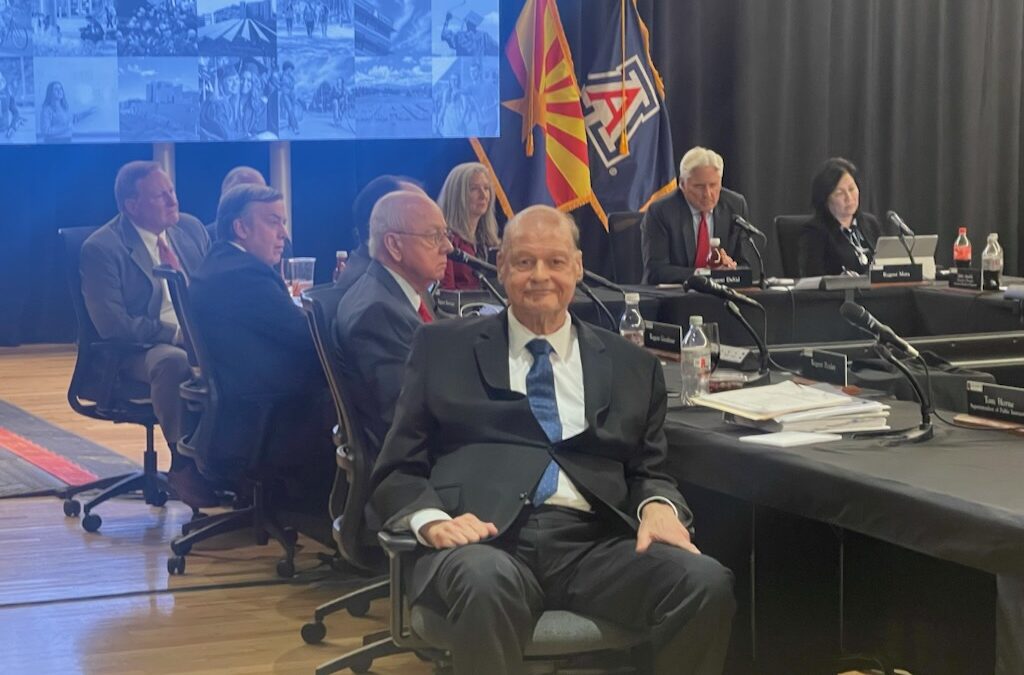
Earlier this month, the Arizona Department of Education posted a picture on “X” of Superintendent of Public Instruction Tom Horne at a recent Board of Regents meeting with the caption, “Superintendent Horne will not tolerate antisemitism. When protestors started speaking in support of a terrorist organization at the Arizona Board of Regents meeting, he turned his back to hatred.”
Superintendent Horne will not tolerate antisemitism. When protestors started speaking in support of a terrorist organization at the Arizona Board of Regents meeting, he turned his back to hatred. pic.twitter.com/s2DTM6DSF5
This gesture from Horne follows a recent press conference he hosted to “denounce antisemitic and anti-American materials provided by two organizations at a high school club event that made Jewish students feel unsafe.” The high school where this action occurred at was Desert Mountain High School in Scottsdale.
Horne minced no words in alerting the public to the dangers to students by the presence of these materials at this school – or any school in the state, saying, “The materials presented to these students were profoundly antisemitic in particular and anti-American, in nature. Some of the material states that ‘Palestinians have been subject to killings, torture, rape, abuse, and more for over 75 years.’ This is a ‘blood libel’ similar to the blood libels used in the Middle Ages to get people to go out and kill random Jewish people.”
In an interview with a national outlet, Horne explained why this issue has been so important to take a stand on, saying, “All of my extended family were killed in the Holocaust. So I grew up with just my parents and my sister. No grandparents, no nieces and nephews, no uncles or aunts. They were all killed. So when I see signs of antisemitism developing in the United States, you can imagine it’s something that affects me personally.”
Daniel Stefanski is a reporter for AZ Free News. You can send him news tips using this link.
Earlier this month, Arizona’s schools chief took a stand against antisemitic and anti-American materials at state schools.
Superintendent of Public Instruction Tom Horne held a press conference to “denounce antisemitic and anti-American materials provided by UNICEF and Amnesty International at a high school club event that made Jewish students feel unsafe.”
The reason for Horne’s press conference, according to the release from the Arizona Department of Education, was due to tips from “several community members who had learned of antisemitic and anti-American materials being presented at a lunchtime club sponsored by those organizations…at Desert Mountain High School in Scottsdale.”
Horne minced no words in alerting the public to the dangers to students by the presence of these materials at this school – or any school in the state, saying, “The materials presented to these students were profoundly antisemitic in particular and anti-American , in nature. Some of the material states that ‘Palestinians have been subject to killings, torture, rape, abuse, and more for over 75 years.’ This is a ‘blood libel’ similar to the blood libels used in the Middle Ages to get people to go out and kill random Jewish people.”
The Republican superintendent pointed out the failure of these materials to document the truth of the horrific attacks in southern Israel on October 7. He said, “In none of this propaganda is there any reference to what happened on October 7. The fact that 1,400 civilians were murdered does not begin to describe to horror of what Hamas did. They went house to house in the neighborhoods, machine gunning entire families, and sometimes killing fathers in front of their children and children in front of their fathers. They copied the Nazi technique of setting fire to houses so that people would burn to death, or if they came out of the fire house, killed them upon their exit. The actions of Hamas are a repetition of what happened during World War II. Yet the materials make no mention of October 7.”
Horne shared an email he had sent to each district superintendent across the state, asking that their schools refrain from inviting UNICEF and Amnesty International and soliciting any materials from these two groups to campuses. The schools chief warned that “giving aid and comfort to terrorists is contrary to US law,” and that the groups and their literature “generate antisemitism among impressionable young people.”
Daniel Stefanski is a reporter for AZ Free News. You can send him news tips using this link.
Last week, Republican Superintendent of Public Instruction Tom Horne announced that his office would be issuing a $10 million grant “for public schools to purchase art supplies.”
Superintendent Horne is proud to announce a $10 million grant. The funding will provide successful district and charter school applicants with $1,000 per full-time art teacher to purchase art consumables. #EducationForAllhttps://t.co/Wgk1anEQfb
The Art Consumable Grant, according to the Arizona Department of Education’s release, will deliver funds to “successful district and charter school applicants…to purchase arts consumables such as paints, brushes, sheet music, dance props, theatrical costumes, and much more.” Selected schools will receive $1,000 for every full-time arts teacher.
In a statement that accompanied the announcement, Superintendent Horne said, “I am a passionate supporter of arts education; it is an essential part of any successful school. There are studies that show learning how to play stringed instruments helps students do better in math, so there are both aesthetic and academic benefits to arts education. I am pleased to encourage schools to apply for these funds to support arts education throughout Arizona.”
The Department encouraged Arizona district and charter schools to apply for the Art Consumable Grant. Schools have until December 31, 2023 to submit their applications for these funds.
Daniel Stefanski is a reporter for AZ Free News. You can send him news tips using this link.
On Wednesday, the Arizona Department of Education (ADE) unveiled a new program using off-duty cops to supplement the shortage of safety officers on campus.
Under this new program, ADE filled its school resource officer (SRO) force from 190 to 301 positions — despite the statewide officer shortage. Superintendent Horne said in Wednesday’s press conference announcing the new program that an increase to SROs was one of his main priorities.
Horne said that the state’s police officer shortage initially posed a problem to the SRO increase. That meant that the fully-funded SRO positions had no officers to fill them. To work around this issue, Horne explained that the ADE contracted with Off Duty Management (ODM), which enables law enforcement to pick up off-duty shifts.
Horne credited Mike Kurtenbach, head of ADE’s school safety division and former Phoenix Police Department assistant chief, for the idea. Horne noted that their arrangement with ODM ensures full coverage at schools.
“We don’t involve partial coverage. The nightmare is that some maniac walks into a school and kills 20 kids — this has happened in other states and could happen here — and there’s no one there to protect the kids,” said Horne.
ODM President Bryan Manley thanked ADE for engaging in an “innovative” approach, the first of its kind in the state. ODM traditionally works security for businesses or venues, such as movie theaters.
Traditionally, SROs are fully-dedicated officers to a school that receive a minimum of 40 hours of training to work in schools. These ODM-deployed officers will be armed off-duty officers that receive a foundational 8 hours of specialized training from ADE for working in schools, on top of the 650 hours minimum of basic training to work in a police department, as well as field and on-the-job training.
Horne noted that the city of Phoenix has declined to participate in the SRO arrangement. Phoenix police force shrank last week to 2,561, according to Kurtenbach. As such, law enforcement from surrounding areas like Peoria will have ODM-deployed officers for Phoenix-area schools.
In response to reporter queries about parental concerns of increased arrests or intimidation of students, Horne said that the officers would provide order and a feeling of security — not fear. The superintendent said that those upset that some students may be arrested on campus were perpetuating the idea that “it’s okay to break the law without consequence.”
“This will allow us to provide a safe environment for more of our schools,” said Horne. “People should not be afraid of the police officers. The police officers are there to protect us. Without the police officers, we would have no civilization.”
Horne paraphrased 17th-century English philosopher Thomas Hobbes to supplement his claim, noting that civilized societies have a healthy and appreciative relationship with their law enforcement.
“Life becomes ‘solitary, nasty, brutish, and short’ if we don’t have police officers to protect civilization. It’s a very bad attitude to have a negative attitude toward police officers,” said Horne.
Recent student shooting threats have concerned students who have brought guns to campuses at Bostrom High School, Linda Abril Educational Academy, Maryvale High School, and North High School (Phoenix Union High School District); Kyrene de la Estrella Elementary School (Kyrene School District); and Desert Ridge High School (Gilbert Public Schools).
John Croteau, Dysart Unified School District superintendent, expressed gratitude for the ADE’s “creative” expansion of SROs.
“Safety is one of the most important things, if not the most important thing we can provide in education,” said Croteau. “We know that our students won’t learn if our students don’t feel safe, and that goes for the employees and staff [as well].”
Troy Bales, Paradise Valley Unified School District superintendent, added that he looked forward to the further expansion of the SRO presence on campus through the new program.
Watch the full press conference here:
Corinne Murdock is a reporter for AZ Free News. Follow her latest on Twitter, or email tips to corinne@azfreenews.com.