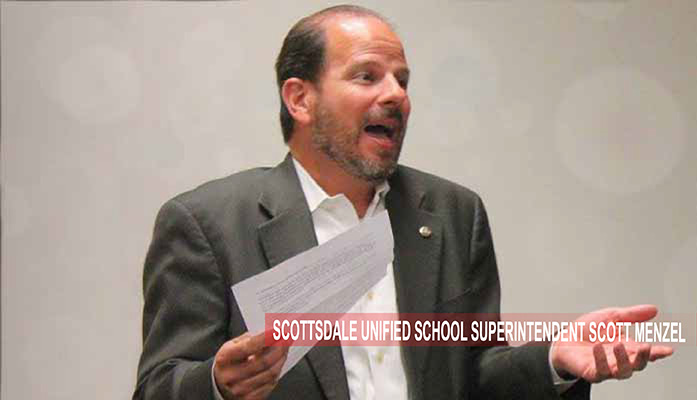
by Mike Bengert | Jun 16, 2025 | Opinion
By Mike Bengert |
Following multiple complaints regarding the social studies curriculum recently approved by the Scottsdale Unified School District (SUSD) Governing Board on May 13, the Arizona Department of Education launched a formal investigation. On Wednesday, June 11, Arizona State Superintendent Tom Horne held a press conference to announce the findings. He stated that he would report to the federal government that SUSD violated a statement they signed saying they would not teach Diversity, Equity, and Inclusion (DEI) content.
Horne clarified that his comments were directed at what he called the three “woke” members of the SUSD Governing Board who voted in favor of the curriculum. Superintendent Scott Menzel responded to this characterization, arguing it was unfair and uninformed—particularly without a full review of the 1,250-page textbook. He called such labeling “a problem from his perspective.”
While finding a common definition of “woke” is a bit of a challenge, most would agree that it originally meant being aware of social injustices, particularly around race, and it was rooted in activism. The term has now evolved into a broader often vague term for hyper-awareness of social issues. Critics often say it is dogmatic overreach where someone pushes rigid beliefs or ideologies beyond reason, imposing them on others without flexibility or evidence.
So, is it fair to describe these board members as “woke”?
Board Members Past
When Member Sharkey first announced he was running for the board, he said it was because of the rise in the parents’ rights movement (rights codified in Arizona Revised Statues), which he blamed (without citing any evidence) for the issues plaguing SUSD. He rejects the idea that parents are best positioned to make educational and healthcare decisions for their children, asserting that trained professionals know better. Sharkey’s reluctance to recognize these rights suggests a troubling approach to governance that may not prioritize parental input nor respect their legal parental rights.
Dr. Donna Lewis, SUSD Governing Board President, ran on her years of educational experience, including being selected as the national superintendent of the year during her time at the Creighton School District. Her academic record leaves a lot to be desired with 13% of her students proficient in ELA and 8% in math the year she was selected. Additionally, her leadership style has been criticized for creating a hostile and toxic environment, prompting a formal public apology from a school board member after her departure.
Then there is Dr. Pittinsky, another education professional and an expert in public education with 25 years’ experience. Someone who only publicly revealed the conflict of interest with his business ties with SUSD after he was called out. Someone who thinks so highly of SUSD that he put his kid in a private school rather than SUSD.
All three of these board members ran on “protecting SUSD” and Menzel and his “woke” curriculum of DEI, SEL, and gender identity. So far, they have shown themselves to be a predictable rubber stamp for whatever Menzel wants.
Dogmatic overreach?
Superintendent Menzel’s Past and Controversial Remarks
Superintendent Menzel previously led Michigan’s Washtenaw Intermediate School District, where he emphasized equity, inclusion, and social justice. In an interview before leaving Michigan, Menzel described white supremacy as deeply embedded in the fabric of American society, stating that acknowledging it offers a chance to “dismantle, disrupt, and recreate something that’s socially just and more equitable.”
These comments drew sharp criticism from Arizona GOP legislators, who labeled his statements as divisive and inappropriate for someone in public education.
Read it for yourself:
So, is it proper to label the three board members as “woke”?
I’ll let you draw your own conclusion.
Curriculum Content and Allegations of Bias
In addition to Horne, Maricopa County Sheriff Jerry Sheridan also raised concerns about the new social studies curriculum and the anti-police messages they contain. Examples of anti-police rhetoric include textbook passages noting that “several police killings caused the nation to grapple with systemic racism,” and “Black Lives Matter activists and others argue that the deaths of many Black people were the result of institutional racism.” The text also mentions that Black men are statistically more than twice as likely to be killed by police than white men.
Critics argue these lessons present a one-sided perspective and fail to encourage critical thinking. For example, the curriculum omits key facts in controversial cases, such as the Department of Justice findings in the Michael Brown case in Ferguson, Missouri, which concluded that Brown did not have his hands up and was engaged in a physical altercation with the officer trying to take his gun. Likewise, the curriculum does not mention a Harvard study that reportedly found no racial bias in police shootings after examining hundreds of cases.
Menzel has denied that the curriculum is anti-police or promotes indoctrination, insisting it encourages critical thinking and offers diverse perspectives. However, critics argue the content leans more toward ideological teaching than balanced education. Indoctrination, they argue, is defined by presenting only one viewpoint without room for discussion or dissent—contrary to the principles of real education, which promote inquiry and evidence-based analysis.
Again, don’t take my word for it, see for yourself:
Conclusion
Given the content of the curriculum, the past actions of the board members, and Superintendent Menzel’s own public remarks, it seems labeling the board members and even Menzel as “woke” is appropriate.
When Menzel tells you he would never use an anti-police curriculum or that he is promoting critical thinking among students, or there is no evidence to support any of the claims against the curriculum, don’t believe him. He is lying and trying to gaslight you.
It is incumbent on all of us concerned about the future of SUSD to contact the Governing Board members and tell them to withdraw the approval of this radical curriculum. Any purchase orders placed to procure the materials should be canceled.
SUSD is facing difficult financial challenges caused by declining enrollment, a result of Menzel’s failed policies. Continuing down the path of implementing this curriculum will not only serve to accelerate the declining enrollment but put millions of federal dollars at risk. With the loss of the federal money, can school closures be far behind?
Menzel can continue to lie and push back against the federal government, but he is playing a high-risk game, a game he is likely to lose. He is putting the future of SUSD in jeopardy to satisfy his own ego.
The Governing Board needs to seriously consider replacing Menzel before he completely destroys SUSD.
Mike Bengert is a husband, father, grandfather, and Scottsdale resident advocating for quality education in SUSD for over 30 years.
by Matthew Holloway | Jun 15, 2025 | Education, News
By Matthew Holloway |
Arizona Superintendent of Public Instruction Tom Horne announced that his office will report Scottsdale Unified School District (SUSD) to the federal government for violating the “No DEI” pledge signed by district Superintendent Scott Menzel. The announcement came after SUSD adopted a DEI-oriented curriculum, despite objections from parents.
Horne explained, “Today I’m announcing that I will report to the federal government that the Scottsdale School District has violated the statement they signed that they would not teach DEI. They adopted a DEI-oriented textbook, or more than one book actually, over parental objections.”
The superintendent was joined by Maricopa County Sheriff Jerry Sheridan who expressed major concerns regarding the objectively anti-police narrative that the text in question indoctrinates students with.
“At a time when law enforcement agencies are expanding their focus on community outreach and de-escalation of conflicts, it is counterproductive for schools to push a misguided and inaccurate narrative that will make students fearful or suspicious of their local law enforcement officers,” Sheridan said. “The men and women who wear the uniform in Arizona, are among the bravest and most noble public servants in this great state. Many are first responders, who put their lives on the line each day to keep our youth and our communities safe.”
Horne cited several examples of what he called the “unbalanced political propaganda” in the text: “U.S. History Interactive” by the Savvas Learning Company.
“At page 1033: ‘many people, including Black Lives Matter activists argued that these separate events as Well, as well as the death of many Black people in earlier years was the result of deeply embedded racism.’ Nothing was said about what other people may be saying. Other people do not believe that racism is deeply embedded in the United States.”
“On the same page referring to the 2020 riots: protest marches were generally peaceful Horne pointed out that ‘we’ve all seen the video on television of a reporter saying that surrounded by burning buildings and attacks on police cars.’”
“At page 1025, referring to the incident at Ferguson: ‘one witness claimed that before being shot, Brown had raised his hands and said ‘don’t shoot!’ Horne pointed out: ‘To his everlasting credit, Eric Holder, the first African American United States Attorney General in history, conducted an objective investigation, and concluded that officer Wilson shot Ferguson in self-defense. Limiting the discussion to what one witness said was extremely misleading.’”
“At page 1026: ‘a basic tenet of democracy is that power should belong to the people. But what can people try if they feel they’re not being heard or if they live under an authoritarian system? Civil resistance, encompasses a broad range of lawful and nonviolent action aimed at returning power to the people. Use this video as a brief introduction.’
Horne pointed out: “the United States is a Democratic Republic. We do not have a monarch. Officials are elected by a vote of the people. This gives everyone the opportunity, if they disagree with what the government is doing, to campaign for the election of someone else. That is the solution to disagree with government policy. Students are being encouraged by the video to engage in civil resistance to a democratically elected government. The suggestion in this quotation that the United States is an authority system is a woke lie.“
“From Page 167: ‘renovations and improvements conforming to middle-class preferences has driven up the demand for housing and the cost of living in these neighborhoods, making it difficult for less affluent more vulnerable LGBTQUI plus populations to live there’.” Horne replied: “I will not comment on what QUIA plus means, but the suggestion that LGBT people are financially oppressed is extremely misleading. Many LGBT People are quite prosperous. The median income for men in same-sex marriages is $149,900. The median income for men in opposite sex married couples is $124,900.”
Horne also cited issues with a human geography book also used by SUSD: “APHUG 5: Human Geography: A Spatial Perspective, Bednarz et al., Cengage, 2022”
The text states: “Republican lawmakers in some states have packed African-American voters into a single district or small number of districts thereby creating majority Republican districts in the rest of the state.’”
Horne’s response was incredulous: “This was a civil rights project of the Democratic Party. The goal was to assure minority representation in Congress. The Republican Party had nothing to do with it.”
According to AZFamily, Scottsdale Superintendent Scott Menzel rejected Horne’s assessment saying, “To label them woke without having ever read what was the 1,250 pages in the textbook is a problem from my perspective.” Horne replied to reporters that he had read all the passages he quoted. Menzel claimed that content experts reviewed the text and made an informed recommendation conforming to Arizona state standards.
“We would never adopt a curriculum that was anti-police,” Menzel told reporters. “We do have historically situations where some people argue that we should defund the police. Here in Arizona we had people who removed school resource officers. That’s not something that we would ever contemplate, but from a historical perspective our students should be able to wrestle with why someone might have made that argument.”
In a statement released SUSD said, “Horne’s claims of indoctrination and a so-called ‘leftist curriculum being imposed’ on students are simply untrue and unsupported by fact,” without refuting the examples cited by Horne.
Matthew Holloway is a senior reporter for AZ Free News. Follow him on X for his latest stories, or email tips to Matthew@azfreenews.com.
by Mike Bengert | May 16, 2025 | Opinion
By Mike Bengert |
Last Tuesday night, the Scottsdale Unified School District (SUSD) Governing Board held what could only be described as a marathon meeting, lasting six and a half hours, including the executive session. The agenda was packed with items, but one issue drew the most attention: the proposed adoption of a new Social Science curriculum.
Eighteen individuals participated in the public comment portion of the meeting. All but one focused on the curriculum. A significant majority urged the Board not to adopt it, citing deep concerns. Opponents argued that the curriculum was saturated with DEI narratives, anti-law enforcement bias, gender ideology, climate activism, misleading COVID-19 claims, and advocacy for student activism over academic learning. Their primary concern: the curriculum fosters political indoctrination, not education.
Despite their differences, both supporters and critics of the curriculum appeared to agree on two points: students need to be taught the truth about current events, and they must learn to think critically. The debate centers on what constitutes the truth and how critical thinking should be developed.
Those supporting the curriculum’s adoption argued that it presents an honest, if uncomfortable, portrayal of America, especially regarding race and law enforcement. The curriculum cites examples like the 2014 police shooting of Michael Brown in Ferguson, Missouri. It emphasizes that Brown, an unarmed Black teenager, was shot six times and killed by a white police officer, and points to the incident as emblematic of systemic racism.
The curriculum also discusses the rise of the Black Lives Matter (BLM) movement and its evolution from protesting police brutality to addressing broader systemic issues like housing, healthcare, and employment disparities for Black Americans.
Additional content includes explanations about gender identity, stating individuals can identify as male, female, both, or neither. The curriculum also addresses the COVID-19 pandemic, stating that the FDA approved two highly effective vaccines and suggesting that lockdowns saved lives. It frames the environmental benefits of lockdowns as evidence of climate change and the need for continued action.
One speaker supporting the curriculum even admitted that for those questioning these narratives, “I don’t know what to say.”
Critics, however, challenged these representations as incomplete or misleading. Regarding the Michael Brown case, there is no mention that the Department of Justice’s investigation found Brown was attacking the officer and trying to take his weapon—his DNA was found on the gun—and that the claim he had his hands up saying “don’t shoot” was debunked in court. By omitting these critical facts, the curriculum pushes a one-sided narrative that paints law enforcement as inherently racist.
If the goal were truly critical thinking, the curriculum would also include studies like that of a Harvard professor, who, despite his preconceived belief that there is racial bias in policing, found no racial bias in police shootings after analyzing hundreds of cases. An honest and open discussion would allow students to examine why Black Americans commit crimes at a rate disproportionate to their population, not just claim they are victims of systemic racism. Perhaps the high rate of crimes being committed by young Blacks might explain their high rate of involvement with the police. But with this curriculum, it is doubtful the students will ever have such a discussion.
Law enforcement professionals also voiced concerns. The President of the Maricopa County Colleges Police Officers Association, a former Scottsdale police officer, and the Maricopa County Sheriff’s Office both criticized the curriculum’s anti-police tone. They warned that such content erodes trust between youth and law enforcement—trust, they say, is essential for community safety.
Rather than comparing the BLM movement to the civil rights movement and implying BLM has done great things for Blacks in America, why not tell the truth that the leaders of BLM stole money and bought houses for themselves? Or that several of the local chapters said nothing has been done by BLM to help Blacks in their communities.
Critics also took issue with how the curriculum handles topics like climate change and COVID-19. The omission of data showing that Antarctica has gained ice in recent years, information that contradicts climate change alarmism, is concerning. While skeptics of the climate narratives are called “science deniers,” the curriculum promotes the idea that there are more than two genders and that gender is fluid is a fact, when it’s really a denial of biological science.
On COVID-19, the curriculum claims the vaccines were effective at preventing infection but fails to acknowledge how the scientific narrative evolved. Initial claims about vaccine efficacy were later revised, with experts clarifying that while vaccines may not prevent infection, they can reduce the severity of symptoms. The curriculum also omits discussion of the high survival rate of COVID-19, 99%, particularly in children, and the long-term educational harm caused by prolonged school closures. There is no mention of the fact that the government actively blocked any negative discussion about the vaccine, including reporting on the severe negative side effects many people experienced.
One especially controversial element of the curriculum encourages students to take political action, such as organizing protests or social media campaigns, in support of transgender rights, or creating NGOs, leading critics to argue that it turns students into political activists.
Questions were also raised about how the curriculum was reviewed and recommended. Supporters of the adoption process claimed the committee’s work was “thorough and inclusive,” but the review committee was composed mostly of teachers, with only one community member, who happened to be the spouse of a former Board member, and no parents on the committee. One supporter of the curriculum told the Board members it was their responsibility to approve the committee’s recommendation, apparently without considering the curriculum themselves and just rubber-stamping the committee’s work. I don’t think so.
There are financial implications, too. Because the curriculum includes DEI and gender identity material, the SUSD risks losing funding—not just from government sources but also due to declining enrollment—as some families opt out of SUSD altogether. This ongoing trend of declining enrollment tracks with Dr. Menzel’s leadership of SUSD. Not only are students leaving, but critical, experienced staff and teachers are leaving. At this time, only about 50% of the eligible students attend SUSD—a dismal number, but reflective of just how well SUSD is perceived in the community.
I urge you to do your research on the curriculum and draw your conclusions. Follow Scottsdale Unites for Educational Integrity on X to see the specific examples taken directly from the textbooks, and watch the May 13, 2025, Board meeting on YouTube to see the discussion for yourselves.
Keep in mind that indoctrination aims to instill a specific set of beliefs or ideas without allowing for critical thinking or questioning, whereas education encourages exploration, curiosity, and independent thought, fostering a deeper understanding through evidence and critical analysis.
After doing your research, ask yourself: Is this curriculum indoctrination or education? Which do you want for your child?
The current Board makeup makes any substantial changes in SUSD unlikely. Dr. Menzel’s apparent security in his position of “leadership” means we can expect him to continue his destruction of SUSD. I expect to see more 3–2 votes going forward and remain skeptical about the Board’s willingness or ability to restore trust and balance in SUSD and the classroom.
As this school year comes to an end, talk to your kids about what has gone on in their classrooms. What have they learned? Go to the SUSD website and look at the materials they will be using next year. If the information you are seeking is not available, use the Let’s Talk feature to question the staff and Dr. Menzel. If you find something objectionable, exercise your rights under Arizona law and opt your kid out of lessons.
Go to the Arizona Department of Education website and check the academic performance of your child’s school, or the new one they will be attending next year. Don’t fall for the SUSD hype of having so many A+ schools; rather, compare that rating to the academic performance of your schools. Does it meet your definition of A+? You just might be surprised at what you find.
Not every parent can take their child out of SUSD. Many will return next year, but despite the challenges, we must continue to strive for change in SUSD. Get involved. Go to Board meetings. Email the Board with your thoughts and concerns. Talk to the teachers. I know everyone is busy, but you can’t sit idly by and expect others to do the work by themselves. The number of people involved matters.
It’s your kid’s future we are talking about.
Mike Bengert is a husband, father, grandfather, and Scottsdale resident advocating for quality education in SUSD for over 30 years.
by Staff Reporter | Apr 25, 2025 | Education, News
By Staff Reporter |
Scottsdale Unified School District (SUSD) parents are attempting to reverse the relaxation of the district’s dress code.
SUSD surveyed Scottsdale Parent Council (SPC) members about the district’s dress code, which parents criticized for failure to indicate a requirement for students to cover their midriffs.
The survey, shared by Scottsdale Unites For Educational Integrity (SUFEI), only included “genitals, buttocks, chest, and nipples” in its description of “private body parts” in a question to parents about appropriate student clothing.
SUFEI urged parents to respond to the survey in opposition to the question of appropriate student clothing and to leave a comment explaining their support for qualifying the midriff as a private body part.
Current SUSD dress code does not require students to cover their midriffs. However, the dress code does prohibit students from wearing anything deemed “hate speech,” along with any clothing depicting profanity, nudity, or pornography.
In 2022 emails reported by the Arizona Daily Independent last fall, the governing board’s then-vice president Libby Hart-Wells reportedly pressured SUSD administration to override the district’s Code of Conduct to allow girls to wear clothing that exposed the midriff.
Hart-Wells, who presided over the board last year, no longer serves on the board.
Most other districts around the Valley do not allow midriffs and have maintained the traditional set of dress codes, but several have begun to loosen their dress codes as well.
In 2023, Higley Unified School District (HUSD) removed policy language prohibiting clothes which “immodestly exposes the chest, abdomen, midriff, genital area, or buttocks,” instead reducing the prohibition to clothing exposing “undergarments [or] undergarment areas.”
Last year, Tucson Unified School District revised its policy citing concerns of sexism and equity, effectively allowing students to expose most of their breasts along with their entire torsos and buttocks.
Scottsdale parents concerned with the relaxed dress code are also coming off of other, more significant concerns with the district. Last year, the governing board approved a bonus to Superintendent Scott Menzel despite lower test scores. Menzel earned the bonus based on meeting several nonacademic achievement goals over the course of a year, not any of the academic ones: increased attendance rate, increased student extracurricular and cocurricular activity participation, increased certified staff retention, an established baseline for work-based learning opportunities and hours, and the production of a decision making matrix and proposal.
Under Menzel’s leadership for the past four years, SUSD enrollment dropped by over 1,500 students and science scores dropped 24 percent. Less than 50 percent of 8th grade SUSD students were proficient in math, despite 94 percent of students graduating.
Menzel has been a proponent of more progressive ideologies, such as those behind critical race theory and LGBTQ+ lifestyles. Menzel has defended the inclusion of sexualized discourses and subject matter on campuses as protected under Civil Rights law.
Menzel came to SUSD in July 2020 amid the racial reckoning sweeping the nation following George Floyd’s death in police custody. The year before, while still a superintendent in Michigan, Menzel gave an interview calling the white race “problematic” and meritocracy “a lie.”
“[White people] should feel really, really uncomfortable, because we perpetuate a system by ignoring the realities in front of us, and living in a mythological reality,” said Menzel. “In this country it’s about meritocracy. ‘Pull up yourself by your bootstraps, everybody has the same opportunity.’ And it’s a lie.”
The discovery of these past remarks prompted Scottsdale lawmakers to advocate for Menzel’s removal.
Arizona Superintendent of Public Instruction Tom Horne also advocated against Menzel’s contract renewal last fall.
AZ Free News is your #1 source for Arizona news and politics. You can send us news tips using this link.
by Mike Bengert | Apr 10, 2025 | Opinion
By Mike Bengert |
At the April 1 meeting of the Scottsdale Unified School District (SUSD) Governing Board, the main topic of discussion was once again the FY2025-2026 budget. As usual, SUSD Chief Financial Officer Shannon Crosier presented slides filled with numerous figures and did her best to put a positive spin on the information, carefully avoiding direct answers to the questions posed. At times, questions from Board Members Pittinsky and Sharkey seemed to include the answers, perhaps as a reminder of the narrative they were expected to follow.
However, the information presented made it clear that Superintendent Dr. Menzel is once again cutting teachers and instructional staff to deal with the financial impact of declining enrollment. Much of this decline can be traced back to his mismanagement of the district and the implementation of controversial policies like social-emotional learning (SEL), which critics argue undermine academic instruction and teacher morale.
Proponents of SEL, including Dr. Menzel, argue that by addressing students’ psychological challenges, academic achievement will follow. However, independent research, especially outside the U.S. teaching establishment, shows little evidence supporting this theory. You don’t need another study to confirm this; just look at the student proficiency scores in the Arizona Auditor General’s annual school district spending analysis report.
In FY24, SUSD spent 54.4% of its budget on instructional services, slightly below its peer group’s average of 55.2%. Over the past five years, spending on instruction in SUSD has dropped by 1.7%, while spending on student support has increased by 2.6%. During this period, SUSD’s enrollment has decreased by 8.4%, a trend that directly correlates with Dr. Menzel’s tenure. In the 2024 financial report, SUSD cut 59 instructional positions, added 71 student support positions, and increased the number of support and administrative roles by 44. As enrollment continues to fall, instructional spending declines, while support services and administrative costs rise. Yet, despite this shift in priorities, the effectiveness of SEL in improving academic performance has not been proven. Rather, the opposite is true.
For example, in FY24, in SUSD, only 55% of students passed the state math assessment, 61% passed English Language Arts (ELA), and just 41% passed science—an average drop of 12% since 2019. These results point to an inverse correlation between increased spending on support services and academic performance. This fact is well-documented in various unbiased studies.
Dr. Menzel, however, seems undeterred by the data, continuing his agenda of reducing instructional positions while increasing funding for social-emotional support services, including hiring more social workers and psychologists. All of this is happening despite clear declines in academic achievement.
At the meeting, it was apparent that Dr. Menzel has little regard for Board Members Carney and Werner’s requests for cost-cutting measures they made during the first budget meeting. In response to a question from Member Pittinsky about the possibility of future funding, Dr. Menzel stated, “There’s a path to land the plane to address those priorities of the board.” A “path” to address the Board’s priorities? The Governing Board is legally responsible for the district’s financial performance, and Dr. Menzel’s role is to present options that align with the Board’s priorities now, not at some unspecified future date based on potential additional funds.
Crosier claimed that the district had reviewed its costs carefully and had cut 13 positions from district-level departments. However, when questioned, she revealed that only one of those positions was not vacant and that no one had lost their job or experienced a reduction in force. So, how does this translate to cost savings?
When Member Carney inquired about her request for cuts to discretionary spending—such as travel, conferences, and consulting fees, Crosier had no answer. Carney also asked what steps she had taken to preserve the full-time assistant principal positions, which were requested by the Board, community members, and teachers alike. Once again, no answer.
Dr. Menzel’s disregard for the Board’s requests, coupled with his continued expansion of district staffing in non-instructional areas, raises serious concerns. One slide presented during the meeting, titled “Department Level Positions History – All Funds,” listed changes for FY25-26, but the data presented was incomplete and lacked the actual number of staff in each department. Showing the true staffing numbers would prompt uncomfortable questions, such as, “Why are these positions necessary?” and “Are they more important than keeping teachers in the classroom?”
According to the Auditor General, SUSD’s per-student administrative spending is 15% higher than the peer group average. Meanwhile, the public comment portion of the meeting included heartfelt testimonies from teachers, including the president of the Scottsdale Education Association (SEA), who expressed the growing difficulty of teaching amid rising costs, particularly healthcare. Next year, the district plans to offer teachers only a 1% raise while shifting more of the healthcare burden onto the teachers.
We heard stories from teachers struggling to make ends meet, including one who is leaving the district after years of service, and others—one with 27 years of experience—facing insurmountable medical expenses.
Because state funding for education is based on enrollment, the root of the district’s financial troubles lies in the decline of enrollment, which has been exacerbated by Dr. Menzel’s policies and his focus on non-academic priorities. The Auditor General tracks school district enrollment and assesses the financial risks associated with declining enrollment. According to these trends, SUSD has been rated as “high risk” due to its decreasing enrollment numbers.
In FY24, while districts across the state facing declining enrollment worked to reduce operating costs, SUSD failed to make similar adjustments. The statewide average teacher salary increased by 34.6% between FY17 and FY24, reaching $65,113, while SUSD’s average teacher salary rose by just 27.7% to $63,151—$1,962 below the state average. This is a 1.5% decrease in the average teacher salary for FY24 from FY23. Moreover, the average base salary for teachers with less than three years of experience rose by 24.4%, while those with more than four years of experience saw an increase of less than 0.5%. This discrepancy is contributing to the loss of experienced teachers, many of whom are leaving the district. This creates a younger teacher population at SUSD. Recent teaching graduates are more likely to support Dr. Menzel’s policies than older graduates. This is what he wants.
Several speakers at the meeting called for more state funding to address these challenges. While their frustration is understandable, their anger is misplaced. The real issue, as outlined by the Auditor General, is not a lack of state funding but rather mismanagement by Dr. Menzel and the Governing Board, which has consistently approved budgetary decisions that prioritize administrative and support staff over instructional spending.
According to the Auditor General in FY24, statewide school district spending increased by over $500 million to $13.1 billion, with per-student increases, including instruction, over FY23. Despite this increase in funding, the district allocated a smaller portion of the increase in spending to instruction than in prior years. As a result, the FY24 instructional spending percentage is the lowest since the Auditor General started monitoring in FY2001.
The decline in enrollment, because of Dr. Menzel’s continued focus on implementing SEL and bloating administrative positions, will only worsen SUSD’s financial situation. The Governing Board will need to face this ongoing problem for years to come unless drastic changes are made.
Rather than calling for more state funding for education, the SEA should be calling for the removal of Dr. Menzel as the first step in making the changes needed in SUSD.
Unfortunately for students and parents alike, rather than “landing the plane”, what we are witnessing is a controlled crash of the SUSD plane.
Mike Bengert is a husband, father, grandfather, and Scottsdale resident advocating for quality education in SUSD for over 30 years.