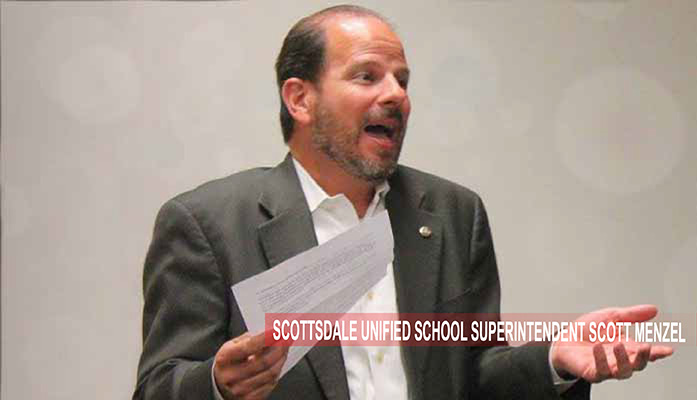
At the Scottsdale Parent Council (SPC) meeting in February, Dr. Cindy Bochna, Director of Assessments and Accountability, and Ms. Lea Mitchell, Assistant Superintendent of Educational Services from Scottsdale Unified School District (SUSD) gave a presentation of the K-12 Statewide Assessments. You can view the video of the meeting here, SPC 2-19-25 Meeting.
A couple of interesting and somewhat disturbing points came out during the presentation and discussion.
One being how SUSD and most of the schools are “A” rated by the Arizona Department of Education.
For those of you not familiar with the AZ report card process, according to the Arizona Department of Education website, the
“Arizona Revised Statutes § 15-241 requires the Arizona Department of Education, subject to final adoption by the State Board of Education, to develop an annual achievement profile for every public school in the state based on an A through F scale.
The system measures year to year student academic growth, proficiency on English language arts, math and science. It also includes the proficiency and academic growth of English language learners, indicators that an elementary student is ready for success in high school and that high school students are ready to succeed in a career or higher education and high school graduation rates.”
To find out what grade your child’s school has been awarded, and how many points the school earned in each category, go to AZ Report Cards and search by the name of the school.
I understand that the Arizona Department of Education assigns the grades and SUSD didn’t establish the criteria, nor the weighted values assigned for the grading, but I think it is important that parents understand exactly what goes into the grades assigned and how to interpret them.
So, when you are looking at your child’s school to determine the assessment grade and detailed scoring, I encourage you to scroll down and look at the other information available, specifically the student achievement in state academic assessment reports.
These reports provide details on student proficiency rates for ELA, math, and science. By looking at previous years, you can see how the data is trending.
During the discussion at the SPC meeting, using Chaparral High School as an example, I asked Dr. Bochna and Ms. Mitchell how Chaparral is given an A grade when across all three academic subjects, an average of only 53% of the students are proficient. I asked how a 53% could be an A, isn’t that more like an F?
What I found disturbing was the response I got from Ms. Mitchell. She explained that Stephen Curry and Steve Kerr, both NBA players, only made 45% of the shots they took yet they were rated as world champion basketball players.
So, Ms. Mitchell, are you saying 53% makes you a world champion in academics? Really?!?
Statements like this are silly and make me wonder just how serious they are about education. SUSD students and parents deserve better.
At one point during the meeting, I asked how Arizona compared to the rest of the country. I said that I thought we were somewhere around 48th or 49th. Both Dr. Bochna and Ms. Mitchell said I was wrong, and that Arizona was somewhere around 30th or so in terms of ACT scores across the nation.
In a follow-up email, Dr. Bochna provided me with the following information:
When you look at the data and sort it from highest to lowest, Arizona is right where I said we are, tied with Mississippi and Hawaii for 47, 48, and 49th positions. Arizona is nowhere near the top 30 or whatever position Ms. Mitchell thought. If they were analyzing the data, they should know that. Being a top performer in a state that ranks at the bottom is nothing to brag about.
When you put this performance in some context, the 21.5 ACT score for SUSD is less than impressive. The average ACT score for incoming students at ASU is 26. While a score of 20-23 is considered competitive at many mid-tier colleges, a score of 24-28 is needed for more selective colleges. To get into a top engineering school, a student needs something like a 30 in math and 36 for a composite score. I’m sure there are a handful of students out of the 20,000 in SUSD who score that high, but to get an average of 21.5, many students do not.
While I certainly encourage you to listen to the entire meeting (Dr. Menzel responds to questions at the beginning of the meeting) the points I discussed here are found in the 44:00 to 1:00:00 portion and the 1:13:00 to 1:24:00 segment in the video. Listen for yourself.
For anyone that has been paying attention to what has been happening in SUSD over the past few years, it comes as no surprise that academic performance under Dr. Menzel has been terrible. Thousands of SUSD students each year are not proficient in ELA, math or science, yet over 92% graduate high school in four years. Remember, Dr. Menzel has never met any of his academic performance goals throughout his tenure at SUSD.
This academic record has contributed, in large part, to the steady decline in enrollment, leading to major financial issues the Governing Board is now struggling with. As has been his practice for the past few years, Dr. Menzel proposes cutting teachers and instructional staff positions and hiring more unlicensed social workers to solve the budget crisis, a crisis that his poor management has caused. Actions, if taken, will ensure the Governing Board will be dealing with the same problem again next year.
At the last Governing Board meeting, Member Pittinsky told Dr. Menzel he wanted to see a deep dive into causes of the declining enrollment. He wants to understand what parents are saying during exit surveys as they pull their children out of SUSD and see the data by site and grade level. All of us involved with SUSD would like to see that information.
I wish Dr. Pittinsky the best of luck as he tries to get this information from Dr. Menzel.
As I have said on multiple occasions, identifying the root cause of the problem and fixing it is the only way anything will change. Unfortunately, change takes time; time that thousands of SUSD students don’t have.
Mike Bengert is a husband, father, grandfather, and Scottsdale resident advocating for quality education in SUSD for over 30 years.
The Scottsdale Unified School District (SUSD) Governing Board held its regular meeting on February 11th. And it was significant for several reasons.
Most notably, the District’s Fiscal Year 2025-2026 Maintenance & Operations and District Additional Assistance Projections were presented. (You can view the presentation and hear the discussion on the budget projections starting a little after the 1:08 mark of this video.)
From the budget presentation, it’s clear that the SUSD’s financial troubles are largely due to declining enrollment. The average daily membership (ADM), which tracks enrollment, is used to determine state funding, including Proposition 123. Under Dr. Menzel, enrollment has consistently dropped. As of February 2025, enrollment stands at 19,367, which is a decrease of 390 students from last year, which was down 355 from the previous year. Over the past seven years, enrollment has fallen by 13%, from 22,608. Dr. Menzel has been superintendent since July 2020, and despite receiving a bonus every year and a pay raise with a contract extension, he has failed to meet any of the academic performance goals set by the Board.
Could the decline in enrollment be due to the dismal academic performance under Dr. Menzel?
Last year, in SUSD, 8,100 students were not proficient in English-Language Arts (ELA), 9,400 were not proficient in math, and over 12,000 were not proficient in science. Yet over 98% are passed on to the next grade or graduate. Unfortunately, this is not an anomaly, but the continuation of a trend at SUSD.
Across all SUSD 5th graders, there are an average of 300 students who are highly proficient in either ELA, math, or science. That means over 1,100 5th graders are not highly proficient. And 600 of those are not even proficient in either ELA, math, or science, yet they will be passed on to middle school.
At Coronado High School, 74% of the students are not proficient in reading, and 83% are not proficient in math, but 89% will graduate in 4 years. How can that be? Is this what Dr. Menzel means when he says SUSD is providing a future-focused, world-class education? What kind of future is he focused on for those students?
The District’s CFO, Shannon Crosier, did offer a “silver lining” to the enrollment decline, noting that staff reductions could help cover part of the projected budget shortfall—$1.2 million of the anticipated $2.9 to $4.2 million deficit (depending on Proposition 123)—and maintain the ratios as established by the Board. I guess that was the good news. But if enrollment is down, doesn’t that mean lower class sizes and a better teacher-to-student ratio? Why is that a bad thing? Why lay off teachers? Answer, Dr. Menzel doesn’t want to make meaningful cuts to District staff.
Both Ms. Crosier and Dr. Menzel pointed out that 85% of funds are allocated to schools, leaving only 15% for district-level expenses. As a result, the budget proposal includes the elimination of only 12 district-level FTE positions. However, according to them, meaningful budget cuts will also require eliminating 20 FTE school-level positions and 3 assistant principal positions.
When Board Member Carney questioned the impact of these cuts, especially considering the 59 instructional positions cut in the 2024 Annual Comprehensive Financial Report, while adding 71 student support positions and 44 support and administration positions, Ms. Crosier promised to investigate the matter further. This trend of reducing instructional staff while maintaining student-teacher ratios amid declining enrollment seems to be continuing.
Member Pittinsky attributed the enrollment decline to changing demographics, a low capture rate (only about 50% of eligible students attend SUSD), and what he called systemic issues. He argued that without addressing these issues, the situation would remain unchanged. He added that without changes in the expense structure, 12 months from now we would be doing this again.
Changing the expense structure is one way to deal with the problem, but it doesn’t tackle the root cause of the declining enrollment.
Citing demographic changes and systemic issues as reasons for enrollment loss seems like a convenient excuse, especially when the key questions remain unanswered: Why are students leaving SUSD? Why is the capture rate so low? Perhaps Pittinsky, who chose Brophy over SUSD for his child, could shed some light on that.
It’s concerning that no one at the meeting seems willing to discuss the root cause of the declining enrollment. Could it be tied to the District’s poor academic performance, combined with the focus on social-emotional learning, gender identity, hiring social workers while laying off teachers, and Dr. Menzel’s broader efforts to disrupt and dismantle SUSD?
Why not address the expense structure right now? Cutting 12 staff positions for next year only represents 3% of the district’s staff, which doesn’t seem like a significant reduction. Why is no one questioning what district staff are doing? For instance, what purpose is served by the 13 FTE in Desegregation? Or the 13 FTE working on State and Federal Titles I, II, and V? How about the 10 working on Student Information? Do we need 7 FTE in the Communications Department and another 7 in Community Education?
Member Pittinsky also asked when the Board would be able to inject their values into the budgeting process. Dr. Menzel’s response, as usual, was long-winded and didn’t fully answer the question. But I’d ask Member Pittinsky: why not act now? You’ve acknowledged the need for an expense structure change. As a Board member, you have the power to ask tough questions about district staff activities and direct Ms. Crosier to prepare a budget based on substantial cuts to district-level staff. Again, do we need 13 FTE in Desegregation? Dr. Menzel claims they leave no stone unturned to tackle the problem, but I remain skeptical.
We should also be mindful of potential cuts to government funding, both state and federal, especially in light of President Trump’s executive orders on education. If these cuts materialize, the impact on the District could be significant.
This was just the first budget meeting, and more details will be presented on February 25th and March 4th. The proposed budget will be presented to the Governing Board on June 10th, with a public hearing and adoption scheduled for June 24th.
The June 10th meeting is a regular meeting, meaning public comments will be allowed with a two-minute time limit. A two-minute time limit will likely also be enforced during the public hearing on June 24th, with the Board voting to adopt the budget immediately after the hearing.
This is all by design. Dr. Menzel put together the budget with little to no input from the Board or the public. Then he presents it when there is very little time to make changes. Scheduling the public hearing just before the Board votes allows Dr. Menzel to say he is following the law, without getting public input in a meaningful way into the budget. He doesn’t care what the public thinks.
That’s why parents and anyone concerned about the direction of SUSD must speak up or ask questions directly to the District staff and Dr. Menzel. Inquire about what each department is doing and then ask yourself—and the Governing Board—whether we can afford to continue funding these activities. Then ask yourself if Dr. Menzel and his team have truly left no stone unturned.
If you care about the education of SUSD students, you need to speak up and let the Governing Board and Dr. Menzel know what your concerns and priorities are. Remember, they work for you!
Mike Bengert is a husband, father, grandfather, and Scottsdale resident advocating for quality education in SUSD for over 30 years.
Scottsdale Unified School District (SUSD) will no longer be using X to stay engaged with the community, with the given reason being a lack of a “family-friendly” environment.
SUSD made the announcement last week, also alluding to board policy necessitating their ceasing the use of X. The district will remain on Facebook and Instagram instead.
“In line with board policy IJNDB and our commitment to safety, SUSD schools are stepping away from X to prioritize family-friendly engagement,” said SUSD. “For updates, find us on Facebook, Instagram, or visit http://susd.org. Let’s stay connected in spaces that uphold our values.”
In line with board policy IJNDB and our commitment to safety, SUSD schools are stepping away from X to prioritize family-friendly engagement. For updates, find us on Facebook, Instagram, or visit https://t.co/EN0kZ8ruFl. Let’s stay connected in spaces that uphold our values. pic.twitter.com/ZJUyD9fi8D
— Scottsdale Unified School District (@ScottsdaleUSD) November 12, 2024
IJNDB refers to policy on the use of technology resources in instruction. Per that policy, the district implements technology protections against visual depictions that are obscene, child pornography, or content which may be discerned as harmful to minors.
Yet, the district allows children access to sexually explicit books and content in its libraries and classrooms.
In stepping away from the use of X, the district also remarked that X failed to align with its values. In addition to protections for sexually explicit materials, SUSD holds values such as transgenderism in minors, social emotional learning, and critical race theory.
SUSD made their announcement a week after Election Day, when Donald Trump won the presidency and Republicans secured a trifecta.
Tech billionaire and Tesla CEO Elon Musk bought Twitter (now X) for the express purpose of preserving and supporting free speech following the 2020 election. During that election, the silencing of certain right-wing voices occurred under social media platforms such as Twitter and Big Tech companies.
SUSD lost nearly 500 students over the course of this past year, amounting to millions in lost revenue. The auditor general has scored the district as “high risk” due to its continued decline in enrollment. Enrollment has declined 10 percent under the tenure of SUSD Superintendent Scott Menzel, and reports have emerged of record staff turnover.
Additionally, SUSD spending on classrooms and teachers have hit another historical low for this school year: 54 percent versus nearly 64 percent from 20 years ago, just over the lowest fiscal year (2017, which amounted to 53 percent).
Parent watchdog group Scottsdale Unites for Education Integrity said the nine percent decrease signified a $40 million redirection of funds from academic achievement.
Menzel also enjoyed a pay raise earlier this semester despite falling short of academic performance goals: achievements in math, English-Language Arts (ELA), and science fell below desired outcomes. Over 8,000 students weren’t proficient in ELA, over 9,000 weren’t proficient in math, and over 12,000 weren’t proficient in science.
The only goals which Menzel accomplished were nonacademic, and they amounted to less than half of the goals set: increases in attendance rates, student participation in extracurricular and cocurricular activities, and certified staff retention; an establishment of a baseline for work-based learning opportunities and hours completed using Major Clarity; and production of a decision-making matrix and at least one proposal for action by June.
AZ Free News is your #1 source for Arizona news and politics. You can send us news tips using this link.
Can we truly take the American Association of School Administrators (AASA) seriously? They claim to be the premier association for school system leaders and the national voice for public education and district leadership. But do they speak for the majority of parents with children in public schools across America?
The AASA being the voice for public education on Capitol Hill might explain why public education has been failing our children for years. The education professionals who run the AASA and the Arizona School Administrators (ASA) seem more focused on promoting social-emotional learning, DEI, and gender identity rather than prioritizing academic excellence in public schools.
How else do you explain the prior selection of Dr. Donna Lewis as the superintendent of the year when she was the superintendent of a district where math and ELA proficiency were below 15%? And how do you explain the selection of Dr. Menzel as the 2024-2025 national superintendent of the year?
By selecting two failed superintendents for recognition, these organizations demonstrate that they are not concerned with academics.
Contrary to the Scottsdale Unified School District’s (SUSD) claims, Menzel has not enhanced educational outcomes; it is just the opposite. Last year, Menzel failed to meet his academic performance goals, and academic achievement in math, ELA, and science declined. In 2023, SUSD had over 8,000 students who were NOT proficient in ELA, over 9,000 who were NOT proficient in math, and over 12,000 students who were NOT proficient in science. Thirty-five percent of 3rd graders were not proficient in ELA in 2023. Being able to read by 3rd grade is critical to a student’s academic success. By continuing to promote them without being proficient, Menzel is setting them up for academic failure.
Despite these deficiencies, hundreds of SUSD students are promoted and graduate each year.
Under Menzel’s tenure, SUSD experienced a 10% drop in enrollment, with nearly half of the eligible students choosing not to attend SUSD. Additionally, the district has faced record staff turnover due to the fear-driven environment Menzel has created. Yet he is celebrated as the superintendent of the year.
Enough is enough. Scottsdale cannot afford another failed superintendent of the year.
Mike Bengert is a husband, father, grandfather, and Scottsdale resident advocating for quality education in SUSD for over 30 years.
The Scottsdale teachers’ union has endorsed three candidates for the Scottsdale Unified School District (SUSD) Governing Board, emphasizing their extensive experience as education professionals. While their expertise may seem impressive to some, the pressing question remains: does SUSD need more so-called experts on the Board, or do we require individuals who prioritize common sense, academic excellence, and respect for parents’ rights?
Under the current leadership of Dr. Menzel, an education expert, the SUSD has experienced a troubling decline in academic performance and significant student and staff turnover. Despite promises by the experts that social-emotional learning (SEL) would improve academic educational outcomes, the reality has been disappointing. Not only has academic achievement not improved but it has declined during his tenure.
Dr. Menzel and the experts on the Board, who rubber stamp everything he wants to do, not only have a dismal academic record but have caused over 2,200 students to leave SUSD along with record-high staff turnover.
Some studies and reports suggest that SEL is harming the emotional and mental health of students. The shift in spending away from teachers and to more social workers and counselors further drives down academic performance.
The three endorsed candidates—Dr. Donna Lewis, Matt Pittinsky, and Michael Sharkey—have questionable records that raise concerns about their suitability for the Board, but they also promise to “protect SUSD” and Menzel, ensuring the continued disruption and dismantling of the District.
Dr. Lewis has highlighted her accolade as the national superintendent of the year during her time at the Creighton School District, claiming she improved schools from Cs, Ds, and Fs to As, Bs, and Cs. However, she conveniently omits that only 13% of students were proficient in English Language Arts (ELA) and just 8% in math during her celebrated year. Additionally, her leadership style has been criticized for creating a hostile and toxic environment, prompting a formal public apology from a school board member after her departure.
Matt Pittinsky, another candidate with 25 years in education, has been less than forthcoming about his business ties to SUSD. One of his companies provides services to the district, a fact he only revealed after being confronted publicly. This raises serious questions about his transparency and the potential conflicts of interest in his role as a board member. Furthermore, his acceptance of over $10,000 in out-of-state campaign contributions, primarily from CEOs of companies that sell to schools, adds another layer of concern. What motivations could these out-of-state contributors have for influencing a local election?
Michael Sharkey, who has over 20 years of experience in education, has publicly linked his candidacy to the rise of the parents’ rights movement, which he blames for many of SUSD’s current issues. Sharkey asserts that the “book bans, cultural wars, and dysfunction” that are plaguing SUSD are due to the parents’ rights movement.
He rejects the idea that parents are best positioned to make educational and healthcare decisions for their children, asserting that trained professionals know better. This stance is contrary to the Arizona Revised Statutes, which enshrine parental rights in the Parent’s Bill of Rights. Sharkey’s reluctance to recognize these rights suggests a troubling approach to governance that may not prioritize parental input nor respect their legal parental rights.
Despite Sharkey’s recent claims of wanting to engage with families and welcome their input, it’s important to note that initial statements often reflect true beliefs. His previous rhetoric implies a preference for limiting parental involvement and allowing “experts” to take charge of children’s education and healthcare.
You also must ask yourself why a school board member, who should be focusing on academics, would be involved in making healthcare decisions for the students. Again, Arizona law leaves it up to the parents.
This upcoming election presents a critical choice: we can either “protect SUSD” and continue down the path of endorsing more educational experts who have failed to deliver results and are harming children, or we can elect board members who demonstrate common sense, a focus on academics, and a commitment to respecting parents’ rights. Candidates like Gretchen Jacobs, Jeanne Beasley, and Drew Hassler embody these qualities, promising to be responsible stewards of our tax dollars while prioritizing the safety and educational needs of all students in SUSD.
It’s time for a change that puts our children’s future first.
Mr. Williams is a longtime Scottsdale resident, businessman, grandfather, and the parent of an SUSD graduate.