As Scottsdale parents, grandparents, community members, and taxpayers evaluate their choices for school board, it’s important to remember that your vote reflects not just your choice of a candidate, but also the values and policies they represent.
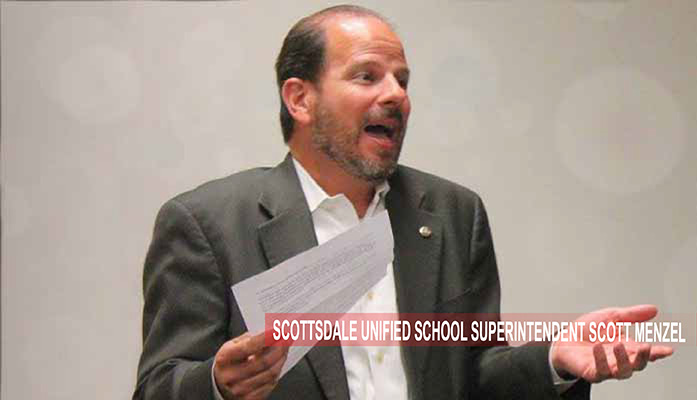
One group of candidates—Michael Sharkey, Donna Lewis, and Matt Pittinsky—are endorsed by the Scottsdale Education Association (SEA), which is affiliated with the Arizona Education Association (AEA) and the National Education Association (NEA) teachers’ unions. Their campaign suggests they aim to “protect SUSD,” implying they will defend and uphold current policies. This includes supporting Superintendent Dr. Menzel’s agenda, which focuses on “dismantling and disrupting” SUSD to promote social justice and equity.
While Dr. Menzel emphasizes social emotional learning (SEL), diversity, equity, and inclusion (DEI), and gender identity, academic performance in SUSD has declined. Teacher and principal turnover are at an all-time high, and Dr. Menzel’s performance evaluation shows he has failed to meet any of the district’s academic achievement goals. For instance, only 60% of 3rd graders are proficient in English Language Arts (ELA), 46% of 8th graders in math, and just 34% of 9th graders in science.
Michael Sharkey, one of the SEA-endorsed candidates, claims one of his priorities is “Represent With Integrity,” pledging respect, honesty, and transparency. However, his LinkedIn statements suggest a dismissive attitude toward parental input on educational decisions, which raises concerns about his commitment to academic integrity. He says:
“So why am I running? Over the last few years, there’s been an uptick in the ‘parent’s rights’ movement. This is the notion that parents are best situated to make educational and healthcare decisions for their kids. While I am 100% in support of parents working WITH teachers and doctors, I reject the premise that parents know better than experienced/trained professionals.”
Once Sharkey received significant pushback on his post, he quickly rewrote it.
Remember the saying, when someone tells you who they are, believe them.
Dr. Donna Lewis, another SEA-endorsed candidate, highlights her being selected as the 2020-2021 Arizona National Superintendent of the Year while serving as Creighton Superintendent. That year, only 13% of the students enrolled at Creighton were proficient in ELA and only 8% in math. Not exactly superintendent of year numbers.
Her tenure at Creighton School District saw her implement so-called innovative approaches like dual-language, multi-age, and constructivist learning. However, even two years after the COVID-19, union-driven school shutdown, academic proficiency rates at Creighton remained dismally low, raising questions about the effectiveness of these innovations. In 2023, ELA proficiency was 17% and math 12%. So much for the innovative approaches.
Why would SUSD parents and Scottsdale community members vote to elect someone to the school board with this less-than-impressive past performance as a superintendent and no past or present ties to SUSD? How long has she even lived in Scottsdale or the SUSD?
Matt Pittinsky, the third SEA-endorsed candidate, says he supports neighborhood schools yet chose to send one of his kids to Brophy, which could indicate a lack of commitment to improving SUSD from within.
The SEA-backed candidates often promise to engage with parents respectfully and transparently but simultaneously criticize those who express concerns or exercise their legal rights in education. This disconnect between their promises and actions reflects a broader trend of undermining parental involvement and accountability. The Scottsdale community has resisted SEA-endorsed candidates, with two other candidates winning the last election.
At the last SUSD Board meeting, a Board member read a Let’s Talk message from a Scottsdale Unified employee revealing the employee’s fears about speaking out against current administration policies:
“… in light of the current climate where many of us feel apprehensive about speaking out. It’s become increasing evident that dissent with the current administration may result in severe consequences.”
So much for the SUSD value of inclusion, where “we create an equitable environment where everyone is respected, is treated with dignity, and has a sense of belonging.”
We cannot afford a slate of SEA-backed progressive candidates who will only continue to “protect” Dr. Menzel and his failed policies.
We need a Governing Board dedicated to academic excellence, parental rights, fiscal responsibility, and school safety.
Mike Bengert is a husband, father, grandfather, and Scottsdale resident advocating for quality education in SUSD for over 30 years.
In a recent opinion piece, Scottsdale Unified School District (SUSD) Superintendent Scott Menzel highlights what he considers a long list of accomplishments. According to Superintendent Menzel, the “2023-2024 school year has been marked by significant progress and achievements as we continue to implement initiatives aligned with our Strategic Plan to improve academic achievement and outcomes and prepare students for real-world opportunities in an ever-evolving landscape.”
Let’s delve into the statistics.
Nearly 1,800 seniors graduated from SUSD on May 23rd. During the May 14th Governing Board meeting, 11 seniors were recognized for their academic excellence. In his column, Dr. Menzel highlighted that 51 graduates had received math and science diplomas. While these acknowledged students have rightfully earned praise for their hard work and accomplishments, including receiving various scholarships, what about the remaining 1,800 graduates? How have they fared after receiving a purportedly “world-class, future-focused” education from SUSD?
According to the Arizona Department of Education’s comprehensive school report card system, the overall performance isn’t encouraging. In 2023, when these graduating seniors were juniors, their proficiency levels were assessed, yielding the following results:
Only 63% demonstrated proficiency in English Language Arts (ELA), leaving 37% (or 666) lacking proficiency.
Math proficiency was even lower at 55%, indicating that 45% (or 810) were not proficient.
Science proficiency was the lowest, with a mere 25% demonstrating proficiency, leaving 75% (or 1,350) lacking in this area.
On average, only 48% (or 858 students) of the 1,800 graduates were proficient across all three academic subjects.
Given these outcomes, it seems apt to reconsider the SUSD slogan “Because kids,” as it appears the district may not adequately prioritize the needs of all students. Perhaps it should be restated as “Because some kids.” A school district’s quality should be judged by how well it supports its lowest-performing students.
Yet, despite this concerning academic record, three outgoing members of the current governing board decided, without public input or feedback from district stakeholders, to extend Superintendent Menzel’s contract by two years and grant him a 4% raise.
Dr. Menzel’s emphasis on using class time for destructive “Social Emotional Learning,” “Diversity, Equity & Inclusion,” and gender identity at the expense of teaching academics appears to be falling short for SUSD students, parents, and taxpayers. It’s perhaps unsurprising that parents are increasingly withdrawing their children from SUSD, and staff turnover, including principals, is at an all-time high.
If you share my frustration with the Governing Board’s apparent rubber-stamping of Dr. Menzel’s failing agenda and believe our children deserve better, I urge you to vote for change this November.
Mike Bengert is a husband, father, grandfather, and Scottsdale resident advocating for quality education in SUSD for over 30 years.
Update: The Scottsdale School Board passed Superintendent Scott Menzel’s contract renewal in a 3-2 vote. Board Members Libby Hart-Wells, Zach Lindsay, and Julie Cieniawski voted to renew the contract while Board Members Amy Carney and Carine Werner voted not to renew the contract.
The Scottsdale Unified School District Governing Board is expected to be asked to renew controversial Superintendent Scott Menzel’s employment contract during its meeting on Tuesday.
Three of Menzel’s biggest allies on the Governing Board, Zach Lindsay, Libby Hart-Wells, and Julie Cieniawski, will not seek reelection and will vacate their seats on Dec. 31. Outgoing boards are usually reluctant to extend employment contracts for administrative positions during an election cycle, but a renewal of Menzel’s contract seems unlikely with any future board.
Arizona Superintendent of Public Instruction Tom Horne called for Menzel’s removal after “unacceptable” comments made by Menzel were revealed last February.
“Critical race theory has no place in Arizona schools,” Horne said at the time. “Superintendent Scott Menzel’s comments are unacceptable. Superintendent Horne joins Scottsdale legislators and parents calling for the removal of Superintendent Menzel.”
Menzel had claimed “white identity” is “problematic.”
“There’s a misperception that educational equity is really only for ethnically and racially diverse districts. But White people have racial identity as well, and in fact [it is a] problematic racial identity that we typically avoid,” Menzel told David Spitzley of the Torchlight in 2019.
Arizona state legislators and parents joined Horne in calling for his removal.
State Sen. John Kavanagh and Representatives Joseph Chaplik and Alexander Kolodin, who all represent Legislative District 3 that includes Scottsdale, wrote an open letter to members of the Governing Board condemning Menzel for “offensive and hateful comments he made in a 2019 interview.”
The Scottsdale Unified School District Governing Board unanimously approved a three-year contract with Menzel in March 2020. The Board unanimously approved a $205,000-plus contract, to run through June 30, 2023.
The Board renewed Menzel’s contract in May 2022 to run through 2025 with his base annual salary increased to $216,000.
Under Menzel’s leadership over the past three years, Scottsdale Unified enrollment has dropped by more than 1,500 students. Science scores have dropped 24%.
Less than 50% of 8th grade students are proficient in math, but 94% of students in the district graduate.
Members of the public can email the board in opposition to the extension at govbrd@susd.org.
Elizabeth Troutman is a reporter for AZ Free News. You can send her news tips using this link.
In the corridors of education, a seismic shift is underway. Local superintendents, entrusted with shaping the educational landscape, are being influenced by a woke agenda that transcends their official roles. Behind this phenomenon lies the shadowy hand of leftist interests, channeled through national and state chapters of the School Superintendent Association (AASA), driving an agenda that reaches deep into the heart of public education.
Recent events in El Paso County, Colorado, underscore the extent of this influence. Allegations have surfaced of a superintendent employing intimidation tactics, supported by legal counsel, to suppress reports of a sexualized gender focus in classrooms. Such incidents reveal a troubling trend of silencing dissent and stifling transparency in the pursuit of ideological conformity.
At the national level, the AASA is actively seeking to modify the Protection of Pupil Rights Amendment (PPRA), often hailed as the Parents Bill of Rights (PBOR). While PPRA mandates parental notification of policies and surveys, the proposed amendments could erode parental consent requirements, potentially leading to increased control over data collection by schools, to the detriment of parental rights and oversight.
Arizona provides a stark example of the consequences of such ideological influence. In Scottsdale Unified School District (SUSD), Superintendent Scott Menzel’s equity-driven agenda has resulted in a dramatic reallocation of funds away from academics toward social support infrastructure. The repercussions are profound, with declining academic achievement, escalating violence, and growing student dissatisfaction.
Menzel’s emphasis on Diversity, Equity & Inclusion (DEI) has permeated every aspect of district life, reshaping classroom dynamics and disciplinary measures. Yet, amidst the proliferation of gender identity and sexuality clubs, concerns about academic focus and student safety persist.
Similar challenges echo across Arizona’s educational landscape. In Flagstaff, revelations about controversial sex education curriculum content have sparked parental concern, while in Mesa, allegations of clandestine aid to students undergoing gender transitions have led to legal battles and ethical scrutiny.
The reluctance of some superintendents to address concerns about new survey questions addressing social-emotional learning and sex education, further exacerbates tensions and raises questions about accountability.
Amidst these local debates, broader concerns loom about the influence of ideological agendas within educational institutions. The rise of what critics term the “Communist Whole/Community School philosophy” underscores the need for vigilance and a return to fundamental principles of education.
In this landscape of change, House Bill 2717 proposes a radical overhaul of the educational system in Mohave and La Paz County. Advocates argue for increased efficiency and cost savings, but questions linger about the potential concentration of power in the hands of county superintendents and its impact on local autonomy and accountability.
As parents and residents, it is incumbent upon us to remain vigilant and hold school officials and school board members accountable. The future of education hinges not only on academic excellence but also on safeguarding the principles of transparency, parental rights, and proper legal oversight in our schools.
Tamra Farah has twenty years of experience in public policy and politics, focusing on protecting individual liberty and promoting limited government. She’s served at the director level at Americans for Prosperity-Colorado, FreedomWorks, and currently with Arizona Women of Action.
Scottsdale Unified School District (SUSD) voted Tuesday to halve its public meetings for the upcoming school year, reducing special meetings to every other month. The reduction results in a five-meeting difference from this year to the next.
Superintendent Scott Menzel said that the changes arose after several board members had indicated that their meetings required more work than the board should have to handle, and that public meetings ran too long. Menzel said he initially opposed proposed reductions to the calendar. However, Menzel said he countered with the currently-adopted calendar: a “hybrid” solution that took away five public meetings.
“I didn’t think it would be possible to go to one meeting a month, for multiple reasons. One reason is that there are statutory deadlines that we would miss if we only had one meeting a month,” said Menzel.
Vice President Carine Werner opposed the measure. She said it saddened her that there were complaints from her fellow members about the amount of work they had to do, and that the proposed changes hurt transparency. Werner pointed out that they haven’t even discussed all of the work they needed to do under the current schedule with more meetings.
“I understand it’s a lot of work, but it’s also part of everyone’s jobs, just like it’s our jobs to be here to do the work that our governing board does,” said Werner.
Transparency has been a hot-button issue for the SUSD community over the last few years. Just last summer, the district opted to publish the names of those who file public records requests, but redact educators’ names. The push for greater transparency has come in the wake of discoveries that SUSD allowed and defended educators promoting sexualized and race-focused agendas in the classroom.
Werner added that she found it interesting that fellow board members wanted to reduce meetings, yet was willing to add meetings for the academy attended by administrators.
“I can only imagine the amount of work that’s gone into creating the academy and then fulfilling the work for the 40 applicants that get elected to participate in the program,” said Werner.
Werner also noted that parents and community members had expressed grievances over the proposed calendar change.
— Scottsdale Unites for Educational Integrity (@ScottsdaleUnite) May 3, 2023
Board member Amy Carney pointed out that, by that point in Tuesday’s meeting, they’d been there two hours discussing key issues — an opportunity not possible in the adopted schedule with fewer meetings.
“We’ve got a lot of work to do. I can’t understand how we can cut meetings,” said Carney. “One of the critical places for school boards to work, to retain informed trust of the communities is the conduct of meetings.”
Carney asked whether SUSD had ever cut meetings this drastically. Menzel said he wasn’t aware, deferring to Board President Julie Cieniawski. Cieniawski said that, in the past, the board had held more non-public meetings.
Cieniawski also claimed that the addition of town halls were sufficient for the reduction of public meetings.
“This isn’t anyone’s voice being limited or taken away,” said Cieniawski.
Cieniawski contended with Carney’s insistence that the changes would erode community trust, and claimed that community trust came from engagement with local schools, not the board.
Carney attempted to respond to Cieniawski, who ignored and spoke over her and filed a motion to vote on the calendar. Board member Libby Hart-Wells, who appeared remotely for the meeting, seconded Cieniawski’s motion.
Menzel said that regular meetings should concern core business of the district, and that this calendar would free up the board to voluntarily call special meetings with at least 24-hour notice to focus on specific issues as needed. Menzel noted that he didn’t believe special meetings should take place every month, either.
“I don’t see the calendar as taking away from being able to conduct the work of the district, I think it actually enhances and keeps us focused in a way that the current calendar drifted away from, with the way the schedule is at the present time,” said Menzel.
Hart-Wells said she hadn’t heard any concerns from the community about the meeting restructuring.
Arizona law only requires school boards to have a minimum of one meeting per month.
Watch discussion of the board meeting reduction here:
Corinne Murdock is a reporter for AZ Free News. Follow her latest on Twitter, or email tips to corinne@azfreenews.com.