by Kevin Gemeroy | Nov 16, 2022 | Opinion
By Kevin Gemeroy |
I was born and raised in Seattle, Washington. I went to high school, and college, and started my business there. We were the fourth generation of our family to live in West Seattle where we founded and operated local businesses. Over the last 80 years, my family has founded four companies, employed hundreds of people, and created opportunities for many others to grow and succeed.
On August 5, 2020, we made the gut-wrenching decision to leave. That was the day that Washington’s Governor, Jay Inslee, proclaimed that it was “unsafe” for children to attend school in the state, extending our school closures indefinitely. Our school reopening guidelines were the among the strictest in the nation, and even most private schools (including our son’s) remained closed until further notice. Our boys were three and six at the time, and we expected another lockdown through the winter would do far more damage to our collective mental and physical health than COVID ever would.
Shortly after Governor Inslee’s press conference ended, we started packing. A few days later, we put 14 suitcases and duffle bags on an airplane and headed out to spend a year in the Sonoran Desert. As our son started in Scottsdale Public Schools, the battle between the districts, unions, and Governor Ducey were in full swing. After yet another week of “iPad school,” we began frantically looking for a private school that would guarantee an in-person education to our first grader.
We found an opening at a nearby for-profit private school and enrolled our boys on the spot. Within a few weeks, we heard from our older son’s teachers that he wasn’t learning normally. Initially, we dismissed their concerns, assuming they were caused by the impacts of Seattle’s hard lockdown and our extended school closures.
They gently pressed, and we agreed to seek a reading evaluation through a local clinic. The results were all over the place, so we were referred to a local neuropsychologist. Our son underwent two days of intensive testing which finally led us to the answer: he is gifted, has mixed dyslexia, and an ADHD (inattentive type) diagnosis would likely follow after he turned seven.
The number one recommendation was that our son would need to be in a private school long-term. The neuropsychologist described the challenges involved in getting an Individualized Education Program (IEP) and 504 plan, especially with a twice-exceptional child, where the giftedness often hides the disability. Our son would need small class sizes and individualized attention, as he would likely struggle in a public school classroom.
Our for-profit private school bent over backwards to accommodate his needs. They allowed him to continue to attend school through his eight-week, half-day intensive dyslexia treatment program so he could maintain the relationships in his class and participate in Spanish, PE, and STEM. His teacher taught his classmates about learning differences, so they’d approach our son with acceptance and curiosity instead of judgment. They approved his providers’ recommended accommodations without hesitation. They welcomed, loved, and supported our child, regardless of his learning differences.
One year later, our son is reading a grade level above his age thanks in part to the three weekly sessions with a reading specialist provided by his school. Three months into third grade, he no longer needs specialized support and is able to operate independently in an accelerated classroom environment.
Our journey was a privileged one. We had school choice, albeit across state lines. We had access to top private clinics and specialists. We used a combination of health insurance, HSA funds, and savings to cover the over $50,000 cost to remediate our son’s dyslexia and provide him with a private school education that met his unique needs. Very few families can afford this on their own.
Washington State has the exact education system that the teachers’ unions advocate for: strong and well-funded public schools. Seattle spends over $23,000 per child per year on school and teachers make around $100,000 on average. Every bond measure placed on the ballot gets approved overwhelmingly.
But choices are strictly limited – well-funded public school or very-expensive private school. Teachers’ unions have unfettered power to lobby the politicians for whatever they want. In response, over 30 percent of parents have pulled their kids out of Seattle Public Schools in neighborhoods where their families can afford to in just the past three years.
My family came to Arizona because of school choice. We stayed because our kids’ needs were met here. We’ve seen a union-first school system firsthand, and COVID revealed its shortcomings. In Arizona, we are leading the nation in building a child-first system, founded on universal ESAs.
As we hear Governor-Elect Katie Hobbs repeat her union supporters’ lines about Arizona’s school system and her criticism of the ESA program, please remember my family’s story of how a great Arizona private school and our school choice programs changed our son’s life and story for the better.
Every family should be able to choose the school that meets their kids’ unique needs, just like we did.
Kevin Gemeroy was recognized as Washington State’s Mr. Future Business Leader in 1998 and as a Puget Sound Business Journal’s 40 under 40 honoree in 2018. He and his wife reside in Scottsdale during the school year with their two twice-exceptional boys. You can follow Kevin on Twitter here.
by Corinne Murdock | Nov 15, 2022 | News
By Corinne Murdock |
Maricopa County’s long-awaited drop of 71,000 ballots on Monday night locked in three key races for Democrats: governor, secretary of state, and senator. The vote results remain unofficial, with two statewide races remaining close.
Republicans easily won the state treasurer’s race with incumbent Kimberly Yee at the helm, leading Democratic challenger Martín Quezada nearly 56 to 44 points.
Quezada retweeted political commentary indicating that the Democratic Party didn’t offer him enough support, financial or otherwise.
Incumbent Democratic Senator Mark Kelly will likely win handily over Republican challenger Blake Masters, 51 to 46 percent.
It appears that Masters issued a preliminary concession on Friday, preparing for what Monday’s returns made more apparent.
Democrat Katie Hobbs will be Arizona’s 24th governor, becoming the fifth woman to do so. Hobbs pulled in 50 percent of the vote to Republican opponent Kari Lake’s 49 percent. Hobbs announced that she won on Monday, but Lake didn’t concede.
Rather, Lake questioned why Maricopa County’s top election officials, Recorder Stephen Richer and Board of Supervisors Chairman Bill Gates, launched a political action committee (PAC) to defeat certain Republicans.
Democrat Adrian Fontes prevailed over Republican Mark Finchem in the Secretary of State race, bringing in 52 percent over Finchem’s 47 percent. Fontes declared victory on Monday morning, long before the ballot drop that night.
Finchem refused to believe the results of Monday’s ballot counts. He reminded voters that the polls didn’t reflect the results at all, challenging the ballots’ validity.
Several races remained too close to call. In the race for superintendent of public instruction, Republican Tom Horne leads Democrat incumbent Kathy Hoffman by .02 percent — just over 6,400 votes. In the attorney general’s race, Democrat Kris Mayes also leads Republican Abraham Hamadeh by .02 percent: nearly 3,200 votes.
Greenlee and La Paz counties had 100 percent of their votes completed. Yavapai and Gila counties had over 99 percent of their votes completed as of Monday night. Maricopa County had nearly 99 percent of votes completed. Yuma and Pima counties had 98 percent of votes completed. Coconino County had 97 percent of votes completed. Pinal and Navajo counties had 94 percent of votes completed. Cochise County had nearly 91 percent of votes completed. At the rear, Apache County had 74 percent of votes completed.
Nearly 48,800 ballots remain.
No estimated percentages of completion were given for Graham, Mohave, and Santa Cruz counties. Altogether, they account for over 106,100 votes.
Corinne Murdock is a reporter for AZ Free News. Follow her latest on Twitter, or email tips to corinne@azfreenews.com.
by Corinne Murdock | Nov 9, 2022 | News
By Corinne Murdock |
The most highly-contested races tightened overnight after Election Day votes were counted, leaving a substantial number of early ballots left to process.
In eight of these 13 races, Democrats lead Republicans. Total ballots processed numbered over 1.8 million, or 44 percent of total registered voters (over 4.1 million). Voter turnout in the 2018 midterms was over 2.4 million ballots cast (nearly 65 percent of the 3.7 million total registered voters).
In the Senate race, incumbent Democrat Mark Kelly leads Republican Blake Masters by nearly 90,000 votes, 51 to 46 percent.
In the gubernatorial race, Democrat Katie Hobbs leads Republican Kari Lake by over 11,700 votes, 50 to 49 percent.
In the secretary of state race, Democrat Adrian Fontes leads Republican Mark Finchem by over 84,500 votes, 52 to 47 percent.
In the attorney general race, Democrat Kris Mayes leads Republican Abraham Hamadeh by 4,000 votes, both sharing about 50 percent.
In the state treasurer race, incumbent Republican Kimberly Yee leads Democrat Martín Quezada by 201,200 votes, 55 to 44 percent.
In the superintendent race, Republican Tom Horne leads incumbent Democrat Kathy Hoffman by nearly 7,700 votes, both sharing about 50 percent.
In the first congressional district, Democrat Jevin Hodge leads incumbent Republican David Schweikert by 4,400 votes, 51 to 49 percent.
In the second congressional district, Republican Eli Crane leads incumbent Democrat Tom O’Halleran by 18,700 votes, 53 percent to 46 percent.
In the third congressional district, incumbent Democrat Ruben Gallego leads Republican Jeff Nelson Zink by 47,300 votes, 76 to 24 percent.
In the fourth congressional district, incumbent Democrat Greg Stanton leads Republican Kelly Kooper by 24,400 votes, 57 percent to 43 percent.
In the fifth congressional district, incumbent Republican Andy Biggs leads by 38,200 votes, 56 to 38 percent.
In the sixth congressional district, Republican Juan Ciscomani leads Democrat Kirsten Engel by 2,400 votes, 50 to 49 percent.
In the seventh congressional district, incumbent Democrat Raúl Grijalva leads Republican Luis Pozzolo by nearly 34,000 votes, 64 to 36 percent.
Incumbents Debbie Lesko (R-AZ-08) and Paul Gosar (R-AZ-09) were unchallenged.
Corinne Murdock is a reporter for AZ Free News. Follow her latest on Twitter, or email tips to corinne@azfreenews.com.
by Corinne Murdock | Nov 8, 2022 | News
By Corinne Murdock |
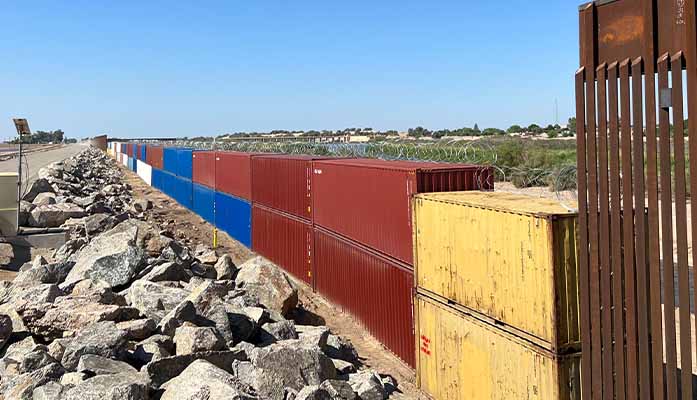
Democratic gubernatorial candidate Katie Hobbs said she would remove the shipping containers closing up the border wall gaps if elected. Governor Doug Ducey closed the border gaps using shipping containers topped with razor wire in August; he refused the Biden administration’s demand last month that he remove them.
In an interview with KYMA, Hobbs called Ducey’s shipping containers nothing more than a “political stunt.” She insinuated that Ducey’s motive wasn’t so much to secure the border wall as to instigate a legal fight with the Biden administration. Hobbs indicated that the Biden administration had the border situation under control.
“We need to work with the federal government to implement solutions that are right for Arizonans,” said Hobbs.
The shipping containers took 11 days and about $6 million to install. For well over a year in office, the Biden administration refused to add to the border wall. They spent an estimated $3 million every day to not complete the border wall under contracts set by former President Donald Trump, or around $2 billion in total.
Yet, Hobbs claimed in an NBC interview a little over a week ago that Arizonans were “tired of inaction at the border.” Hobbs implied that she would largely pass the border crisis buck onto the federal government.
“[T]his is largely a federal issue,” said Hobbs.
Unlike Hobbs, Republican gubernatorial candidate Kari Lake told KYMA that she would ignore the Biden administration’s request to remove the shipping containers.
Lake’s campaign later remarked that Hobbs wanted no border wall at all.
Hobbs’ endorsements from law enforcement included a prominent sheriff who denied the existence of the border crisis. Santa Cruz County Sheriff David Hathaway rejected Arizona National Guard assistance for his people last April. Hobbs said that Hathaway’s support as a border sheriff reflected her border policy.
Corinne Murdock is a reporter for AZ Free News. Follow her latest on Twitter, or email tips to corinne@azfreenews.com.
by Corinne Murdock | Nov 8, 2022 | News
By Corinne Murdock |
Republican gubernatorial candidate Kari Lake challenged Democratic gubernatorial candidate Katie Hobbs to push back on a mainstream media warning of election hacking.
On Monday, the day before Election Day, Politico issued an article warning that hackers impose “real risks” to election equipment such as voting machines. They prefaced their warning with the disclosure that claims of voting machine hacks from the 2020 presidential election were invalid.
The Politico article stated that there were six potential threats to elections, five of which were related to cybersecurity: misinformation/disinformation, election office and campaign website crashers, campaign social media hijackers, voter registration database hackers, voter harassers, and wireless modem hackers.
Only that last potential threat, the wireless modem hackers, could compromise election results by tampering with unofficial vote data, voting machine processing, or computer tallying. Politico assured readers that this type of cyberattack would be less likely to occur because it’s more difficult and time-consuming. Discovery of this type of cyberattack would only occur through paper ballot analysis and post-election audits.
Tensions over Hobbs’ role overseeing the election as secretary of state in a highly contested race have grown over the last few weeks. Last Tuesday, Lake hired one of former President Donald Trump’s lawyers from the 2020 election lawsuits.
As TIME reported, two former secretaries of state advised that Hobbs should grant election oversight to other officials. However, Hobbs’ office told TIME that she wouldn’t do so.
Richard Mahoney, a Democrat, suggested that Attorney General Mark Brnovich or Maricopa County Recorder Stephen Richer assist Hobbs.
“I think it would be wise if the secretary of state seconded responsibility for ministerial oversight to either the attorney general or the Maricopa County recorder,” said Mahoney.
Ken Bennett, a Republican, suggested others within her office assume control.
“She should recuse herself from the official acts that she would normally perform as secretary and let a deputy secretary or somebody else take care of those,” said Bennett.
The latest polling favors Lake over Hobbs. According to FiveThirtyEight’s summary, Lake leads Hobbs by over two points.
Corinne Murdock is a reporter for AZ Free News. Follow her latest on Twitter, or email tips to corinne@azfreenews.com.