by Corinne Murdock | Aug 25, 2022 | News
By Corinne Murdock |
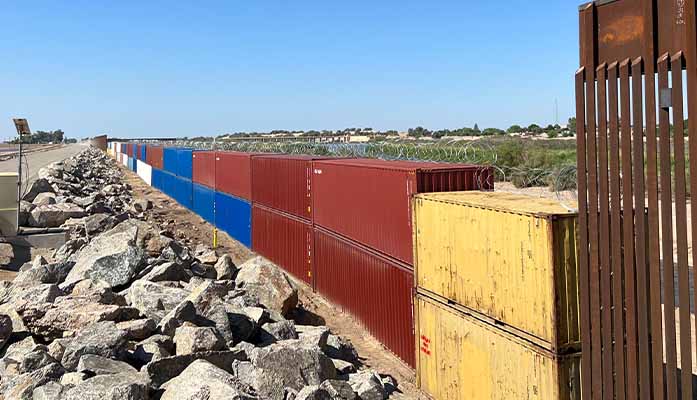
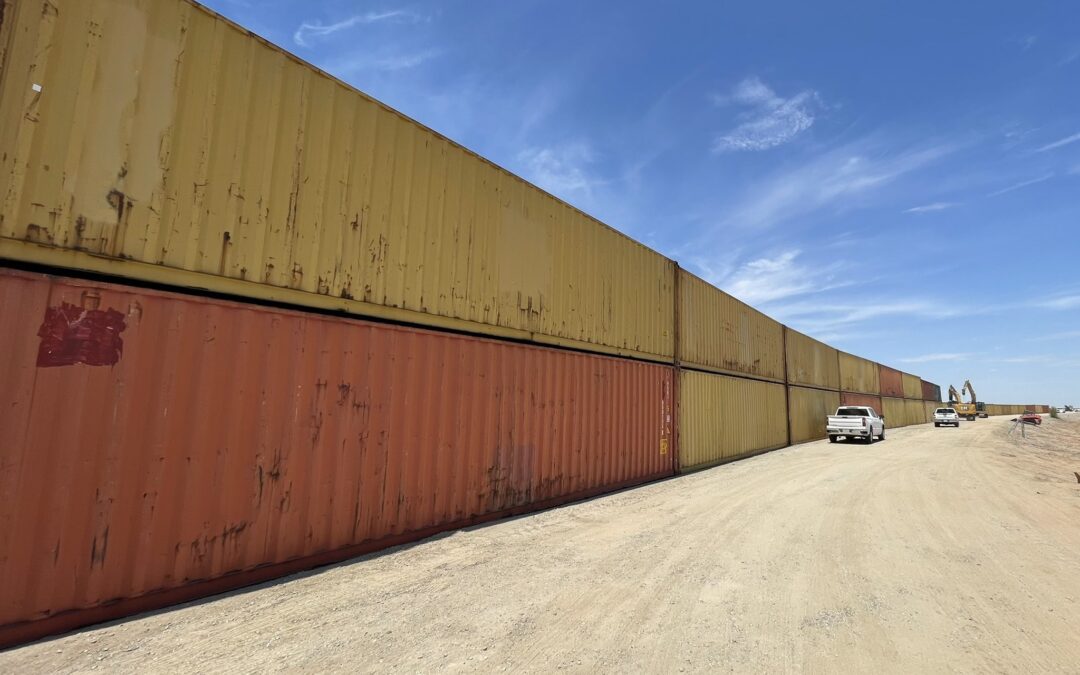
On Tuesday, Arizona finished the border wall gaps in Yuma. The state began closing the wall 11 days ago, on Friday, August 13.
Governor Doug Ducey celebrated the state’s rapid securement of the border the following day, the conclusion of an executive order which he dubbed the “Border Barrier Mission.”
“We did it,” wrote Ducey. “Yuma is safer today.”
In a press release, Ducey declared that his action didn’t mean the federal government was off the hook for border security. Ducey insinuated that Arizona’s quick action proved that the Biden administration didn’t really want the border closed.
“In just 11 days, Arizona did the job the federal government has failed to do — and we showed them just how quickly and efficiently the border can be made more secure – if you want to,” declared Ducey.
The state closed five gaps amounting to over 3,800 feet in the border wall. Securing the wall took 130 shipping containers and 48 workers, coming in at a cost of over $6 million. By comparison, the Biden administration spent an estimated $3 million every day — around $2 billion total — to not complete the border wall, per President Joe Biden’s proclamation.
The governor’s office secured the funding through border security legislation passed in the most recent legislative session: HB2317 from State Representative John Kavanagh (R-Fountain Hills) codified June 30.
Ducey relayed that the Biden administration promised Arizona last December that it would close the Yuma border wall gaps. No construction has taken place. Ducey noted that Yuma communities and their resources, such as nonprofits, food banks, and shelters, were overburdened by the illegal immigrant crisis. The area’s agriculture, the lifeblood of their economy, also suffered due to the travel of illegal immigrants.
In the press release, Yuma Mayor Douglas Nicholls expressed gratitude for Ducey’s action.
“Every day hundreds of people come across the border into the Yuma area,” said Nicholls. “By closing the border wall gaps, Governor Ducey is helping to protect our city from the dangerous drugs and bad actors that come through on a daily basis. Yuma is grateful for the effective process of getting these containers in place quickly and secured. Governor Ducey showed the nation how to secure the border and keep illegal activity at the border at bay.”
Yuma County Supervisor Jonathan Lines also commended Ducey and excoriated the Biden administration for its inaction.
“The open border left behind by the Biden administration has left Yuma County residents exhausted and our resources depleted,” said Lines. “We’re tired of the lethal drugs and human smuggling entering our county. These containers are making a huge difference and will disrupt the cartels’ trafficking operations. Thank you, Governor Ducey, for prioritizing our county and protecting our families.”
Corinne Murdock is a reporter for AZ Free News. Follow her latest on Twitter, or email tips to corinne@azfreenews.com.
by Christine Accurso | Aug 22, 2022 | Opinion
By Christine Accurso |
Parents want options for their children’s education. That is why so many went to the legislature and the governor and asked them to pass the Universal Empowerment Scholarship Account (ESA) Program for all of Arizona’s students!
The ESA program has been around for 11 years, but it’s only been available for a limited number of students who have qualified under particular classifications. As a mother of a child who has qualified under the category of special needs, I have seen our son thrive with his education for the last 9 years on an ESA. The tax dollars that we have been able to draw down are completely accountable to the state. After submitting all the documentation for every purchase and having it all approved by the Department of Education, we can then have access to the next quarter’s funds.
There is no better advocate for a child than their parents. Public district and public charter schools are not for everyone. We need options for students and parents who don’t thrive in these settings. For our son, the public district school failed us, and the public charter schools disappointed us. That is why we left the “public system” of education. Every child is uniquely different and has different needs. ESAs simply ensure that each child’s needs can be met without significant financial sacrifices from their families.
The latest controversy now seems to be between the parents and the teachers’ unions. But it is not an EITHER/OR for public schools and ESAs. It really is a BOTH/AND. We need strong public schools, and we also need options for our children who don’t fit into that cookie-cutter style of learning. Children may be doing very well in a public school now and that is great, but their needs may change. Or the school may change and then, an ESA may be needed in the future.
If you read House Bill 2853, you will see that there is a significant amount of money that is allocated to the public school system. They also retain all federal and local tax dollars. A student on an ESA only receives 90% of the state per pupil funding. According to the Joint Legislative Budget Committee, a public school child will receive approximately $14,326 in the coming school year, but an ESA recipient will receive $6,966. This is a win-win-win for the student, the public schools, and the taxpayers!
But right now, a group called Save Our Schools is out on the streets attempting to get the people of Arizona to sign a petition that could stop families from having the freedom of school choice. They’re trying to spread the false narrative that the new ESA law only benefits rich parents who want to send their kids to private school. If that were the case, you would expect to see a low demand for these ESAs. And yet, the new ESAs have been so popular with parents across all backgrounds and political spectrums that it has overwhelmed the Arizona Department of Education’s website!
It’s time for the people of Arizona to see through the lies. Save Our Schools wants to defund and deprive Arizona kids from receiving an amazing education. But thankfully, hundreds of parents have joined the Decline to Sign Movement. These engaged parents have been peacefully countering the Save Our Schools petition gatherers before a voter signs it to make sure that they understand what they are signing.
I encourage every voter in Arizona to Decline to Sign any petition from Save Our Schools. When our lawmakers put our children first, that is always a WIN! And that’s exactly what Governor Ducey did when he signed the new ESA law, making Arizona the gold standard for school choice laws in the country. Let’s leave this new law the way it is so that parents have full control over their children’s education. Our state and our kids will be better off if we fund students rather than systems.
Christine Accurso is a wife, mother, and ESA parent leading the charge for the Decline to Sign Movement. You can find out more about this effort here.
by Terri Jo Neff | Aug 17, 2022 | Education, News
By Terri Jo Neff |
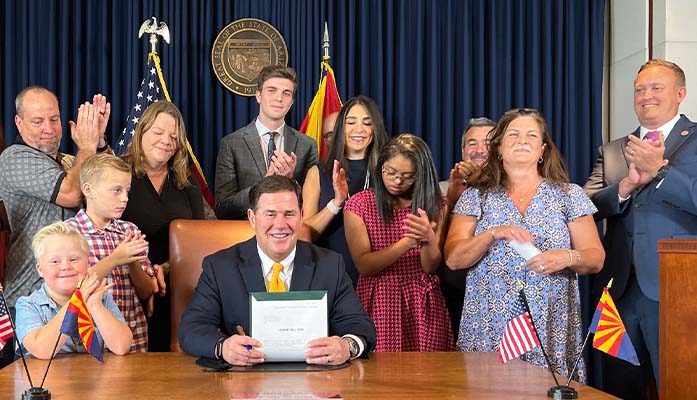
A pep rally type celebration was held Tuesday to help promote expansion of Empowerment Scholarship Accounts (ESAs) for all K-12 students in Arizona.
“Today, we celebrate the signing of the most expansive school choice legislation in recent memory,” Ducey said during a ceremonial signing of House Bill 2853 which provides about $7,000 in education credits for every Arizona student to attend the K-12 public, private or charter school of their choice.
“Arizona is now the gold standard for educational freedom,” the governor said.
The expansion of ESAs under HB2853 was sponsored by House Majority Leader Ben Toma (R-Peoria) with the support of the Goldwater Institute. ESAs are paid out as scholarships for families to use for tuition and tutoring expenses as well as transportation, textbooks, computers, and other costs related to supporting a student’s educational needs.
ESAs served roughly 100 Arizona students back in 2011. Last year that number was 11,000. But with HB2853 now in effect, all 1.1 million students at the K-12 level.
“This reform empowers parents weary of a one-size-fits-all approach to public education to customize their children’s schooling based on their unique needs,” Goldwater Institute President and CEO Victor Riches said when the law took effect. Riches added that Arizona families “deserve the right to choose the best education option for their children, regardless of zip code.”
“States around the nation should follow Arizona’s lead and pass legislation that funds students, not systems,” he said.
Reactions to Tuesday’s signing ceremony event were very positive.
READ MORE HERE
by Corinne Murdock | Aug 16, 2022 | News
By Corinne Murdock |
On Monday, Governor Doug Ducey announced that the border wall gap near Yuma, Arizona was closed. That section of the wall resembles more of a wall than the border fencing elsewhere: rather than slats, the state installed double-stacked cargo shipping containers welded together and lined at the top with razor wire standing 4 feet tall.
Each double-stacked shipping container block weighs 17,600 pounds and stands 44 feet tall without the razor wire. The new Yuma border wall section spans 1,000 feet. The state plans on filling three gaps totaling 3,000 feet in the coming weeks.
As AZ Free News reported, Ducey signed an Executive Order on Friday to finish the border wall. Ducey’s action occurred several hours before the U.S. Consulate issued a “shelter in place” advisory for Americans residing in Tijuana, Mexico. On Thursday, at least 11 people were killed amid a fight between factions of the Sinaloa Cartel.
On Sunday, the Consulate lifted the advisory.
The Friday advisory followed another, similar advisory from several days prior, marking another week of cartel violence in Mexico.
In his original announcement, Ducey declared that the Biden administration’s lack of urgency was a “dereliction of duty.”
Ducey said that the Tijuana violence prompted the immediate action to finish the border wall.
Ducey’s action far outpaced that of the Biden administration.
At the end of last month, the White House promised to finish the border wall. However, agency rules concerning environmentalism protocols, or “environmental stewardship reviews,” will likely delay that project by well over a year.
That could prove to be a snag for Ducey, who undertook construction without federal permission.
Earlier this month, Customs and Border Patrol (CBP) data revealed that hard drugs topped marijuana for drug busts along the border for the first time ever.
Cochise County Sheriff Mark Dannels shared with radio host James T. Harris of “Conservative Circus” that the fentanyl crisis is a direct result of Biden’s border crisis. Dannels said that Arizona had over 5 million fentanyl dosage seizures in 2021, beating out all other states including California.
“They know exactly what’s going on. These are intelligent people. They just don’t care. This is intellectual avoidance at its worst. It’s almost like ‘American Second’ on our southern borders,” said Dannels.
Dannels added that the county has taken back some control, noting that the county jailed 617 individuals associated with border crimes from January to July. Dannels noted that so far, they’ve handled nearly 300 recognized victims of border-related crimes.
Dannels also lamented the number of illegal immigrant deaths that occurred. Since January, 126 illegal immigrants have died attempting to cross the border.
In similar remarks, Ducey blamed the Biden administration for giving cartels more power.
The governor’s remarks were part of a series of statements deriding the Biden administration for its inaction. Ducey declared that Department of Homeland Security (DHS) Secretary Alejandro Mayorkas has a “defeatist attitude” that worsens the border crisis.
Corinne Murdock is a reporter for AZ Free News. Follow her latest on Twitter, or email tips to corinne@azfreenews.com.
by Corinne Murdock | Aug 15, 2022 | News
By Corinne Murdock |
Arizona now prohibits health care providers from using an individual’s disability as a disqualification from an organ transplant. The sole exception would be in the case that a patient’s disability poses a medical problem when receiving an organ transplant, excluding that patient’s ability to comply independently with the procedure.
The legislation also requires health care facilities to accommodate their organ transplant-related services for disabled patients, such as communications and counseling. It included specific provisions for patients with hearing and visual impairments, as well as cognitive, neurological, developmental, or intellectual disabilities.
Comprehensive information on all organ transplant centers’ policies regarding patients with disabilities doesn’t exist — only studies exist. A 2019 study from the National Council of Disability, a federal agency, confirmed that to be the case, observing a lack of transparency and consistency concerning organ transplant policies. What’s more, the council reported that individuals with disabilities and their families actually face pressure to donate organs. One of the most comprehensive studies, conducted in 2008, estimated that 43 percent of organ transplant centers “always” or “usually” deny children with a neurodevelopmental disability, while about 39 percent “rarely” or “never” do.
One Arizona mother, Felicia (Josie) White testified to the House Health & Human Services Committee that she supported this bill because Phoenix Children’s Hospital policy didn’t confirm that they would approve her daughter for a heart transplant, due to her having Down Syndrome. The White family felt compelled to seek treatment across the country, 3,000 miles away, in Boston, Massachusetts.
“We know individuals with Down Syndrome live full and fruitful lives well into adulthood. If transplant centers can teach illiterate, non-English speaking parents to dose meds, there’s no reason someone with Down Syndrome could not be taught,” said White. “I understand that organ allocation is a limited resource, but I also know that labeling anyone with cognitive delays ‘unable to transplant’ is a slippery slope that could include everything from ADHD to who knows what.”
Another mother, Andrea Temarantz, shared that her son also has Down Syndrome and would be jeopardized if he needed an emergency organ transplant. Temarantz informed the legislators of the studies on organ transplant discrimination. She insisted that the federal Americans with Disabilities Act (ADA) already prohibited such discrimination, but that there weren’t any enforcement mechanisms to protect patients with disabilities from ADA violations in Arizona.
“Every life is precious, and no one should be blocked from a transplant because of stereotypes about persons with disabilities,” said Temarantz.
Governor Doug Ducey signed that anti-discrimination bill, HB2659, into law in March.
The bill received no opposition in the state legislature. Both the House and Senate, as well as their respective committees, passed it unanimously.
State Representative Steve Kaiser (R-Phoenix) sponsored the bill. It received an endorsement from the Center for Arizona Policy (CAP).
Corinne Murdock is a reporter for AZ Free News. Follow her latest on Twitter, or email tips to corinne@azfreenews.com.