Congressman David Schweikert (R-AZ-01) raised an alarm about what he believes is the oncoming fiscal demise of the U.S. in a speech from the House floor.
Schweikert explained that a simple series of calculations “point to a shrinking labor force, and lack of young people in our society, and the reality that in 8 years, the United States will have MORE deaths than births,” citing the Congressional Budget Office (CBO).
"The fact of the matter is, and @RayDalio said it himself, there's a shortage of borrowable money in the world. We've run out of global savings. Our goal is stability, not collapse." – Chairman @RepDavidhttps://t.co/2dkQCJcYIG
— Joint Economic Committee Republicans (@JECRepublicans) March 26, 2025
The congressman’s speech coincided with the release of a devastating report from the CBO, which warned that the federal government’s capacity to borrow through “extraordinary measures” will be exhausted by the end of August or September.
Speaking to the House, Schweikert laid out the dire projections of the CBO report, as well as the remarkable insufficiency of the metrics the government is using, in the face of three unassailable facts: “debt, deficits and demographics:“
“I’m going to walk you through just how dangerous the game we are playing right now, because when you look at these charts — and this is online. Go on C.B.O. from last Friday. It’s not a hard read. Why are my brothers and sisters so terrified to tell the truth to the public? You have a country that — and I’m going to show the charts, that in 7 1/2 years we have more deaths than births. You have a country that, when we get out of the extraordinary measures…remember right now we are borrowing from different funds because we are up against the debt ceiling, we may be borrowing almost $70,000 every second of every day. For those of you who turn to me and say, ‘David, I demand you balance the budget.’ I could do it tomorrow. Lets’ see…if I use the 2024 numbers for every dollar we took in tax collections, we spend $1.39.
“Tell me the 39 cents you want me to cut. And the problem with that math is that when you look at the charts, you see what’s in blue. That’s everything a member of Congress gets to vote on, defense and nondefense. The only problem is. it’s 26% of the spending. So, if you ask a member of Congress right now to balance the budget, we can do it, we can do it. Gotta get rid of all defense, all non-defense, discretionary. That’s basically the park service, the EPA, all the agencies. And then tell me what portion…because you have to pay your interest or you blow up the world economy.
“Tell me what portion of social security, medicare, medicaid, other things you want to hack away at. The reality of it is, in this fiscal year, our projection is…for every dollar we take in tax collections, we are going to spend functionally $1.36.
“Do you understand how screwed—excuse me, yeah that’s the technical economic term— how SCREWED WE ARE when we don’t tell the truth about the math?
“And it is not fixable, but it is possible to stabilize. We can stabilize this. We just have to think and do things that are hard. So often around here, the thinking part is complex and it’s hard and we have to go home and tell our constituents the truth about math.
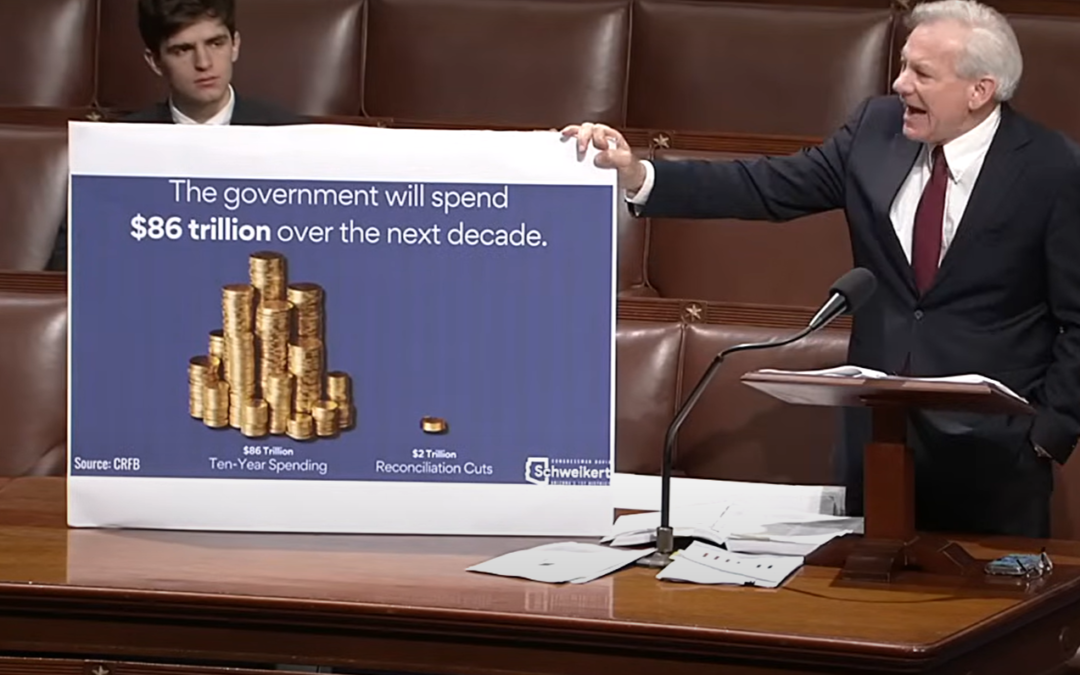
But remember, the math will win. How many have you heard about how people are protesting and terrified there are going to be cuts? Ok, let’s actually have a moment of truth about math. This was baseline. Over the next 10 years, we are going to spend $86 trillion. Next 10 years, CBO baseline, we are going to spend $86 trillion. The reconciliation budget had $1.3 trillion in cuts, and if we get lucky, we’ll get to $2 trillion over 10 years on $86 trillion of spending.
That’s what the left over here is losing their minds over because they need something. They have lost the working middle class. They’ve lost so much, and American voters no longer trust them because the spent decades not telling them the truth about the math. And it’s not hard, except the problem is 30% of that is borrowed. 30% of that is borrowed. And people are losing their mind that we are trying to cut $2 trillion on $86 trillion of spending. That’s what this place has become. This place has become a clown show of math.
“Think about this. We are functioning and going to spend about $7 trillion this fiscal year. We’re going to take in about $5 trillion. And this is in a time when the economy is good. We’re not in a pandemic. We’re not in a war. We’re not in a recession. And understand when you take some of these charts of interest exposure into the future, one of my charts, it shows in nine budget years interest, just interest is over $2 trillion a year. Just interest. Why aren’t we running around terrified here? If you care about your retirement or someone that’s crazy like my wife and I, we are older parents. I have a 2 1/2-year-old and a 9-year-old. You do realize for my 2 1/2-year-old, when he turns like 24 or 23, 25, every tax in the United States has to have been doubled just to maintain baseline services. This is the morality of this place.
“The United States and other countries are binging on debt. The United States borrows about 40% of all the world capital that goes into sovereign loans. His argument is, your problem is, there’s not enough savings in the world. We are consuming more money. China, Europe, now Germany’s going into the debt markets as they’re raising their spending caps. What happens in a world when there’s a shortage of borrowable money? Remember, every day when we borrow, what, $6 billion a day, functionally that debt has to be sold. Most of it’s actually financed domestically. You know, it’s in this pension, it’s in this bank…And then foreigners, except the foreigners have been lowering their U.S. Debt because they’re having to finance their own governments. And you start to look at our interest payments, and there’s this concept called a term premium. When we make the bond markets nervous, we pay a higher interest rate.”
Congressman Schweikert summarized the fiscal nightmare scenario saying, “And you look at the next 10 years, it’s the point I’m trying to make. Is, ok, here’s the growth. 24% of the growth in spending over the next 10 years is interest. 31% of the growth of spending over the next 10 years is Social Security and disability. 28% of the growth of spending over the next 10 years is Medicare. Other mandatory and discretionary growth, about 13%. But a portion of that is actually you think defense and other things in that. The fact of the matter is your government is an insurance company with an army.”
Congressmen David Schweikert (R-AZ), Tim Burchett (R-TN), and Steve Cohen (R-TN), co-sponsors of the Justice for Kennedy (JFK) Act, hailed the release of over 1,100 PDF files of documents pertinent to the assassination of President John F. Kennedy in a statement released Tuesday.
Social media and news outlets have been abuzz examining the files, many of which are being seen in unredacted form for the first time, having been previously released with key segments withheld.
The files, which total over 80,000 pages, were released with Director of National Intelligence Tulsi Gabbard stating, “President Donald J. Trump promised maximum transparency and a commitment to rebuild the trust of the American people in the Intelligence Community (IC) and federal agencies. Part of that promise was to fully release previously-classified records related to the assassinations of President John F. Kennedy, Senator Robert F. Kennedy, and the Rev. Dr. Martin Luther King Jr.”
One file that has garnered significant attention from July 19, 1967, refers to a CIA employee named Gary Underhill who was reportedly found dead after he claimed that the agency was responsible for the assassination of the president. “The day after the assassination, Gary Underhill left Washington in a hurry. Late in the evening he showed up at the home of friends in New Jersey. He was very agitated,” the document states. “A small clique within the CIA was responsible for the assassination, he confided, and he was afraid for his life and probably would have to leave the country. Less than six months later Underhill was found shot to death in his Washington apartment. The coroner ruled it suicide.”
Newly released JFK files tell a story about how Gary Underhill, who worked for the CIA, was found dead after he revealed to friends that the CIA was responsible for JFK’s assassination.
“The day after the assassination, Gary Underhill left Washington in a hurry. Late in the… pic.twitter.com/psZkYQ5COi
“It’s been 61 years since the tragic murder of President John F. Kennedy. A truly functioning republic ensures Americans have access to information, and this moment symbolizes the long-awaited restoration of the people’s trust in the federal government,” Congressman Schweikert said in a statement.
“I applaud the Trump Administration for following suit with our Justice for Kennedy Act and requiring all assassination records be unclassified and unredacted.”
Jeff Morley, a former Washington Post reporter and Co-Founder & Editor of JFK Facts, commented on the release saying, “Today’s release needs to include removing the many unnecessary redactions in the JFK files current held at the National Archives. I appreciate Congressman Schweikert’s years of work pushing Administrations of both parties to provide more government transparency on the Assassination of President Kennedy, especially from the CIA.”
More records are expected to become available according to the National Archives who wrote on its JFK Assassination webpage, “As of March 18, 2025, the records are available to access either online at this page or in person, via hard copy or on analog media formats, at the National Archives at College Park, Maryland. As the records continue to be digitized, they will be posted to this page.”
“I am happy that after decades of questions from the public and government cover-ups that the American people finally may have answers to the JFK assassination. President Trump is once again showing his commitment to having the most transparent administration this country has ever seen,” said Congressman Burchett.
“It’s too soon to know whether there’s much in the documents released today, but it is a good sign that some progress toward the goal of full disclosure is under way,” said Congressman Cohen. “The assassinations of the 1960s need to be understood in their full historical context and the documents being released may help us get there.”
Congressman David Schweikert (R-AZ1) delivered his weekly speech before the U.S. House of Representatives last Tuesday and stated that the looming fiscal crisis of the United States is not an ideological matter but is instead a matter of inevitability.
Schweikert, widely known as a budget hawk conservative on the federal deficit and the trajectory of the national debt, warned that the political culture on both sides of the aisle “remains entrapped in a cycle of partisan folklore.”
In a press release, he stated that “the nation’s debt trajectory—already consuming 40 percent of global sovereign borrowing—is poised to spiral out of control, with interest payments alone eclipsing essential expenditures.”
Schweikert suggested in his remarks that with the Social Security trust fund projected to collapse by 2033, “the nation is blindly entering into an era where senior poverty will double overnight.” But he provided a blueprint for a potential solution that leverages data science and AI-driven efficiencies to close this gap, noting that Congress’ failure to do so has further exacerbated the oncoming fiscal collapse.
He told the House, “If I came to you today and said, ‘Let’s strip any partisanship; we need to find waste, fraud, abuse, modeling issues where we’re doing things the wrong way, where we have models that are decades out of date…’ would you hire an army of auditors? An army of lawyers? Or would you hire data scientists?”
He answered, “Turns out, several years ago, Congress started requiring agencies that send out payments that cover health care costs and that send out checks to start sending error reports. In 2023, the reports came back at $236 billion of improper payments. That’s a stunning amount of money, but that doesn’t mean that there’s $236 billion of improper payments that have been stolen. There’s a bunch that has been, but it’s more complex. An army of auditors would take years to grind through this. That’s why there’s the miracle of technology right now—hire some data scientists.“
Schweikert also suggested a policy of aggressive transparency and candor with the American people saying ,“In 2033, the Social Security trust fund is empty. Our brothers and sisters on Social Security will take a 17 percent to 20 percent cut; we DOUBLE senior poverty in America. And when someone says, ‘Just raise the cap,’ our model shows that in 2034, raising the cap only covers about 38 percent of the shortfall. You’ve wiped out the cash needed to save Medicare, which actually runs out like three years later.”
He continued, citing the COVID shutdown and stimulus as being a serious contributor to the problem, “One of the reasons for this chart is [it’s] trying to demonstrate something very simple, that back before TCJA– the 2017 tax reform– the actual projection of what tax receipts would be– so, before the tax changes– we’re right on track. You see the weird blip there? That was a remarkable amount of spending that happened during the pandemic. We actually just went back to nominal. So, what happens here? What happens when there’s this intense, intense hunger to play this weird blame game instead of being willing to tell our voters the truth?“
Arizona Congressman David Schweikert has introduced a new bill to promote new product labeling requirements to improve pet safety. The new law, if enacted, would amend the federal Food, Drug, and Cosmetic Act to require foods containing the chemical xylitol to be labeled identifying the toxic properties of the chemical in pets or be declared mislabeled.
Schweikert explained in a press release that the bipartisan Paws Off Act of 2025 originates from a petition launched by 11-year-old Ahana Kameshwar. Schweikert and his staff were informed by Kameshwar of the tragic death of her loyal dog Loki.
Xylitol is an additive found in various foods such as mints, baked goods, desserts, vitamins, and gum which can be lethal to pets. A lack of appropriate labeling on these products can make it difficult for owners to be aware of this danger.
In her petition, Ahana said that Loki had died due to this lack of labeling. Schweikert held a video conference with Ahana and listened to her experience.
“We had Loki for about five years. One day, after we got back from our summer trip, he got into a bottle of melatonin pills that we forgot to put away while [un]packing,” she told the congressman. “Those pills, they had 250 milligrams of xylitol in each tablet. Here’s the problem; the xylitol was listed, but the dosage wasn’t. Loki [ingested] about 85 tablets. His liver started failing and ultimately, we had to put him down.”
The congressman’s office elaborated that millions of American families could be unaware of the potential danger to their pets presented by xylitol exposure. Citing the Poison Pet Helpline, they note that such exposures are not limited to food and typically involve medication, supplements, dental products, and skin care products.
This assessment was confirmed by Dr. Renee Schmid and Dr. Ahna Brutlag who wrote, “When dogs eat xylitol, it is quickly absorbed into the bloodstream, causing the pancreas to release insulin, resulting in a rapid increase in insulin levels in the blood. This rapid insulin increase causes a profound drop in blood sugar (hypoglycemia) as soon as 30 minutes to 2 hours after ingestion. If untreated, hypoglycemia can cause seizures and can be life-threatening. Ingestion of higher levels of xylitol leads to increased liver enzymes within 12 to 48 hours of ingestion, and liver failure within 24 to 48 hours.”
In her petition, Ahana wrote, “Xylitol is very dangerous to dogs, and we need to make others aware. [I] ask Congress to strengthen the PAWS Off Act so that no other families have to lose their pets the way I lost mine. We can save so many pets by making these changes!”
Analysis by Congressional researchers found that “Surveys by ADDA suggest almost 50% of US households have one or more dogs, estimating 78 million dogs owned by Americans in total. Despite FDA awareness campaign efforts, nearly 50% of pet owners are unaware of the dangers xylitol poses to their dogs.”
In a statement on the bill, Schweikert wrote, “We have been working tirelessly to move this simple, yet impactful piece of legislation through Congress. The damage of these sugar alcohols is truly lethal for our pets and furry companions. All it takes is a simple labeling fix to prevent more people from enduring the heartache that Ahana went through, and better yet, to save the lives of animals across America.”
Congressman David Schweikert revealed the truth about job numbers after an update was released by the Bureau of Labor Statistics which claimed the economy under outgoing President Joe Biden added 256,000 jobs in the month of December.
“As we transition to a new administration, the December jobs report provides an essential opportunity to assess the economic policies of the Biden administration and the challenges facing hardworking Americans,” stated Schweikert, Vice Chairman of the Joint Economic Committee.
“While the December data demonstrates strong employment growth, having increased 2.2 million in 2024, the report underscores persistent issues that demand immediate attention,” added Schweikert.
“Under the Biden administration, American families have faced unprecedented economic headwinds, including inflation rates that outpaced wage growth for much of the last four years. Policies prioritizing excessive spending and burdensome regulations have strained small businesses, stifled innovation, and eroded purchasing power. While there have been temporary gains in certain heavily subsidized sectors, the broader economic foundation remains unstable,” concluded an exasperated Schweikert.
In a post to X, the Joint Economic Committee Republicans summarized, “In December, employment rose by 256K, averaging a monthly gain of 186K in 2024. While these gains are notable, challenges remain: an unemployment rate above 4% for the past 8 months and a historically low labor force participation rate.”
In December, employment rose by 256K, averaging a monthly gain of 186K in 2024.
While these gains are notable, challenges remain: an unemployment rate above 4% for the past 8 months and a historically low labor force participation rate.
— Joint Economic Committee Republicans (@JECRepublicans) January 10, 2025
In his remarks Friday, Schweikert added, “It’s imperative that we prioritize policies which foster economic growth, encourage innovation, empower domestic businesses, and restore confidence in our markets.”
He added, “Reducing government overreach, prioritizing fiscal responsibility, and enacting tax reform that incentivize investment while rewarding hard work are the most crucial facets of restoring American prosperity.”
“I am committed to working with my colleagues to enact solutions that address these economic challenges and create a thriving future for all Americans. Together, we can ensure that 2025 is the beginning of a stronger, more resilient future for all Americans.”
Payroll employment rose by 2.2 million in 2024 (an average monthly gain of 186,000), with some industries growing more than others. pic.twitter.com/dzesehbhMG
— Joint Economic Committee Republicans (@JECRepublicans) January 10, 2025
The update from the Bureau of Labor Statistics (BLS) is infamously subject to revision as well. This proved to be a factor that badly hurt the Biden administration and the Kamala Harris campaign in August 2024 when the BLS estimate of new jobs created between March of 2023 and March of 2024 was revised down by almost 818,000 or about 30%. The release was allegedly intended after November 5th but was leaked according to President-elect Donald Trump.
Rep. Jodey Arrington, Chairman of the House Budget Committee, observed at the time, “Based on more comprehensive data released from state unemployment tax records, the Biden Bureau of Labor Statistics acknowledges they were way off on the number of new jobs created between March of 2023 and March of 2024 by almost one million or 30%, which is five times their average margin of error. The economy is the top issue in this presidential race and the recent downwardly revised job numbers taken together with persistently high prices and interest rates bellies a much weaker Biden-Harris economy than we were led to believe.”
Accusations that the Biden White House deliberately inflated the jobs numbers abounded with President-elect Donald Trump addressing the revision directly calling it a “total lie,” and “a scandal.”
President Trump addresses report that Biden-Harris Labor Department inflated jobs numbers by 818,000 during speech in Asheboro, NC pic.twitter.com/mNyq6JJ3XL
Trump told supporters in Asheboro, NC, at the time, “The Harris-Biden Administration has been caught fraudulently manipulating job statistics to hid the true extent of the economic ruin that they’ve inflicted on America.”
Schweikert’s office provided a few highlights of the BLS report, noting that the outgoing legacy of the Biden administration will be marked by:
“Real wages failing to keep pace with inflation, leaving many families burdened with record-high levels of credit card debt and preventing the ability to grow savings.
A labor force participation rate that has struggled to recover to pre-pandemic levels, leaving millions of Americans sidelined from economic opportunities.
The failure to address workforce development, with an uneven rate of job openings compared to worker skills, leaving both manufacturing and construction industries with critical labor shortages.”