Republican Congressman David Schweikert, working alongside Reps. Mike Kelly (R-PA), Glenn Grothman (R-WI), and Jared Golden (D-ME) introduced the Employee Retention Tax Credit Repeal Act on Tuesday. The bipartisan legislation is designed to streamline lower-risk returns from small businesses for more rapid processing by prohibiting the IRS from processing COVID-19 Employee Retention Tax Credit (ERTC) claims filed after January 31, 2024. The bill also drastically increases the penalties on businesses and individuals defrauding the government.
According to a press release from Schweikert’s office, the ERTC was initially created to enable “Main Street” businesses to keep furloughed staff employed during the COVID-19 pandemic. “However, legitimate returns from small businesses desperately needing support were crowded out by perverse promoters looking to take advantage of an emergency program, landing ERTC on the IRS’s ‘Dirty Dozen’ list in 2023.”
In a July statement, IRS Commissioner Danny Werfel warned that the law, as written, presented “more and more questionable claims,” noting that, “The further we get from the pandemic, we believe the percentage of legitimate claims coming in is declining.” The Congressman’s office noted that Werfel asked for Congress to help with this situation and to assist the U.S. Department of the Treasury to “address fraud and error.”
“The ERTC Repeal Act would enable the return to fiscal sanity and end a program riddled with fraud that could cost up to seven times more—up to $550 billion—than initially estimated if allowed to continue. By eliminating the ERTC program, this bill would save taxpayers an estimated $79 billion over ten years. “
🚨 The bipartisan Employee Retention Tax Credit Repeal Act was introduced this week by @SenatorRomney (R-UT), @SenThomTillis (R-NC), and @Sen_JoeManchin (I-WV). In response to massive cost overruns and fraud associated with the pandemic-era Employee Retention Credit (ERC), the… pic.twitter.com/kdzSyBhHqL
Schweikert explained, “We’ve all heard from the number of small businesses in our district waiting for their claims to be processed. A 1.4 million return backlog still exists, and moving the deadline up, rather than waiting until April 2025, will enable the IRS to go after the bad actors seeking to take advantage of taxpayers while approving legitimate claims faster and delivering long-overdue refunds to small businesses. Congress would be perpetuating a moral hazard if this level of fraud were allowed to go unpunished. It’s past time fiscal responsibility prevails, and we act on behalf of future generations who will be shouldered with a more than $35 trillion national debt.”
Per the release, the ERTC Repeal Act would advance the sunset date of the original program, and in addition to prohibiting processing of claims submitted after January 31, 2024, it would:
Increase penalties for promoters from $1,000 to $10,000 for individuals and $200,000 for business promoters;
Impose a $1,000 penalty for failure to comply with due diligence requirements; and
Extend the statute of limitations period on assessments to six years.
According to the text of the bill, any businesses promoting the ERTC may also be subject to “75 percent of the gross income derived (or to be derived) by such promoter with respect to the aid, assistance, or advice.”
A corresponding Senate Measure spearheaded by Senators Tom Tillis (R-NC), Mitt Romney (R-UT), and Joe Manchin (D-WV) was announced September 18th.
“Repealing the ERTC is a critical step towards addressing America’s debt crisis,” Tillis said in a statement. “It’s past time to eliminate this fraud-ridden pandemic-era policy so we can concentrate on getting our fiscal house in order.”
According to the Senate findings, the ERTC added approximately $230 billion to the U.S. deficit through Fiscal Year 2023 and was projected to ballon to as much as $550 billion. The IRS also announced in June that between 10% and 20% of claims showed “clear signs of being erroneous” while another 60% to 70% showed an “unacceptable risk” of being improper.
Under existing law, the credit will persist until April 25, 2025.
A new law, H.R. 3269, the Law Enforcement Innovate to De-Escalate Act, has passed the House Committee on Ways & Means and will move to the full floor of the U.S. House of Representatives. The proposed legislation would reform federal firearms laws to “account for advancements in de-escalation and less-than-lethal instruments, ensuring the continued innovation of lifesaving devices,” according to a press release from Congressman David Schweikert (R-AZ).
Under the existing laws, less-than-lethal weapons such as the TASER are legally considered “firearms” under federal regulation and the Firearms and Ammunition Excise Tax (FAET). Title 18 of the U.S. Code applies the Firearms and Ammunition Excise Tax, and the National Firearms Act also imposes an additional excise tax on “sales by the manufacturer, producer, or importer of certain firearms and ammunition,” potentially stifling adoption of the less-than-lethal devices by agencies and the public alike.
In the press release, Schweikert said, “Imagine a society where law enforcement is able to effectively protect our communities, without any lives being lost. Aligning the tax code to meet the needs of our law enforcement officers and communities offers Congress the opportunity to reduce the chance of the use of deadly force and the unnecessary loss of life. Our ability to keep pushing forward to a world where such technology is available and robust has inspired this moral fix in hopes to solve part of the bigger societal issue, and I promise to continue advocating for this bill until it is signed into law.”
The new bill would define a “less-than-lethal projectile device” as a “device with a bore or multiple bores, that—‘‘(A) is not designed or intended to expel a projectile at a velocity exceeding 500 feet per second by any means; and (B) is designed or intended to be used in a manner that is not likely to cause death or serious bodily injury.’’
Committee Chairman Jason Smith (R-MO) observed, “We need many different tools to keep the peace and protect our communities. Unfortunately, inconsistencies in our laws and tax code have resulted in critical and innovative less-than-lethal devices such as tasers being taxed as firearms, making it costly and difficult to meet safety needs. The Law Enforcement Innovate to De-Escalate Act, sponsored by Reps. Schweikert and Stanton, will harmonize our tax code to ensure less-than-lethal technology is readily available and that our communities can keep pace with future innovations.”
In a post to X in April, The International Union Of Police Associations endorsed the bill writing, “The I.U.P.A. vigorously advocates for law enforcement professionals on a national level by supporting legislation that serves their interests. One recent example is H.R. 3269, the ‘Law Enforcement Innovate to De-Escalate Act’.”
The I.U.P.A. vigorously advocates for law enforcement professionals on a national level by supporting legislation that serves their interests. One recent example is H.R. 3269, the “Law Enforcement Innovate to De-Escalate Act”. pic.twitter.com/4sjLzyV7ib
— International Union Of Police Associations (@IUPA34233) April 24, 2024
The bill was introduced by Rep. Greg Stanton (D-AZ) and co-sponsored by Congressmen Andy Biggs (R-AZ), David Schweikert (R-AZ), Debbie Lesko (R-AZ), Eli Crane (R-AZ), Juan Ciscomani (R-AZ), and Ruben Gallego (D-AZ) along with forty-three other Republicans and seventeen Democrats making it a truly bipartisan piece of legislation.
Correction: A previous version of this story incorrectly referrred to Rep. Greg Stanton as a Republican. Rep. Greg Stanton is a Democrat. The story has been corrected.
Arizona Rep. David Schweikert shared the shocking July Consumer Price Index (CPI) report of the U.S. Bureau of Labor Statistics that utterly shatters any narrative suggesting that the economy has recovered and inflation is abating. Citing the Bureau, Schweikert’s office noted that consumer prices are up 0.2% month-over-month and 2.9% compared to 2023. This requires the average family to spend $13,138 more per year to maintain the same lifestyle they enjoyed in 2021, while real average weekly earnings dropped 3.9%.
Most damningly, per the report, Cumulative CPI inflation (not seasonally adjusted) is up a devastating 20.2% with the American people effectively losing one-fifth of their buying power since President Joe Biden and Vice President Kamala Harris took power in 2021.
It's no wonder that consumers have declining confidence in President Biden and Vice President Harris to improve their financial standing after 3.5 years of economic calamity.
— Joint Economic Committee Republicans (@JECRepublicans) August 14, 2024
In several states, the cumulative inflation is significantly higher still. In the states of Arizona, Utah, Colorado, and Nevada, all key states in the 2024 Presidential election, cumulative inflation stands at 21.8%, and cumulative additional costs are the highest in the nation with Colorado’s the worst at $36,703 per average household. Colorado is exceeded only by Washington, D.C. where the cost increase is a staggering $41,313 per household. Arizonans have spent $32,625 more due to cumulative inflation.
Schweikert said in the statement:
“Though hardworking Americans received positive news this morning that inflation continued to slow in July, overall prices are still up more than 20% and real average weekly earnings are down 3.9% since the beginning of the Biden-Harris administration.
From Day One, this administration’s radical agenda has been a rubber stamp for growth-slowing tax hikes and runaway inflationary spending that have dramatically reduced Americans’ purchasing power and standard of living. It’s no wonder that consumers have declining confidence in President Biden and Vice President Harris to improve their financial standing after three-and-a-half years of economic calamity.”
The congressman’s office summarized the lengthy report, finding that food prices have increased 22% since January and energy costs have skyrocketed over 40%.
According to the JEC State Inflation Tracker, the average U.S. household was forced to spend $1,095 more in July, or $13,138 more per year, to maintain the same consumption basket they had in January 2021.
Headline CPI-U inflation increased 0.2% m/m and 2.9% y/y.
Core CPI-U inflation increased 0.2% m/m and 3.2% y/y.
Since January 2021:
Headline CPI-U inflation has increased 20.2%.
Core CPI-U inflation has increased 18.3%.
The food price index has increased 22%.
The energy price index has increased 40.2%.
Real average weekly earnings for all employees have decreased by 3.9%.
On the national inflation tracker, measuring the additional monthly cost for the average U.S. household since January 2021, Arizona placed 11th, well above the national average. The five states that enjoyed the smallest cost increases due to inflation were Arkansas, Oklahoma, Maine, West Virginia, and Louisiana.
On August 2, the Joint Economic Committee Republicans also reported that per the July jobs report, only 114,000 new jobs were added to the economy, well short of the 175,000 projected, and unemployment has increased to 4.3%, further indicating a weakening economy. A week prior, in a fiery speech to a largely empty House, Schweikert sarcastically congratulated Congress for the gross national debt passing $35 trillion.
Our gross national debt passed $35 trillion on Monday.
The math isn’t partisan.
It’s not Republican, nor is it Democrat.
Doing the math is MORAL. We need to be willing to have hard conversations to save future generations. And it starts by putting batteries in the calculator. pic.twitter.com/ORAryaBqKr
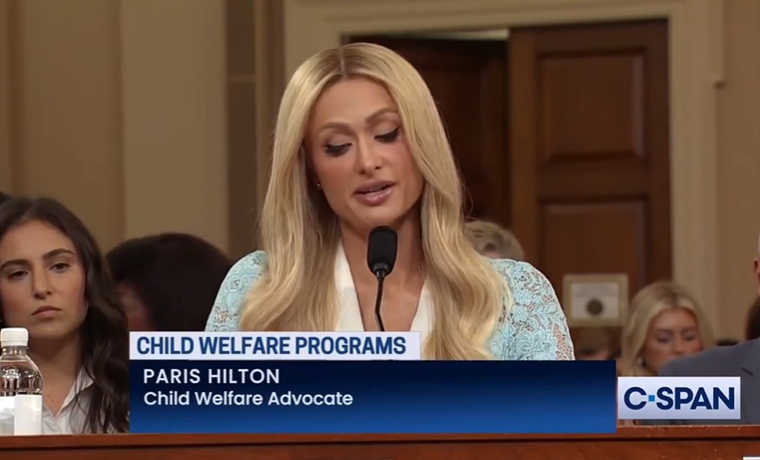
Republican Rep. David Schweikert criticized adoption agencies for predatory practices during a hearing this week featuring celebrity Paris Hilton, founder and CEO of 11:11 Media.
Schweikert came to the conclusion through his experience adopting his two-year-old son, the brother of the little girl they’d adopted before him. According to Schweikert’s remarks during Wednesday’s Ways and Means Committee hearing, adoption agencies impose prohibitively expensive adoption fees — even if the mother had just given birth and they had no role in the pregnancy or birth up to that moment, as was in his case.
“Two years ago this week, all of a sudden I’m getting text messages from my office, saying there’s a social worker who needs me to call her. Okay. I immediately assume I have a family member who needs bail money. I call the social worker and the first words out of her mouth were, ‘Are you going to come pick it up?’ Pick up what? Apparently the birth mother of the little girl we had adopted six years earlier had walked into the hospital, no prenatal care, substance abuse, and had a little boy. The little boy was very small, and going through withdrawals. […] One of the greatest things that’s ever happened in our lives. But before we were able to walk out of that hospital with him, turns out an adoption agency worker had gotten the birth mother to sign a piece of paper. Now remember, the birth mother had said, ‘Hey, the Schweikerts had adopted my little girl. This is the brother, wouldn’t that be nice if they could be together?’ We were told we had to sign a piece of paper for $40,000 before we were allowed to walk out the door with the baby because the baby belonged to adoption services. How does a middle class family adopt with these types of costs?”
Schweikert reflected on his experience to compare with Hilton’s testimony, which detailed her allegations of inhumane treatment at a congregate-care facility. The congressman concluded that the child welfare system suffers from financial greed.
“Mrs. Hilton actually said something that was brilliant. It’s about the money,” said Schweikert.
Yesterday, @ParisHilton bravely shared her traumatizing experience at a congregate-care facility with the Ways & Means Committee.
Having such a prominent voice express the flaws within the child welfare system is invaluable. pic.twitter.com/6RQkqlRteE
Hilton recounted how she was taken to a youth residential treatment facility at 16 years old. She testified that, under “troubled teen” programs promising “healing, growth, and support,” she had actually faced two years of physical, emotional, and sexual abuse.
Hilton testified she was force-fed medications, sexually abused by staff, violently restrained, dragged down hallways, stripped naked, forced in solitary confinement frequently, and deprived of views of the outside world.
“My parents were completely deceived, lied to, and manipulated by this for-profit industry about the inhumane treatment I was experiencing,” said Hilton. “Can you only imagine the experience for youth who are placed by the state and don’t have people regularly checking in on them?”
As reason for her testimony, Hilton advocated for the reauthorization of Title IV-B, a Social Security Act provision that created two child welfare programs with federal funding under two parts. Part 1 enacted Child Welfare Services while Part 2 enacted Promoting Safe and Stable Families.
Hilton also advocated for the Stop Institutional Child Abuse Act and again declared support for the Senate Finance Committee’s “Warehouses of Neglect” report.
This latest hearing of the Ways and Means Committee was the latest in a long string of hearings on the subject, more than any in the last eight congressional systems combined per the committee. The committee has been conducting a thorough review of Title IV-B over the past year.
Committee Chairman Jason Smith, a Missouri Republican, outlined a number of pervasive issues with the child welfare system: inadequate kinship care support, high social worker turnover, excessive bureaucratic red tape, slow hearings and lack of lawyer access for families, remaining barriers for Native American tribal families, high rates of mental health issues in older foster youth, and discrimination rather than support for impoverished families.
Watch Wednesday’s full hearing below:
AZ Free News is your #1 source for Arizona news and politics. You can send us news tips using this link.
Congress’s Joint Economic Committee (JEC) warned that the Biden administration’s economic policies have caused an unsustainable debt crisis and historic inflation.
This assessment was announced formally earlier this week by JEC Vice Chairman and Congressman for Arizona’s first district, David Schweikert, through the 160-page Republican Response to the Council of Economic Advisers’ 2024 Economic Report of the President.
Schweikert stated in a press release that 2024 serves as a “critical juncture” for the nation’s fiscal health, one that transcends political parties.
“The challenge before us is neither Republican nor Democrat — it is our moral obligation to ensure American families aren’t left behind. Congress holds the keys to determine which path we choose,” said Schweikert. “We can either behave like adults and choose the path of fiscal responsibility or continue our partisan gamesmanship that will put the American dream further out of reach for future generations.”
Schweikert said that the problems and proposed solutions put forth by the JEC report were inherently bipartisan, focusing on common-ground economy boosters like a healthier population and secure social safety net programs.
“Those of us on the Republican side, we built a report that offered actual moral, great economic solutions instead of the election year rhetoric.”
— Joint Economic Committee Republicans (@JECRepublicans) June 21, 2024
The JEC assessed that the Biden administration’s demand-side policies financed by increased borrowing have placed unsustainable pressure on constrained supply. As a result, JEC predicted that debt-to-GDP would grow from 99 percent to 116 percent by 2034, with interest costs rising. JEC noted that the labor force participation rates haven’t recovered to prepandemic levels; historic mortgage payments for new homebuyers, the highest in 30 years; constraints on budding American industries due to new restrictions on trade; and the cost of clean energy subsidies amounting to $1.2 trillion over 10 years, despite emissions from electricity production declining.
Further exacerbation of the economy comes from an aging population, declining fertility rates, and decreased prime-age labor force participation among men, per the JEC. The aging population is anticipated to drive Social Security spending to 6 percent of GDP by 2035, an increase from the present 5.2 percent and the 1970s at 3.1 percent, though no major expansions have occurred in over 20 years. The JEC reported that one in nine prime-age men remain out of the labor force; if just 25 percent of those entered, the economy would grow by $215 billion.
JEC disputed the Biden administration’s belief that increased taxes of wealthier individuals would amount to their desired revenue, a dwarfed amount of around 1.1 to 2 percent of GDP compared to future deficits. JEC stressed that only reduction in spending would improve fiscal consolidation.
Another demographic with an outsized impact on the economy, according to the JEC, is the rapid increase in obesity. Excess medical expenditures are anticipated to amount to over $9 trillion, as well as federal government spending of over $4 trillion within the next decade. Labor productivity and supply reductions impacted by obesity are projected to cost nearly $3 trillion and $12 trillion, respectively.
As for a positive solution to the nation’s current and looming fiscal woes, JEC indicated that artificial intelligence could grow the economy and improve government efficiency.
JEC also issued a lengthy assessment of the Congressional Budget Office’s revised budget and economic projections for the next decade. This included a $400 billion increase in projected FY2024 deficit, with about 80 percent of the increase coming from President Joe Biden’s student loan forgiveness, the Federal Deposit Insurance Corporation failing to recover payments from 2023 bank failures quickly, new legislation, and higher than expected Medicaid outlays.
CBO recently released its updated budget and economic projections for 2024-2034 from the original forecast in February 2024. Below are some key takeaways from the revised estimates 🧵
— Joint Economic Committee Republicans (@JECRepublicans) June 19, 2024
AZ Free News is your #1 source for Arizona news and politics. You can send us news tips using this link.