by Elizabeth Troutman | May 16, 2024 | Economy, News
By Elizabeth Troutman |
Arizona Republican Rep. David Schweikert urged Americans to take “our fiscal responsibility” seriously in light of the Social Security Administration’s 2024 Trustees Report.
“I implore my brothers and sisters to take our fiscal responsibility seriously before it’s too late,” Schweikert said.
Schweikert, who serves as Joint Economic Committee vice chairman, issued a statement on the report, which projected that the Old-Age and Survivors Insurance (OASI) Trust Fund will become insolvent by 2033.
“The Social Security Trustees Report confirms that it’s no longer just future generations who should be concerned about receiving their full earned benefits but rather current retirees too,” Schweikert said
The congressman criticized Congress for failing to protect the entitlement programs millions of Americans depend on.
“As our nation’s fiscal health continues to deteriorate, Congress refuses to live up to its moral obligation to protect and modernize Social Security and Medicare,” he said. “It’s past time for the political class to put aside their talking points and start working on bipartisan solutions to save these programs for our seniors.”
According to the report, the Old-Age and Survivors Insurance Trust Fund is projected to become exhausted by 2033. Once the OASI Trust Fund goes insolvent, all beneficiaries will face an across-the-board 21% cut to retirement benefits.
The Disability Insurance (DI) Trust Fund will be able to keep paying full benefits through at least 2098. But the combined OASI and DI Trust Funds will become depleted by 2035.
Once the combined OASDI trust funds go insolvent, all beneficiaries will face an across-the-board 17% cut to retirement benefits.
The Hospital Insurance (HI) Trust Fund will become insolvent by 2036. At that point, the HI Trust Fund will only be able to cover 89% of total benefits.
The combined Social Security programs will run a cash-flow deficit of $169 billion this year and $2.7 trillion over the next decade.
Elizabeth Troutman is a reporter for AZ Free News. You can send her news tips using this link.
by Staff Reporter | Apr 20, 2024 | Economy, News
By Staff Reporter |
Rep. David Schweikert (R-AZ-01) gave a brief rundown on the state of his constituents’ financial well-being under Biden before Congress on Tuesday.
Schweikert said that his district consists of some of the more well-off, educated, and entrepreneurial constituents in Arizona and the country. Yet, Schweikert says his more “prosperous” district has become poorer even when accounting for factors like wage growth.
“In my district, we’ve had the highest inflation in the continental United States. If you do not make 23.6 percent more money today than you did the day President Biden took office, you are poorer,” said Schweikert.
Schweikert’s district spans a northeast section of Phoenix that encompasses Scottsdale, Paradise Valley Fountain Hills, Cave Creek, the Salt River and Fort McDowell Yavapai Nation reservations, and part of the Tonto National Forest.
The congressman went on to say that his fellow congressmen, dubbed “the clown show,” needed to have “an honest conversation” with constituents to acknowledge that they’ve grown poorer in recent years.
Arizona experienced the highest inflation rates since February 2021, only returning to a lower rate of 2.7 percent earlier this year, last seen March 2021.
Both Arizona State University business professor and Carey School director Mark Stapp and University of Arizona economics center director George Hammond told Cronkite News last year that the reason for Arizona having the highest inflation — mainly Phoenix — has to do with shelter costs.
Arizona’s high growth rate, coupled with the lack of supply, prompted a rapid rise in housing and rent prices.
In 2022, the state boasted the highest inflation rate in the nation. At the time, the Phoenix area had a 13 percent inflation, much higher than the nationwide inflation rate at the time of 8 percent.
Schweikert has repeatedly urged his colleagues to curb inflation, last month pointing out the effects of the record levels of spending under the Biden administration. Schweikert projected that the total deficit spending for the 2024 fiscal year will be higher than both the Congressional Budget Office (CBO) and Office of Management and Budget (OMB) have projected.
Over the past three years, Arizona’s food banks have reported an unprecedented increase in the number of clientele they’re serving. The Arizona Food Bank Network reported earlier this year that it and its member food banks have served 14 percent more individuals in 2023 than in 2022 (a total of nearly 570,000 people a month), and 20 percent more than before the pandemic.
Conversely, the census reported that 12.5 percent of Arizonans were living in poverty in 2023 — the lowest rate in the past decade.
Schweikert hasn’t been the only one of Arizona’s congressmen to criticize federal leaders’ approach to handling inflation. Congressman Andy Biggs (R-AZ-05) remarked during President Joe Biden’s State of the Union last month that the overall inflation rate had hit nearly 20 percent since 2021, costing Arizonans nearly $13,000 in 2023 according to the Joint Economic Committee.
AZ Free News is your #1 source for Arizona news and politics. You can send us news tips using this link.
by Elizabeth Troutman | Apr 6, 2024 | News
By Elizabeth Troutman |
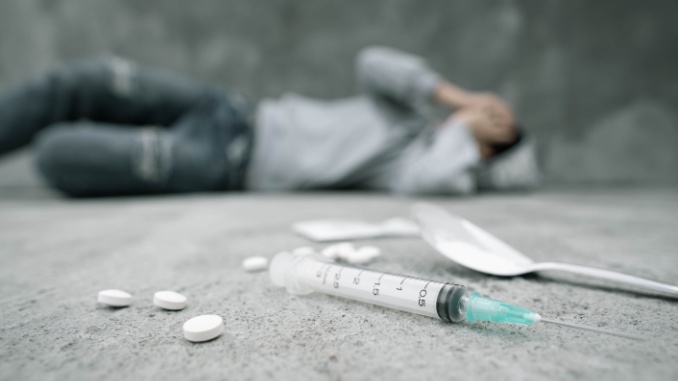
Newly introduced legislation would allow opioid, cocaine, methamphetamine, and alcohol to be eligible for an FDA breakthrough therapy designation in order to expedite the development and review of treatments.
U.S. Representative David Schweikert introduced the Substance Therapy Designation Act on April 1. The bill aims to ensure that the designation process for such treatments receives an even further fast-track.
“In the month of March alone, the United States Border Patrol has seized almost 15,000 pounds of controlled substances,” Schweikert said. “With the Substance Therapy Designation Act, I hope to be able to save more children that are falling victim to the continuing influx of these illicit drugs. This bill speaks to my continuing fixation of making our brothers and sisters healthier, while at the same time, promoting the safety and treatment from these addictive substances.”
Schweikert proposed the bill in response to Arizona’s increase in fentanyl coming across its border with Mexico illegally under the Biden administration’s border crisis. In the Nogales sector, Customs and Border Protection reported that it has seized over 8.5 million fentanyl pills since December 2023.
The total cost for opioid-related hospitalizations was $2.2 billion in 2022, a report from the Arizona Department of Health Services shows. Fentanyl is reportedly the most common component in many Arizona opioid overdoses. An average of three people die per day from fentanyl overdoses in Maricopa County.
Schweikert’s bill requires the Health and Human Services Secretary to grant priority review to substance abuse treatments and a fast-track designation to opioid, cocaine, methamphetamine, and alcohol treatments.
A number of treatments for substance abuse therapy are undergoing clinical trials. The first vaccine to combat cocaine addiction was formulated at the Federal University of Minas Gerais in Brazil.
A research team at the University of Houston plans to start manufacturing a clinical-grade vaccine that targets fentanyl after trials conducted with immunized rats succeeded. The vaccine blocks fentanyl from entering the brain.
Elizabeth Troutman is a reporter for AZ Free News. You can send her news tips using this link.
by Elizabeth Troutman | Mar 25, 2024 | Economy, News
By Elizabeth Troutman |
Inflation persists due to record levels of spending over the past three years, according to Rep. David Schweikert, R-Ariz., in a speech on the House floor Thursday night.
Schweikert said the total deficit spending for FY24 will be dramatically higher than both the Congressional Budget Office (CBO) and the Office of Management and Budget (OMB) initially projected if the national debt continues to increase at the current pace of over $99,000 per second.
Last May, Congressional fights over the next speaker overshadowed the greater concern, the national debt, Schweikert said.
“And think of this — in that time, we were fighting over like $16 billion,” he said. “We’re borrowing about $9 billion a day. So we’ve gone how many months, and we’ve never gotten around to actually working on the real problems because of the theatrics around here.”
As a result, the Scottsdale-Phoenix area resident said the Congressional Budget Office missed its FY24 deficit spending projection by $1 trillion.
Interest spending alone is projected to top $1 trillion this fiscal year, he said.
“When I came here a couple of months ago and said we could be heading for $1 trillion [in interest spending], I got mocked. I even saw my colleagues go, ‘Schweikert, you’ve got to stop making things up!’ Well, turns out I’m right,” he said.
“We will spend all day fighting over a few million here, which is important, and I am willing to cut these things, but we’re picking up pennies off the ground as the avalanche is crushing us,” he continued. “Because that same day we fought over those millions, we borrowed $9 billion a day when we are fighting over millions. Understand, $1 trillion has 12 zeros. Start to work your zeros and understand the scale.”
Addressing inflation, Schweikert said America is paying the price for spending money in ways that did not actually spike productivity. He said subsidizing things does not yield the most efficient and cheap way to produce them.
Schweikert advocated for a level of competition so the best, fastest product is rewarded.
“The last two months, [inflation] hasn’t been going down the way it’s supposed to,” he said. “So expect these interest rates I just showed you to continue. And if you live in my neighborhood, if you live in the Scottsdale-Phoenix area — wonderful area, absolutely incredibly beautiful this time of year. From January 2021 to two months ago, if you’re not making 23.6% more, you are poorer today than you were in January 2021.”
Making Americans less sick with new healthcare technology is one of the most powerful things we could do to lower the national debt, he said. Six weeks ago, the FDA approved the first cure to sickle cell anemia.
“Artificial intelligence is about to have a revolution in bringing cures to market dramatically faster,” Schweikert stated. “We’ve actually now had the first couple of AI drugs designed to make it through the FDA.”
Schweikert said policies can make it possible to bring new drugs to the market without costing $100 million.
“Do we think about things we could do in farm policy and nutrition policy in helping our brothers and sisters live better, healthier, more prosperous, [improve their] ability to join the labor force, maybe family formation, crushing income inequality,” he asked his fellow congress members.
Elizabeth Troutman is a reporter for AZ Free News. You can send her news tips using this link.
by Elizabeth Troutman | Mar 17, 2024 | Economy, News
By Elizabeth Troutman |
Two House Republicans and one Democrat from Arizona wrote to IRS Commissioner Daniel Werfel asking the agency to reconsider its decision to subject the Arizona Families Tax Rebate Program to federal income taxation.
Representatives David Schweikert, R-Ariz., Juan Ciscomani, R-Ariz., and Greg Stanton, D-Ariz., sent the letter Wednesday.
“We urge the IRS to reconsider its determination and provide expedited relief to compliant Arizonan taxpayers who have already filed their 2023 tax returns,” the three wrote.
More than 700,000 Arizona taxpayers were eligible to receive a one-time tax rebate as the state continues to recover from historic inflation levels that placed severe financial strain on families across the state, according to the representatives’ news release.
“The country is poorer now than it was three years ago, and Arizonans are no different, facing the brunt of financial pressure with supermarket prices now nearly 25% higher than in January 2020, for example,” the letter says. “State officials acted in good faith with the reasonably available information to provide more than 700,000 households with much-needed relief from price increases on everyday goods and services.”
Tax rebates enacted by 21 states were determined to be tax exempt in guidance issued by the IRS in February 2023, Schweikert, Ciscomani, and Stanton wrote. Though Arizona’s tax rebate wasn’t signed into law for another three months, the IRS extended its decision to make the rebate taxable past the period when the state issued payments, according to the letter.
“In December 2023, the IRS relayed its decision orally through a video meeting, providing no written explanation until February 15, 2024, eighteen days after the start of tax season, and only in response to a letter from the Arizona Attorney General challenging the decision,” the letter says.
Arizona taxpayers are estimated to owe $20.8 million in extra federal taxes due to the IRS’ inconsistent rationale in failing to specify the factual and legal basis for the 21 states’ rebates and payments that were deemed nontaxable in 2022, according to the representatives.
“The inconsistency and delay in communication have resulted in undue financial strain on Arizonans,” the letter says.
Elizabeth Troutman is a reporter for AZ Free News. You can send her news tips using this link.