Over the last four years Governor Katie Hobbs, the teachers’ unions, and their allies in the corporate media have been relentlessly attacking Arizona’s Empowerment Scholarship Accounts (ESAs) program, the most popular and successful school choice program in the country. Over 106,000 kids are currently using an ESA scholarship, with thousands more signing up each year.
Their most recent assault began last March, when the unions filed their ballot initiative in an attempt to gut ESAs. If passed, over 30,000 kids would have immediately lost their ESA scholarship or had their scholarship funds revoked because of the new restrictions. Another 400,000 children would have been permanently barred from participation in the program. The National Education Association (NEA) poured $7 million into this fight, hiring an army of paid circulators that were willing to say, and sometimes do, just about anything for a paycheck.
Interestingly, there were two different responses to this most recent threat. The response from most of Arizona’s school choice organizations and ESA families was a full-throated defense of the program. Within days, the AZ school choice coalition launched a countercampaign and made clear that ESAs would not go undefended. They fundraised, developed messaging, deployed grassroots “decline to sign” efforts, and crafted legislative countermeasures to put the unions on their heels.
And after the initiative was filed with the Secretary of State in July, a petition review was launched by the Goldwater Institute, which our organization helped support. That petition review revealed that thousands of signatures were either invalid or unlawfully collected by convicted felons. The result was that we proved in court that the NEA and Save our Schools was short of qualifying by nearly 15,000 signatures, and we knocked them off the ballot.
It was a pivotal victory in a long line of big wins for school choice in Arizona.
However, during this battle against the radical left, an alternative response to this attack emerged from the shadows: a belief that the only way to save the ESA program was to enact punitive regulations on the families that use the program. Rather than fighting back against the false attacks being levied against ESAs by the unions and the media, they preferred to make concessions that would make the program politically “attack-proof” in the future.
Sadly, this strategy has been tried in the past when dealing with the unions, and it almost resulted in irreversible disaster for our state.
Conceding the Issue to the Left Is the Quickest Way to Defeat
Our organization has seen this coordinated attack from the left before. Different issues, different talking points, but the same trajectory that involves goading us into accepting the other side’s terms of surrender…
This November, Arizona voters will decide whether to amend the state Constitution to prohibit taxes on vehicle miles traveled (VMT) and restrict government monitoring of or limits on how much people drive through Proposition 141.
The proposal would bar the state, counties, cities, towns, and other political subdivisions from imposing a tax or fee based on the miles a person travels in a motor vehicle. It would also prohibit those governments from enacting mileage-monitoring or mileage-limiting laws or rules unless they require the person’s voluntary consent.
The measure reached the ballot through SCR 1004, which passed the Senate on Feb. 20, 2025, and the House on June 13, 2025. The resolution was filed with the Secretary of State on June 16, 2025.
The Legislature advanced the proposal amid debate over mileage-based charges as a source of transportation funding. Such charges assess motorists based on distance traveled.
Supporters describe Proposition 141 as the Freedom to Move Act. In a published ballot argument, Arizona Free Enterprise Club (AZFEC) President Scot Mussi urged approval for the sake of privacy, affordability, and freedom of travel.
“From wide-open highways cutting through desert landscapes, lanes carving through mountains, bridges traversing valleys and open water, the Freedom to Move is engrained in the American spirit,” Mussi wrote. “Vote YES to preserve your privacy. Vote YES to keep Arizona affordable. Vote YES to preserve your freedom to move,”
Prop 141 protects your freedom to drive without the government tracking every mile.
You already pay at the pump. You already pay sales taxes. You already pay plenty of taxes that help fund Arizona’s roads.
In an August interview with Mussi, AZFEC Vice President Aimee Yentes noted that Arizona’s transportation dollars already come from several taxes, such as the tax on fuel and sales taxes. She added, “…this would prohibit the government from tapping into a new way to tax your driving by taxing every mile that you drive…”
Arizona Trucking Association President and CEO Tony Bradley also submitted an argument supporting the measure, citing reporting, auditing, and administrative costs associated with mileage-based taxation.
“Unlike fuel taxes, which are collected efficiently at the point of sale, mileage-based taxes require ongoing reporting, oversight, and enforcement,” he wrote. “Government agencies must devote resources to audits and compliance, while taxpayers and businesses bear additional recordkeeping and reporting costs. Those dollars are spent operating the tax system instead of improving roads and bridges.”
Under the official ballot explanation, a “yes” vote would amend the Arizona Constitution to prohibit: (1) taxes or fees based on motor vehicle miles traveled; and (2) laws or rules that monitor or limit motor vehicle miles traveled without consent.
A “no” vote would retain the current constitutional language on taxation.
If Proposition 141 is approved by voters, Arizona would become the first state to embed a ban on VMT taxes and mileage limits into its constitution.
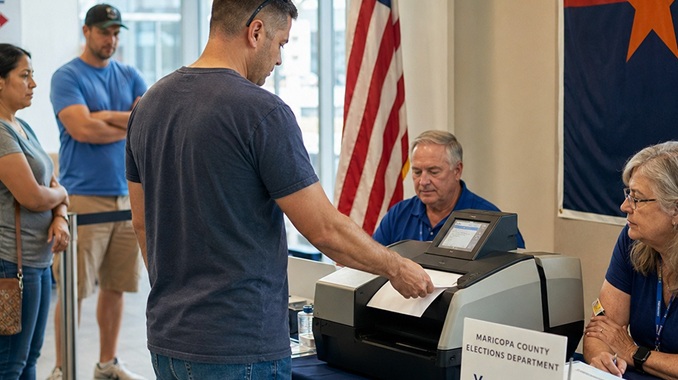
Arizona voters will decide in November whether to amend the state Constitution to require an Election Day ballot tabulation option at voting locations and government issued identification for every voter, including those voting by mail.
Proposition 144, referred to voters through House Concurrent Resolution 2001, also addresses citizenship requirements, foreign contributions, and the legal standard governing election laws.
Known as the Fast Accurate Secure Transparent Election Results Act (Fast Election Results Act), the proposal would apply to elections taking place on or after Jan. 1, 2028.
Under the final text, all voters would have the option on Election Day to have their ballots tabulated at their voting locations, with procedures prescribed by law. The provision states that its purpose is to prevent administrative delays and ensure timely, accurate results.
The Arizona Free Enterprise Club (AZFEC), which supports the measure, highlighted Maricopa County’s use of on-site early-ballot tabulation during the 2026 primary in an Aug. 13 commentary. The organization argued that making the option available statewide would reduce the backlog of early ballots requiring processing after Election Day and allow voters to see their ballots counted.
HOW DID PROP 144 GET ON THE BALLOT?
It took a last-minute fight at the Legislature to give Arizona voters the final say on the FAST Elections Act.
Prop 144 would put major election requirements into the Arizona Constitution, including government-issued voter ID, citizenship… pic.twitter.com/z7FeRfX4FG
In a discussion with AZFEC, Rep. Alex Kolodin (R-LD3) described GOP efforts to get the Proposition on the ballot, saying, “So what we hear from people, that they’re frustrated. They voted for Republicans to deliver things like common-sense election security, but then Republicans don’t give it to them. They just ask for money so that they can do it next time. And I was so sick and tired and embarrassed that we hadn’t done that. And so that’s why I put in all the effort that was required, and it was an enormous amount. But at the end of the day, we got it done.”
Maricopa County reported that 23,400 voters tabulated early ballots at vote centers on Election Day. County officials credited that option, along with improvements in removing ballots from envelopes and sending them to tabulation, with enabling the county to report 99% of results the following day.
Under the county’s 2026 procedures, voters bringing early ballots to vote centers on Election Day can check in, show identification, and use a tabulator programmed for early ballots. The county says ballots tabulated at vote centers are included in election-night results.
Proposition 144 would separately require valid government-issued proof of identity before casting a ballot in each election, whether voting in person or through another method. The amendment leaves implementation to law and does not specify a detailed process for presenting identification when voting by mail.
The official ballot language describes this provision as limiting acceptable identification documents to government-issued ID and extending the requirement to mail voters.
The measure would also reaffirm that only U.S. citizens may register and vote in Arizona elections and that elections must be decided solely by eligible citizen voters. It would prohibit foreign nationals from spending or contributing money or anything of value to influence an Arizona election and prohibit anyone from knowingly accepting such contributions.
Another provision would allow the people and Legislature to enact election laws, including those governing early and mail voting, when rationally connected to a legitimate state interest. Listed interests include election security, efficient administration, timely and accurate results, and public confidence.
The official ballot description says that provision would create a new standard for judicial review under the Arizona Constitution that could make election laws harder to challenge.
The Legislature would be required to appropriate money necessary to implement the measure. Its statement of intent also specifies that it does not change federal law governing the overseas military voting process.
A yes vote would approve the constitutional amendment. A no vote would retain the current constitutional provisions governing elections.
Three Arizona House Republicans have requested weekly, in-person briefings from Arizona Department of Water Resources (ADWR) Director Thomas Buschatzke on Colorado River negotiations, seeking the same information provided to Gov. Katie Hobbs.
In a September 4 letter, Reps. Gail Griffin (R-LD19), Neal Carter (R-LD15), and Chris Lopez (R-LD16) asked Buschatzke to meet with them and relevant agency staff and legal counsel at least once a week. The lawmakers proposed Tuesdays at 2 p.m., while offering to arrange another mutually agreeable time.
The request follows the federal government’s decision on Colorado River operations for 2027 and 2028, which drew mixed reactions from Arizona officials. Arizona would absorb approximately 61% of the total reductions across the three Lower Basin states, with a 760,000-acre-foot reduction compared with California’s 440,000 and Nevada’s 50,000.
Griffin chairs the House Natural Resources, Energy & Water Committee, where Lopez serves as its vice chair, and Carter is speaker pro tempore of the Arizona House of Representatives.
In the letter, the lawmakers cited the Legislature’s authority under A.R.S. § 45-106, which requires legislative approval by concurrent resolution before an agreement between the water resources director and the United States, another state, or a government involving Arizona’s sovereign rights or claims can take effect.
💧 Did you know?
Arizona’s water future depends on more than one source.
Colorado River water remains critical, but Arizona also relies on groundwater, reclaimed water, conservation, water storage, and new supply projects to support communities and future growth.
“Given our unique legislative role under A.R.S. § 45-106, we believe we are entitled to receive the same briefing you would deliver to the Governor’s office or the Governor herself, free from any filters or withholding of information,” the lawmakers wrote.
The requested meetings would allow members to receive updates, ask questions, and examine the factual, policy, and legal rationale for prospective offers, terms, or decisions. The lawmakers also asked to be informed of developments as they occur.
The letter also references two pieces of correspondence from August. They said Buschatzke confirmed on August 25 that implementing a Lower Basin Agreement would require legislative approval and committed to keeping House and Senate members informed of information relevant to their decision.
— Arizona Department of Water Resources (@azwater) September 4, 2026
The lawmakers also said Hobbs affirmed her commitment to providing relevant updates in an August 26 letter and directed Buschatzke to “continually update” them as requested.
Hobbs plans to call a special legislative session for lawmakers to vote on a water-sharing agreement between Arizona, Nevada, and California.
Hobbs highlighted her administration’s Colorado River negotiations in a June interview with 12 News. After the federal government released its proposed operating guidelines, she urged federal officials to adopt the Lower Basin states’ proposal and distribute water reductions equitably.
In August, the federal government came to an agreement with Arizona and the other Lower Basin states on Colorado River water usage. Under the deal, Arizona will lose about 61%: the most out of the Lower Basin states. The news was met with mixed reactions. Hobbs said the decision protected Arizona from deeper cuts. U.S. Rep. Juan Ciscomani (R-AZ-06) said his initial review indicated the plan avoided the most drastic options previously announced, while U.S. Rep. Greg Stanton (D-AZ-04) described the two-year reprieve as another short-term fix and called for durable agreements.
Scot Mussi, president of the Arizona Free Enterprise Club, called the deal “a total failure of leadership” in a statement posted to X. He stated that the deal “will place most of the cuts on new single family homes while data centers and apartments get unlimited water.” He added, “Conveniently, those big water users happen to be some of your biggest campaign contributors.”
This deal is a total failure of leadership. On top of that, this deal will place most of the cuts on new single family homes while data centers and apartments get unlimited water. Conveniently, those big water users happen to be some of your biggest campaign contributors. https://t.co/pLaenPuDCc
The Trump administration has finally come to an agreement with Arizona and the other Lower Basin states on Colorado River water usage.
The news was met with a mixed reaction.
Gov. Katie Hobbs described the agreed-upon deal in an announcement on Friday as adequately protecting the state from the “disastrous and unacceptable forced federal water cuts” that were floated by the federal government earlier this month.
I'm glad the federal government has chosen to implement the Lower Basin's water allocation plan. We've protected Arizona from disastrous and unacceptable forced federal water cuts.
Together, we’ve proven that the Lower Basin will work in meaningful ways to protect the Colorado…
Under the federal government’s proposal, Arizona would have seen cuts up to 77%.
Under this deal, Arizona will lose about 61%: the most out of the Lower Basin states.
While Arizona will give up 760,000 acre-feet between 2027 and 2028, California and Nevada will collectively lose 490,000 acre-feet. Overall, the cuts represent a reduction of approximately 25%.
The Upper Basin states will not see cuts under this plan.
Brenda Burman, Central Arizona Project (CAP) general manager, said the Upper Basin states needed to pull their weight.
“Lake Mead should not be sacrificed to protect Lake Powell or other Upper Basin reservoirs, and every state that relies on the river should be part of the solution,” CAP General Manager Brenda Burman said in a statement. “The Colorado River needs to be treated as the system it is.”
Some of Arizona’s elected leaders issued stand-in statements in which they disclosed that they were still reviewing the plan.
Rep. Juan Ciscomani (R-AZ-06), co-chair of the congressional Colorado River Caucus, said that upon initial review the current plan avoids the “most drastic options” previously announced by the Trump administration. However, Ciscomani intimated that long-term solutions were still lacking in this latest plan.
“The goal is clear: long-term water certainty and security for Arizona,” said Ciscomani. “I will continue working with the Administration and bipartisan leaders at every level of government to protect this critical resource for our farmers, ranchers, businesses, tribes, and every Arizona family that relies on the Colorado River.”
Rep. Greg Stanton (D-AZ-04) said that the deal provided two years of “welcome” stability, but that it was only “another short-term fix” and not a lasting solution.
“[A] two-year reprieve is not a solution. The agreements holding this decision together must be durable, and a record-breaking drought won’t suddenly resolve itself,” said Stanton. “Every two years, this same threat of ‘CAP to zero’ will hang over Arizona’s head. That’s no way to run a system millions of people depend on for water, power and food.”
Rep. Yassamin Ansari (D-AZ-03) didn’t issue a statement on the plan, but did post on social media calling water “the lifeblood of Arizona,” promising “bold action to confront the climate crisis,” and including a link to the city of Phoenix’s water quality page.
Rep. Adelita Grijalva (D-AZ-07) issued a statement blending elements from colleagues Stanton and Ansari, calling for a more permanent solution among both the Upper and Lower Basin states while also urging action on climate change as the purported root causes of the prolonged drought.
Democrat Senators Mark Kelly and Ruben Gallego issued a joint statement simply expressing gratitude for the two years the plan afforded Arizona, and presented a lighter look forward at the road ahead for a more “lasting” plan of action. The senators also indirectly called on the Upper Basin states to take on some of the water-cuts burden as well.
“This decision provides much-needed certainty for Arizona and the Colorado River over the next two years,” Kelly and Gallego said. “The 2027 and 2028 guidelines protect Arizona from even deeper near-term cuts while giving the seven Basin states more time to reach a long-term agreement.”
Danny Seiden, Arizona Chamber President and CEO, said that the deal was “workable,” not perfect. Seiden credited state leaders for working in a bipartisan manner to accomplish the deal, specifically Hobbs, Senate President Warren Petersen (R-LD14), and House Speaker Steve Montenegro (R-LD29).
“We are still working through the details, but today’s decision appears to provide a workable path forward over the next two years and avoids some of the most damaging scenarios our state was facing,” said Seiden. “Arizona has already put real conservation and real cuts on the table, and the work now continues toward a long-term agreement that requires every Basin state to share in the responsibility. Arizona’s business community will continue to support our leaders as they fight for a fair, durable solution that protects our water and our economic future.”
Others weren’t so optimistic.
Scot Mussi, president of the Arizona Free Enterprise Club, called the deal “a total failure of leadership.” Mussi criticized the deal, saying it imposes water cuts on single family homes but not data centers and apartments.
This deal is a total failure of leadership. On top of that, this deal will place most of the cuts on new single family homes while data centers and apartments get unlimited water. Conveniently, those big water users happen to be some of your biggest campaign contributors. https://t.co/pLaenPuDCc