by Terri Jo Neff | Nov 5, 2021 | Economy, News
By Terri Jo Neff |
Earlier this month the Arizona Supreme Court agreed with a lower court’s ruling that parts of 4 of the 11 budget bills signed into law by Gov. Doug Ducey this summer are unconstitutional on procedural grounds. The reaction from business owners and community leaders was swift, with many left wondering when and how lawmakers will address the dozens of provisions dropped from those budget bills.
Among those provisions was a prohibition on a county, city, or town from issuing COVID-19 ordinances that impact private businesses, schools, churches, or other private entities, including mask mandates. Other prohibitions would have kept K-12 schools from requiring vaccines with an emergency use authorization for in-person attendance and ensured public universities and community colleges could not mandate COVID vaccines and vaccine passports.
The Arizona Free Enterprise Club (AFEC) describes the Justices’ recent opinion as “devastating” and “a big blow to the people of Arizona.” The organization has drawn attention to the uncertainty and frustration across Arizona at a time when the pandemic impacts are still being felt in the state’s economy, and as individual freedoms are under attack.
As a result, the AFEC is leading the call for the Arizona Legislature and the Governor to immediately address the critical reforms that the Supreme Court struck down.
“They must exhaust every option possible, including special session, to protect Arizonans from more COVID mandates and the bigoted teachings of Critical Race Theory,” according to AFEC. “But make no mistake, while this ruling is devastating, it will not stop the battle over these critical issues. There’s just too much at stake. Because if the uncertainty and frustration caused by these issues are allowed to continue, it would be the most devastating news of all.”
by Corinne Murdock | Aug 24, 2021 | News
By Corinne Murdock |
Last week, the Secretary of State’s office received the “Arizonans for Voter ID Act:” a ballot initiative to strengthen ID requirements for in-person and mail-in voting through universal voter ID. The initiative will require ID for mail-in ballots, but will also provide a free voter ID to those registered voters who need it. Voters would also be required to give certain information: their date of birth, as well as either the last four digits of their Social Security Number, driver’s license number, or nonoperating state identification number.
Proponents of the Arizonans for Voter ID Act assert that its voter ID requirement will also deter ballot harvesting. The political committee that filed the ballot initiative, Arizonans for Voter ID, was joined in their efforts by the Arizona Free Enterprise Club, Heritage Action, Honest Elections Project Action, Foundation for Government Accountability, the Goldwater Institute, the Republican Liberty Caucus of Arizona, AMAC Action, and Arizona Women of Action.
As required by law to qualify for the 2022 November ballot, the Arizonans for Voter ID Act acquired at least 237,645 signatures by July 7.
Arizona Free Enterprise Club President Scot Mussi asserted that most Arizonans and all other American citizens support strong voter ID.
“This initiative will ensure that no matter when you vote, where you vote, or how you vote, identification will be required,” said Mussi.
The polls support this claim. Over 60 percent of Arizona voters support voter ID. Nationally, around 80 percent of Americans support voter ID.
In July, U.S. Supreme Court Justice Samuel Alito ruled that Arizona law makes it “quite easy” for individuals to vote. The court case, Brnovich, et al. v. Democratic National Committee, et al., outlined the provisions of Arizona voting law that ease the burden for voters. Alito noted that this included in-person voting on Election Day, 27 days of early in-person voting, and only one application required for mail-in voting which could be extended perpetually through the Active Early Voting List as long as voters vote once within two straight two-year election cycles (rebranded from “Permanent Early Voting List,” or PEVL, through legislation passed earlier this year limiting the system’s perpetuity).
ID plays a role in many mainstream societal transactions, as Arizonans for Voter ID Committee Chair Vicki Vaughn argued.
“Arizonans show identification all the time in their daily lives to purchase alcohol, receive unemployment benefits, make major transactions, and board a plane, among others,” stated Vaughn. “Requiring identification before casting a ballot is necessary for our elections.”
A photo ID or another valid, government-issued ID is also required for the following: obtaining a driver’s license, receiving certain in-patient or out-patient doctor or hospital treatments, receiving certain over-the-counter or prescription medicines, buying guns or ammunition, visiting schools or jails, filing court documents, adopting a child, engaging in parole or probation, receiving auto insurance, donating blood, cashing or paying with checks, pawning items, responding to a traffic stop, obtaining a passport, picking up packages at the post office, buying cigarettes, opening a bank account, renting or buying a house, applying for a mortgage, adopting a pet, renting a hotel room, applying for a hunting or fishing license, establishing a utilities account, and applying for a job.
Learn more about the Arizonans for Voter ID Act here.
Corinne Murdock is a reporter for AZ Free News. Follow her latest on Twitter, or email tips to corinne@azfreenews.com.
by AZ Free Enterprise Club | Aug 22, 2021 | Opinion
By the Free Enterprise Club |
It needed to be done. At the end of June, Governor Ducey signed HB2898, which included a provision prohibiting a city, town, county, school board, or charter school governing body from requiring students or teachers to wear masks.
Bear in mind that this law doesn’t mean students and teachers can’t wear masks. They certainly can if they want to. But it keeps the heavy hand of government from enforcing unnecessary restrictions—especially on students who should be focused on learning.
Predictably, the liberal left has had a meltdown. The board president at Northland Preparatory Academy in Flagstaff went on a tirade in a now-removed Facebook post, referring to parents and students who disagree with mask mandates as “the worst of humanity.”
And some schools have decided that their first lesson for the year is to teach kids it’s ok to violate the law. A growing number of Arizona school districts are openly defying Governor Ducey by requiring students and staff to wear masks if they want to set foot on campus.
Our children have become pawns in a game of COVID chess—all at the mercy of the kings and queens on school boards throughout the state.
While parents are speaking up, they need help. Thankfully, Arizona’s House and Senate Republicans heard their cries. Last week, a group led by state representative Jake Hoffman called for Governor Ducey to do something…
>>> READ MORE >>>
by Corinne Murdock | Aug 20, 2021 | Education, News
By Corinne Murdock |
On Thursday, the Arizona Supreme Court ruled that Proposition 208 (Prop 208), the voter-approved increase on income taxes to fund public education, was unconstitutional and remanded to lower court. If that trial court determines that Prop 208 exceeds the constitutional spending limit, then Prop 208 would be killed. Chief Justice Brutinel authored the opinion.
The case, Fann, et al. v. State of Arizona, et al., challenged one major provision of Prop 208 and the circumstances of its approval.
First, the case questioned how Prop 208 exempted itself from the Arizona Constitution’s provisions on tax revenue spending caps, or the Education Expenditure Clause.
Brutinel ruled this aspect of Prop 208 unconstitutional. The chief justice made sure to note that this ruling rendered the other aspects of Prop 208 unworkable and unseverable. Meaning, no part of Prop 208 is enforceable if the trial court concurs with the Arizona Supreme Court’s opinion.
“We hold that the direct funding provision does not fall within the constitutional definition of grants in article 9, section 21 of the Arizona Constitution, and Prop. 208 is therefore unconstitutional to the extent it mandates expending tax revenues in violation of the Education Expenditure Clause,” wrote Brutinel. “Likewise, the remaining non-revenue related provisions of Prop. 208 are not separately workable and thus not severable.”
Second, the case challenged tax impositions made by voter initiative. The plaintiffs cited the Arizona Constitution’s Tax Enactment Clause, which stipulates that tax changes must be approved through a two-thirds vote by the state legislature.
The court disagreed with this assessment.
“Additionally, we hold that Prop. 208 does not violate article 9, section 22 of the Arizona Constitution (‘Tax Enactment Clause’), because that clause does not apply to voter initiatives,” wrote Brutinel. “Therefore, the bicameralism, presentment, and supermajority requirements found therein are inapplicable to Prop. 208.”
The Goldwater Institute, Snell & Wilmer, and Greenberg Traurig filed the lawsuit on behalf of the 11 plaintiffs: State Senate President Karen Fann (R-Prescott); State Senators David Gowan (R-Sierra Vista) and Vince Leach (R-Tucson); Arizona House Speaker Russell Bowers (R-Mesa); State Representatives Regina Cobb (R-Kingman), John Kavanaugh (R-Fountain Hills), Steve Pierce (R-Prescott); Montie Lee of Lee Farms; Dr. Francis Surdakowski; NO on 208; and Arizona Free Enterprise Club.
In a statement, Goldwater Institute Vice President for Litigation Timothy Sandefur classified the ruling as a win.
“Today represents a major victory for the hardworking taxpayers of Arizona,” said Sandefur. “The justices made clear that the state constitution’s limits on spending—which were added to the Constitution by the voters themselves—cannot be simply ignored, as Prop. 208’s funders attempted.”
Governor Doug Ducey concurred that this ruling signaled that the end was near for Prop 208.
“There is a clear legal path to Prop 208 being knocked down entirely, it’s only a matter of time,” tweeted Ducey. “The out-of-state proponents of this measure drafted bad language, and now they are paying the price.”
Proposition 208 (Prop 208) tacked on 3.5 percent to the existing 4.5 percent income tax for individuals making over $250,000 or couples making over $500,000. Previously, Arizona’s income tax rate was capped at 4.5 percent for individual incomes above $159,000 or joint incomes above $318,000. The revenue from the income tax increase would fund a wide variety of educator salaries and programs.
About 52 percent of Arizonans voted in favor of Prop 208 last November, and about 48 percent voted against it.
Corinne Murdock is a reporter for AZ Free News. Follow her latest on Twitter, or email tips to corinne@azfreenews.com.
by Terri Jo Neff | Aug 17, 2021 | News
By Terri Jo Neff |
Several Arizonans, Republican state lawmakers, and organizations are joining forces to secure enough signatures so voters can decide during the November 2022 General Election whether to strengthen existing voter ID requirements.
Arizonans for Voter ID is a political committee sponsoring the ballot initiative which seeks to revise existing voter ID laws for in-person voting and vote-by-mail ballots, as well as individuals who return another voter’s ballot.
Paperwork for the “Arizonans for Voter ID Act” initiative was filed Monday with the Arizona Secretary of State’s Office by committee chair Vicki Vaughn and Bill Luhrs, committee treasurer.
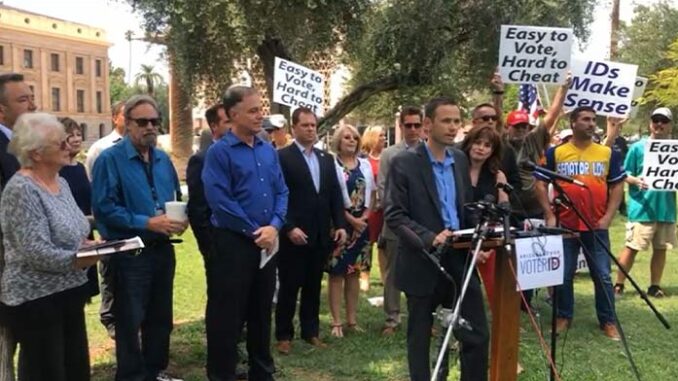
House Majority Leader Ben Toma (R-LD22) will join other lawmakers, including Senators Warren Petersen (R-LD12) and J.D. Mesnard (R-LD17), for a press conference Tuesday at 1:45 p.m. on the Senate lawn to formally launch the initiative effort.
“The vast majority of Arizona voters support voter ID because it is a common-sense and critical election integrity practice that is increasingly implemented around the country,” according to Scot Mussi, president of the Arizona Free Enterprise Club. “This initiative will ensure that no matter when you vote, where you vote, or how you vote, identification will be required.”
In addition to Arizona Free Enterprise Club, other coalition members include The Goldwater Institute, Heritage Action for America, Republican Liberty Caucus of Arizona, Foundation for Government Accountability, Arizona Women of Action, AMAC Action, and the Honest Elections Project Action.
“Election experts have always recognized voting by mail as the voting method most susceptible to error and fraud,” said Jason Snead, executive director of Honest Elections Project Action. “Adding objective identification requirements to Arizona’s mail-in ballots builds voter confidence in elections by ensuring only legal votes are accepted and counted.”
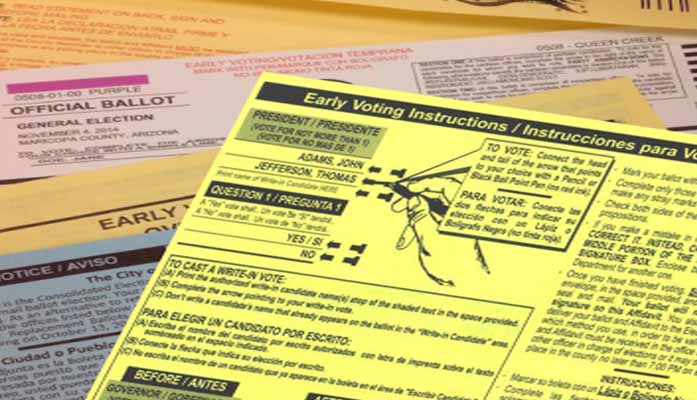
Under the Act, voters who receive their ballot by mail would still sign the voter affidavit section, but would also include their date of birth, In addition, the voter would need to include the last four digits of their social security number, Arizona driver’s license number, or state identification card.
“Arizonans show identification all the time in their daily lives to purchase alcohol, receive unemployment benefits, make major transactions, and board a plane, among others. Requiring identification before casting a ballot is necessary for our elections,” Vaughn said in announcing that the process got underway Monday.
Those interested in more information about the initiative can contact info@azvoterid.com.