by Corinne Murdock | Nov 18, 2021 | News
By Corinne Murdock
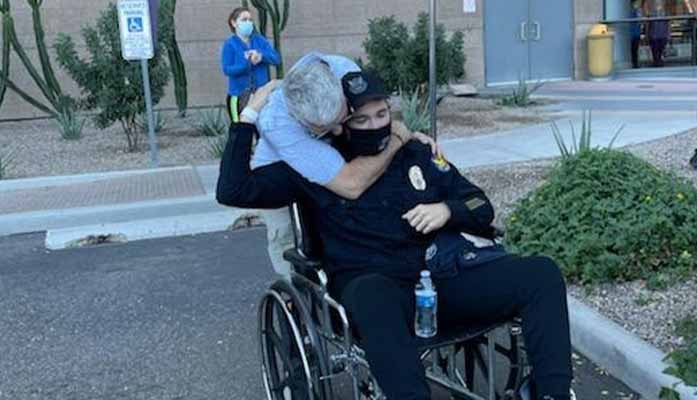
The Phoenix Police Department (PHXPD) granted one of their own officer’s sons, Zach Hunzinger, an honorary appointment to fulfill his lifelong dream of joining the department like his father as he continues his battle with osteosarcoma – bone cancer. Officer Hunzinger was appointed by PHXPD outside of Phoenix Children’s Hospital on Tuesday. His father pinned his badge to make it official, and later posted a heartfelt message to his son.
“Growing up, Zach Hunzinger always wanted to follow his dad’s footsteps to become a Phoenix Police Officer. In April of 2018, Zach was diagnosed with bone cancer in his leg, which has recently spread to his lungs. Welcome to the Phoenix Police Department, Zach. We will always be here for you! #NoOneFightsAlone #ForeverStrong #PHXPD,” wrote PHXPD.
The newly-established Officer Hunzinger attended Liberty High School (LHS), where he was the captain of his football team and began training his final semesters to join his father at PHXPD. Then his first cancer diagnosis came in 2018. Hunzinger went on to complete several rounds of chemotherapy and surgeries, having part of his femur removed and a steel rod inserted.
Hunzinger returned to LHS in March of 2019 to finish his senior year and resume training. Upon graduating, he continued training to test for the PHXPD. His plans were stalled again around November after his cancer returned.
It wasn’t until recently that this second bout of cancer spread to Hunzinger’s lungs.
Those interested in supporting Officer Hunzinger’s fight can donate to his GoFundMe here.
Corinne Murdock is a reporter for AZ Free News. Follow her latest on Twitter, or email tips to corinne@azfreenews.com.
by Corinne Murdock | Nov 17, 2021 | News
By Corinne Murdock |
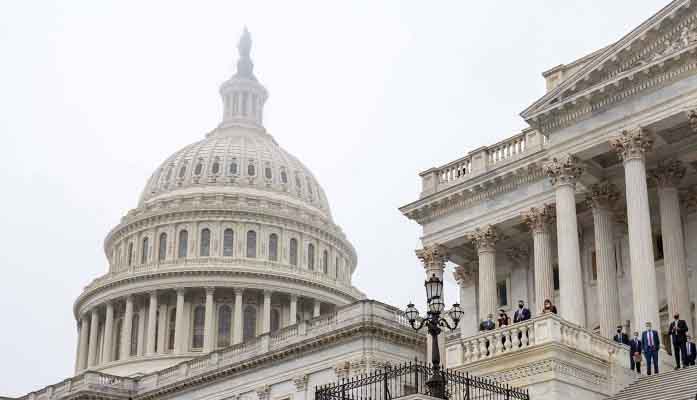
Arizonans have one less voice in two congressional committees – the National Resources Committee and the Oversight and Reform Committee – after the House voted Wednesday to punish Congressman Paul Gosar (R-AZ-04) for posting an anime meme. The offending post photoshopped Gosar’s face on that of the protagonist featured in the intro of a popular anime series, Attack on Titan, attacking villains with the photoshopped faces of Congresswoman Alexandria Ocasio-Cortez (D-NY-14) and President Joe Biden. The anime meme also incorporated clips of the border crisis and Border Patrol.
The House also censured Gosar with their vote (House Resolution 789), breaking an 11-year dry spell since the last censure. The House decision, 223-207, was largely partisan with the exception of several congressmen generally considered “Republicans In Name Only” (RINOs) for their tendency to oppose Republican policies and stances. Those members were Congressman Adam Kizinger (R-IL-16) and Liz Cheney (R-WY); Congressman David Joyce (R-OH-14) opted to vote “present” only.
The 4 hours of debate over Gosar’s censure and committee removals consisted of the same arguments. Democrats and Republicans alike largely rehashed the same talking points other members of their party were making.
Democrats’ general argument was that Gosar’s meme fantasized and incited violence. They claimed Gosar’s post was the same kind of hate speech that led to incidents like the January 6 storming of the Capitol. Many reasoned that Gosar should be punished because employers fire employees, and schools suspend or expel students, over similar or lesser offenses. Democrats claimed that they were getting death threats because of the meme.
Aside from insisting that the entire debate was a waste of time better spent on putting out bigger fires – such as the border crisis or the mounting tensions with both Russia and China – Republicans warned that the resolution would set a bad precedent, in which the majority party could pick and remove at their leisure who may sit on committees. Nearly every Republican that took to the podium asserted that Democrats were acting hypocritically with a “rules for thee, but not for me” attitude, citing Democrats’ speech encouraging the protests as cities were destroyed during last year’s George Floyd riots.
Prior to Gosar, Congresswoman Marjorie Taylor Greene (R-GA-14) faced similar threats of censure and committee removal for her past social media posts. Though Democrats dropped the censure threats, the latter punishment stuck. Greene was stripped for remarks she made prior to her election and even prior to her campaign, effectively limiting her influence from the start of her term. Greene also continues to accrue fines for refusing to mask up; according to Greene’s latest estimates, House Speaker Nancy Pelosi has fined her over $60,500 and counting.
Gosar defended himself a little over midway through the House vote. He explained that the anime was intended to convey a policy battle regarding amnesty for illegal aliens, catering toward young voters “who are too often overlooked.” Gosar asserted that the meme wasn’t intended as a threat.
“[I] reject the mischaracterization and accusations from many in this body that the cartoon from my office is dangerous or threatening. It was not, and I reject the false narrative categorically,” explained Gosar. “I do not espouse violence towards anyone, I never have. It was not my purpose to make anyone upset. I voluntarily took the cartoon down, not because it was itself a threat but because some thought it was. Out of compassion for those who generally felt offense, I self-censored.”
It appeared that the only member who could offer cultural context to the meaning and intent behind the anime meme was Congressman Andy Biggs (R-AZ-05).
“I’ve lived in Japan for several years! I speak Japanese. I read and write Japanese. This is an anime. Highly popular. Stylized. Intended to demonstrate the alienation people feel – particularly young people – in their cultures. Now, does anime have violence? Yes. It’s highly stylized violence,” explained Biggs. “It was not Mr. Gosar’s intention, I believe, to induce anyone to violence, and like he, I also condemn violence. I would ask you to reconsider further usurping and taking control of this body for political purposes because that’s what’s happening here today.”
Ocasio-Cortez said that the Republicans’ downplaying of the meme’s severity was “nihilism.” She also inferred that average Americans look up to congressional members for influence and direction. Ocasio-Cortez then called the meme an incitement to violence that would directly connect to violent acts. The congresswoman insisted that the meme shouldn’t be simplified as a mere trend, but examined critically for all its problematic parts and their significance. Conversely, Ocasio-Cortez insisted that the vote on such a matter should be simple.
“So when we talk about […] that these depictions are part of a larger trend of misogyny, and racist misogyny, this has results in dampening the participation,” said Ocasio-Cortez. “This vote is not as complex as perhaps the Republican leader would like to make folks believe. It’s pretty cut and dry. Does anyone in this chamber find this behavior acceptable? Would you allow depictions of violence against women and colleagues in your home? In your school board? In your city council? In a church? If it’s not acceptable there, why is it acceptable here?”
Though Ocasio-Cortez and the Democrats wanted an apology for the meme with their vote, they didn’t get one – and it doesn’t appear that they will.
Corinne Murdock is a reporter for AZ Free News. Follow her latest on Twitter, or email tips to corinne@azfreenews.com.
by Terri Jo Neff | Nov 17, 2021 | News
By Terri Jo Neff |
Some business leaders have dreamt for years of an interstate that would traverse Arizona, providing a better connection for international trade through Nogales to Phoenix and Las Vegas, and in the process providing a north-south route between Canada and Mexico.
Las Vegas and Phoenix are the only two cities with population of more than 1 million residents which are not linked by a direct interstate route. That dream of new opportunities for trade, commerce, job growth, and economic competitiveness took a leap forward Tuesday when the Arizona Department of Transportation (ADOT) announced its preferred route for the state’s portion of Interstate 11 as it would be known.
Officially called the “Record of Decision and Final Preliminary Section 4(f) Evaluation,” the report released Nov. 16 was prepared by ADOT and the Federal Highway Administration (FHWA) in compliance with the National Environmental Policy Act. It represents the final step in the Tier 1 Environmental Impact Statement process, culminating five years of study, technical analysis, and stakeholder input.
The Record of Decision also includes proposed corridor, or route, for the 280 miles of I-11 that would run between Nogales and Wickenburg utilizing new and existing roadways. Another 200 miles of what is currently U.S. Highway 93 from Wickenburg to the Arizona / Nevada state line where 23 miles of I-11 begin its run in Nevada would also become part of I-11 after a series of upgrades. That section is not part of the Record of Decision.
The idea of a Canada to Mexico transportation route which would connect the two largest cities in Arizona and Nevada dates back 25 years. However, it was not until 2015 that Congress formally designated I-11 as an interstate highway in Arizona, although the designation came with no funding for design or construction.
Deciding where the new interstate would be located has presented a years-long challenge for ADOT and FHWA. While the route between Phoenix to Wickenburg was delineated early, there have been two potential routes considered for the Phoenix to Nogales segment. That was further narrowed down to utilizing I-10 from Phoenix for several miles until just north of Marana.
The Tier 1 environmental impact review then looked at two alternatives for reaching Nogales. One of those options took an easterly route by utilizing existing roadways of I-10 to I-19 to State Route 189.
A westerly option, which is the one recommended by ADOT and approved this week by FHWA, would require construction of a new roadway through Avra Valley and then down near Three Points before merging into I-19 in Sahuarita. More than 60 percent of the land near that route is currently vacant.
Previous concerns voiced by stakeholders in the Sahuarita area led to an adjustment of the westerly route before it was recommended this week. The town of Sahuarita has even designated more than 90 acres of vacant land that could be utilized for the merging of I-11 with I-19.
But the I-11 project in Arizona is a long way from ever breaking ground, if it even gets that far. The Tier 1 report released this week with its westerly option recommendation is only the beginning. Additional studies would be necessary, including a Tier 2 environmental review.
“It is during the Tier 2 process that the Selected Corridor Alternative would be narrowed to a maximum 400-foot-wide highway alignment, or route,” according to ADOT. “Based on need and purpose, these segments would focus on smaller and shorter sections of I-11 and not the entire 280-mile corridor.”
And as with the recent announcement of a preferred alternative route for theSonoran Corridor connecting Interstate 10 to Interstate 19, the I-11 project is unfunded.
“Currently there are no plans or funding available to initiate these Tier 2 studies,” ADOT confirmed.
Less than 23 miles of I-11 have been competed in Nevada, running from the Hoover Dam Bypass at the Arizona state line to Henderson, Nevada. The CEO of the Las Vegas Chamber of Commerce has called completion of I-11 one of the most critical projects for the Intermountain Western states.
For more information about I-11 and the Tier 1 Environmental Impact Statement, visit i11study.com/Arizona.
by Corinne Murdock | Nov 16, 2021 | Education, News
By Corinne Murdock |
Arizona State University (ASU) announced last month that they redesigned their Architectural Studies, Bachelor of Science in Design (BSD) program to expand admissions for the sake of inclusivity, removing a built-in competitive edge that used GPA to reduce the number of second-year students from several hundred to 45. Competitive cuts are common practice for architecture programs: traditionally, the massive reduction affords students more one-on-one instruction and ensures a ratio of 10 to 20 students to one professor. ASU’s new take on their architecture program will have a ratio of 150 students to one professor, with about 10 teaching students to buffer. ASU is currently the only university to expand its architecture program in this way.
Herberger Institute for Design and the Arts (HIDA) architecture professor and Associate Director Catherine Spellman explained in the university’s announcement that it was “heartbreaking” to have to make hard cuts essentially based on GPA.
“We’ve rewritten the undergraduate course in architecture to be completely inclusive,” said Spellman. “It used to be that we had room for 45 students in the second year going forward, but we’ve rewritten the undergraduate BSD in architectural studies to accept everyone who has a 3.0 grade point average.”
In an interview with AZ Free News, Spellman explained that the students that made the cut under the previous program structure usually had around a 3.7 or higher GPA. Spellman made the case that GPA doesn’t directly measure intelligence or ability – instead, it reflects opportunity.
“A lot of what a GPA is, is a measure of a student’s opportunity. It’s one thing if you have a student that’s fully funded and doesn’t have to work to subsidize their education, is not raising a family – well, then that student is in a situation that they can achieve the GPA that they care to achieve,” said Spellman. “The next student may be a nontraditional student [like] a first-generation student that is perhaps working 40 hours a week and working to pay the mortgage for their family home. The university opportunity is still important to that student but the possibility of a [higher] GPA is different.”
When AZ Free News asked if there were concerns that the divestment of a built-in competitive nature to the program would lead to a reduced quality of students and their output, Spellman said that perspective was framed around privilege and a misunderstanding that quality in education necessitates exclusiveness. Spellman characterized competitiveness as advantageous for students of privileged backgrounds: those who aren’t necessarily representative of their community and society at large.
“The type of university we are is trying to make a place for all types of students and not just students that represent a type of privilege,” said Spellman. “[We are] really trying to be open-minded and inclusive, rather than exclusive and competitive about [the program].”
Spellman referenced ASU’s charter to explain their urgency to support inclusivity, asserting that the university’s role is to educate for success and not exclude.
“There is an attitude about quality in education that means exclusiveness. That, however, is not the university we are at. Our charter says that we are here to educate students to succeed, not to exclude people,” said Spellman. “You could say that a lower GPA means that the students aren’t as competitive but I would argue the more people we educate what architecture is about, the better we’re serving society. Architecture is a very important discipline relative to society. You learn literature, history, math, science, structures, [and] social behavior.”
Architecture professors restructured their teaching approach to accommodate the influx of students. One recent example of this was a mass exercise mimicking on-site conflicts. First-year Architecture 101 students had to work within a group to recreate assigned circular patterns on an outdoor field using butcher paper, while mitigating challenges presented by their “on-site” location, such as wind.
Spellman said that the transition to larger group work also came from a purposeful effort to deemphasize the idea that a one-to-one experience between faculty and students is the only way to conduct studio teaching (a method of hands-on instruction used in architecture programs). She noted that one-to-one experience was still available in ASU’s professional programs.
“It limits the numbers of students that you can have in a studio space if you teach in a one-to-one kind of way,” said Spellman.
AZ Free News also spoke with Marc Neveu, the head of ASU’s architecture program. He noted that their student expansion was just one component of a greater redesign of the program that began before his arrival four years ago.
“The basic premise [behind the redesign] was that ASU has a mission for being known who we include and how they succeed rather than who we exclude,” said Neveu. “Architecture schools are very competitive. Sometimes that competition may be good. More often than not that competition is very bad. It’s not healthy to stay up all night, it’s not healthy to protect your work from other people. It doesn’t actually model the way the professional practice works which is inherently collaborative. Rather than being competitive, we’re being collaborative, [like] working in teams.”
The complete overhaul of the program for inclusivity’s sake stopped short of challenging the grading system. That traditional scale remains, according to Neveu.
“We do have grades, we do have critique and feedback. It’s just that we’re not trying to pit students against one another,” explained Neveu. “My experience in undergrad – not by design – was that I learned more from my peers than from my faculty. [Here at ASU,] we’ve tried to design intentionally peer-to-peer learning, [such as] learning those sorts of soft skills.”
Neveu concluded by noting that the newly-redesigned program remains a work in progress, but expressed optimism in the promise of its unique nature.
Corinne Murdock is a reporter for AZ Free News. Follow her latest on Twitter, or email tips to corinne@azfreenews.com.
by Corinne Murdock | Nov 16, 2021 | Education, News
By Corinne Murdock |
Around three weeks after privately sending an apology to its members for its controversial letter asking the Biden Administration to investigate parents for domestic terrorism, the National School Boards Association (NSBA) posted their apology memo on their website’s news page and backdated it to make it appear as though they’d publicized the apology on the same day they’d sent it.
After state associations began disaffiliating with and denouncing the NSBA for its letter, the NSBA sent its members an apology memo on October 22. Per our original reporting on October 30, the NSBA hadn’t publicized that apology memo on their news page. They also hadn’t deleted their celebratory press release about the Biden Administration heeding their call to investigate parents. As of press time, the apology memo was listed as one of their most recent news releases.
Archived versions of the webpage on October 23 show no record of the apology that they allegedly publicized on their site on October 22. Rather, the news at the top of NSBA’s page that day concerned the appointment of Dr. Viola Garcia to the National Assessment Governing Board (NAGB). In fact, the memo wasn’t published on their news page until some point between November 11 and 14. That’s when they also chose to delete their celebratory press release about the Biden Administration heeding their call to investigate parents, although as of press time they hadn’t deleted the affiliated tweet or Facebook post issued the same day as the press release.
“@TheJusticeDept’s swift action is a strong message to individuals with violent intent who are focused on causing chaos, disrupting public schools & driving wedges between school boards & the parents, students, & communities they serve,” read the NSBA post.
Over the last few weeks, school board members and other education leaders have received death threats and have been subjected to threats and harassment, both online and in person. The individuals who are intent on causing chaos and disrupting our schools—many of whom are not even connected to local schools—are drowning out the voices of parents who must be heard when it comes to decisions about their children’s education, health, and safety. These acts of intimidation are also affecting educational services and school board governance. Some have even led to school lockdowns. The U.S. Department of Justice’s swift action is a strong message to individuals with violent intent who are focused on causing chaos, disrupting our public schools, and driving wedges between school boards and the parents, students, and communities they serve. We need to get back to the work of meeting all students’ needs and making sure that each student is prepared for a successful future. That’s what school board members and parents care about.
They’d also tweeted and posted to Facebook about their letter to the White House on the same day that they publicized the letter on the website.
However, NSBA didn’t announce the apology memo on either their Twitter or Facebook. Initial news reports on the apology memo didn’t link to the post allegedly available at the time on NSBA’s website, either.
Unlike some of NSBA’s other state associations, the Arizona School Boards Association (ASBA) hasn’t denounced or withdrawn from the NSBA over the White House letter, only publicizing their support for it.
Instead, ASBA has remained silent on that issue indicative of the conflict between public schools and parents – even as those tensions have come to a head in their own backyard. Last Tuesday, it was discovered that the father of newly-demoted Scottsdale Unified School District (SUSD) Governing Board President Jann-Michael Greenburg had compiled a secret Google Drive dossier on parents and other political enemies. Greenburg reportedly had access to the drive and sent a picture of it to one of the targeted parents.
One day after the initial news of the Greenburg dossier broke, ASBA announced a webinar event educating members on how to be a good school board president on Facebook and Twitter. The webinar occurred Wednesday – two days after SUSD demoted Greenburg from the presidency in a special meeting. Greenburg refused to resign his membership, claiming that the board didn’t have “all the facts” and making multiple remarks insinuating that investigations currently underway would exonerate him. Both SUSD and Scottsdale Police Department (SPD) are investigating the dossier; Greenburg inferred that at least one private investigation was also underway.
“Being board president used to look easy, even though it wasn’t,” read the webinar description. “Now being board president is even more complex given the amount of public interest in school board meetings. Learns [sic] the ins and outs of board presidency and decide if it’s right for you.”
The event will be hosted by ASBA Leadership Development Manager Julie Bacon and ASBA Interim Director of Legal Services David DeCabooter.
Corinne Murdock is a reporter for AZ Free News. Follow her latest on Twitter, or email tips to corinne@azfreenews.com.
by Corinne Murdock | Nov 15, 2021 | News
By Corinne Murdock |
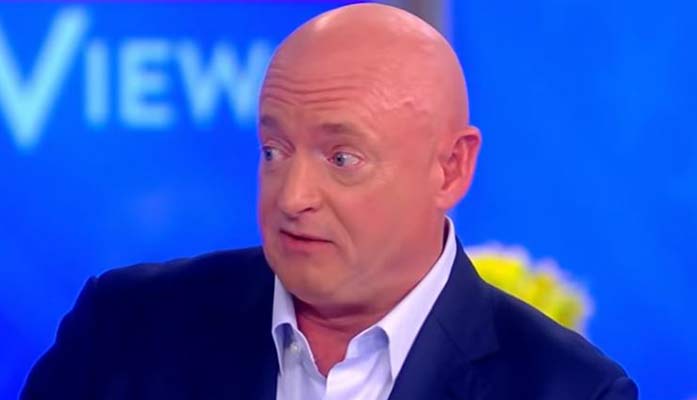
Senator Mark Kelly (D-AZ) hasn’t denounced the dossier targeting parents and political enemies that leads back to one of his donors: Scottsdale Unified School District’s (SUSD) now-former governing board president, Jann-Michael Greenburg. Federal Election Commission (FEC) records show Greenburg donated $1,000 to Kelly’s campaign last year.
AZ Free News reached out to Kelly for a comment on the dossier and Greenburg’s donation; his campaign was silent, offering no repudiation.
Not all have opted for silence or inaction in the face of the Greenburg dossier, which rose to national prominence within days of initial reports on its existence. On Monday night, the SUSD Governing Board convened in a special meeting to determine Greenburg’s fate as president and a member of the board. They voted to demote him from his presidency. However, Greenburg refused to resign. He stated repeatedly that the board members lacked “all the facts” and urged them not to demote him, pleas made to an unyielding group.
Prior to the meeting, questions arose as to whether Kelly would denounce Greenburg as other Arizona politicians had. He hasn’t, but his awareness of current events in education has been fine otherwise.
Though Kelly has been silent on the dossier threatening the parents and community members of a public schooling system in his state, he took the time to issue a celebratory announcement about public schools hours prior to SUSD’s meeting.
“It’s #AmericanEducationWeek! Public schools are the foundation of our education system thanks to the teachers who dedicate their lives to making sure the next generation is set up for success. It’s our job to support them and make sure they have the resources they need.”
Kelly’s silence on the matter prompted remarks from opponents. GOP U.S. Senate candidate Jim Lamon characterized Greenburg’s connection to the dossier as typical behavior for a Kelly supporter. Lamon issued a statement that Greenburg had been “stalking, harassing, intimidating, and doxxing” parents through the dossier, and called for his immediate resignation.
“Storing parents’ personal information and photos of their children, recording parents with a body camera, taking down license plate numbers, and creating a dossier against parents is outrageous and unethical. It’s no wonder he’s given money to Mark Kelly!” wrote Lamon. “Parents are NOT the enemy!”
The Greenburg dossier served as a reminder of another ongoing controversy: the apparent collusion between the National School Boards Association (NSBA) and the Biden Administration. Days after the White House received a letter from the NSBA requesting an investigation into parents and community members for domestic terrorism, among other things, Department of Justice (DOJ) Attorney General Merrick Garland issued a memo effectively directing the FBI to heed the NSBA’s call.
Since the memo’s publication, it’s come to light in email records and other paper trails that the White House collaborated with the NSBA on the submission of their letter.
Corinne Murdock is a reporter for AZ Free News. Follow her latest on Twitter, or email tips to corinne@azfreenews.com.