Greg Roeberg, a Scottsdale attorney, announced his intention to join the race for Arizona Attorney General on Thursday with an appearance on Steve Bannon’s War Room. Roeberg, who describes himself on his campaign website as “serving as President Trump’s campaign attorney and defending the integrity of our elections,” has defined himself as an America First candidate on a mission to provide President Trump with needed “backup.”
Roeberg’s Statement of Interest in the 2026 Primary Election was filed shortly before 1 PM on Thursday, according to the Arizona State Election system at Arizona.vote.
“President Trump needs backup, and Arizona needs an Attorney General who will enforce the law with zero apologies,” Roeberg said in his video announcement posted to X. “Safe streets, strong borders, and secure elections — those are the foundations that will give my kids’ generation a chance to build new industries, new opportunities, and a better Arizona. With your help, we will Make Arizona Great Again.”
President Trump needs backup, and Arizona needs an Attorney General who will enforce the law with zero apologies.
Safe streets, strong borders, and secure elections — foundations that will give our kids a better Arizona. With your help, we will Make Arizona Great Again! 🇺🇸🇺🇸 pic.twitter.com/3fe9cSYfs3
In a campaign statement, Roeberg wrote that he “vows to bring an America-First agenda directly into the halls of justice by:
Restoring law and order with aggressive prosecution of violent criminals and drug traffickers.
Standing shoulder-to-shoulder with law enforcement as radical politicians try to tie their hands.
Securing Arizona’s elections with uncompromising oversight, tougher penalties for fraud, and ironclad protections to ensure every legal vote counts — and only legal votes count.
Putting Arizona families first by fighting for parental rights, shielding our kids from harm, and making Arizona the most secure, pro-business state in the country.
“For years, I’ve worked alongside President Trump and the America First movement, pouring my energy into strengthening our elections and safeguarding the integrity of our democratic system. I’ve always believed that if our elections aren’t secure, nothing else matters.
Right now, we are at a crossroads. And Arizona doesn’t need any more empty suits. It needs action. That’s why I’ve decided to run for Attorney General of our great state.”
Speaking with Bannon on War Room, Roeberg reflected on serving as “President Trump’s 2024 election attorney,” adding that he was “with Trump like [Bannon] before it was popular, back in 2016.”
Turning to incumbent Democrat Attorney General, he told the host, “Arizona’s current Attorney General, Kris Mayes, is an absolute disaster. She needs to be replaced. I’m the one to do it because I’m a fighter.”
He added, “People on both sides of the aisle are sick and tired of hearing about Arizona’s elections dragging on months on end, weeks, and weeks on end, and questionable results, and people on both sides of the issue want that finally resolved. Strong borders and safe streets. It’s pretty easy. We have to stand with President Trump, and the administration, and the work they’re doing. Kris Mayes has currently… thirty-one lawsuits against the administration, shutting down the progress that President Trump and the administration are trying to do.”
“She does so at the expense of the Arizona people. She has a limited number of resources, and she could be spending those resources going after the drugs, going after the border, going after the homeless, the fentanyl, you name it. But instead, she just wants to score points with Act Blue and Soros and folks like that back East. And that’s got to stop,” he continued.
Roeberg concluded his remarks on Mayes saying, “I’m sick and tired again of seeing our squishy go-along, get-along Republicans do nothing about it. I’m not a politician. This is my first race, and I’m getting in and we’re in it to win.”
Scottsdale’s popular Old Town Farmers Market will soon have a new home. The City Council voted on Nov. 17 to approve an agreement relocating the long-running Saturday market from its current spot at the city-owned parking structure at First Street and Brown Avenue to the surface lot at City Hall on 75th Street and Bennie Gonzales Way.
The shift comes as Scottsdale prepares to expand the parking structure that has hosted the market for more than a decade. The move will take effect at the start of the 2026–27 season. City Manager Greg Caton said city leaders worked to ensure the change would keep the market thriving with minimal disruption for both shoppers and vendors.
“The farmers market is one of Scottsdale’s most loved traditions,” Caton said. “Moving it to City Hall keeps it close to the heart of Old Town and gives vendors and visitors the space they need while we make improvements elsewhere. It’s a win for residents, small businesses and the community as a whole.”
Since its founding in 2009, the Old Town Farmers Market has grown into a weekly staple for Scottsdale residents, operating each Saturday from October through June. Roughly 100 vendors participate each week, offering fresh produce, baked goods, specialty foods, and locally made products in a lively, community-focused setting.
Officials say the new location will provide more room and easier access, allowing the market to continue offering the variety of goods and events that have made it a weekend favorite. Beyond its role as a shopping destination, the market has become a community hub—supporting Arizona farmers and food producers, drawing customers to nearby businesses, and accepting food assistance vouchers to help low-income families access healthy food.
The market also partners with Scottsdale’s Senior Services and plays a recurring role in major city events such as Western Week, Scottsdazzle, and June Days. Under the new agreement, the market will be permitted to operate on up to 40 Saturdays per year at the City Hall site. City staff noted the relocation will not require additional municipal resources or staffing.
Jonathan Eberle is a reporter for AZ Free News. You can send him news tips using this link.
A new report from the Common Sense Institute (CSI) Arizona examines the state’s management of its state trust lands, set aside in 1912. It makes the case that the lands represent a “$140 Billion Missed Opportunity.” CSI Arizona argues that the beneficiaries of the trust, primarily K-12 education, could benefit from developing the land, while potentially addressing Arizona’s growing demand for developable space.
In a release posted to X on Wednesday, the CSI wrote, “Arizona’s State Land Trust was supposed to be a generational funding engine for K–12 schools. But new research shows how much potential has been left on the table. CSI finds Arizona could have distributed up to $140 billion to K–12 students if trust land had been sold and reinvested more efficiently over the last century — compared to just $5.8 billion distributed to date.”
Arizona's $140 Billion Missed Opportunity
Arizona’s State Land Trust was supposed to be a generational funding engine for K–12 schools. But new research shows how much potential has been left on the table.
Arizona received about 10.96 million acres under The Arizona-New Mexico Enabling Act of 1910, with roughly 8 million acres dedicated to K-12 education—one of the largest such grants in the nation. As of 2024, the state retains approximately 84% of its original grant, compared to an average of 36% across other land-grant states. More than 80% of the remaining trust land is used for low-intensity purposes such as grazing or rights-of-way, generating an average annual return of $8.40 per acre for K-12 beneficiaries.
The report estimates that historical delays in selling and developing trust lands have cost beneficiaries approximately $134 billion in lost distributions over the past century. Had lands been sold early (1913–1923) and proceeds invested at market rates, the K-12 Permanent Land Endowment Trust Fund (PLETF) could be worth $163 billion today, compared to its current combined value (distributions plus assets) of approximately $19 billion.
The ASLD has grown the trust’s value from $811 million in 1995 to $8.7 billion today, with the PLETF reaching over $9 billion in 2024. However, only 80,000 acres statewide are under commercial lease, and since 1998, the department has sold 101,600 acres while initiating new commercial leases on just 588 acres.
The report identifies up to 3 million acres of trust land within a 10-mile radius of population centers and argues that even if a portion of this land were sold or leased strategically, Arizona could add more than 1 million new housing units over the next 20 years easing pressure on a market where prices have risen more than 40% since the pandemic.
Arizona is one of the fastest-growing states in the country, but more than 8 million acres of state trust land remain largely unused. Most of Arizona’s growth has occurred on less than one-fifth of the land in the entire state.
An econometric model using REMI TaxPI+ projects that an orderly sale of remaining trust lands over the next decade could generate $18.5 billion in direct revenue, $55 billion in new economic activity, and an additional $65 billion in distributions to public schools over 50 years, while reducing housing prices by approximately 10% over two decades.
Arizona remains one of the most land-constrained states in the country. Roughly 83% of all land within its borders is publicly owned, in the form of federal, tribal, or state trust land, leaving comparatively little privately held land for growth.
CSI argues that this structural constraint has pushed up development costs and slowed housing construction, even as the state’s population has more than doubled over the past 30 years.
The study concluded that modernizing ASLD’s statutory framework, improving development timelines, and exploring new leasing and disposition tools could unlock long-untapped value for taxpayers, schools, and communities.
Over 100 out of about 400 schools in Arizona have advanced out of federal school improvement status, per the Arizona Department of Education.
There are over 2,800 schools in the state. That means approximately 14 percent (after this latest update) of all schools statewide remain on the Arizona Department of Education (ADE) list.
Schools on the federal list consist of those with low graduation rates and test scores per the Every Student Succeeds Act (ESSA), a federal law passed by the Obama administration in 2015 that, essentially, reauthorized the Elementary and Secondary Education Act of 1965.
ESSA was responsible for every state and district publishing a report card for public review, as well as publishing how much is spent per student at every school, broken down by federal, state, and local monies.
ESSA’s predecessor was the No Child Left Behind Act (NCLB), enacted in 2002. NCLB received criticisms for its heavily federal approach to education, where many thought the states could yield student outcomes better.
ADE identifies these schools — classified as Comprehensive Support and Improvement – Low Achievement (CSI-LA) schools — every three years. Schools have four years upon identification to exit this status.
CSI-LA schools are those that don’t meet the 60 percent proficiency, 20 percent growth or graduation rate, 10 percent English Learners achievement and growth, and 10 chronic absenteeism (K-8) or 10 percent drop out rate (high school).
Superintendent Tom Horne said in a statement that these schools’ advancements prove that dedication to the basics — namely through Project Momentum Arizona (PMA) — does work.
“The schools we are honoring today have proven that when students are challenged academically and class time is devoted to teaching core subjects like reading and math, test scores will go up, and students will succeed,” said Horne. “It is a highly effective program that emphasizes academic knowledge and helps educators do the right work to ensure that all students succeed.”
Horne hosted a press conference on Wednesday to praise these schools, including Roosevelt School District, which had four schools leaving the list. Horne also issued a similar announcement on Thursday.
PMA has schools select one or more from a list of guiding questions around which to frame their improvement plans. These questions focus on recognizing the specifics of desired student outcomes, evidence of student comprehension, highest-yielding instructional practices, responses to lack of student learning, planned responses to student mastery of materials, and goals for improving, cataloging, and saving work.
Spring state assessment results showed that an average of 33 percent were passing math, and 40 percent were passing English. These results aligned with those from the previous year.
COVID-19 caused student proficiency to drop significantly. They were on an upward trend, achieving 42 percent in math and English.
Oversight of failing schools may soon become more of a state problem, with ongoing efforts to dismantle the Department of Education.
Horne told The Center Square that he’s “pleased” with the Trump administration’s decision.
“[I am] pleased with the administration’s work to move the work of education back to the states and addressing the needless bureaucracy of the federal department,” said Horne.
AZ Free News is your #1 source for Arizona news and politics. You can send us news tips using this link.
Arizona State Senator Janae Shamp (R-LD29) hailed a significant court victory after a challenge to one of the state’s strictest child-protection laws was rejected, ensuring that convicted sex offenders remain subject to rigorous registration and oversight requirements.
The court ruled that the plaintiff—a registered sex offender previously convicted of attempted sexual conduct with a minor, two counts of sexual abuse, and public indecency—must continue to comply with all current sex-offender registration laws and conditions.
The decision upholds years of Republican-led legislative efforts to close loopholes that once allowed thousands of dangerous offenders to evade public scrutiny.
In just the past two years, four bills authored by Senator Shamp to strengthen protection for children and increase accountability for predators have been signed into law. These measures have resulted in more than 6,800 Level 1 sex offenders—previously spared by “legal loopholes”—now appearing on Arizona’s public registry for crimes against children.
“This ruling sends a loud and clear message: Arizona stands with children, not with offenders. I will not slow down, I will not back off, and I will continue to close every door that pedophiles try to slip through,” said Senator Shamp. “All sex offenders in Arizona, your secrets are revealed, and the consequences will follow you. I want to thank victims like Kayleigh Kozak for fighting this battle alongside me to get the job done. My mission is to protect the vulnerable, and I will fight every day to continue finding legislative solutions to achieve that. This victory is only the beginning—our work to secure Arizona’s future continues.”
Kayleigh Kozak, the driving force behind “Kayleigh’s Law”, has become one of Arizona’s most prominent victim-advocates. The landmark legislation, passed with bipartisan support and signed into law in 2022, gives victims of dangerous crimes, including sexual abuse, the right to obtain a lifetime restraining order against their perpetrators.
The law was born out of Kozak’s own experience. As a middle-school student in Buckeye, she was sexually assaulted by her soccer coach. Years later, she learned that her abuser was attempting to have his probation lifted, sparking her to team up with Sen. Kerr to draft such legislation.
Within its first year, Kayleigh’s Law enabled 1,009 Arizona victims to serve their perpetrators with lifetime protective orders.
“Over the past four years, I have worked alongside Senator Shamp on critical legislation to ensure that perpetrators are held accountable and to bring truth and transparency to the judicial system—making our communities and children safer,” said Kozak. “The actions of these registered sex offenders are both disgusting and dangerous. Now, through multiple lawsuits, they are challenging the enhanced sex offender registration laws, further demonstrating their disregard for rules, boundaries, and laws.”
She continued, “If these offenders feel uncomfortable with society knowing who they are, where they live, and what they have done, they should have considered the consequences of their actions before choosing to harm a child. Together, we can continue to advocate for safety, accountability, and transparency in our communities!”
Ethan Faverino is a reporter for AZ Free News. You can send him news tips using this link.
Maricopa County Recorder Justin Heap has announced that his office set a new speed record for processing Election Day ballot drop-offs, completing signature verification and curing ballots within 48 hours of the Nov. 4th elections. The matter was complicated when officials scrambled to process thousands of ballot envelopes discovered days later in a misplaced transport box.
In a Nov. 6 update on X, Heap wrote, “All calls to voters with signature inconsistencies have been completed.” He added that finishing both signature verification and voter calls “within just 48 hours of Election Day shatters all previous timeframes for elections with more than 100,000 Election Day drop-offs.”
RECORDER’S ELECTION UPDATE:
✅ All calls to voters with signature inconsistencies have been completed.
Finishing both signature verification and voter calls within 48 hours of Election Day shatters all previous timeframes for elections with more than 100,000 Election Day…
— Maricopa County Recorder Justin Heap (@azjustinheap) November 7, 2025
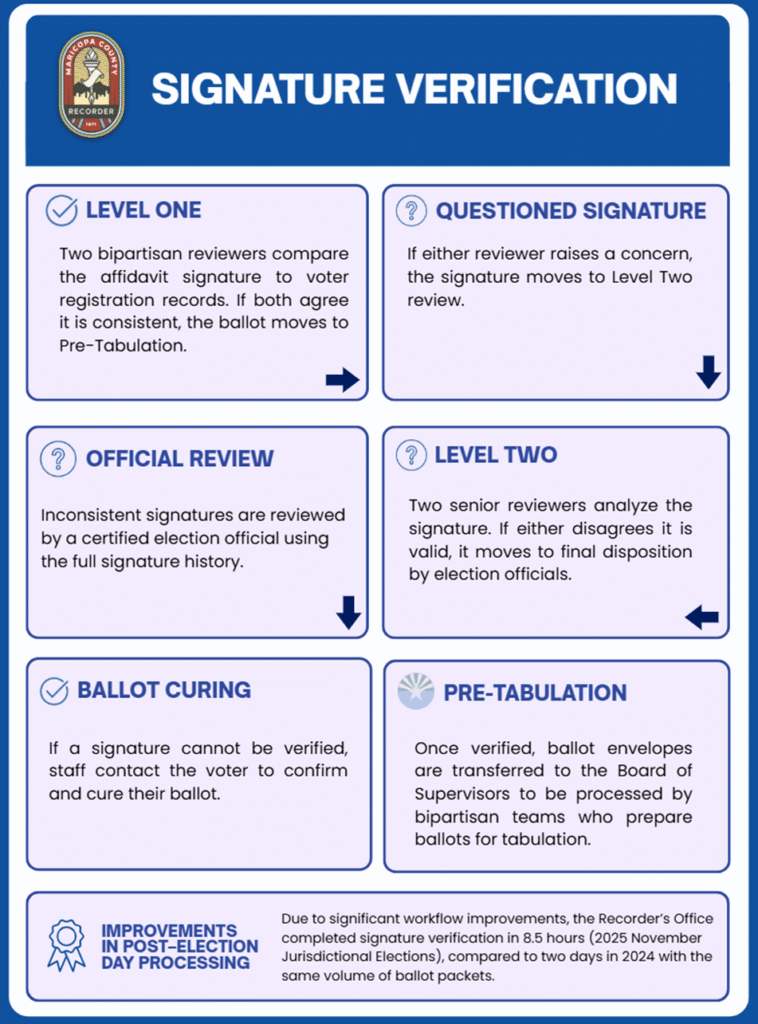
According to detailed metrics provided to AZ Free News by the Maricopa County Recorder’s Office, the November election included 117,664 ballot packets returned via mail or drop box on Election Day. Signature verification on those packets began at 6:00 a.m. on Wednesday, Nov. 5, and the office says the final file review was completed by 2:33 p.m., for an 8.5-hour turnaround on the Election Day returns.
For comparison, the Recorder’s Office pointed to the July 30, 2024, primary, when roughly 114,681 similar packets took about two days to clear signature review under then-Recorder Stephen Richer. In an emailed statement to AZ Free News, Maricopa County Director of Communications Judy Keane wrote:
“This represents a dramatic acceleration in post–Election Day processing: completing in 8.5 hours what previously required two days in the 2024 Primary, despite similar packet volumes. This outcome demonstrates the effectiveness of process improvements and the exceptional performance of the team.”
Two-Reviewer System and Quad-Screen Interface
Heap campaigned on tightening signature verification and has spent much of his first year in office overhauling the workflow while feuding with the Maricopa County Board of Supervisors over funding, control of election IT systems, and a controversial Shared Services Agreement now mired in litigation.
In response to written questions from AZ Free News, the county Public Information Office said that every early-ballot signature in the Nov. 4 election was reviewed by at least two human reviewers of different parties.
The office described the workflow this way:
Level One review uses a “quad-screen” interface on a single monitor:
Bottom left: the affidavit signature being reviewed
Above it: the voter’s latest signature on file
Upper right: second-latest signature
Middle right: third-latest signature
Bottom right: the voter’s registration signature
All signature exemplars can be rotated to the primary comparison position above the affidavit signature so reviewers can align shapes and slants.
According to the county, Level Two reviewers see the same layout. Still, they can also scroll through the voter’s full signature history when Level One reviewers either disagree or cannot comfortably verify a match.
County officials say that the combination of two reviewers of opposing parties and deeper access to a voter’s signature history at the second level was designed to increase both scrutiny and perceived neutrality, after years of partisan conflict over how Maricopa handles early ballots.
For voters whose signatures still couldn’t be confirmed, the office used multiple curing channels tied to identity verification: calls from election staff, text messages (for those who opted in), emails, and a secure online dashboard at BeBallotReady.vote, consistent with state guidance on signature curing windows.
Record Processing Claims Tested by Ballot Mishap
Heap’s announcement of “shattering” past performance landed just as Maricopa County was forced to acknowledge another election-administration black eye: the discovery of two sealed transport boxes with 2,288 returned ballot affidavit envelopes that had not been included in the initial post-Election Day processing.
On Nov. 7, county elections officials disclosed that poll workers had mistakenly placed the sealed transport boxes inside a blue drop box instead of returning them to the county’s election center on Election Night. Local outlets reported that the boxes bore intact tamper-evident seals and matched election-night serial numbers, but the ballots inside had not been counted, according to AZ Family.
Heap’s office responded with its own update, saying signature verification on all 2,288 ballot packets had been completed and that every voter whose signature needed curing had been contacted before the statutory deadline.
RECORDER'S ELECTION UPDATE:
The County Recorder’s Office has completed signature verification on all 2,288 of the missing ballot packets we received from the Board this morning. In the last hours, we have contacted all remaining voters with signatures requiring additional… pic.twitter.com/M1PGHj6Tkw
— Maricopa County Recorder's Office (@RecordersOffice) November 7, 2025
Jennifer Liewer, Deputy Elections Director, issued a statement following the report saying:
“Friday, Nov. 7, 2025: This morning, as part of standard post-election protocols, elections workers inspected equipment that had been returned from voting locations. This process includes unpacking and logging equipment.
“During this inspection, two sealed transport boxes of returned ballot affidavit envelopes were found inside a blue drop box. While the transport boxes did have tamper evident seals, ensuring the security of ballots, poll workers had mistakenly placed the sealed boxes inside a blue drop box rather than returning them on Election Night. Immediately after the discovery, a bi-partisan team of election staff took custody of the sealed bins and worked quickly to ensure chain of custody was followed. The green affidavit envelopes will now be signature verified and processed for tabulation.
“Per statute, green affidavit envelopes are to be counted at the close of voting on Election Night. Counted envelopes are then placed in a large bin, sealed, and returned to the Maricopa County Tabulation and Election Center.”
As previously reported by AZ Free News, Recorder Heap has been embroiled in a lengthy legal battle with the Maricopa County Board of Supervisors over funding to modernize and provide technical support for the county’s election equipment, and centered on the division of responsibilities created in a Shared Services Agreement (SSA) agreed to by Heap’s predecessor, Stephen Richer.
Heap sought a Temporary Restraining Order against the Board’s planned assessment of election systems and databases in early October, per KJZZ. However, on November 6th, Maricopa County Superior Court Judge Scott Blaney denied the motion, writing “The Recorder’s concerns regarding the assessment’s potential interference with the 2026 Primary Election are speculative at this point in the litigation,” according to the court order.