Democratic gubernatorial candidate Katie Hobbs blamed two years of rhetoric from her opponent, Republican Kari Lake, for a break-in at her campaign headquarters earlier this week. Lake denied Hobbs’ accusation, calling it “absurd.”
Hobbs’ campaign manager issued a statement on her behalf, insinuating that Lake was the source of all threats against Hobbs.
“Let’s be clear: for nearly two years Kari Lake and her allies have been spreading dangerous misinformation and inciting threats against anyone they see fit,” stated Hobbs. “The threats against Arizonans attempting to exercise their constitutional rights and their attacks on elected officials are the direct result of a concerted campaign of lies and intimidation.”
In statements to reporters, Lake compared Hobbs’ blame to that of the infamous Jussie Smollett hate crime hoax.
“That is absolutely absurd. And are you guys buying that? Are you really buying that? Because this sounds like a Jussie Smollett part two,” stated Lake. “I don’t even know where her campaign office is. I’m assuming it’s in a basement somewhere because that’s where she’s been campaigning.”
On @katiehobbs campaign office burglary, @KariLake responds to @KateSullivanDC: “That is absolutely absurd. And are you guys buying that? Are you really buying that? Because this sounds like a Jussie Smollett part 2.”
According to surveillance footage obtained by the Hobbs campaign, the suspect may be a dark-skinned, dark-haired man wearing a green t-shirt, gray pants, white tennis shoes, a watch on his left wrist, a backpack, and a metallic necklace. The Hobbs campaign reported that some unspecified items were taken.
As of Wednesday, Phoenix Police Department said that they hadn’t identified any suspects.
This wouldn’t be the first time Hobbs blamed Lake for unwanted aggressions toward her. Just last week, Hobbs claimed that Lake incited protests and threats of violence causing Arizona State University (ASU) to shut down campus. It appears those claims originated from one of Hobbs’ staffers, since the school didn’t report receiving threats and no protests occurred.
Hobbs’ announcement of a burglary at her headquarters comes hours after one of the latest polls revealed Lake leading Hobbs by 11 points.
That same poll by Fox News revealed incumbent Senator Mark Kelly (D-AZ) leading his Republican challenger Blake Masters by two points.
A new FOX 10 InsiderAdvantage poll shows the race for Governor – widening a bit. But the race for U.S. Senate is turning into a dead heat. https://t.co/wrG7DQeAiX
In a bid to win over independent voters, Arizona’s dominant voting group, Senator Mark Kelly’s campaign staffers are telling voters he’s pro-life.
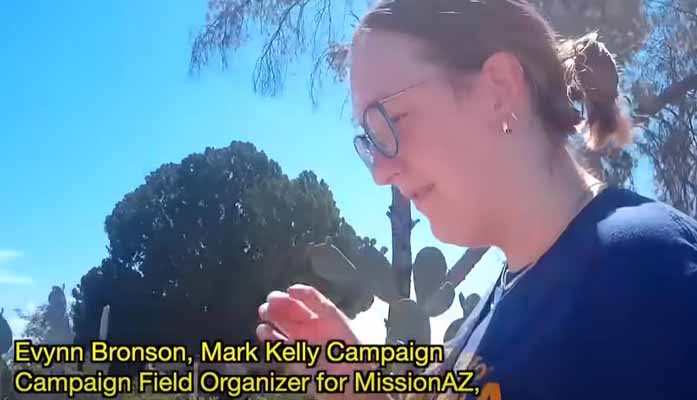
Paid campaign staffer Evynn Bronson told an undercover Project Veritas reporter that Kelly is pro-choice, but advised the reporter to tell voters that Kelly is pro-life and avoid the phrase “pro-choice.”
“I would [tell a pro-life voter that] Mark Kelly is pro-life but also pro-keeping the government out of our health care. I don’t know, something stupid like that,” said Bronson. “Absolutely he is not pro-life.”
Bronson, an Idaho native and LGBTQ+ activist, is a political science major at Brigham Young University (BYU) and plans to graduate this fall. Bronson was involved with the Raynbow Collective, an activist group pushing for LGBTQ+ acceptance at BYU, a private Mormon university. Bronson has since wiped her social footprint: her LinkedIn profile, Twitter account, Facebook and Instagram profiles are gone. Earlier this spring, Bronson interned with Congressman Adam Schiff (D-CA-28) — a gig set up by the Victory Institute.
Bronson claimed to Project Veritas that she didn’t know Kelly’s stance on abortion. However, her job as a paid campaign staffer contradicts that claim: she gave a presentation on Kelly’s abortion stance and other topics like inflation and gun control.
“As far as I remember, I said that I don’t know his stance but that he supports the decision between a woman and her health care specialist,” stated Bronson.
Bronson worked the Kelly campaign through Mission for Arizona (AZ) throughout the summer, the advocacy nonprofit funded by the Arizona Democratic Party. In July, Bronson advised the Democrats of Greater Tucson (DGT) on “How to Talk to Voters.” One of the contentions that DGT members had during the presentation was that Bronson and fellow Mission for AZ staffer Anna Smith focused on advocating for Kelly rather than other Democratic candidates ahead of the primary elections.
In her advice, Bronson claimed that she and other campaign staffers weren’t there to change minds. Advice on addressing Kelly’s stance on abortion didn’t include any mention of his being “pro-life.”
“It’s important to remember we are not changing minds. We cannot have a productive conversation with a super far-right-leaning, conservative person because they’re just so rooted in their beliefs,” said Bronson. “We’re focusing in on those independents, those 40 percent of independents that we showed you, that really don’t know who they’re going to vote for.”
Part of the Mission for AZ plan presented by Bronson included registering voters to the Active Early Voting List (AEVL). According to the nonprofit’s research, those who receive an early ballot are 30 percent more likely to vote. Mission for AZ also collected “vote commitments” that included voters’ contact information.
Corinne Murdock is a reporter for AZ Free News. Follow her latest on Twitter, or email tips to corinne@azfreenews.com.
A political action committee (PAC) financed by Democrat billionaires is making good on its promise to spend millions to ensure Republican gubernatorial candidate Kari Lake’s defeat.
The Republican Accountability PAC, an advocacy arm of the Republican Accountability Project (RAP), spent nearly $3.7 million on advertising against Lake according to trigger reports on the secretary of state’s campaign finance website. They began spending their millions a week after the primary election, and haven’t spent for or against any other candidates.
Those expenditures break down as follows: Trilogy Interactive, over $1 million; Google, over $840,000; Longwell Partners, over $441,000; Tegna, over $284,000; Scripps Media, nearly $245,000; Fox Corporation, nearly $230,000; Gray Media, over $222,000; Meta Platforms, over $202,000; Allen Media Broadcasting, over $100,000; Clear Channel Outdoor, over $83,000; and Extreme Reach, over $1,000.
It appears that one of the RAP leaders benefits greatly from the PAC money. Sarah Longwell, RAP executive director and the PAC’s treasurer, owns Longwell Partners. In addition to the over $441,000 her communications firm received for anti-Lake advertising, her firm has received at least over $554,000 for advertising and political consulting according to the Federal Election Commission (FEC).
Longwell, a self-described “Never Trumper” is also the Defending Democracy Together co-founder (the parent organization behind RAP, and one of the top-spending dark money groups in the 2020 election), The Bulwark publisher, and former Log Cabin Republicans national board chair.
The only media company with an Arizona address that received Republican Accountability PAC money was Tegna. The listed address is the building that houses 12News and the Arizona Republic. Tegna was formerly part of Gannett before the media giant split into two publicly traded companies in 2015: Tegna, the broadcasting and digital operations, and Gannett, the publishing operations. Gannett shareholders retained the shares that became Tegna shares.
Gannett’s primary shareholder is BlackRock, the world’s largest asset manager and one of 100 strategic partners for the World Economic Forum (WEF). The WEF is the globalist lobbying organization that invented the social credit score system similar to one used currently by the Chinese government, called ESG investing or scoring, short for “Environmental, Social, and Governance” scoring.
Tegna’s board of directors consists of major corporate players representing nearly all sectors: its chairman is also a president of Dell Technologies, while other members include the executive vice president of Pfizer, the CFO of global sports entertainment giant DAZN Group and former Morgan Stanley executive, the former vice president of Coca-Cola, the former president of HBO, the former vice president and CFO of E*Trade, the president and CEO of WNET and former president of NBC, and former vice president of Time Warner Cable and HBO.
Last year, Maricopa County Recorder Stephen Richer and Board of Supervisors Chairman Bill Gates teamed up with RAP for a video speaking against the Arizona Senate’s audit of the 2020 election. About a month before Richer and Gates released their RAP video, RAP’s executive director Sarah Longwell donated $250 to Richer’s PAC, Pro-Democracy Republicans of Arizona.
A week before Longwell’s donation, Richer’s PAC also received $100 from Mindy Finn (formerly Feinberg), the founder of another self-described Never Trumper advocacy group called Stand up Republic. Both Defending Democracy Together and Stand Up Republic receive funding from nonprofit networks associated with Pierre Omidyar, eBay’s founder, a partner organization of the lucrative leftist dark money network originating with Arabella Advisors.
The other top PACs spending millions against candidates are the Future Forward PAC and MoveOn.org PAC: both leftist dark money groups, both spending to defeat Trump-backed Arizona candidates. In addition to Lake, they spent to defeat attorney general candidate Abraham Hamadeh and secretary of state candidate Mark Finchem.
Corinne Murdock is a reporter for AZ Free News. Follow her latest on Twitter, or email tips to corinne@azfreenews.com.
One lawmaker has a solution to the ballot drop box watcher controversy in Maricopa County, but the recorder says they won’t be modifying their operations.
State Senator Michelle Ugenti-Rita (R-Scottsdale) proposed removing the two controversial drop boxes situated outdoors, leaving voters with the drop boxes located indoors. However, Maricopa County Recorder Stephen Richer told AZ Free News that removing the two controversial drop boxes would be surrendering to cancel culture, not assuaging voter tensions. Richer explained that outdoor drop boxes enabled a 24/7 option for returning early ballots, whereas drop locations inside government buildings are limited to business hours.
“I don’t believe in surrendering to cancel culture. I don’t believe that we should cave to intentionally disruptive behavior (as some of the watchers appear to be; others not). I don’t think ASU should cancel speaker events because some people protest,” said Richer. “I don’t think the county should change the voting plan that has been in place for many months now — and that worked successfully for the August primary — because of these people.”
I tried to ban drop boxes last session. At a minimum, the county should remove the 2 outside drop box locations before someone gets hurt. Problem solved.
Ugenti-Rita proposed her solution on Sunday. By Monday, the Democratic Party’s top election lawyer renowned for his role in the Russiagate hoax, Marc Elias, had jumped into the Arizona elections ring again — ensuring that Arizona’s elections are once more the center of national attention.
Outdoor drop boxes have been the source of numerous complaints of voter intimidation and voter fraud this election season. Secretary of State Katie Hobbs announced in a press release on Monday that her office referred six complaints of voter intimidation to the Department of Justice (DOJ).
Arizona police were called to investigate 2 individuals parked near a ballot drop box Friday night, dressed in tactical gear & armed with guns. The Maricopa County Sheriff's Office said they were not breaking any laws because they were more than 75 feet away from the ballot box.
Those seeking to report voter intimidation may call 1-877-THE-VOTE or access Arizona.Vote. Those seeking to report voter fraud may submit their complaint to the attorney general here.
Elias sued to stop Arizona’s ballot drop box watchers on behalf of the Arizona Alliance for Retired Americans and Voto Latino against Clean Elections USA. The nonprofits allege that the drop box surveillance amounts to voter intimidation prohibited by the Voting Rights Act (VRA) and the Ku Klux Klan Act of 1871.
. @marceelias sounds an encouraging note on the speed with which the court is responding to the lawsuit against Arizona ballot box vigilantes. pic.twitter.com/ketOafu29B
Elias and the two leftist nonprofits have been busy resisting Republican-led changes to election law. In August, the pair sued to stop SB1260, a bill enacted in June to clean up the state’s voter rolls. The Arizona District Court issued a temporary injunction against provisions of the bill enforcing voter registration cancellation for those who register to vote in another county and issuance of felony charges against those who facilitate voter fraud, but didn’t block removals from the Active Early Voting List (AEVL). Elias’ team appealed.
In March, Elias’ law group sued on behalf of Voto Latino as well as Mi Familia Vota against HB2492, a bill signed into law earlier this year requiring proof of citizenship in order to vote (though it won’t go into effect until 2023). The Arizona District Court is hearing that case; at present, the court is considering the state’s motion to dismiss.
In that case, Elias and the nonprofits have the Biden administration’s support: in July, the DOJ sued the state over the new law. DOJ Assistant Attorney General Kristen Clarke claimed that Arizona’s required proof of citizenship to vote was “onerous” and “unnecessary.”
Prior to this year, Elias only represented Voto Latino in one other case: a 2020 lawsuit against Hobbs to extend the state’s mail-in ballot deadline. Although Elias’ team was unsuccessful in extending the mail-in ballot deadline, they did get Hobbs to expand Hispanic voter outreach efforts and increase funding for early voting across different counties.
Corinne Murdock is a reporter for AZ Free News. Follow her latest on Twitter, or email tips to corinne@azfreenews.com.
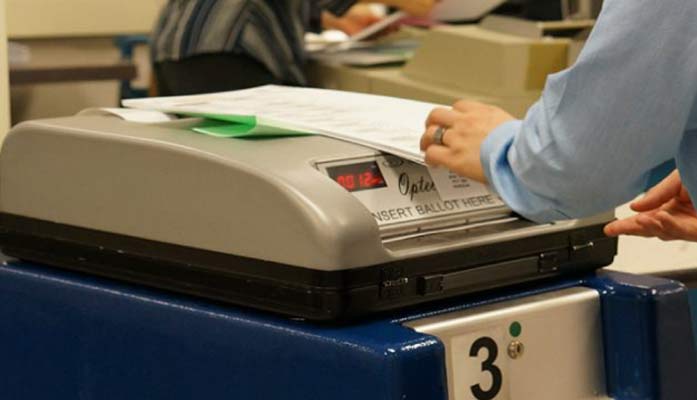
On Monday, Maricopa County began the tabulation of approximately 168,000 early ballots. The county estimated that around 150,000 to 250,000 early ballots will be dropped off on Election Day, with 98 percent of ballots reported by November 11.
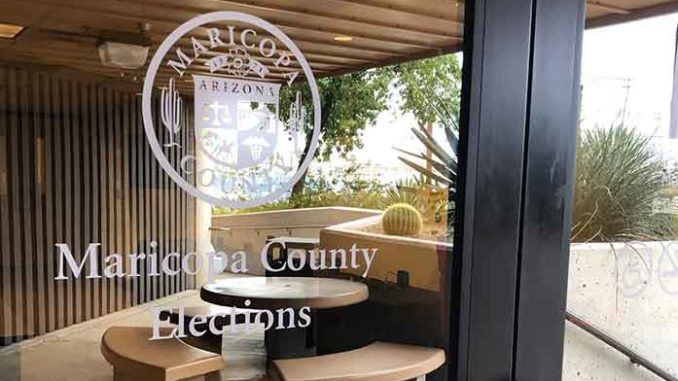
The Maricopa County Elections Department counts all early and provisional ballots. Vote Center tabulators handle Election Day ballots. As the county noted, state law allows for early ballot tabulation prior to Election Day.
— Maricopa County Elections Department (@MaricopaVote) October 24, 2022
Bill Gates, Maricopa County Board of Supervisors chairman, assured voters in a press release that the tabulators were vetted and staff were bipartisan.
“Regardless of who wins or loses, voters can trust in the results that our election processes, procedures, and audits provide,” stated Gates.
The county noted that voters should be aware of the possibility of an automatic recount following the publication of final results. SB1008 increased the automatic recount threshold from .001 to .5 percent. If that occurs, the final election results would be available by late December at the earliest.
The county’s detailed explanation of its processes, prediction of when vote counting ends, and assurance of election integrity precautions are likely part of efforts to alleviate tensions after nearly two years of vocal voter distrust in elections — especially those in Maricopa County.
Some voters who did not want to receive a ballot by mail have reported receiving one. If you received a ballot through the mail after previously requesting not to vote early, it was likely because we did not receive the request within the time required by state law. A 🧵 (1/3)
— Maricopa County Recorder's Office (@RecordersOffice) October 19, 2022
County leadership condemned citizens surveilling ballot drop boxes, saying that it amounts to voter intimidation. The county encouraged citizens to become poll workers or official party-affiliated observers rather than surveil drop boxes.
“Uninformed vigilantes outside Maricopa County’s drop boxes are not increasing election integrity. Instead they are leading to voter intimidation complaints. Although monitoring and transparency in our elections is critical, voter intimidation is unlawful,” stated the county.
Video surveillance of the drop boxes exists, but isn’t always reliable. As AZ Free News reported in August, the county failed to record an unstaffed drop box for three weeks — a mistake only discovered by the county after a records request for the video feed by the Maricopa County Republican Committee (MCRC).
— Maricopa County Elections Department (@MaricopaVote) October 23, 2022
Maricopa County Recorder Stephen Richer shared that approximately 1.9 million early ballots were mailed, accounting for around 77 percent of voters (over 2.4 million). Richer added that the county processed over 25,000 new or updated voter registration applications.
Wondering what the barcode on your ballot's green envelope is for? It links your ballot to your voter profile, and it's how we ensure each voter only casts one ballot, and all ballots are associated with registered voters. pic.twitter.com/adFXUiRtiA
Election results will be made available here starting at 8 pm on Election Day, and updated every night. Voters can track and verify their ballot status by texting “JOIN” to 628-683 or by visiting BeBallotReady.Vote.
A woke black “pastor” from California claimed Democrat gubernatorial candidate Katie Hobbs isn’t racist, prompting Talonya Adams, the staffer twice vindicated in court for racial discrimination she faced under Hobbs, to rebuke him.
Robinson, a Californian and former Arizonan who claims to be a Christian pastor despite violating Scripture, claimed Hobbs’ actions were mistakes.
“Contrary to popular beliefs, Katie Hobbs isn’t racist. If she was, I would let you know,” tweeted Robinson. “She made mistakes. We all do. AZ, she needs your vote on Nov 8th!”
Contrary to popular beliefs, @katiehobbs isn't racist. If she was, I would let you know. She made mistakes. We all do. AZ, she needs your vote on Nov 8th!
In response, Adams said Robinson’s claim was a lie and quoted a Bible verse condemning liars.
“This is a lie Redeem,” wrote Adams. “Proverbs 12:22: Lying lips are an abomination to the Lord, but those who act faithfully are his delight.”
This is a lie Redeem.
Proverbs 12:22: Lying lips are an abomination to the Lord, but those who act faithfully are his delight. https://t.co/TMHmomzjNi
— Talonya Adams 🇺🇸 (personal acct) (@TalonyaAdams) October 23, 2022
Robinson came to Phoenix earlier this week to do voter outreach on behalf of Democratic candidates.
Black voter outreach in Phoenix! Arizona has some amazing Black faith leaders. Thankful for them letting me come through to inform their churches and drop off material about the upcoming election! #WeWontBlackDown ✊🏿✊🏿✊🏿 pic.twitter.com/kvwi2w5IFF
Over the past decade until last year, Robinson was involved throughout Arizona as a “pastor” at various churches, a political activist, and politician. Robinson served as a “pastor” with All Nations Temple AME Zion Church in Tucson, then Ebenezer Church in Phoenix.
Robinson also served as a field director for the Arizona Democratic Party; a southwest organizing manager for Need to Impeach, a PAC to oppose former President Donald Trump founded and principally funded by Democratic dark money kingpin Tom Steyer; a state deputy political director for Steyer’s 2020 presidential run; a campaign manager for the scandal-ridden, leftist dark money nonprofits Arizona Coalition for Change/Our Voice Our Vote; founder of the Tucson chapter of Black Lives Matter (BLM); the Black Engagement Committee founder and Sergeant At Arms for the Maricopa County Democratic Party.
The “sex-positive” Robinson was also a failed 2018 Democratic candidate for the Arizona Senate. His candidacy took a hit from news coverage of domestic violence charges filed by his ex-girlfriend, with whom he had a child out of wedlock. (He has a total of three daughters, who he says live in Arizona while he lives in California). The court later dismissed the charges against Robinson because the prosecutor’s office wasn’t prepared to proceed.
It appears that Robinson’s latest efforts are a fusion of alleged “Christianity” and political activism: All Souls Movement, a nonprofit he founded and directs. Robinson pays himself to do “paid partnership” social media posts for his nonprofit; earlier this month, he posted a video on Instagram telling people to “not be an a**hole” and claiming that being a Christian doesn’t mean abstaining from sin. Notably, Robinson didn’t cite any Scripture to justify his claims.
“Jesus’ ministry was as simple as it. Literally, His ministry on earth was telling us don’t be an asshole. With the richer getting richer and poor getting poorer, and white supremacy going unchecked, and racism out of control, and homophobia, xenophobia, and transphobia, and sexism just out of control,” said Robinson. “We need to hear daily. Don’t be an asshole. That’s what true holiness is about. It’s not about long dresses and abstaining from certain things. It’s about treating other people right so that the world can be a better place.”
Corinne Murdock is a reporter for AZ Free News. Follow her latest on Twitter, or email tips to corinne@azfreenews.com.