On Thursday afternoon, Arizona made history by becoming the first state to implement universal school choice in modern-day education. The state’s school choice system, the Empowerment Scholarship Account (ESA) Program, ensures that all of Arizona’s students receive up to $7,000 annually to receive the education they desire. Students may apply the scholarship account funds to public school alternatives or supplements like private schools, homeschooling, educational therapies, or tutoring.
For the past month, Governor Doug Ducey has celebrated the historic legislation in a flurry of tweets and press releases. Ducey declared Arizona’s universal school choice program the “gold standard for education freedom.”
📚SIGNED: THE MOST EXPANSIVE SCHOOL CHOICE LEGISLATION IN THE NATION📚
This is a monumental moment for all of Arizona’s students. Our kids will no longer be locked in under-performing schools. 1/ https://t.co/CEz1Vk43E0
Arizona House Majority Leader Ben Toma, the sponsor behind the bill to universalize school choice, emphasized in a press release that the GOP overcame divided opinion within its “razor thin” majority to universalize ESAs.
“In Arizona, we fund students, not systems, because we know one size does not fit all students,” said Toma. “I couldn’t be prouder that House Republicans stood united to pass the first truly universal ESA program in the nation and deliver educational freedom to more than 1.1 million students.”
House Majority Leader @RepBenToma Hails Enactment of Universal ESA Program, Expanding School Choice for All K-12 Families.
— Arizona House Republicans (@AZHouseGOP) July 7, 2022
In the wake of the Arizona legislation’s approval of Toma’s bill, school choice opponents invoked rhetoric to reiterate their longstanding claim that school choice leads to segregation. Proponents of school choice refute that claim, including one prominent Black pastor from South Phoenix — a Democrat who benefitted from school choice.
Anti-school choice activists with Save Our Schools Arizona (SOSAZ) launched a campaign to subvert the new law, “Stop Voucher Expansion” — a mischaracterization of the school choice funds as “vouchers.” If successful, SOSAZ would put the fate of universal school choice on the 2024 ballot.
Today, we are proud to announce the launch of #StopVoucherExpansion, an all-volunteer petition drive to refer universal ESA voucher expansion to the 2024 ballot. Join our movement to protect public education & keep $1B in AZ’s public schools TODAY: https://t.co/Se3tAgpXWzpic.twitter.com/ODf9Z1CFxo
The ESA Program is not a voucher program. It is an education scholarship account. Vouchers are education funds awarded for use at private schools only. The ESA Program allows parents to apply their funds to a variety of education options including, but not limited to, private schooling. Prior to its universalization, the ESA Program was open to a select few classes of students, mainly utilized by those with disabilities that relied on the funds to obtain niche educational therapies.
Parents who benefited from ESAs pleaded with their community to oppose the SOSAZ activists.
Please DECLINE TO SIGN anything from Save Our Schools Arizona. ALL Arizona children deserve access to an education that meets their individual needs. Signing their petition does not allow families to make the best educational choice for their children. #DeclineToSignpic.twitter.com/nNDGDth1iO
13 private schools in Arizona are associated with a private school accreditation network that’s long advocated for transgenderism in minors: the Washington, D.C.-based National Association of Independent Schools (NAIS).
The following are the 13 NAIS-accredited schools:
Mayer: The Orme School
Paradise Valley: Phoenix Country Day School
Phoenix: All Saints’ Episcopal Day School, Gateway Academy, New Way Academy
Scottsdale: International School of Arizona, Nishmat Adin – Shalhevet Scottsdale, Pardes Jewish Day School
Sedona: Verde Valley School
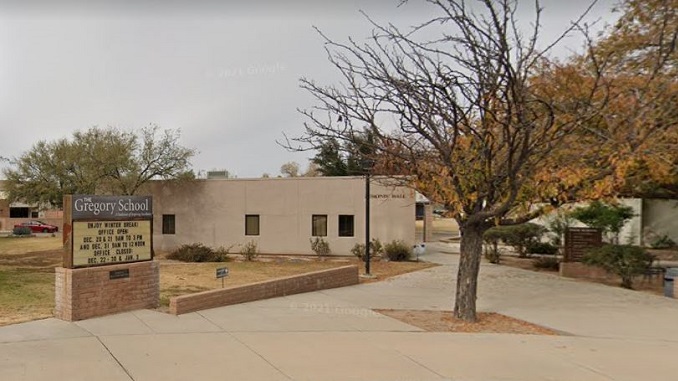
Tucson: The Gregory School, Imago Dei Middle School, International School of Tucson, Tucson Hebrew Academy
One of the latest major initiatives by NAIS involves transgenderism advocacy for minors. Last month, NAIS hosted a joint conference with Gender Spectrum, a pro-transgenderism organization heavily focused on promoting child and teen gender transitions. Gender Spectrum partners with a plastic surgeon that specializes in gender transition procedures: Align Surgical Associates.
What if you found out that your child's teacher, counselor, and principal were trained by an org that encourages child transgenderism and partners with trans surgeons?
— Spencer Lindquist 🇺🇸 (@SpencerLndqst) July 6, 2022
Gender Spectrum’s premiere sponsor is Pearson, one of the leading education materials providers in the world.
NAIS has an entire page dedicated to “Supporting Transgender Students in Independent Schools.” Many of their resources on the page, such as their legal advisory on handling transgender students, is hidden behind an NAIS member login.
NAIS’ reliance on Gender Spectrum and advocacy for minors transitioning genders isn’t new. They’ve been doing so for well over a decade. One of their earliest mentions of transgenderism advocacy occurs in a 2010 edition of their magazine, which was dedicated entirely to gender and sexuality ideology. In a guideline, NAIS instructed affiliate schools and educators on “Gender and Sexuality Diversity,” which they abbreviated as “GSD.”
NAIS told its schools to incorporate GSD materials in curriculum and libraries, establish GSD professional development programs for faculty and staff, and form GSD non-discrimination and anti-bullying policies. The network encouraged schools to allow students to wear gender-affirming clothes, and use the preferred bathrooms of their choice.
“If you have a gender variant child in your school, put together a team, including a professional therapist and/or consultant, to create plans and approaches on a case-by-case basis. Each child and school community has particular needs that can best be addressed with a collaborative consultation model,” read the guideline. “Remember that helping your school community examine unhealthy gender-role stereotyping is a benefit to all, not just those students who are gender variant.”
Nearly 2,000 private schools in the U.S. and abroad are affiliated with NAIS, with over 1,600 of those being independent, private K-12 schools in the U.S. That accounts for over 60,000 out of nearly 131,000 teachers in the country, nearly 46 percent, and just under 697,000 of the nearly 54 million students, a little over 1 percent.
31 percent of NAIS membership is based in the West and Southwest, followed by 29 percent in the East and Mid-Atlantic regions. 50 percent of all NAIS-affiliated U.S. schools are elementary and high schools, with 38 percent being preK-8 schools, and only 13 percent being high schools.
.@NAISnetwork, a network servicing close to 2,000 private schools, partnered with an organization that pushes "gender affirming" surgeries, has "chat rooms" for minors to talk to trans and non-binary adults, and pays teachers to learn about gender identity. https://t.co/2e3uwizB2F
Gov. Doug Ducey vetoed a bill Wednesday which would have allowed Maricopa County voters to decide next year whether to extend a 2004 voter approved one-half cent transportation tax for another 25 years.
Ducey explained in his veto notice that his action was not about whether the 20-year voter approved Proposition 400 tax set to expire in December 2025 should be extended. Instead, he determined lawmakers approved House Bill 2685 with ballot language that was not responsible nor transparent.
“The language is not only biased, but it fails to include any mention of the increase of 20 to 25 years nor the changes to distribution for state highways, local roads and public transit,” Ducey wrote, pointing out the proposed ballot measure also does not take into consideration passage of the Investment in Infrastructure and Jobs Act.
As a result, Ducey noted that what voters would have been asked to approve “does not properly account for the opportunity to properly leverage state dollars for federal transportation infrastructure funding.”
HB2685 passed the State Senate with only 7 aye votes from the 16 members of its Republican caucus, while the bill received support of only 10 of the 31 House Republicans on the final vote. It was introduced in March to replace Senate Bill 1356 which did not make it out of the House Rules Committee.
Ducey’s veto notice did not have much good to say about HB2685, but he gave a shout out to Sen. Michelle Ugenti-Rita for introducing various amendments to both bills to address several concerns the majority of Republican lawmakers had with the language of the ballot measure.
The amendments offered by Ugenti-Rita (R-Scottsdale) would have ensured a fairer ballot description narrative, Ducey explained, as well as provide more strategic insight into how the transportation and infrastructure tax dollars would be spent.
“Unfortunately, none of these amendments were adopted,” Ducey wrote, adding that asking voters to approve the extension as proposed “is not the way to address the needs of our growing state.”
Reaction to Ducey’s veto was swift, including a statement from the Arizona Free Enterprise Club which called the veto “well-deserved” to avoid allocating transportation dollars for bike lanes, trollies, and “little used transit” at the expense of critical freeway maintenance.
“We commend the Governor for this wise decision and for hearing the concerns brought up by opponents throughout the process as well as thousands of Arizona taxpayers who expressed deep concerns over the poorly drafted legislation,” the AFEC statement reads. “The real victors of course are the taxpayers themselves who deserve common sense transportation policy and accountability for their tax dollars.”
Also complimenting Ducey’s veto was the Arizona Chapter of the Republican Liberty Caucus.
Thank you @DougDucey for your veto of HB2685! We testified against this massive 25 year tax extension while down at the Capitol for our Liberty Lobby Day earlier this session. Our bloated budget spends enough on infrastructure. Arizonans need lower taxes for inflation relief! pic.twitter.com/TEZT8p2hLS
However, Phoenix Mayor Kate Gallego tweeted that she was profoundly disappointed by what she called Ducey’s shortsighted, anti-economic development, and “out of touch” veto.
By killing the bill, the governor seems to think Arizonans love sitting in traffic jams, giving up time with family, and further damaging air quality. 3/6
One thing Gallego’s six-part missive did not mention is there is nothing in Ducey’s veto to prevent legislators from drafting a sounder bill next session and get it before voters in plenty of time to be decided before the one-half cent tax expires.
On Tuesday, the Department of Justice (DOJ) announced that it sued the state over its new law requiring individuals to show proof of citizenship when registering to vote. The law, HB2492, wouldn’t take effect until next January.
DOJ Assistant Attorney General Kristen Clarke called Arizona’s proof of citizenship rule an “onerous” and “unnecessary” requirement.
The DOJ contended in its press release that Arizona’s law violates Section 6 of the National Voter Registration Act (NVRA) and Section 101 of the Civil Rights Act. The NVRA specifies that individuals aren’t required to show proof of citizenship for the federal voter registration form enabling them to vote in federal elections, just to attest that they have one: these are called “federal-only voters.”
Justice Department Files Lawsuit Against the State of Arizona Over Restrictive Voter Registration Requirementshttps://t.co/nIzluHFZVj
In its lawsuit, the DOJ rationalized that the federal voter registration form doesn’t require anything beyond an attestation because documentation “is not necessary to prove citizenship.”
The DOJ also cited the 2013 Supreme Court (SCOTUS) ruling in Arizona v. Inter Tribal Council of Arizona, which determined that Arizona couldn’t require proof of citizenship for those registering to vote using the federal form.
As for the alleged Civil Rights Act violation, the DOJ argued that Arizona officials couldn’t deny individuals the right to vote if they willfully or mistakenly didn’t check a box on the voter registration form confirming that they’re a U.S. citizen. The checkmark serves as an attestation of citizenship, similar to the one outlined by the NVRA.
With this lawsuit, the Biden administration effectively declared their allegiance with other establishment Democrats suing Arizona over the citizenship requirement. At the helm of lawsuits from progressive activist organizations is Marc Elias, a favored lawyer within the Democratic Party who was at the center of the 2016 Russiagate hoax.
HB2492 not only requires proof of citizenship when registering to vote. It also requires election officials to cross-check applicants’ citizenship through government databases. On top of local and state databases, these include databases within the Department of Transportation concerning Arizona IDs and driver licenses, the Social Security Administration, the Citizenship and Immigration Services Systematic Alien Verification for Entitlements Program, and the National Association for Public Health Statistics and Information Systems Electronic Verification of Vital Events System.
Over 11,000 voters in the 2020 election didn’t provide proof of citizenship. In 2018, that number was about 1,700.
Attorney General Mark Brnovich pledged to fight the Biden administration to uphold the law.
In addition to free rooms and transportation for those illegally entering our country, the DOJ now wants to give them a chance to vote.
I will once again be in court defending Arizona against the lawlessness of the Biden administration. https://t.co/tYt3EVoEn8
Arizona’s largest newspaper, the Arizona Republic, doesn’t put up a paywall for any articles on its Spanish sister publication, “La Voz” — even if they’re translated versions of subscriber-only articles on its main page.
When AZ Free News reached out to Gannett’s customer service, one of their agents insisted that readers needed a subscription to access any version of a paywalled story. AZ Free News then reached out to spokespersons with Gannett, Arizona Republic’s parent company, to ask about the rationale for not requiring Spanish readers to pay subscriptions. They didn’t respond by press time.
En Arizona, la mayoría de las clínicas que ofrecían servicios de aborto ya cerraron a raíz del fallo de la Corte Suprema, eliminando casi por completo el acceso al aborto en el estado. https://t.co/qPF6dqVD85
La Voz launched in 2000, the same year that Arizona Republic was acquired by Gannett, a Virginia-based mass media company that owns USA Today, a national paper, along with over 250 papers across 44 states. The only states that Gannett listed no paper ownership in: Alaska, Hawaii, Idaho, Maine, Nebraska, West Virginia, and Wyoming.
Though there isn’t an explicit reason given for the free access to La Voz, a plausible explanation might have to do with the newspaper chain’s social justice commitments.
Gannett is one of many companies across the globe committed to “ESG,” or “Environmental, Social, and Governance” criteria that amount to a “social credit score.” Internationally, there are over 70 major companies committed to ESG criteria. The world’s greatest asset manager, BlackRock, serves as one of 100 strategic partners behind the globalist lobbying organization that invented ESG, the World Economic Forum (WEF); BlackRock is the largest shareholder in Gannett by far.
As part of those ESG criteria, Gannett has committed to diversity, equity, and inclusion (DEI) initiatives in hiring and media coverage. Last September, Gannett also announced that it created 20 national and 40 regional positions exclusively focused on social justice issues, with more to come.
The company pledged to reshape its workforce to mirror the nation’s demographics and communities where its papers exist by the end of 2025. Per Gannett’s latest data, the Arizona Republic successfully neared this goal in several demographics last year. From 2020 to 2021, the newspaper reduced its White journalists from 66 to 62 percent, gaining on its community makeup of 55 percent; reduced its Black journalists from 7 percent to 5 percent, matching the 5 percent community makeup;
However, the Arizona Republic fell short in several demographics. Though it increased its Hispanic/Latino journalists from nearly 15 percent to 18 percent, the community makeup totals 30 percent. And, it barely reduced its Asian journalists, hovering around 7 percent when the community makeup is just under 4 percent. It actually increased its Native American journalist hires, from just over 2 percent to nearly 3 percent, though the community makeup is just under 2 percent.
Gannett was acquired by New Media Investment Group in 2019. The firm is controlled by Fortress Investment Group, another private equity firm, who is owned by Softbank, a Japanese conglomerate.
Corinne Murdock is a reporter for AZ Free News. Follow her latest on Twitter, or email tips to corinne@azfreenews.com.
On Wednesday, Maricopa County will open the first 10 of 211 vote centers for the upcoming primary election; in all, double the number operating during the 2020 election. Five of those locations will only serve as vote centers on certain days — otherwise, they’ll only house drop boxes.
Vote centers allow voters to cast ballots at any location rather than an assigned precinct, leading them to be referred to as “vote anywhere” locations.
We'll have over 120 additional voting locations from August 2020. All of them will be "vote anywhere" vote centers. Early voting 27 days before Election Day. We have vote by mail. We have special election boards.
— Stephen Richer—Maricopa Cnty Recorder (prsnl acct) (@stephen_richer) June 2, 2022
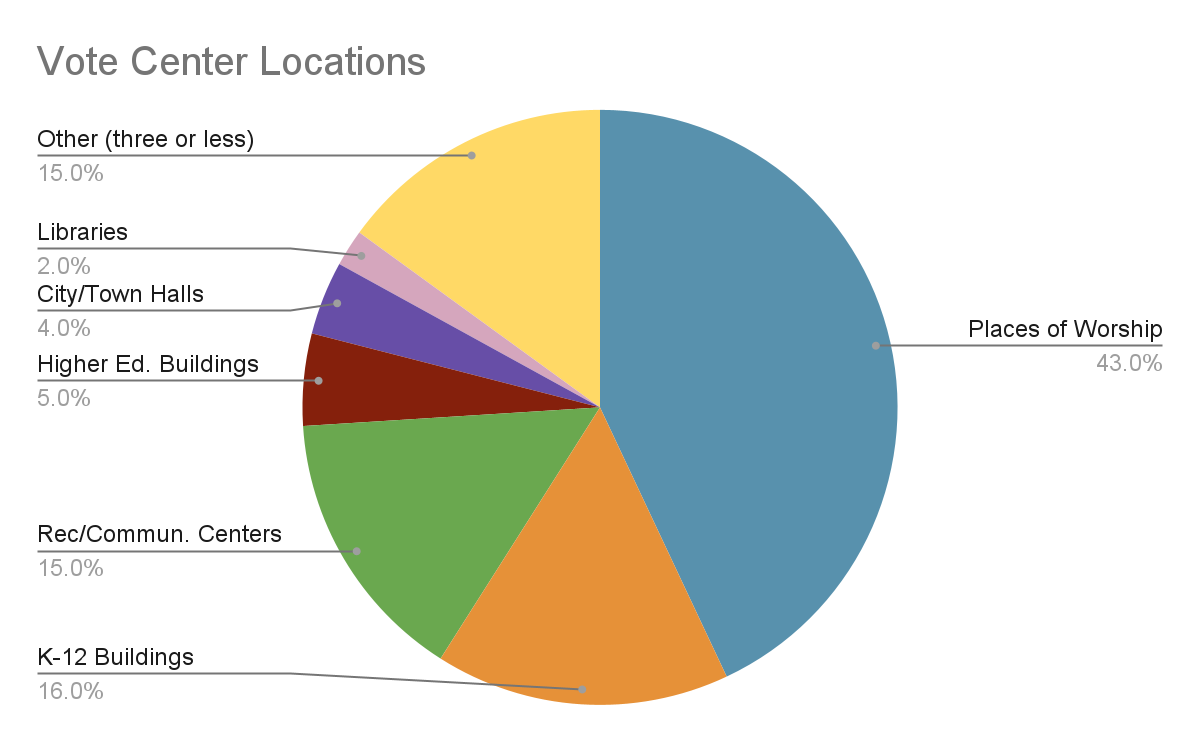
The majority of vote centers were concentrated at places of worship: churches and a few mosques accounted for about 44 percent of all vote centers. About 16 percent were located at K-12 schools or district offices. About 15 percent were located at recreational or community centers.
Another 15 percent were scattered almost evenly across 17 different types of buildings. Of note, there was a vote center at a mortuary, a union, a country club, an airport, and a commercial real estate agency.
The first 10 voting locations open on Wednesday (7/6). I've listed them in the next tweet.