by Corinne Murdock | Jun 28, 2022 | News
By Corinne Murdock |
Arizona has two pathways for addressing abortion: an outright ban as old as the state itself, or the 15-week restriction codified in March.
On Friday, the Supreme Court (SCOTUS) ruled that Roe v. Wade invented a nonexistent constitutional right to abortion, wrongly forcing the states to surrender their authority on the subject. Arizona’s elected officials must decide whether to honor the state’s original outright ban on abortion or, instead, enforce the 15-week ban passed earlier this year. The latter will likely go into effect in the second-to-last week of September; the SCOTUS ruling will be effective near the end of next month.
The Senate’s Republican caucus declared in a press release that the original outright ban is in effect. However, the attorney general’s office hasn’t issued a formal statement of which law it will enforce. It explained in a statement that it’s conducting a legal review.
“This law, that is already on the books, bans most abortions, unless the procedure is necessary to save the life of a mother,” wrote the Senate majority. “Last year, the legislature amended this law, so that the mother who chooses to have an abortion will not face any punishment.”
Long before the legislature revised the ban, the Arizona Court of Appeals enjoined the law as unconstitutional in its 1973 ruling in Nelson v. Planned Parenthood Center of Tucson. That decision was directed by the SCOTUS precedent in Roe.
Insecurity over current law prompted Arizona’s abortion providers to suspend abortions until further notice. Chris Love, the chairwoman of Planned Parenthood Arizona’s advocacy arm who bragged about her husband assaulting a black Trump supporter at a pro-abortion rally last month, explained that they didn’t want providers to lose their licenses or police engaging with their patients.
Cathi Herrod, the president of the Center for Arizona Policy, spoke with “Conservative Circus” host James T. Harris about the viability of restoring Arizona’s original abortion ban.
Herrod opined that Arizona’s original abortion ban would stand because it preceded Roe v. Wade and that was never repealed after. Arizona outlawed abortion from 1901, prior to achieving statehood, up until it was required by the Supreme Court to allow abortions in 1973. The original ban is A.R.S. 13:3603, which only punishes abortion providers and not the pregnant women.
“I believe that is still good law and that it should be enforceable,” said Herrod.
Herrod clarified that the 1973 Arizona Court of Appeals decision rested on the SCOTUS decision at the time, indicating that the law was no longer enjoined as a result of Friday’s ruling.
Herrod also noted that even the most recent limitation on abortion — SB1164 banning abortions after 15 weeks, signed into law in March — stipulated that it didn’t repeal the state’s original abortion ban.
“This act does not: […] Repeal, by implication or otherwise, section 13-3602, Arizona Revised Statutes, or any other applicable state law regulating or restricting abortion,” reads the latest law.
In a Facebook post, Herrod added that the state’s original ban had greater enforceability than the 15-week restriction, unless a court enjoins that ban. In that case, Herrod stated that the 15-week restriction would be enforceable.
In response to claims that the legal system would punish expectant mothers for obtaining abortions, Herrod clarified that no state laws extended punishment to mothers. She noted that Governor Doug Ducey codified a repeal of a pre-Roe law punishing women who received abortions with jail.
Herrod predicted that there would be lawsuits on Arizona’s abortion bans. Pro-abortionists undertook legal action on Saturday, a day after the SCOTUS ruling. ACLU of Arizona, the Center for Reproductive Rights, the Arizona Medical Association, and the National Council of Jewish Women Arizona filed an emergency motion in the Arizona District Court.
According to the latest data from the Arizona Department of Health Services (AZDHS), there were nearly 13,300 abortions completed in 2020 — over 36 a day across the dozen facilities that provide abortions in the state. Over 85 percent of those who obtained abortions were unmarried. The greatest number of abortions occurred in women aged 20-24 years old: about 4,000. Over 1,200 of the abortions came from teenagers, from under 15 years old to 19 years old. Over 7,600 of the abortions came from women in the 20’s, and over 3,800 came from women in their 30’s.
Corinne Murdock is a reporter for AZ Free News. Follow her latest on Twitter, or email tips to corinne@azfreenews.com.
by Corinne Murdock | Jun 27, 2022 | News
By Corinne Murdock |
During pro-abortionists’ attempted insurrection of the Arizona State Capitol on Friday, several Republican senators took up arms to defend their legislature. The Arizona Department of Public Safety (ADPS) noted that there were between 7,000 and 8,000 protesters at the Arizona State Capitol Complex on Friday.
In an interview with “Conservative Circus” host James T. Harris, State Senator Kelly Townsend (R-Mesa) recounted how the senate was in the middle of approving universal school choice when pro-abortion protestors attempted to breach the Arizona Capitol. Townsend said that she and three other legislators retrieved their firearms to help secure the building.
“We got word that there was trouble in paradise, that people were trying to break into the capitol. We knew they were out there, but then they started trying to break into the doors,” said Townsend. “It was just surreal. It wasn’t traumatizing, it wasn’t dramatic. It was just, ‘This is really happening in our capitol.’ It was something that I will never, ever forget.”
Townsend also described the wide range of fellow members’ reactions to the insurrection threat: from those assuming leadership roles to those cowering and experiencing meltdowns. The legislator shared that she encouraged fearful members to take heart, sharing confidence in their safety due to being armed against the rioters.
“That’s the difference between AOC and us — when you’re armed, you are empowered to take care of yourself. You’re not traumatized. You are there to hold down the fort, right?” said Townsend.
The senator recounted that the only individuals traumatized by the event, by her observation, were the two children of a fellow, unnamed senator.
“When you saw who was out there, it was these petulant little 20-year-old girls. There was definitely some Antifa, and that was what caused DPS to act, but mostly it was just girls banging on the window and then coming out with their spray paint and then destroying these monuments with their graffiti — not destroying them but, you know, getting them messy,” said Townsend.
AZDPS reported that rioters committed “felony criminal damage” to the capitol. In their attempts to address the chaos brewing amid trespass and unlawful assembly, AZDPS explained in a press release that they resorted to deploying gas to clear the plaza. In response to criticism of their tactics with children present, AZDPS countered that it was unwise for individuals to bring children to such a protest.
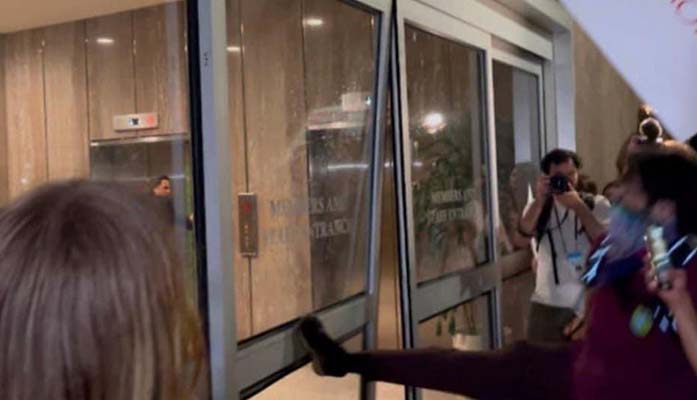
“What began as a peaceful protest evolved into anarchical and criminal actions by masses of splinter groups. As groups realized the state legislature was in session, they attempted to breach the doors of the Arizona Senate and force their way into the building. The violence of their efforts literally shook the building and terrified citizens and lawmakers who occupied the building. As the glass doors bowed from attempts of forced entry, the occupants of the building were instructed to move to secure locations,” reported AZDPS.
Attorney General Mark Brnovich denounced the rioters’ attempts to undermine law and order.
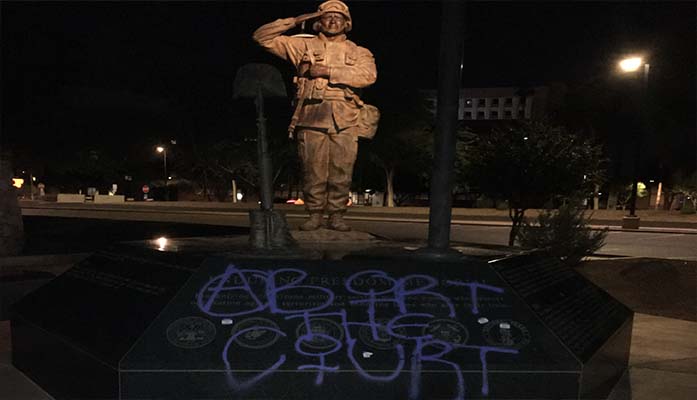
Despite the antics of the weekend, Townsend said that she and other legislators showed up early to the capitol to clean up the aftermath of the pro-abortionists. She observed that some Gold Star mothers were outraged by the defacement of the Enduring Freedom Memorial. The rioters wrote “ABORT THE COURT” and “F**K SCOTUS” across multiple memorials.
“If you could put yourself in their shoes and your son’s name is on there, and these petulant children come and spray paint it because they’re not able to take their child’s life?” remarked Townsend.
Corinne Murdock is a reporter for AZ Free News. Follow her latest on Twitter, or email tips to corinne@azfreenews.com.
by Corinne Murdock | Jun 27, 2022 | Education, News
By Corinne Murdock |
Tensions escalated during the Chandler Unified School District (CUSD) regular meeting on Wednesday over discussions of funding school resource officers (SROs).
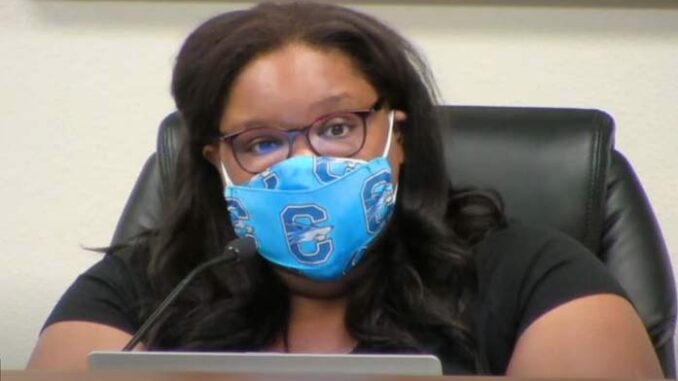
Governing Board member Lindsay Love exhibited signs of a meltdown after fellow board member Joel Wirth expressed discomfort over her opposition to SROs. Love wanted the board to present more metrics and plans to the public for SROs before adding more of them on campuses. She cited the recent mass shootings in schools, namely Uvalde, Texas, to bolster her point for additional meetings on the subject.
“I don’t necessarily feel comfortable with cops on campus, right? I’m that person who doesn’t necessarily feel comfortable with cops around kids, right? But no matter how you feel about that, I think that there needs to be some transparency and I think that people need to know what the plan is,” said Love.
Wirth responded that he was uncomfortable with Love’s opposition to SROs. He saw the issue behind the Uvalde tragedy differently, arguing that more armed officers on campus would prevent similar tragedies from befalling CUSD. Wirth said that no SROs at all was not the right choice.
“Considering what’s going on in the world, that seems like the worst decision we can make — ” began Wirth.
At that point, Love interrupted Wirth to argue that there were CUSD members who didn’t want SROs. She claimed that SROs impacted certain categories of students to a greater negative degree than others. Love didn’t elaborate on what motives could drive that claimed impact.
“You may be comfortable with cops on campus but there are parents in this audience and students in this audience who may not, right? Because what we know is that we have cops on campus and they disproportionately impact BIPOC students and SPED students,” said Love. “I will not be silenced about this. We just had parents and students get up and address this. So you not feeling comfortable does not negate people in this audience and in our community who do not feel comfortable.”
Board President Barb Mozdzen instructed Love to give Wirth the floor to speak. Love interrupted Mozdzen instead.
“You know what Barb, I interrupted because I overheard him say over there, ‘Let somebody else speak,’ and I let everybody on this board speak,” said Love.
When Wirth tried to respond, Love shouted him down.
“No, I’m not letting you speak. I’m not letting you speak. I polled this myself, I had questions and I won’t be silenced,” said Love. “You can speak but I will not sit up here for a lecture.”
Mozdzen intervened to inform Love that she was out of order for breaking away from the agenda. Love refused to allow Mozdzen to continue speaking. Love asserted that if she was out of line, then Wirth was out of line for “lecturing” her in his response.
At that point, Mozdzen repeated to Love that Wirth was going to speak and that Love should remain silent.
Wirth concluded by reiterating his belief that SROs were necessary for school safety.
“My point is, I believe it’s important to have officers on the campus based on what’s going on in the world right now. That’s all I have to say,” said Wirth.
In a later post on Twitter, Love insisted that police intimidated minority and LGBTQ+ students.
Love, a controversial member, decided last November that she wouldn’t seek reelection.
Corinne Murdock is a reporter for AZ Free News. Follow her latest on Twitter, or email tips to corinne@azfreenews.com.
by Terri Jo Neff | Jun 26, 2022 | News
By Terri Jo Neff |
An expansion of Arizona’s Empowerment Scholarship Account (ESA) program has long been a cornerstone platform issue for Conservative lawmakers. And on Saturday, Gov. Doug Ducey made comments which have supporters believing he will sign into law what he called “the most expansive school choice legislation in the nation.”
House Bill 2853 creates a roughly $7,000 education credit for each of the 1.1 million K-12 student in Arizona to attend any school of their choice, whether it be a public, private or charter school, or even homeschooling. Ducey has called passage of the bill sponsored by House Majority Leader Ben Toma (R-Peoria) a “monumental moment for Arizona’s kids and families.”
That sentiment was shared by the Goldwater Institute, which noted Arizona’s new universal ESA expansion provides school choice for all students and “empowers families to choose the best schooling option for their children regardless of their zip code.”
HB2853 will take effect on behalf of the state’s more than 1.1 million students a mere 90 days after signed by the governor. The credit, which is paid out as scholarships, can be used for expenses such as tuition and tutoring, transportation, education tools (i.e. textbooks and computers), and other costs directly related to supporting a student’s educational needs.
Among those across the country recognizing the legislative victory in Arizona is former Florida Gov. Jeb Bush, a longtime advocate of ESA programs.
In addition, Corey A. DeAngelis of the Washington DC-based American Federation for Children tweeted about the bill which now allows all Arizona families to direct their student’s ESA dollars to the educational institution that can best serve the student.
However, organizations such as Save Our Schools have threatened to push back on the new legislation if Ducey signs it. The group advocates for funding the needs of public school systems instead of the needs of individual students, even when a family has determined a private, charter, or home school situation is better for the student than a public school setting.
EDITOR NOTE: The original article has been updated to reflect that Gov. Ducey has not yet signed HB2853 despite his public comments in support of the legislation.
by Corinne Murdock | Jun 26, 2022 | News
By Corinne Murdock |
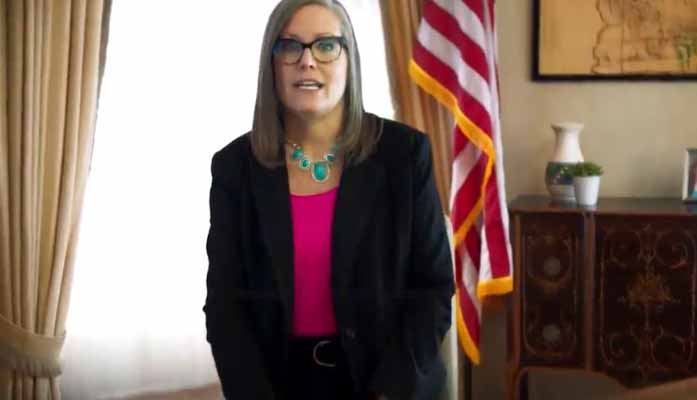
On Tuesday, Secretary of State Katie Hobbs published her plan for reimagining Arizona energy if she’s elected governor this November. Some of the major changes desired by Hobbs included total elimination of fossil fuels, creating a new bureaucratic body to oversee water and “clean” energy, tree planting in all neighborhoods, and rebate clean energy programs for those 150 percent below the poverty line.
Overhauling the state’s energy and water infrastructure to combat climate change will cost the state and Arizonans more than it would to maintain the status quo. Hobbs’ plan comes as Arizona voters feel increasing pressure from inflation. At present, Arizonans pay an average of over $5.35 per gallon for gas, with Maricopa County residents feeling the gas hike more acutely at $5.65 a gallon. They’re also paying an average increase of over $700 a month on household goods. That latter figure amounts to an average of nearly $8,800 more a year, according to the latest congressional research.
As AZ Free News reported earlier this month, the cost of electric vehicles alone haven’t proved feasible for most Arizonans, let alone Americans — a reality becoming more apparent with inflation. In March, less than 15 percent of Americans were estimated to afford an electric vehicle.
Hobbs’ plan didn’t include an estimated total cost. However, Hobbs did give dollar amounts for certain initiatives, amounting up to $295 million if she serves one term, and up to $575 million if she serves two terms:
- up to $5 million a year to remove toxic chemicals from water
- a one-time allocation of $15 million to build wells for rural Arizonans, Latinos, and indigenous communities
- $15 million a year to restore forests and watersheds
- $25 million a year in grants for communities and private landowners affected by wildfires
- up to $25 million a year for preserving cultural and historical heritage spaces
Associated with some of these planned funding initiatives were disclosures that preference would be given to those aligning with certain social justice aims, such as combatting the urban heat island effect.
“Katie Hobbs’ Plan for a Resilient Arizona” proposed three overarching priorities: securing and modernizing the state’s water infrastructure, addressing wildfires and sustaining natural resources, and building a “clean energy economy.”
The Republican National Committee (RNC) research team issued a lengthy rebuttal of Hobbs’ plan. In a statement, spokesman Ben Petersen criticized the timing of a plan that would raise energy prices in the context of inflation increasing prices on everything, most noticeably gas and groceries.
“Democrat Katie Hobbs will struggle to explain her ‘Green New Deal’-esque scheme to voters paying record-high gas prices under Biden,” asserted Petersen. “Arizonans want more energy production and relief from the Biden Gas Hike, not Katie Hobbs’ far-left scheme to raise gas prices and energy bills.”
Tucson Mayor Regina Romero endorsed Hobbs’ plan. Last year, the city undertook a number of efforts to expand “clean” energy usage, which included requiring new homes to have electric vehicle charging ports.
Corinne Murdock is a reporter for AZ Free News. Follow her latest on Twitter, or email tips to corinne@azfreenews.com.
by Terri Jo Neff | Jun 26, 2022 | News
By Terri Jo Neff |
The reactions to Friday night’s initially peaceful protest at the State Capitol which was turned into a melee by agitators eerily echo the response to the January 6, 2021 events in Washington DC, only this time the political shoes are on different feet.
Many Republicans back in 2021 urged Americans to not paint all attendees at protests and rallies across Washington DC on Jan. 6 as criminals. In fact, less than 2,000 of the estimated 40,000 who gathered in the city that day have ever been investigated or charged for engaging in criminal conduct.
Yet some leaders of the Democratic Party have sought since then to paint anyone who attended a “J6” protest or rally as domestic terrorists.
Their tune has changed, however, at least as it relates to Friday night’s gathering of what an Arizona Department of Public Safety spokesman said was 7,000 to 8,000 people present to protest the U.S. Supreme Court’s ruling in Roe v. Wade.
Among those who promoted the protest was Raquel Teran, the chair of the Arizona Democratic Party and a LD30 state representative. Teran tweeted a flyer which called on those who opposed the SCOTUS ruling to show up at the Capitol on Friday at 7 p.m.
The same event was publicized by a group going by the name RadicalWomenPHX which advised those attending to use a Sharpie to write the group’s arrest hotline on their arms “as an extra safety precaution” if the protest went “sideways.”
Teran is another Arizona Democrat who does not shy away from calling on supporters to “fight” in the streets, despite national Democrats who continue to blame former President Donald Trump’s call for supporters to fight election fraud as the cause of the incursion into the U.S. Capitol in 2021.
Twenty-four hours later, Teran had not tweeted any condemnation of those seen in multiple videos attempting to kick in doors at the Senate Building. Or those belonging to what an Arizona Department of Public Safety spokesperson called “splinter groups” who turned the initially peaceful protest into “anarchical and criminal actions.”
According to Graves, when some of the attendees realized the Arizona Legislature was in session, “they attempted to breach the doors of the Arizona Senate and force their way into the building. The violence of their efforts literally shook the building and terrified citizens and law makers who occupied the building.”
At one point some of the glass doors of the Senate building bowed from the attempts of forced entry, which Graves said triggered security and law enforcement officials to instruct everyone inside the building to move to secure locations.
“Due to the direct threat to the occupants of the Senate building and damage to the building itself, Arizona State Troopers took immediate action and utilized tactics including the deployment of field force teams and tear gas,” Graves noted.
On Saturday, Senate President Karen Fann tweeted a short video recorded by Sen. Michelle Ugenti-Rita from inside the Senate building. The video shows protestors outside the building, which has several glass doors and windows on the ground floor.
In her tweet, Fann described the crowd as an “insurrection” but the DPS statement makes clear no one unlawfully entered any of the Capitol buildings. In fact, the video taken by Ugenti-Rita shows most of the large crowd of protestors yelling and carrying signs. Only a handful of agitators are seen pounding on the windows and kicking at the glass doors.
There were also false social media reports about educators “invading” the Arizona Senate as part of the protests, which Fann quickly refuted. She noted the educators seen in photos wearing Red for Ed shirts on the Senate floor were guests seated in the gallery and then brought to the floor in an effort to get them to safety along with Senators and staff.
Ugenti-Rita tweeted a second video taken later on Friday night when a DPS tactical team was deployed inside the Senate building. By then many of the protestors and rioters had left the area after tear gas was fired at the unruly crowd. .
Sen. T.J. Shope supported the decision by DPS command to utilize tear gas when the crowd failed to stop the attack on the building.
However, the situation at the Senate building was not the only one which triggered a law enforcement response in the area.
“As the riotous behavior at the Legislature was taking place, concurrent and spillover criminal misconduct in the form of felony criminal damage and the defacing of state memorials was occurring in Wesley Bolin Plaza,” Graves said.
The response of troopers and other law enforcement officers was complicated by the fact some people had brought children to the protest which turned into unlawful assembly, according to Graves.
“After multiple warnings, and notifications of trespass and unlawful assembly, state troopers deployed gas and strategically moved to clear the plaza,” Graves said, adding that as rioters were cleared from one area they damaged state property in the next area. Those properties and publicly funded memorials which suffered what Graves called “significant criminal damage” include:
- Arizona Law Enforcement Canine Memorial
- Arizona Peace Officers Memorial
- Lt. Frank Luke Jr. Memorial
- Korean War Memorial
- Operation Enduring Freedom Memorial
- Wesley Bolin Memorial Amphitheatre
- 158th Regimental Memorial
Estimates for the cost of cleaning and repairing the damage is not yet available. DPS released no information about any arrests which may have been made in connection with the damage, but among those calling for prosecution of those who marred the various memorials is Republican gubernatorial candidate Karrin Taylor Robson, who shared several photos taken by Sen. Kelly Townsend the morning after.