by Staff Reporter | Feb 12, 2026 | News
By Staff Reporter |
Tesla CEO and former Department of Government Efficiency chief Elon Musk is urging the federal government to ban mail-in voting.
Musk and other top Republican leaders have signaled support for greater federal intervention in state and local elections.
“Voter ID and in-person voting is the only way to save democracy,” said Musk. “Critical to avoid fraud.”
Although X influencers said Musk’s comments were “breaking news,” the SpaceX CTO has advocated for in-person voting, along with ID requirements, for years.
“We should require government ID and in-person voting (unless valid medical/military/etc excuse), like other countries do or like if you want to buy beer,” said Musk in a comment over two years ago.
In the summer of 2024, Musk also advocated against electronic and drop box ballots. Musk said additional voting methods beyond in-person voting created additional variables that made it much more difficult to detect fraud.
“When combined with mail-in ballots, the system is designed to make it impossible to prove fraud,” said Musk. “Mail-in and drop box ballots should not be allowed, as cameras on the in-person voting stations would at least prevent large-scale fraud by counting how many people showed up vs ballots cast.”
Last week, Musk backed the Safeguard American Voter Eligibility (SAVE) Act, legislation to amend a gap in citizenship proof existing in the National Voter Registration Act of 1993. The SAVE Act would require proof of citizenship in order to register to vote in federal elections.
Proof of citizenship would include a REAL ID-compliant ID, a passport, military ID with proof of U.S. birth, government-issued photo ID card with proof of U.S. birth, or a government-issued photo ID along with a certified birth certificate, an extract from a U.S. hospital record of birth, a final adoption decree, a consular report of birth abroad, a naturalization certificate or certificate of citizenship, or an American Indian card.
“It must be done or democracy is dead,” said Musk.
Rep. Andy Biggs, candidate for Arizona governor, said the bill wasn’t controversial as the media portrayed it.
“It’s not controversial to require proof of citizenship and a photo ID to vote — countries around the world require both!” said Biggs.
Reps. Eli Crane and Paul Gosar also support the legislation. The pair signed onto a letter urging the Senate to act on the legislation.
Although Musk departed DOGE over certain policy agreements earlier last year, he does agree with President Donald Trump on mail-in voting.
“No mail-in ballots (except for illness, disability, military, or travel),” posted Trump to Truth Social.
Trump had made his criticism of mail-in ballots during public conversations urging the passage of the SAVE Act, though the legislation doesn’t ban mail-in voting. Instead, the legislation would require mail voters to submit an application to receive their ballot.
The president has also issued another call to action not included in the SAVE Act: federalizing elections.
Last Monday the president said in an interview that the federal government should take over elections from the states. He proposed the takeover during the debut of former FBI director Dan Bongino’s newly resurrected podcast. Bongino will also return to his role as a Fox News contributor.
“We should take over the voting in at least many places. The Republicans ought to nationalize the voting,” said Trump. “We have states that are so crooked and they’re counting votes.”
AZ Free News is your #1 source for Arizona news and politics. You can send us news tips using this link.
by Matthew Holloway | Feb 12, 2026 | News
By Matthew Holloway |
The Arizona House of Representatives passed a bill unanimously on Monday to intensify prison sentences for fentanyl traffickers. Supporters say it will strengthen law enforcement’s tools against the opioid crisis.
House Bill 2132, sponsored by Rep. Quang Nguyen (R-LD1), lowers the amount of fentanyl that triggers enhanced prison terms in state law. Under current law, mandatory enhanced sentences apply at the 200-gram threshold; the measure approved by the House would apply those penalties at 100 grams.
The bill passed the chamber with unanimous support and now advances to the Arizona Senate for further consideration.
“Fentanyl is killing Arizonans, destroying families, and driving crime across our state,” Nguyen said in a statement following the Monday vote. “HB 2132 targets the dealers who profit from death and puts serious prison time on the table. This bill backs law enforcement, protects our communities, and makes clear that Arizona will not tolerate fentanyl trafficking.”
According to the Arizona House GOP leadership, enhanced sentence ranges under existing law carry mandatory terms of five to 15 years, with longer terms for repeat offenders. Nguyen’s office says applying those penalties at a lower fentanyl threshold better reflects how the drug is moved and sold in real-world trafficking cases.
Critics of stricter sentencing, such as Rep. Alma Hernandez (D-LD20), have argued that enhanced penalties alone may not significantly deter addiction or drug distribution. She told the Judicial Committee in January, “I am just concerned that we continue to move the goal posts,” as reported by the AZ Mirror.
Yavapai County Sheriff’s Office Chief Deputy Jeff Newnum described fentanyl as “a drug of mass destruction,” speaking to the committee. He explained that 100 grams amounts to approximately 1,000 pills, adding that an average sale in his county involves about 30 grams.
“I would love an amendment that lowers it to 30 grams, but I’ll take 100 grams today,” Newnum said per the Mirror. “These are not people, in my opinion, that need to be placed on probation. They need to be put in prison.”
“Public safety is non-negotiable,” Nguyen said in his statement. “House Republicans are taking direct action against fentanyl dealers because Arizona families deserve safe streets, strong laws, and accountability for those who profit from destruction.”
The next stop for HB 2132 is the state Senate, where it will be assigned to a committee before a potential floor vote. A similar measure from Sen. Wendy Rogers (R-LD7), Senate Bill 1061, would lower the enhanced sentencing threshold to nine grams. The bill passed the Senate Judicial Committee in January and is pending a floor vote.
Matthew Holloway is a senior reporter for AZ Free News. Follow him on X for his latest stories, or email tips to Matthew@azfreenews.com.
by Ethan Faverino | Feb 12, 2026 | News
By Ethan Faverino |
State Representative Teresa Martinez (R-LD16) recognized Pinal County Sheriff’s Office (PCSO) Deputies Gregory Sanders and Jacob Montoya on the floor of the Arizona House for their courageous actions in rescuing an 8-year-old boy from a suspected human trafficking and smuggling operation in January.
In a formal legislative proclamation read before members of the House, Rep. Martinez honored the deputies for their quick thinking, professionalism, and unwavering commitment during a multi-agency traffic stop that led to the child’s safe recovery and the arrest of a suspect.
“These deputies trusted their training, asked the right questions, and refused to ignore what didn’t add up,” stated Martinez. “Because of their professionalism and courage, a child was removed from danger and protected. This is the kind of work Pinal County deputies do every day to keep our communities safe.”
According to PCSO, the incident began on January 7, when a multi-agency task force, including officers from Cochise County and federal partners, conducted a traffic stop on a vehicle with Mexican license plates in Cochise County. The driver, a Mexican citizen, was transporting two young children: her biological daughter and an unrelated 8-year-old boy.
During a subsequent search of the vehicle for narcotics, federal partners flagged suspicions of child trafficking linked to cartel activity. The vehicle was temporarily seized, and the woman obtained a motel room in Eloy, Arizona. PCSO deputies were called to make contact.
Upon questioning, deputies observed inconsistencies in the woman’s story. The boy appeared coached in his responses and was unable to correctly identify the woman as his guardian. Deputies separated the child from the suspect, confirmed that he was unharmed, and learned the woman had provided a false name for the boy.
She ultimately admitted to being paid $500 to transport the 8-year-old across the border for unknown individuals, with no knowledge of his family or destination.
Body camera footage released by the Pinal County Sheriff’s Office captured the interaction, including the moment the suspect confessed to the payment and the boy’s visible relief and comfort once separated from her, allowing him to speak freely without coercion.
Cochise County deputies assisted in Eloy, and federal agents took custody of the boy to facilitate family reunification efforts. The suspect was placed in federal custody, facing potential charges, while the investigation continues to determine the full intentions of the traffickers.
Following the proclamation, Rep. Martinez praised the Pinal County Sheriff’s Office and all involved agencies for their collaborative efforts in combating human trafficking and protecting vulnerable children.
Ethan Faverino is a reporter for AZ Free News. You can send him news tips using this link.
by Staff Reporter | Feb 11, 2026 | News
By Staff Reporter |
The state’s elections portal for candidates experienced another outage, prompting leaders of both political parties to cast blame at the other.
The E-Qual system experienced an outage that lasted from Friday through Sunday. This portal allows voters to sign candidate nominating petitions and give qualifying contributions. It also houses some sensitive candidate data.
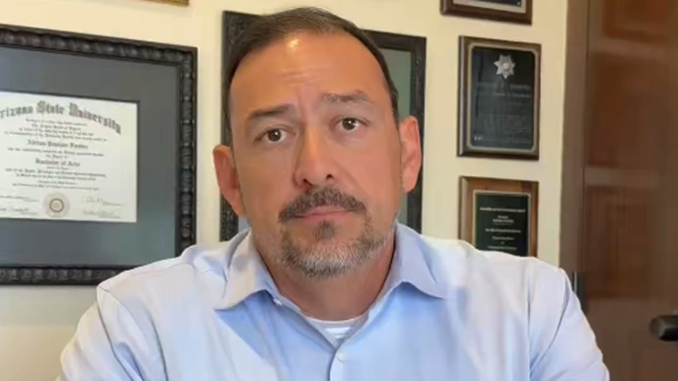
Secretary of State Adrian Fontes blamed the outage on the accelerated primary election schedule. Gov. Katie Hobbs signed a Republican-led bill into law on Friday that moved the primary election to the second to last Tuesday in July, a bipartisan decision to accommodate military voters.
Fontes said a “typo” caused the outage, which he promised was “temporary” on Friday. However, he said his team wasn’t to blame. Fontes said he was dealing with insufficient staffing and outdated systems caused by the GOP-controlled legislature.
The secretary of state put a price on his problems: $17 million to overhaul the election and candidate-facing systems. A one-time funding boost that occurred in 2024 wasn’t enough, Fontes said.
In a premature announcement on Friday that would quickly be proven false, Fontes claimed the system was fixed. Fontes again stressed that the outages his team was experiencing were preventable — the fault that caused the outage had less to do with a “typo” but inadequate funding from the legislature.
“System interruptions are preventable and my office will continue requesting the necessary funding to mitigate issues in the future,” said Fontes.
In a longer video statement from the comfort of his Super Bowl setup on Sunday, Fontes said E-Qual was “fragile,” “old,” and “outdated” due to the legislature’s refusal to provide fiscal support for updates. Fontes further promised that important data relating to tabulation and voter information weren’t impacted.
“Some people wanted to politicize this,” said Fontes. “The failure is the legislature that has been exploiting this longtime issue that I’ve been trying to get fixed for years and they’re not funding it. It’s as if they broke it and they want to blame someone else for breaking it.”
Fontes later disclosed to reporters that one single person was in charge of maintaining the main election management systems for their office. Fontes said he pays a lot to keep that individual on staff as a contractor.
Republican lawmakers rejected Fontes’ attempt to push the blame onto them.
State Rep. Alexander Kolodin (R-LD3), who is campaigning to unseat Fontes this November, said more money couldn’t fix incompetence.
“Even with millions in additional funding, voters are still being disenfranchised by his incompetence,” said Kolodin. “Waste of money!”
In a similar vein, State Rep. David Livingston (R-LD28) questioned how Fontes’ office caused such a major outage over a typo — and how another tens of millions of dollars could have prevented such an error.
“I think the other information, changing July 21, should just be standard operating procedure, and they shouldn’t need any money to do that,” said Livingston. “And if they can’t handle doing that, they probably shouldn’t be running the secretary of state’s office at all.”
Livingston is vice chair of the Joint Legislative Budget Committee, which Fontes called out when identifying those who were to blame.
Some lawmakers had a little less to say on the subject.
The new chairman of the Arizona Republican Party, Sergio Arellano, said Fontes was again proving his inability to own his mistakes.
“Arizonans expect elections to be administered with competence and seriousness, and when preventable failures occur, they demand accountability — not silence, not excuses, and not business as usual,” said Arellano.
Last summer, Iranian hackers breached the E-Qual system under Fontes’ watch.
AZ Free News is your #1 source for Arizona news and politics. You can send us news tips using this link.
by Matthew Holloway | Feb 11, 2026 | News
By Matthew Holloway |
Arizona lawmakers advanced a constitutional proposal last week that would set a firm deadline for ending the Legislature’s regular session, a major procedural change supporters say would provide a clearer structure for what is currently an open-ended calendar.
Under the state’s current system, the Arizona Constitution requires lawmakers to convene the regular session on the second Monday in January each year, but does not set a deadline for when that session must end. Regular sessions in recent years have stretched into late spring or early summer, with the 2025 session adjourned on June 27 after roughly 169 days in session.
The absence of a constitutional adjournment deadline means lawmakers can continue legislative work beyond traditional spring months, even though state law governs per diem reimbursements for extended sessions.
By contrast, other states employ more rigid schedules. Texas lawmakers meet in regular session once every two years for a constitutionally limited period, and adjourn by a set date unless a special session is called. In 2025, for example, the Texas Legislature concluded its most recent regular session in early June as the statutory timeline expired.
The House Government Committee on Wednesday passed House Concurrent Resolution 2005 (HCR 2005), sponsored by State Representative Justin Wilmeth (R-LD2) of North Phoenix. The resolution would amend the Arizona Constitution to mandate that the Legislature adjourn its regular session sine die no later than April 30 each year.
Under the proposal, lawmakers could still convene special sessions after April 30, but those would be subject to the subjects specified in the Governor’s call. If HCR 2005 clears both chambers of the Legislature, it would be placed on the ballot at the next general election for voter approval.
Wilmeth said the measure is aimed at restoring discipline and accountability to the legislative calendar. “I appreciate the committee moving this measure forward, allowing the discussion to continue,” he said in a statement.
“This proposal is about accountability and discipline. Arizonans expect the Legislature to do its job, pass a budget, and finish its work on time. President Ronald Reagan kept a sign on his desk in the Oval Office that said, ‘It CAN be done.’ I agree with that. Finishing our work by April 30 is achievable, and it should be the standard.”
Wilmeth, a Republican member of the Arizona House of Representatives and Chairman of the House Committee on Artificial Intelligence & Innovation, introduced the constitutional adjournment proposal earlier this year.
Supporters of the resolution have pointed to frequently extended sessions, which in recent years have stretched deep into spring and summer, as justification for a defined end date. In several recent cycles, lawmakers did not adjourn until June, well past traditional deadlines for bill passage and budget agreement.
In a post to X on January 23, Wilmeth wrote, “Decades ago, we told the people we’d have a part-time legislature conducted by citizen-legislators. Nowadays, the legislative session basically goes seven months! That’s unacceptable to me. It’s just responsible government to stick to our part-time commitment.”
If voters approve a constitutional amendment, Arizona would become one of the states with a fixed legislative deadline, rather than relying on internal legislative rules and per diem incentives to guide the calendar. That model differs from states like Texas, where sessions are inherently limited by statute or constitution and extend only through specified time windows.
HCR 2005 now moves to further consideration in the Arizona House as it continues through the legislative process.
Matthew Holloway is a senior reporter for AZ Free News. Follow him on X for his latest stories, or email tips to Matthew@azfreenews.com.
by Matthew Holloway | Feb 11, 2026 | News
By Matthew Holloway |
Resolution Copper has donated $285,000 to Mesa-based United Food Bank under a multi-year agreement extending through December 2028, according to the company. The donation comes as food banks across Arizona report record demand driven by rising food and household costs.
The funding will support United Food Bank’s programs and operations across its 19,000-square-mile service area, which stretches from Arizona’s East Valley to the New Mexico border and includes parts of Maricopa, Pinal, and Gila counties, as well as southern Navajo and Apache counties, including the Copper Corridor.
Resolution Copper President and General Manager Vicky Peacey said the company’s focus in this donation is on food security, particularly in mining and tribal communities within the Copper Corridor, including Superior, Globe, and Miami.
“Mining has always been about more than minerals. It is about people,” Peacey said in the release, adding that meeting basic needs such as food security is essential to building strong communities. “Our work in the Copper Triangle connects us to communities that have powered Arizona’s economy for generations. But we know that strong communities start with meeting basic needs, and for many families, that means food security.”
United Food Bank President and CEO Jason Reed said the multi-year partnership will strengthen the nonprofit’s ability to respond to increasing demand across its service area, including during emergencies when access to food and water may be limited.
According to United Food Bank, demand for food assistance reached record levels in 2025, fueled by economic instability and rising costs for food and household necessities. Reed noted that while food banks often receive increased attention during the holiday season, the need for assistance continues year-round.
United Food Bank partners with more than 125 food pantries, hot meal sites, shelters, and community organizations across eastern Arizona. While food drives help stock shelves, the organization said monetary donations allow for greater flexibility and impact.
Resolution Copper is developing what the company says has the potential to become one of the largest copper mines in the United States, with an estimated $1 billion annual economic impact for Arizona and the creation of thousands of local jobs. The development, approximately 60 miles east of Phoenix near Superior, AZ, has received support from the Trump administration, while also facing opposition from environmental groups. The company said it supports a range of community initiatives, including education, workforce development, environmental stewardship, and cultural preservation.
Reed said the partnership will strengthen food assistance efforts across Arizona, particularly in tribal communities. “This partnership provides critical, multi-year support for our food programs across Arizona,” Reed said. “It strengthens our ability to meet rising demand, address day-to-day food insecurity, and respond during emergencies when access to food and water is at risk. Support for tribal communities is an important part of this agreement, reflecting the shared commitment to the communities we serve.”
Resolution Copper Mining LLC is owned 55% by Resolution Copper Company, a subsidiary of Rio Tinto PLC, and 45% by BHP Copper Inc., a subsidiary of BHP PLC.
United Food Bank, founded in 1983, serves more than 100,000 Arizonans each month and is a member of Feeding America, the national network of food banks.
Matthew Holloway is a senior reporter for AZ Free News. Follow him on X for his latest stories, or email tips to Matthew@azfreenews.com.