On Monday, the Arizona legislature approved a bill requiring K-12 schools to implement parental review and notification procedures for school library books.
Specifically, HB2439 requires schools to give parents lists of the books or materials their children borrowed from the library, make available online a list of all books purchased for school libraries, and notify parents of the public review period for the books. Certain schools and school districts were exempted: those without full-time library media specialists and those engaged in agreements with county free library districts, municipal libraries, nonprofit and public libraries, tribal libraries, private schools, and tribal schools.
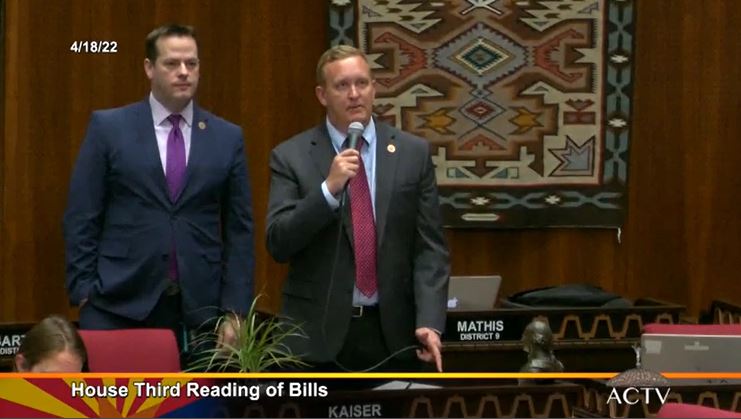
The Arizona House passed edits made to HB2439 on Monday along a party line vote. The Senate passed their version with amendments last week. One of the major amendments to the bill removed the requirement that school boards review and approve all books prior to their addition to a school library.
State Representative Beverly Pingerelli (R-Peoria) sponsored the bill.
Activists argued that children should have the right to read anything without parental oversight.
A local high school has enforced its district mask mandate relentlessly but students dropped their masks to participate in the “Day of Silence,” or “DOS,” a day of action for LGBTQ acceptance. Pre-pandemic, students participated by taping their mouths shut. This year was no different for some, according to reports received by AZ Free News.
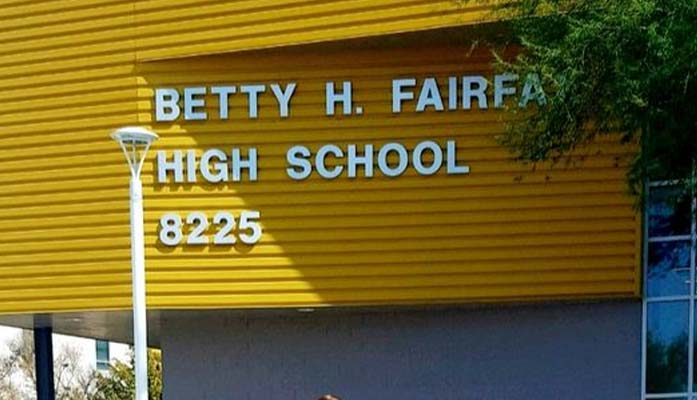
Last Friday, the Gay Straight Alliance (GSA) Club at Betty H. Fairfax High School within the Phoenix Union High School District (PXU) organized a slew of activities to commemorate students taking a vow of silence for the purported silencing that the LGBTQ+ community faces. The club handed out rainbow lanyards with DOS informational cards, rainbow stickers, and rainbow masks. There were several large tables set up outside with posters, and they encouraged students to participate in either of the two “solidarity circles” during lunch: students standing or walking in a circle holding hands.
AZ Free News reached out to PXU for comment. They didn’t respond by press time.
DOS and the GSA clubs, also identified by a number of other names such as “Genders & Sexualities Alliance” or “Queer-Straight Alliance” at other schools, are the brainchild of Gay, Lesbian, & Straight Education Network (GLSEN), an activist organization focusing on minors’ sexualization. GLSEN has expressed repeatedly that they never advocated for duct tape wearing for DOS, but acknowledged that it was a popular outward expression of the vow of silence.
Current students weren’t the only ones subject to GSA exposure that week. Several days prior to the DOS protest, Betty H. Fairfax High School welcomed future freshmen with a GSA booth, among others.
Several months before these events, the club passed out pronoun pins for students and faculty to wear on their lanyards.
Former Arizona Attorney General and Superintendent of Public Instruction candidate Tom Horne said in a statement to AZ Free News that Arizona students’ SAT scores were above the national average but declined after he left office. Horne characterized the GSA club events like Day of Silence as diversions that hurt academic outcomes.
“This is because leadership has neglected the necessary emphasis on academics, with harmful diversions, such as critical race theory, or, as in this case, A day of silence, which interferes with learning,” said Horne. “Schools need to be teaching the academics and not promoting racially divisive critical race theory, or other similar diversions such as the day of silence. The exception for the mask mandate shows runaway hypocrisy. My heroes are teachers who love their subjects, and focus on teaching them, rather than those who see their role as pushing ideological agendas.”
Betty H. Fairfax High School GSA has led the charge on LGBTQ popularity and acceptance in the district for years. In 2018, they won the GSA of the Year award.
Then in 2019, the woman who started the GSA club, Dayna Monroe, won GSA Sponsor of the Year. Monroe explained in an interview on receiving the award that her efforts caused district-wide policy changes. Her students nicknamed her “Mommy Monroe,” with one female student likening Monroe to a “therapist” figure.
“Mrs. Monroe, I consider her my school mom. She’s someone I can trust,” testified another female student.
Monroe has taught in schools for 20 years, with a decade spent in PXU.
Corinne Murdock is a reporter for AZ Free News. Follow her latest on Twitter, or email tips to corinne@azfreenews.com.
SB1211, which would require schools to publish curriculum lists on their websites, failed in the House 28-30 on Monday.
The votes weren’t panning out in the way Republicans hoped, so several legislators voted to kill the bill in order to salvage it for later discussions. State Representatives Joel John (R-Buckeye), Steve Kaiser (R-Phoenix), and Justin Wilmeth (R-Phoenix) voted with Democrats to kill the bill. Kaiser explained during the floor vote that he and Wilmeth did so in order to keep it active and open for discussion.
John, however, argued as a former teacher that the bill was too much of a burden for educators. He characterized the transparency bill as an “unfunded mandate” foisted on those in a “low-paying, thankless job.” John issued the false claim that he was only one of two other educators in the House. Other past and present educators include State Representatives Neal Carter (R-Queen Creek), Shawnna Bolick (R-Phoenix), Michelle Udall (R-Mesa), and Jennifer Pawlik (D-Chandler).
“The laws are quite robust already. I think this bill frankly goes too far and puts too many extra burdens [on teachers], as some of our colleagues have already pointed out,” said John.
Kaiser responded that the laws clearly don’t go far enough because K-12 schools are rampant with transparency issues.
“The reason we need to have a bill about this is because there’s problems happening in schools across Arizona,” said Kaiser. “If you don’t think this is a problem, look at the board [of votes]. This is a direct reflection of what’s happening to parents in schools. ‘There’s not a problem,’ they say. ‘Go home,’ they say. ‘We gave you a thumbnail sketch of what we’re talking about, go home.’ I’m so disappointed in how these votes are turning out.”
Apart from John, teacher perspectives on the bill differed along party lines.
Udall, a current teacher, supported the bill. She suggested that additional funding should be established to help ease the additional burdens of the bill. Udall noted the importance of proactive forms of transparency, rather than retroactive.
Conversely, Pawlik, also a teacher, asserted that educators shouldn’t have to be concerned about posting last-minute tweaks to curriculum or learning materials. Pawlik argued that it would not only inhibit teachers’ flexibility, but ultimately stunt students’ education.
The Senate passed the bill along party lines last month. Left-wing activist organizations celebrated the bill’s rejection.
We are so grateful for all lawmakers who voted today against SB1211, a harmful bill that would have created undue burden, more red tape and onerous requirements for our teachers. AZ teachers deserve support, not additional work, punishments & threats of lawsuits. pic.twitter.com/N38MXfp4my
SB1211 would enable parents access to all curriculum, learning materials, and teacher training at their school, organized by subject, grade, and teacher. Democratic legislators argued that parents should switch schools if they weren’t happy with the transparency at their current schools. They contended further that the legislation would create more red tape and punishment for educators. One legislator went so far as to argue that the bill constituted an effort to control speech.
For now, #SB1211 is stopped in the House. It would have been an unfunded mandate. It would have caused teachers to spend more time on red tape. ⛔ This bill is a sledge hammer that could have bad unintended consequences. #TeachersDeserveRespectpic.twitter.com/tUawQg5Mqb
If the Republican representatives hold to their promise, SB1211 may be resurrected this session in one form or another. As of press time, no exact solution was made apparent.
Corinne Murdock is a reporter for AZ Free News. Follow her latest on Twitter, or email tips to corinne@azfreenews.com.
After making waves for accusing a black DJ of blackface, Scottsdale Unified School District’s (SUSD) social justice professionals marched onward with their work. In the week following accusations from Scottsdale Parent Council (SPC) Equity, Diversity, and Inclusion Committee co-chair Jill Lassen and SUSD Equity and Inclusion Committee member Stuart Rhoden against a black DJ for alleged blackface and the school of racism for hiring him, SPC DEI Committee promoted a “Drag Queen Story Hour.”
Although SPC describes itself as an autonomous support organization for SUSD, it collects dues from SUSD parent and teacher groups annually: parent-teacher organizations (PTO), parent-teacher associations (PTA), and association of parents and teachers (APT).
As first reported by the Arizona Daily Independent, Lassen, a school librarian and self-described “community activist,” and Rhoden, an Arizona State University (ASU) professor, accused the Hopi Elementary PTA of racism at a charity earlier this month for hiring a DJ the pair believed to be wearing blackface. The DJ in question was Koko Kim Hunter, a black man. Hunter performed at a disco-themed charity event that raised over $300,000 for the elementary school.
Days later, the SPC Equity, Diversity, and Inclusion Committee promoted a young adult drag story hour. The event occurs next Tuesday at the One N Ten Chandler Satellite Center in Chandler at 6:30 pm.
Rhoden complained about the perceived blackface to both the elementary school PTA and principal. Both informed Rhoden that Hunter was black. However, that revelation didn’t stop Rhoden’s accusations. Rhoden doubled down. He insisted in a Facebook post that he never thought Hunter was a white man committing blackface, and that Hunter, though black, may have committed blackface still. Rhoden attached several photos of Hunter and encouraged readers to judge whether Hunter darkened his skin to look more black. He then accused the parents of “cultural disconnect.”
“Let me be clear, a Black man, apparently in Black face [sic] is an entirely different discussion than a White person. However I did not state that the person was White. It was assumed that was my intent, and perhaps it was, but nonetheless, looking on his Facebook page (photos below), it seems at the very least he is in darker make-up [sic] if not ‘Black face’ [sic] or I am completely mistaken and it’s the lighting of the patio,” wrote Rhoden. “I apologize to [Hunter] for the implication, but the sentiment still stands, Black face [sic] by anyone, in this day and age is problematic. I also apologize to folks who reposted and made other statements based on my assumption. The other images, some of which are still on his FB page, are problematic and speak to the cultural disconnect of the parents at this school. Rather than acknowledge that, they chose to double down on being angry at me rather than trying to understand how one could have made this error. And yes, it was my error.”
Lassen emailed the Hopi Elementary PTA leader, Megan Livengood, with accusations of racism. After Livengood responded with the facts of Hunter’s race and a rebuke of Lassen’s conduct, Lassen replied with an apology.
The accusations reflected Lassen and Rhoden’s perspectives on SUSD parents.
Lassen complained in a promotional video for the drag queen story hour that parents have the amount of influence they do over the district’s activities. In another promotional video, Lassen said that her focus as a parent and educator concerned safe spaces and gender stereotypes.
“I think it is much harder at the school level, as far as the parents having a lot of say and clout with the school district, unfortunately,” said Lassen. “What it means to me as a parent is to provide a safe and nurturing environment for my child to develop their identity as a human, and to always be aware and counterbalance the gender stereotypes that we continually run into as a society. As a librarian, it means providing a safe space for LGBTQ individuals to gather, to learn, and to overall be a part of their community.”
In a Facebook post, Lassen called parents upset about remote learning, “super rich, white ‘Karen’s’,” who she instructed to have “blow [her]” for having concerns about SUSD children’s mental and physical health. She added the explicit hashtag, “#F***MichelleUgentiRita” as an insult to the sitting state senator from Scottsdale.
“You don’t care about them until it’s convenient for you and you pretend to align yourselves with them because suddenly you have the same interests, but when all is said and done and your kids are back in school, you won’t think another thought about them or offer any kind of help or support to the districts or teachers,” wrote Lassen.
Rhoden offered similar sentiments about parents in an August 2020 Facebook post.
“I need a training on training myself to not get exasperated at parents who only care about themselves, who are selfish and who’s [sic] intentions are not socially just,” wrote Rhoden. “Sorry to put this so bluntly, but if another Karen/Becky or Ken ask [sic] one more question on a back to school Zoom call that is only germane to them, I’ma [sic] blow. We are all in this ish [sic] together. Be a team player!”
Currently, there’s a petition calling for the resignation of Lassen and Rhoden. The petition documents the various offenses committed under the oversight of Lassen and Rhoden: promotion of a Drag Queen Story Hour, praise of Planned Parenthood founder and infamous eugenicist Margaret Sanger, and the unfounded blackface accusation made against Hunter.
“One of the organizations that parents have noticed as being problematic is the subcommittee of the Scottsdale Parent Council that is Equity, Diversity and Inclusion. The name implies that kindness and compassion abound, but grievously, the opposite is true. The members of EDI consistently offend and confuse parents and community members with their controversial and divisive rhetoric.
Corinne Murdock is a reporter for AZ Free News. Follow her latest on Twitter, or email tips to corinne@azfreenews.com.
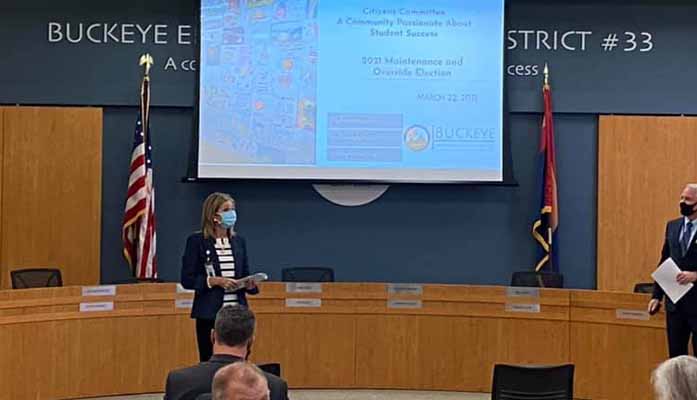
The governing board of the Buckeye Elementary School District is coming under fire after the Arizona Auditor General discovered the superintendent of the 5,100-student district received about 100 percent more in compensation than the superintendents of Arizona’s three largest districts made on average.
Kristi Wilson became superintendent of the Buckeye District’s seven elementary schools in 2013. From July 2016 to December 2021, she received total compensation of more than $3.2 million under the terms of three employment agreements, according to a report released April 12 by Arizona Auditor General Lindsey Perry.
Of that, roughly $1.7 million is categorized as “additional compensation,” including nearly $570,000 which Perry’s auditors believe was not owed to Wilson.
The report also contends the District “omitted critical information” and records associated with two of the three employment agreements. The auditors expressed concern that there was a lack of transparency which “did not enable the public to monitor the District and superintendent’s performance.”
Any overpayment could constitute a violation of the Gift Clause in the Arizona Constitution, while violations of Arizona’s public records law can be prosecuted in some instances. As a result, the Auditor General’s findings have been referred to the Arizona Attorney General’s Office for investigation.
Data provided by the Auditor General shows 16 percent of the Buckeye District’s students come from families at or below the poverty rate. And nearly 70 percent of all students qualify for free or reduced lunches.
Furthermore, four of the seven schools had a D or F grade in Fiscal Year 2019. This has resulted in the Arizona Department of Education working with District officials to create an integrated action plan to improve student achievement.
Equally concerning, according to the audit report, is that District students performed below their peer group and students statewide on State assessments in the four fiscal years ending in Fiscal Year 2019. Yet at the same time, the salary and benefits package for Wilson worked out to 54 percent more in per pupil spending for executive administration than the statewide average.
In addition, the average teacher salary in the District was $44,536, about 15 percent below the average in Arizona.
Jane Hunt, the president of the District’s governing board, responded earlier this month to Perry. Hunt did not agree with several of the audit’s findings, but Perry’s staff contends the District’s response contains “certain inaccurate or misleading statements” about the situation.
In one instance, the District contended it had agreed to pay Wilson “a retirement credit” sufficient to cover all tax liability associated it with. Such an arrangement was expressly authorized by the Arizona State Retirement System through the use of post-tax pay, Hunt responded.
But that is not what happened, according to the audit report.
“The District’s assertion that the superintendent’s retirement credits were purchased using post-tax pay is wrong,” the report notes. “ Rather, per the superintendent’s election, the District deducted and sent to the ASRS the superintendent’s retirement credit payments through pre-tax deductions.”
This is an important distinction, Perry’s staff noted, because the District’s failure to correctly apply pre-tax status when calculating Wilson’s additional compensation led to a significant overpayment “to and on behalf of the superintendent.” And that could lead to legal problems for Wilson and the District Board.
The audit report notes that four of the District’s five current governing board members held such positions in April 2016 when the first of the employment agreements was approved to provide the superintendent with additional compensation.
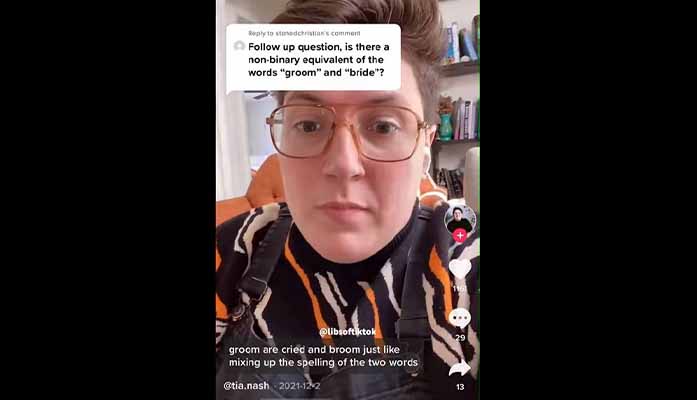
This week, Twitter silenced another prominent conservative voice — this time, one relied on heavily by parents and older generations distant from today’s social media fads. Libs of TikTok, the social media account that offered parents insight on what the world was exposing to their children through educators and pop culture, was suspended for 12 hours on Twitter. The social media giant said that the account’s content violated rules on hateful conduct: promoting violence against, threatening, or harassing other people on the basis of race, ethnicity, national origin, sexual orientation, gender, gender identity, religious affiliatoin, age, disability, or serious disease.
Effectively, Twitter implemented its “account-level enforcement” of “placing an account in read-only mode.” Twitter noted that it saved these account-level tactics for “particularly egregious” or repeated violations of its rules.
The account launched in November 2020, reposting videos from the Chinese social media app TikTok in order to display a more comprehensive view of the left’s political ideology. It began to pick up more popularity last summer, jumping from under 100 likes to several hundred to thousands within months. The account owner’s identity remains anonymous, but virtual anonymous interviews revealed that the owner is female.
According to social media analyses, Libs of Tiktok’s most-used words included, in order: teacher, students, school, parents, and kids. At the time of her suspension, she had close to 612,000 followers. The highest number of retweets achieved on one tweet revealing that a school nurse was suspended over “transphobic comments” reached over 6,000, while the highest number of likes reached over 26,000 on a clip of Fox News host Tucker Carlson praising her work.
Twitter just censored @libsoftiktok, locking the account for “hateful conduct.”
News of the account’s suspension came from Seth Dillon, CEO of The Babylon Bee: a satire news company that was banned from Twitter. The satire site’s ban occurred after it published the story, “The Babylon Bee’s Man Of The Year Is Rachel Levine,” poking fun at the current U.S. Department of Health and Human Services (DHS) assistant secretary of health.
As evident, the offending content of both Twitter accounts remain available. However, Twitter stipulated to The Babylon Bee that it must remove the offending tweet before it may access its account. Twitter placed no such stipulation on Libs of TikTok — the suspension functioned as a warning to moderate future content.
AZ Free News has relied on Libs of TikTok and even TikTok itself for our reporting. In October, we discovered that the teacher nominated by Arizona Secretary of State Katie Hobbs for a national youth leadership award was pushing the vast majority of popular left-wing political ideologies in her elementary school classroom. Libs of TikTok helped notify Arizonans and the world of the three female students at Arizona State University (ASU) who harassed two fellow students for being white males with perceived conservative attire in their multicultural center.
Most recently, Libs of Tik Tok revealed an American government class at ASU telling students that state efforts to require voter ID, get rid of permanent early voting lists, restrict early voting, remove mail-in voting, and close primaries were forms of voter suppression.
Although Libs of TikTok was banned from Twitter, versions of the account exist elsewhere: Instagram, Rumble, GETTR, YouTube, and Gab.
Corinne Murdock is a reporter for AZ Free News. Follow her latest on Twitter, or email tips to corinne@azfreenews.com.