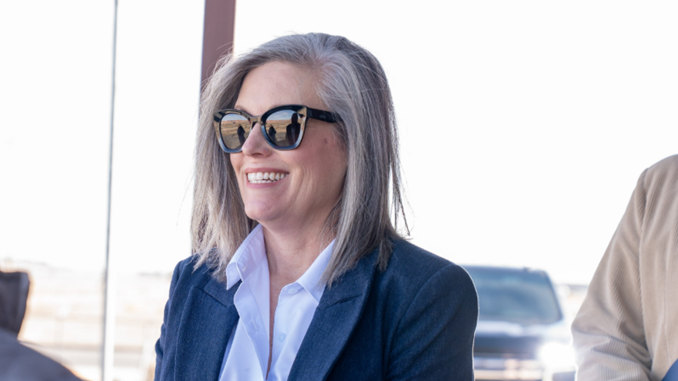
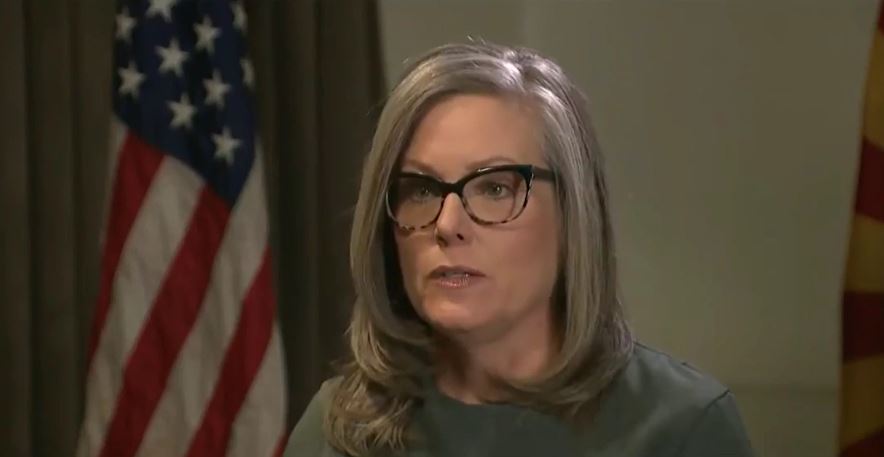
A recent campaign ad from the Democrat incumbent governor cost her millions, but critics and past reporting indicate the ad is misleading and takes credit for work done by Republicans.
Gov. Katie Hobbs’ 30-second “Work” ad released last month claimed that she reduced electricity bills, cut red tape to build more affordable housing, and balanced the budget. Critics across the political spectrum assessed these claims as misleading.
Utility rates have increased by more than 25% under the Hobbs administration.
The Arizona Free Enterprise Club calculated based on Energy Information Administration data that utility rates in Arizona have increased by an average of 27% under Hobbs’ tenure. The Arizona Corporation Commission (ACC) sets rates.
The largest donor to Hobbs’ controversial inaugural fund, Arizona Public Service, also wants to increase the utility rates by 14%. That ratemaking case is ongoing with the ACC.
The Hobbs administration imposed more red tape on housing construction that had the effect of imposing a housing moratorium. A court struck down that red tape earlier this year as an unlawful overreach in agency rulemaking, a ruling which has the potential to put Arizona taxpayers on the hook for over $1 billion in compensation claims.
One developer duo, Buckeye Tartesso I and II, already filed such a claim last September with the help of the Goldwater Institute. The duo is seeking over $320 million in compensation for lost value, an amount their demand letter claimed was a compilation of conservative, not maximum, estimates.
Budget talks were repeatedly called off and subjected to a bill moratorium by Hobbs as she tried to impose what Republican lawmakers characterized as unrealistic revenue assumptions, hidden tax increases, and cost-raising policies.
In the thick of budget talks earlier this year, House Speaker Steve Montenegro (R-LD29) commented that Hobbs’ budgeting style was reminiscent of the more liberal-style budgets coming out of California: fiscal approaches which increase government size and create inconsistencies within the tax system. Hobbs held out on securing tax conformity for months to align the Arizona tax code with many of the congressional changes passed under the One Big Beautiful Bill Act
Hobbs has been accused by bipartisan critics of turning her inheritance of a $2.5 billion surplus from former governor Doug Ducey into a $1.6 billion shortfall.
Last summer, a report by the Common Sense Institute Arizona found that state spending outpaced the $3.3 billion in revenues that emerged following the passage of the flat tax in 2023.
Per the Hobbs campaign, the ad buys required millions from her campaign coffers.
Additionally, the Hobbs campaign press release implied that the Spanish-speaking version of her “Work” ad, “No Se Rinde” (“Doesn’t Give Up”), was uniform in its messaging. However, the ads contained key differences that indicated an awareness of Arizona’s split demographics.
Both opened with a characterization of Hobbs’ background as a mother who worked multiple jobs and as a social worker, but differed distinctly in their portrayals of Hobbs’ approach to governance.
The English-speaking ad, “Work,” depicted Hobbs as a budget and policy expert with key wins in electricity bill and red tape cuts, and school lunch and community college scholarship expansions.
The English ad described Hobbs as working fast food and Uber jobs to make ends meet. It included the misleading claims that Hobbs was responsible for balancing the budget without raising taxes, reducing electricity bills, and cutting affordable housing red tape, along with the valid claims that she expanded school lunches and community college scholarships.
The Spanish version of the ad, “No Se Rinde,” depicted Hobbs as a social worker with key wins in medical debt forgiveness, medical cost cuts, and salary boosts. Hobbs forgave $30 million in medical debts early on in her administration.
The Spanish-speaking ad similarly characterized Hobbs as having a background as a working mother, but only highlighted her past Uber driving work and expanded on her time as a social worker as mainly aiding female domestic violence victims. The ad further diverged in describing Hobbs as responsible for canceling tens of millions in medical debt, reducing medical costs with discounts up to 80 percent, and raising salaries.
A Centers for Disease Control report published in 2024 suggested that Latino and Hispanic women have a disproportionately higher risk of experiencing domestic violence: one in three, indicating an occurrence average up to three times higher than white women.
Close to a quarter of all Latinos in Arizona are uninsured, as are nearly half of all illegal aliens, according to a 2022 research analysis from the Latino Policy & Politics Institute. Approximately 80% of Latino families in Arizona reported financial trouble according to recent polling by UnidosUS; nearly half of Latinos across Arizona, California, and Texas reported medical debt in a 2024 UnidosUS poll.
AZ Free News is your #1 source for Arizona news and politics. You can send us news tips using this link.
Supportive leadership, collaborative freedom, and safe campuses are the leading reasons why thousands of Arizona educators say they don’t quit education.
A new survey from the Arizona Department of Education (ADE) polled more than 9,300 current Arizona teachers during the 2025-2026 school year on their reasons for staying in the profession.
More than 2,000 teachers (22%) completed the survey. ADE disclosed that it excluded the responses of approximately 170 teachers that were ultimately deemed ineligible upon further screening.
According to ADE interpretation of the data, a majority of these educators cited strong leadership support, the ability to collaborate with other educators, and safe campuses as among their highest priorities. Districts who meet these criteria for their teachers have better chances at higher rates of K-12 educator retention, they say.
Superintendent of Public Instruction Tom Horne said the results of the survey confirmed his sentiments on the matter, which he has vocalized in interviews with the media and implemented through ADE policy. Horne said tapping into available state funds would alleviate one key issue raised by educators in the survey: teacher pay.
“This survey confirms what I have consistently said about educators needing support from their school leadership, a collaborative and safe workplace environment, and higher pay,” said Horne. “Arizona is facing a catastrophic teacher shortage, but this survey shows there are some answers that can be implemented immediately, although more effort needs to be made to raise teacher pay. That is something I have consistently fought for and can be done without raising taxes because there is money available in the state land trust.”
93% of responding teachers said they planned to return to a teaching position for the 2026-2027 school year. 7% said they did not.
Nearly 77% of respondent teachers collectively said they felt safe and supported at their school site. Nearly 75% said they felt their school fostered a positive and collaborative environment. Nearly 74% said they felt they had autonomy to make instructional decisions for their students. Nearly 71% said they felt valued and respected by school leaders. About 70% said they felt they had access to the instructional resources and materials they needed to be successful.
Class sizes at their school were manageable according to most (nearly 700 agreed), followed by a close-second majority who said they disagreed (nearly 400), and those who strongly agreed or were neutral were close in numbers (more than 300 respectively). Those who strongly disagreed with the sentiment totaled 160.
A strong sense of belonging in the school community was present for most (more than 700 who strongly agreed), followed by a close-second majority who said they agreed (nearly 700), then those who said they were neutral (nearly 300), then those who said they disagreed (about 150), and those who said they strongly disagreed (about 60).
However, teachers indicated that they had insufficient time during their work days to complete non-instruction tasks. Close to 600 teachers said they disagreed that they had sufficient time, followed by more than 500 who strongly disagreed. 360 teachers said they agreed they had sufficient time, nearly 300 were neutral on the matter, and 150 strongly agreed.
Teacher pay came a close second for highest levels of dissatisfaction among respondent teachers. Only 38% overall said they felt their salary was competitive with similar positions in the state.
More than 500 teachers said they agreed that their salary was competitive with similar positions in the state, and 190 said they strongly agreed. More than 400 were neutral or in disagreement, respectively. More than 300 said they strongly disagreed.
AZ Free News is your #1 source for Arizona news and politics. You can send us news tips using this link.
One of the Arizona Democratic Party’s (ADP) political crown jewels has been arrested for breaking into a former romantic partner’s home with a knife.
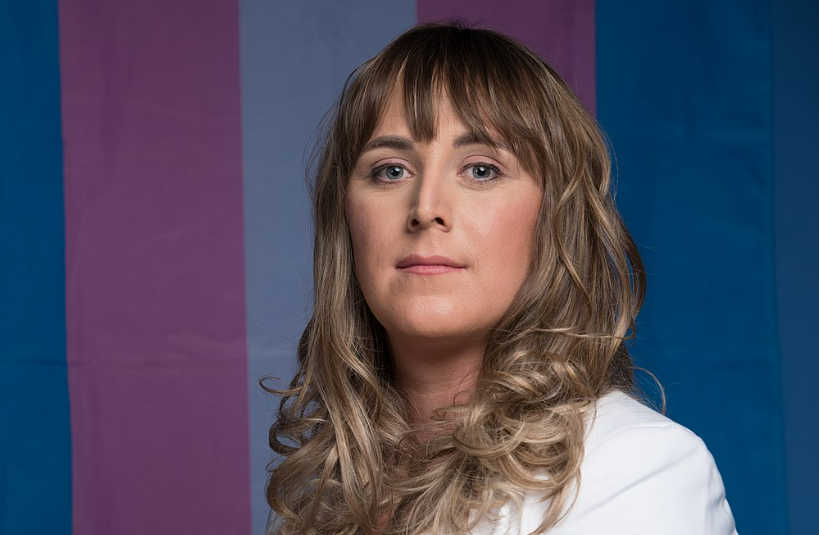
Phoenix police arrested Brianna Westbrook, 41, former ADP vice chair and current education coordinator, last Friday for allegedly breaking into a former partner’s home brandishing a knife and carrying gloves and duct tape.
Westbrook, formerly a Peoria-area car salesman named Mike McDanel, allegedly forced himself into the victim’s residence, where he pushed the victim onto a couch. It was allegedly only after the victim screamed that Westbrook fled the scene.
Westbrook alleged that the incident was part of consensual roleplay, a “big misunderstanding” — a narrative the alleged victim denies.
A judge set Westbrook’s bond at $15,000.
Apart from the disputed nature of the alleged home invasion, Westbrook does have a history of advocating for violence.
As AZ Free News reported previously, Westbrook applauded a call for gun violence in the wake of the 2023 Nashville school shooting in which three children and three adults were slain by a transgender-identifying woman, Aiden Hale.
The year prior, Westbrook publicly expressed opposition to Blue Alerts, communications sent to the public and law enforcement notifying them of suspects who have assaulted, critically injured, or killed law enforcement officers.
It was around 2017 that Westbrook began a rise to prominence among Arizona Democrats as the state’s first federal elected official to identify as transgender. Westbrook told the Phoenix New Times that he began identifying as transgender about five years earlier at the age of 27. Westbrook once operated a YouTube account, since deleted, which reportedly documented his gender transition.
Westbrook has run for office multiple times since 2017, when he announced his campaign for what was then the 8th Congressional District as the first openly transgender candidate for federal office in Arizona.
Westbrook was not Arizona’s first transgender candidate overall: that title belongs to 2004 candidate Amanda Simpson, a Raytheon executive from Tucson who ran for the state legislature believed to be the first openly transgender presidential appointee. Neither could he claim the title as the nation’s first openly transgender federal candidate: that would be 2016 candidates Misty Snow, running to represent Utah in the Senate, and Misty Plowright, running to represent Colorado in Congress.
Westbrook lost in the general election to Republican candidate Debbie Lesko, the former congresswoman currently serving on the Maricopa County Board of Supervisors.
Following a protest in 2018 in the thick of a congressional campaign, Westbrook publicized his alleged mistreatment at the hands of the Maricopa County Sheriff’s Office following his arrest for trespassing at former Republican Sen. Jeff Flake’s office.
Westbrook argued in an ACLU blog post that the sheriff’s office should have complied with his request to jail him with other women, not men. Law enforcement ultimately put Westbrook in a solitary cell, according to his account.
Westbrook went on to serve as a vice chair of the Arizona Democratic Party (ADP) from around 2019 to 2024.
Westbrook had also served as the at-large officer for Phoenix Democratic Socialists of America around the same time, and has belonged to the Democratic Socialists of America for years.
Westbrook ran for the Arizona House of Representatives in 2022, but lost the primary to former lawmakers Amish Shah and Jennifer Longdon.
In 2024, Phoenix Democrats nominated Westbrook and two others for the legislative seat vacated by Longdon. The County Board of Supervisors declined to select Westbrook.
As of this report, ADP has Westbrook listed as its education coordinator.
AZ Free News is your #1 source for Arizona news and politics. You can send us news tips using this link.
Gov. Katie Hobbs stands accused of illegally commingling millions in funds to subsidize her campaign.
A letter sent by attorney Tim La Sota to Secretary of State Adrian Fontes earlier this month accuses the governor of commingling funds between her reelection campaign committee, Elect Katie Hobbs, and two other entities which submit funds to her campaign committee.
Elect Katie Hobbs and all other candidate campaign committees are restricted in the types of funds they may accept. Campaign committees must rely on what’s known in campaign finance parlance as “hard money,” or donations given by individuals directly to a political candidate, and cannot accept “soft money,” or donations or contributions collected into political action committees (PACs) from corporations or unions. Individual donations are limited to $5,500 per person.
The letter claims that Hobbs has used a PAC, which it claims to be hers, Copper State Values, as an unlawful repository for soft money to be used for Elect Katie Hobbs expenses. Allegedly, Copper State Values receives soft money funds from Hobbs’ joint fundraising committee PAC, the Katie Hobbs Victory Fund, and then sends the funds on to Elect Katie Hobbs and other political entities working to reelect Hobbs such as the Navajo County Democrat Party and the Arizona Democratic Party.
“Candidate contribution limits mean little if candidates can simply funnel money that the candidate herself cannot legally receive to a political action committee and turn around and have that political action committee pay for that candidate’s campaign expenses,” said the letter.
Since 2023, Elect Katie Hobbs has accrued more than $7.8 million and spent more than $4 million, Copper State Values has accrued more than $3.8 million and spent more than $2 million, and Katie Hobbs Victory Fund has respectively accrued and spent more than $1.8 million.
The letter further described Copper State Values as unusual since it lacked the typical hallmarks of a PAC, such as a political activity or a website. The PAC’s main activity appears to be the alleged shared expenses with Elect Katie Hobbs for which it pays, such as payroll, rent, and travel.
“The PAC seems to only function as a repository of monies that are then distributed to various left-wing entities, who will presumably help the Governor get elected — that and paying for expenses that legally must be paid by [Elect Katie Hobbs],” stated the letter. “[I]n terms of the PAC, it seems to do nothing but receive money and distribute money. It does not have any discernible political activity in terms of expenditures for express advocacy. It does not even have a website. And yet, it racks up hundreds of thousands of dollars in expenses, money that it reimburses to Elect Katie Hobbs.”
Hobbs’ reelection campaign manager, Nicole DeMont, serves as the chair of Copper State Values, and both Copper State Values and Elect Katie Hobbs share the same address, email address, and treasurer, Dacey Montoya.
The letter noted that Demont’s consulting firm, Monteverde Strategies, has received about $55,000 from Copper State Values. It also noted that Capital Strategies, a consultant for Hobbs, has received more than $198,000 from Copper State Values, though the consultant doesn’t disclose its relationship to the PAC on its website page for current and former clients.
AZ Free News is your #1 source for Arizona news and politics. You can send us news tips using this link.
New expert analysis warns that the Arizona government’s plan to reduce the Salt River wild horse population to 120 horses could prove devastating to their continued existence.
The herd currently has approximately 274 horses, nearly half of what the herd was at its peak in recent decades.
Dr. E. Gus Cothran, equine population geneticist and professor emeritus at Texas A&M University, issued a statement expressing concern that the plan may prove detrimental to the future existence of the wild horses. Cothran says wild horse populations require 150 to 200 horses minimum for long-term genetic health, though no number can provide an exact guarantee on a herd’s survival.
“At the most basic level, 150 to 200 animals is a minimum number,” said Cothran. “This is the number that, if everything goes right and only population genetics is involved, should maintain genetic health for 200 years or so.”
Cothran said genetic testing of just 20–25% of the herd would allow for insight into the herd’s genetic health: approximately 55 to 70 horses.
Citing that assessment, advocates and community members have raised concerns that the state’s current plan of removal for the horses would have the potential for permanent and devastating impact to the wild horse population.
The Friends of the Salt River Wild Horses have asked Gov. Katie Hobbs to pause the permanent removals pending an independent genetic study and scientific review.
“Once that diversity is lost, it is gone forever!” said Friends of the Salt River Wild Horses in a statement. “Before a single horse is permanently removed, Arizona should demonstrate through independent science that the remaining herd will be genetically healthy and capable of surviving for generations. Friends of the Salt River Wild Horses calls upon Governor Hobbs to halt removals, to do the science, and respect the public process.”
Some contend the Arizona Department of Agriculture’s (AZDA) plan to remove these horses violates the Salt River Wild Horse Protection Act passed in 2016. The act empowers the state to exercise discretionary management of the horse population, with protections against the obstruction, chase, capture, removal, or euthanasia of the horses without government permission.
AZDA awarded the management contract to the Salt River Wild Horse Management Group (SRWHMG). The company is operating on a goal to reduce the herd size over the next five years through natural attrition, fertility control, and manual relocation, per a press release issued by AZDA in February.
SRWHMG has already been involved in population reduction efforts. They reduced the population from 450 horses using fertility control methods.
AZDA promised that all removed wild horses were only permitted for the relocation to approved sanctuaries — no horses may be donated, traded, slaughtered, or sold.
According to AZDA, the contract procurement process included input from an assessment panel consisting of veterinarians, a rangeland management scientist, and a federal wild horse manager.
AZDA Director Paul Brierley said the management plan represented the responsible promotion and protection of the “Salt River experience.”
SRWHMG President Simone Netherlands called the plan “a pragmatic compromise.”
Last month, the Arizona legislature failed to pass a proposed three-year moratorium on the herd reduction and mandatory study on the Salt River horses’ genetic diversity. The House passed the bill, SB 1199, but the Senate declined to pass it on concurrence.
Republican Reps. Juan Ciscomani (AZ-06) and David Schweikert (AZ-01) were among the founding members of the bipartisan Congressional Wild Horse Caucus last year.
These and other members of Congress have been pushing for the passage of the Wild Horse and Burro Protection Act, HR 4356, which would eliminate helicopter roundups.
EDITOR’S NOTE: Corrections adjust the name of “The Friends of the Salt River Horses” to “The Friends of the Salt River Wild Horses” and clarify that the Arizona Senate did not pass SB 1199 on concurrence.
AZ Free News is your #1 source for Arizona news and politics. You can send us news tips using this link.