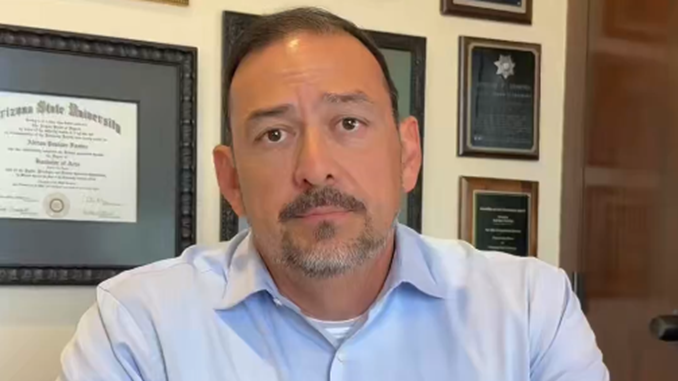
The latest National Defense Authorization Act (NDAA) has two key amendments from the Republican nominee for Arizona governor, Rep. Andy Biggs (AZ-05).
The two bipartisan-backed amendments impose budgetary restrictions for poor financial management, and a counter to the Chinese threat of critical mineral mining dominance.
Biggs explained in a statement that the two amendments were critical for public confidence in government accountability and independence concerning nonfuel minerals.
“My amendments address critical issues within America’s massive national defense apparatus, ensuring more transparency and accountability within our government and closing the gap between China and the United States for a critical workforce,” said Biggs.
One of the amendments establishes greater financial oversight of the Department of Defense (DOD). The amendment language was derived from Biggs’ “Audit the Pentagon Act,” one of the first bills introduced by Biggs in 2017.
The amendment requires the DOD, and certain military departments and defense agencies, to submit a financial statement for the previous year and receive an audit opinion. Without a financial statement and audit opinion, the discretionary budget authority will be reduced by 0.5%, except for accounts handling military, reserve, and National Guard personnel and the Defense Health Program.
The DOD has presented “unauditable financial statements” for decades and to date has been the only major federal agency to have never passed an audit, according to a May report by the General Accounting Office (GAO). Since 2018, the Pentagon has failed eight consecutive agency-wide annual audits.
The DOD spends more than $1 trillion annually on foreign and domestic defense — nearly half of the federal government’s discretionary spending. It also retains approximately 82% of the federal government’s total physical assets and its financial management problems account for 17% of the federal government’s costs.
The DOD’s prolonged financial weaknesses contributed to the U.S. insolvency announced by the Treasury Department earlier this year. The U.S. has about $6 trillion in assets against nearly $48 trillion in liabilities.
The GAO reported that the DOD had more than $16 billion worth of previously untracked assets and inventory.
Last month, the GAO reported that the DOD weapons programs have continued wasting billions of dollars and decades of time from exceeding cost estimates and delivery schedules.
The other amendment boosted federal support for accredited mining engineering programs. Chinese mining engineering graduates outnumber American mining engineering graduates annually by anywhere from 15 to 1, to 50 to 1. China reports graduating 3,000 to 10,000 mining-related engineers across dozens of programs, while America reports graduating about 200.
Mining engineering program graduates peaked in 1980, declining from then until 2004, when program resurgence occurred until 2015, according to data from the Society for Mining, Metallurgy, and Exploration. Even at its most high peak in 1980 and most recent high peak in 2015, graduates numbered between 600 and 700 a year.
The University of Arizona has a mining program.
President Donald Trump issued a memorandum in May directing the Office of Personnel Management to impose critical position pay for up to 400 positions oriented toward expanding U.S. critical mineral capacity, along with advanced materials and other essential components for the supply chain.
AZ Free News is your #1 source for Arizona news and politics. You can send us news tips using this link.
New legislation imposing domestic violence protections in family court apply in all active cases regardless of when the case was originally filed.
State Representative Lisa Fink (R-LD27) issued a notice to make courts and legal partners aware of the applicability of protections imposed by the law she sponsored and Gov. Katie Hobbs signed, HB 2995.
Fink says Arizonans have reported issues with accessing the law’s protections due to a misunderstanding among some that the law only applies to cases filed after the law went into effect last month.
“That is not how the law was written, and it is not what the Legislature intended,” said Fink. “The emergency clause was included so the law would take effect immediately and apply to every active case before the court. Families do not lose these protections simply because their case began before June 22.”
HB 2995, known as the Alec and Lydia Act, overhauled courts’ framework for legal decision-making and parenting time cases by prioritizing domestic violence findings, expanding what qualifies as domestic violence, and requiring the court to issue detailed written findings of domestic violence.
The law established that the safety and well-being of the child and domestic violence victim serve as the highest priority in custody matters, and prohibits courts from requiring domestic violence victims to prove the severity and frequency of abuse to justify restrictions.
The law also requires courts to disregard as irrelevant the child’s absence at the time of the domestic violence, the child’s unawareness that domestic violence occurred, and the child’s preference for maintaining contact with the domestic violence perpetrator.
Additionally, courts may not order domestic violence victims to join their abusers in any treatment or counseling program.
HB 2995 applies when the court is actively considering legal decision-making or parenting time. This includes temporary-order proceedings and requests to modify existing orders.
The legislation was named after Alec and Lydia Mater, siblings killed in a murder-suicide by their estranged father, Brock Mater, during an unsupervised custody visit in May 2024.
At the time of the crime, Mater was experiencing a psychotic episode. In the months prior, he had been diagnosed with bipolar disorder and was undergoing mental health treatment. The court had documented his history of domestic violence.
Alec and Lydia’s mother, Hope Hooton, described during a hearing on the bill earlier this year all the evidence that had been provided in court of Mater’s abuse: physical and sexual violence including strangulation, thrown objects, and stabbings, along with financial, verbal, and emotional abuse to include withholding money and food, and forcing exercise.
“In family court, mothers are often told, ‘He was abusive to you, not the children,’ but research shows this assumption is dangerously wrong,” said Hooton. “The court did not fully evaluate strangulation, coercive control, suicidal or filicidal ideation, and acute psychiatric instability together before granting unsupervised parenting time.”
Maricopa County Superior Court Judge Michael Valenzuela granted Mater equal parenting time and joint decision-making. Valenzuela disputed the evidence presented had proved Mater to be a danger to his children, since no police reports existed of abuse directed toward the children.
Hooton advocated for the bill’s passage, saying it aligns with current research-based understanding that abuse of a parent serves as a warning sign to children.
“My children were not killed because of prior child abuse. They were killed in the context of domestic violence, coercive control, mental health crisis, and loss of control,” said Hooton.
Alec was seven years old, and Lydia was six.
“This law is not only about preventing the worst possible outcome, including the death of a child. Children can be profoundly harmed by coercive control, emotional abuse, intimidation and post-separation abuse, even when no physical assault occurs. The Alec and Lydia Act is intended to protect their physical, mental and emotional well-being before that harm becomes irreversible,” said Fink. “The safety and well-being of children and victims of domestic violence must come first. That is the purpose of the Alec and Lydia Act, and its protections are in effect now.”
Few opposed HB 2995’s passage: Sen. Sally Ann Gonzales (D-LD20) and Reps. John Gillette (R-LD30), Alexander Kolodin (R-LD03), Justin Olson (R-LD10), and Cody Reim (R-LD03).
Kolodin explained during the House floor vote that he opposed the bill due to concerns that it would cause rampant and baseless allegations of abuse between feuding spouses.
Kolodin read some provisions of the bill constituting abuse that he alleged were especially harmful: suicidal ideations; firearm cleaning; monitoring or regulating financial activity, which Kolodin said could include reading the family’s credit card statement; demeaning, degrading, or humiliating words or actions; threats to make reports to law enforcement, which Kolodin said could include an abuse victim announcing intent to call police if their abuser hits them again; threats of civil litigation, which Kolodin said could include calling for divorce; and jeopardization of immigration status, which Kolodin said could include refusing to marry a significant other due to their noncitizenship.
“The language of what constitutes abuse in this bill is so broad that it will result in both parents in a family law proceeding almost always being labeled as an abuser,” said Kolodin. “This bill takes everybody in a marriage relationship and labels them as the abuser, forces them to fight to the death at the expense of their reputation and children, as to who is the worse abuser, and it will cause even worse chaos in our family law system. It will destroy families, tear them apart, and cause them lifelong animosity that will do permanent damage to Arizona’s children.”
Olson agreed. He noted that the bill may disincentivize couples from joining their lives too much, like mixing finances.
Fink dismissed the concerns, citing the legislation’s requirement that judges find a “pattern of violent, threatening, or coercive conduct.” Fink said the judicial framework was similar to law enforcement screening tools for domestic violence.
AZ Free News is your #1 source for Arizona news and politics. You can send us news tips using this link.
Sen. Ruben Gallego (D-AZ) says he still would like to run for president, in spite of the recent allegations and controversies surrounding him.
Gallego revealed his continued intent to make a 2028 presidential run to KTAR News on Friday during a sit-down interview on Outspoken with Bruce & Gaydos.
Gallego justified his electoral victories in Arizona and his Latino ethnicity as the basis of his proposed run, though he described Arizona as “red” rather than purple.
“There’s only a couple of Democrats that are thinking of running for president that have won red states. I’m one of them,” said Gallego. “There’s only a couple of Democrats who can speak to working-class Democrats, especially Latino men. I’m one of them.”
Gallego described his intent as “surface-level” and not too deep.
“We’re thinking about it, right? My first hurdle is: I have three children, and I do have a challenge of figuring out how to balance my time with them and my job and potentially running for office,” said Gallego.
New reporting issued earlier this week revealed that Gallego dated multiple staffers working for other members of Congress while he was serving in the House.
When asked about that past behavior during Friday’s interview, Gallego said he wasn’t “going to engage in gossip” in his past as a bachelor dating around in Congress. He said he supports a rule change to prohibit elected officials from dating other members’ staffers.
“I’m now happily married, I moved on,” said Gallego.
Gallego skirted around questioning as to whether his dating of other congressmembers’ staffers constituted impropriety.
“Anytime I dated anybody, my whole thing that I focused was on being a gentleman, acting like I would want someone to act when it comes to how someone would treat my daughters or my sisters, or things of that nature, and of course I treated everyone like adults and they treated me like adults,” said Gallego.
Gallego offered some defense of his former endorsees: Eric Swalwell, former congressman and California’s former Democratic gubernatorial candidate and Gallego’s ex-longtime best friend, and Graham Platner, Maine’s former Democratic gubernatorial candidate. Both men withdrew from their respective races in their respective states this year following accusations of sexual misconduct and assault.
Gallego said he wasn’t always aware of Swalwell’s day-to-day, and therefore had no suspicions of sexual misconduct.
Gallego also defended his endorsement of Platner pre-sexual assault allegations, calling Platner’s Nazi tattoo “young, stupid Marine” behavior.
Gallego said any and all allegations against him were a product of “the right-wing echo system” based in politics and not truth.
“Guess what? Nothing has shown up. So they’re dogpiling with more and more misinformation,” said Gallego.
The Senate Ethics Committee cleared Gallego of the sexual and financial misconduct alleged in a complaint by a Republican congresswoman out of Florida, Anna Paulina Luna.
The committee reviewed records including from the Federal Election Commission (FEC), Senate secretary expenditures, House of Representatives clerk’s expenditures, and privately sponsored travel documents.
The Department of Justice is investigating Gallego for alleged campaign finance misconduct.
AZ Free News is your #1 source for Arizona news and politics. You can send us news tips using this link.
Republican leaders of the Arizona legislature are suing Secretary of State Adrian Fontes for allegedly misrepresenting a ballot measure to preserve school choice funding for military families.
Arizona Senate President Warren Petersen (R-LD14), the Republican nominee for attorney general, and House Speaker Steve Montenegro (R-LD29) sued Fontes to prevent the ballot measure language from going to voters.
The 66-page verified complaint accused Fontes of drafting ballot language that intentionally undermines the constitutional amendment, Proposition 145, in order to give a leg up to a competing ballot proposition to end the universality of the Empowerment Scholarship Account (ESA) program.
The language for Prop. 145’s descriptive title reads:
“Would nullify Proposition 212 (below) if voters enact it this election; prohibits the state from sweeping funds from certain state-run scholarship accounts if the student’s parent has provided certain active-duty military service; nullifies all laws that would sweep any such funds, including unrelated provisions of those laws.”
The yes/no language reads:
“A ‘yes” vote shall have the effect of amending the Arizona Constitution to: (1) nullify Proposition 212, which imposes spending and income limits on the Empowerment Scholarship Account (ESA) program, if the people enact that Proposition during this election; (2) prohibit the state from sweeping funds from certain state-run scholarship accounts if the student’s parent has provided certain active-duty military service; and (3) nullify all parts of any law that would sweep any such funds, including unrelated provisions of those laws, applying retroactively to all laws enacted on or after November 1, 2026.
A ‘no’ vote shall have the effect of maintaining current constitutional provisions related to scholarship accounts and allowing Proposition 212 to go into effect if voters enact it this election.”
According to the lawmakers, Fontes’ Prop. 145 ballot language allegedly skimped on and buried details of how the proposed constitutional amendment would preserve military families’ school choice funding. Much of the language, they say, used “partisan, argumentative framing” of Prop. 145 as a direct nullification of Proposition 212, or the Protect Education Act.
Prop. 212 seeks to end the ability for all Arizona students to enter the ESA program by imposing an income cap. It would also require approved curriculum for the release of ESA funds, degrees and background checks for ESA-funded tutors, accreditation or administration of state standardized tests for ESA-funded schools, and revocation of unspent ESA funds for public school usage.
The lawmakers argued that the “impermissibly misleading” ballot language focused more on Prop. 145’s potential future impacts on Prop. 212, in conflict with Arizona law, rather than summarizing the essential change in existing law. They claimed the ballot language is biased, argumentative, and fails to state the measure’s impact on existing law.
Attorney General Kris Mayes signed off on the ballot language.
Montenegro accused Fontes of “play[ing] political games” at the expense of military families.
“Instead of giving voters a fair description, Fontes turned the Secretary of State’s Office into a platform for Democrats’ anti-school-choice talking points,” said Montenegro. “Military families deserve better. I’ll see him in court.”
Adrian Fontes claims to support our veterans, yet he is using official ballot language to play political games with the children of military families. Prop. 145 safeguards their scholarship funds and protects school choice. Instead of giving voters a fair description, Fontes…
Gov. Katie Hobbs launched a new attack ad accusing Republican challenger Andy Biggs of driving up costs, but one of the ad’s top financial backers is an insurance company that has imposed significant premium increases and is seeking another double-digit rate hike.
The ad, “No Clue,” accuses Biggs of ignoring inflation and planning to raise sales taxes by 23%.
“Biggs does have a plan to raise prices 23% more, a sales tax on everything: gas, groceries, rent,” stated the ad.
The ad disclosed that much of its funding came from Elevance Health (branded as Anthem Blue Cross and Blue Shield), an insurance company which has instituted massive rate hikes in recent years.
Elevance Health was one of the top single donors last year to the heavily indebted Arizona Democratic Party.
Elevance Health has not donated to the Arizona Republican Party.
Although Elevance Health’s headquarters is in Indiana and its political action committee is in Washington, D.C., the company used the address of its corporate office in Cincinnati, Ohio, to disclose donations to various Hobbs-affiliated entities.
Elevance Health raised its premium rates by up to 24% across its Affordable Care Act and Medicare plans, and is requesting another 17% increase for 2027, as reported by the Wall Street Journal.
Elevance Health also recently reported a raise to its annual profit forecast. They recently announced a second-quarter net income of more than $1.4 billion.
The company also reported a 1.5% decline in membership year-over-year, declining to less than 45 million members.
Elevance Health has also put more affordable health care options on the chopping block. The company is taking steps to exit Medicaid markets, starting with Washington, D.C., this summer.
The Navajo County Democratic Committee (NCDC) paid for the governor’s latest attack ad. Other top donors besides Elevance Health were Marcia Grand, former leader in the consumer technology publication industry, and Uber, the rideshare giant.
NCDC funds have been alleged to be unlawfully sourced from the millions derived from a commingled campaign funding scheme by Hobbs. This alleged scheme involved the political action committee Copper State Values, which serves as the largest single funding entity to Hobbs’ reelection campaign “Elect Katie Hobbs” and to which Elevance Health reported donating $40,000 last year.
Hobbs’ campaign reported that Copper State Values has contributed more than $400,000 in non-contribution income. The heavily indebted Arizona Democratic Party served as the single largest donor to Copper State Values, having given more than $1.7 million to the political action committee.
Though not identified as a top donor on this latest attack ad, another major contributor for Hobbs benefiting from rate hikes is Arizona Public Service (APS), the state’s largest electric utility.
APS is requesting to increase its rates by more than 14% for its residential customers and more than 45% for large load users like data centers and manufacturing companies. Its 31-day rate case hearing that concluded earlier this month is one of the Arizona Corporation Commission’s longest and more contentious hearings in recent commission history. Most rate case hearings conclude within two weeks.