by Staff Reporter | Dec 12, 2025 | News
By Staff Reporter |
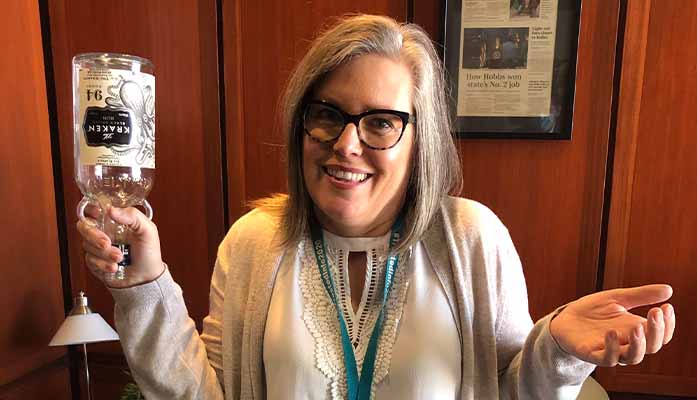
Governor Katie Hobbs is being accused of kicking black and disabled adults and children off an elevator so she didn’t have to wait in line at a football game.
The alleged incident was said to have occurred at the Territorial Cup: the post-Thanksgiving Day football game between Arizona State University (ASU) and the University of Arizona (U of A).
A local reverend and former political candidate, Jarrett Barton Maupin, Jr., accused Hobbs of forcing his group, which consisted of several handicap adults and disabled kids, off an elevator to the executive suites for the game. His group had waited in line for the elevator connecting to the suites. Maupin explained he had a delegation with him consisting of folks from the inner city who had never attended an ASU football game.
According to Maupin in a post to X and a subsequent interview on “The Afternoon Addiction with Garrett Lewis,” the displaced group was given the reason of “executive privilege” for their removal.
Others of equal or greater elected importance were present, per Maupin, waiting in line for the elevator connecting the executive suites at the game.
Here’s Maupin’s account of what occurred:
“Everyone was in line to leave. You had a U.S. Senator in there waiting in line behind us, you had the governor of the River Indian community, you had so many people there, congressmen, even people like Karrin Taylor Robson, candidates. Lots of what people might consider special people, but everyone waiting and understanding that there’s one elevator up to the suites and one elevator down. So we get in, it’s our turn to get in, and it’s about 15 people, and we all happen, just happened to be African American, it wasn’t planned, including the elevator operator who was a black woman. And we get in, she’s getting ready to press the button and everything, and suddenly they say, ‘You gotta get off the elevator! Clear the elevator!’ I thought there was a problem, I said, ‘What’s going on?’ And they said, ‘Well, there’s somebody with executive privilege. You gotta get off the elevator.’ So we get off. And, lo and behold, our governor and her security detail, it’s like maybe five or six people, get on this elevator, and so they took this elevator.”
When others countered that Hobbs required that elevator ride for security reasons, Maupin shared that he and almost every other attendee within the suites had a security detail, but he didn’t observe others forcing the evacuation of an elevator as Hobbs was alleged to have done. Maupin also disclosed that Senator Ruben Gallego shared a subsequent elevator ride with them.
“No, it was not [a call made by her security team]. Funny thing is a U.S. Senator and staff/security rode down after us,” said Maupin. “I have a security detail. Almost everyone in the suites did, besides guests. Electeds, candidates, business leaders. What she did was rude and unnecessary. It was a lame move. But only her latest.”
Maupin questioned whether Hobbs had the authority to order people off elevators, and what about the football game triggered an executive privilege.
“What was the emergency?” said Maupin. “We all have pressing business. I’m pretty busy. I know Senator Gallego is pretty busy and [Governor] Stephen Roe Lewis, and everyone that was up there[.]”
Later, Maupin said he was assured by Representative Andy Biggs that the congressman wouldn’t use executive privilege to oust constituents, especially not minorities or disabled individuals. Biggs is vying to unseat Governor Hobbs in 2026.
“I have also been assured that he would have ‘jumped right in [the elevator] with us,’” said Maupin.
Maupin questioned whether this was a consistent pattern of behavior with Hobbs, citing the racial discrimination allegations put forth by Talonya Adams, her former staffer, which were twice affirmed in court.
AZ Free News is your #1 source for Arizona news and politics. You can send us news tips using this link.
by Staff Reporter | Dec 11, 2025 | Education, News
By Staff Reporter |
The Arizona Board of Education (ASBE) removed language relating to diversity, equity, and inclusion (DEI) from state teaching standards and English language learning courses.
This follows a delay in their decision on the matter several months ago.
State Superintendent of Public Instruction Tom Horne published a press release approving ASBE’s decision to go forward with removing DEI language from Arizona education.
Arizona’s federal funding for 2026 amounts to about $870 million; should Arizona schools not purge DEI, that federal funding may be refused, per the Trump administration.
Horne said the DEI divestment not only counted as compliance with President Donald Trump’s executive order conditioning federal funding on the absence of DEI, but as a philosophical good for students.
“All people should be judged based on their character and ability, not their race or ethnicity. DEI language and programs promote the exact opposite, and they have no place in the classroom,” said Horne. “These terms do not belong in teaching standards, which are meant to direct educators on the most effective ways to teach students’ core academics. Every instructional minute is precious, and DEI efforts distract from that essential mission.”
Multiple federal courts issued nationwide preliminary injunctions against the DEI ban earlier this year. However, the proceedings of those cases were impacted by the Supreme Court ruling in June through Trump v. CASA that declared these and other nationwide injunctions improperly exceed the authority of federal courts. The Supreme Court determined that lower courts must offer specific relief to the involved parties, and generally can’t issue nationwide injunctions to non-plaintiffs.
Following this decision by ASBE, a dedicated working group launching in February will draft materials purging DEI from the Arizona Professional Teaching Standards and Structured English Immersion (SEI) Endorsement Course Frameworks.
These materials will define DEI-related language in order to determine which language to remove or revise.
All 15 counties will have representation in this working group. There will be special considerations to include teacher representatives from General Education, Special Education, and the various teacher subgroups such as English Language Learning, Gifted, and Talented programs.
Stakeholder input will be collected from the three public universities, county education superintendents, school administrators, Arizona Rural Education Association, Arizona Educators Association, and current Structured English Immersion course providers.
ASBE is scheduled to consider these materials next September.
While the state’s top education authority supports these modifications, other stakeholder groups oppose them.
The Arizona Education Association (AEA) submitted a letter to ASBE urging rejection of the proposed changes. AEA leadership claimed over 22,000 educators statewide signed onto the letter in their press release. That’s roughly one-third of the teacher workforce in the state. However, the letter clarified that AEA counted mere membership with their organization as equivalent to all members signing on to their letter.
AEA President Marisol Garcia said without DEI Arizona education would cause a “race to the bottom” — vulnerable to constant changes and little of the continuity required for imparting a strong education — as well as a purging of history.
The other major teachers unions at the national level — the American Federation of Teachers and National Education Association, as well as the civil rights organization, the National Association for the Advancement of Colored People — sued the Trump administration to stop the DEI ban.
AZ Free News is your #1 source for Arizona news and politics. You can send us news tips using this link.
by Staff Reporter | Dec 9, 2025 | News
By Staff Reporter |
Rep. Adelita Grijalva claimed ICE agents pepper sprayed her; the Department of Homeland Security (DHS) debunked her version of events.
Instead, DHS says Grijalva joined the mob attempting to obstruct an immigration raid on a Tucson taco restaurant chain.
In a video posted on Friday to X, Grijalva said ICE had just “pushed aside and pepper sprayed” her after she allegedly attempted to intervene with their raid by presenting herself as an elected official.
Grijalva didn’t show any signs of physical distress typical of a pepper spray recipient until well over a minute after the video started, when she gave one single cough after mentioning the pepper spray incident following her story about the raid.
“[I] was sprayed in the face by a very aggressive agent, pushed around by others, when I literally was not being aggressive, I was asking for clarification, which is my right as a member of Congress,” said Grijalva. “Everybody that was with me, my staff member, myself, two staff members, we have like remnants of whatever they sprayed on us.”
Pepper spray usually results in a severe burning sensation in the eyes, skin, and throat, and may temporarily blind and restrict breathing. These symptoms manifest as red, swollen, closed, teary eyes; gasping and coughing; red and itchy skin; and possibly a runny nose and dizziness. Apart from the single cough, Grijalva didn’t exhibit any of those symptoms.
These effects last an hour at least, with some residuals lasting up to 24 hours.
In her video, Grijalva described those unlawfully intervening with immigration enforcement as “protecting their people.” Grijalva complained law enforcement were “rude and disrespectful” when she tried to exert some control over the situation.
Tricia McLaughlin, DHS assistant secretary, said Grijalva’s physical wellness following the altercation would be “a medical marvel,” and served as further proof that she wasn’t targeted by ICE agents.
“She wasn’t pepper sprayed. She was in the vicinity of someone who *was* pepper sprayed as they were obstructing and assaulting law enforcement,” said McLaughlin. “In fact, two law enforcement officers were seriously injured by this mob that [Grijalva] joined. Presenting one’s self as a ‘Member of Congress’ doesn’t give you the right to obstruct law enforcement.”
A video of Grijalva posted of the moment she claimed ICE agents attacked her shows Grijalva repeatedly approaching ICE agents in an attempt to intervene with their arrests of illegal immigrants.
Grijalva posted a snippet of the video showing a gas canister hitting near her feet as she approached ICE agents.
Other videos of Grijalva showed her telling ICE agents to release a rioter being detained for intervening with immigration enforcement.
On Monday, Pinal County Attorney Brad Miller announced a partnership with ICE in a press briefing. Miller said sanctuary cities and the progressive politicians who create and support them were to blame for the harboring of criminal illegal immigrants, specifically calling out Reps. Grijalva and Yassamin Ansari. Miller compared Grijalva to Jussie Smollett, the actor who falsely claimed Trump supporters perpetrated a hate crime against him in 2019.
“Politicans like Representatives Grijalva and Ansari have made people believe that they are safe in those cities. I’m here to let you know they’re not. There are no sanctuary cities in Arizona,” said Miller.
AZ Free News is your #1 source for Arizona news and politics. You can send us news tips using this link.
by Staff Reporter | Dec 7, 2025 | Education, News
By Staff Reporter |
The Tempe Police Department announced last week that they had issued another 249 arrests in one night at Tempe Tavern for underage drinking, fake IDs, and giving false information.
The mass arrests were part of another police sting on the bar, a popular joint for younger adults — especially Arizona State University (ASU) students.
The bar underwent a similar sting back in April, with a similar outcome: about 170 arrests were made. Of those, 165 received citations and were released.
In May, Tempe Tavern issued a statement on the first sting as well as another incident that occurred in the aftermath, in which a Tempe Tavern employee posted a T-shirt likening the police sting to 9/11.
The T-shirt, designed by an ASU student, read “OUR 9-11” on the front and “#TavernStrong” on the back. A since-deleted post sharing the shirt by a Tempe Tavern employee read: “They hit the second tower!” and advised they would be selling the shirts.
“Earlier this week, someone unaffiliated with Tempe Tavern created a shirt that referenced both Tempe Tavern and 9/11. According to what we know, the shirt was designed by an ASU student and circulated in an online student chat. It eventually reached a younger staff member — who did not appreciate the significance of that tragic day — and was shared on Tempe Tavern’s social media account,” said the bar. “Management removed the post as soon as it was brought to our attention. 9/11 is nothing to joke about; the reference was reprehensible. The shirt is tasteless and disgusting.”
Further on in their statement, the bar explained that they scan all IDs for entry into their establishment, but that the current era of fake IDs do scan successfully and appear authentic. The bar advised they provided ID-scan logs and security footage for all bar patrons to back up their claim.
“Tempe Tavern complies with the law, which is why neither the bar nor its employees received citations from the liquor board or the Tempe Police Department,” said the bar.
However, given that there have now been multiple incidents where so many underage drinkers were caught at the establishment, TPD launched an investigation into the bar.
246 of the 249 arrested were given citations and later released. Three went to the city jail.
TPD says they rely on teams with dozens of officers representing the local, state, and federal levels to ensure only those of age are drinking in these establishments. Homeland Security Investigations and Department of Liquor Licenses and Control were present.
TPD called the latest arrest totals “shocking” and indicative of a need for greater crackdowns. Community members were lodging complaints about the bar, hence the second sting operation.
“These are shocking numbers. We don’t celebrate them. Underage drinking puts people at risk — and that’s why we take it seriously,” said TPD.
AZ Free News is your #1 source for Arizona news and politics. You can send us news tips using this link.
by Staff Reporter | Dec 6, 2025 | Education, News
By Staff Reporter |
A North Valley elementary school increased the number of Pride posters in its hallways after parents complained about a lesson in which students were taught to play a song about dancing at a gay bar.
As the Arizona Daily Independent (ADI) reported, parents learned after the fact about a recent lesson in a music class at Desert Trails Elementary in which students were directed to play boomwhackers to “Pink Pony Club,” a charting pop song about transitioning to an LGBTQ+ lifestyle and dancing at a gay bar.
The song is by lesbian starlet Chappell Roan, who gained popularity in 2024 from another hit single about her sexuality, “Good Luck, Babe!” Roan, who dresses in the style of drag queens, is widely viewed as an LGBTQ+ icon and advocate.
According to reports and social media chatter, parents were not offered an opt-out or even made aware of the lesson beforehand. According to the ADI, the Paradise Valley Unified School District cleared the teacher to resume classes this week on the promise that he would abide by parental notification requirements in the future.
The educator who implemented the lesson was hired earlier this summer: Jerry Michael Nanney, who goes by Michael Nanney.
Nanney claimed to the school and parents that he didn’t know the context of the song.
“Pink Pony Club” discusses a woman’s desire to leave behind her religious upbringing in the South and join the progressive community out West. The lyrics of the song define identity through sexuality.
In the song, Roan narrates the horror of the woman’s mother “scream[ing]” as “she sees her baby girl” dancing at a club. The woman in the song explains to her horrified mother that she’s “just having fun.”
“And I heard that there’s a special place / Where boys and girls can be queens every single day,” states the song lyrics. “I’m up and jaws are on the floor / Lovers in the bathroom and a line outside the door / Blacklights and mirrored disco ball / Every night’s another reason why I left it all / I thank my wicked dreams.”
As noted elsewhere in other reports and online, “pink pony” has multiple meanings. The term can refer to sex, as well as male genitalia.
The artist, Roan, disclosed the pink and some of the narration for the fictitious club were inspired by a hometown strip club, and the atmosphere and content within the song were inspired by her first visit to a gay bar in California.
All of this information, along with the music video for the song in which Roan, drag queens, and gay men dance suggestively, is available and easily accessible online.
Sleuthing parents and community members with Scottsdale Unites for Educational Integrity uncovered social media activity by Nanney that undermined his claim that he didn’t know the meaning of the song. Online, Nanney had shared posts by accounts dedicated to drag queen news and culture.
Reports uncovered, further, that Nanney leads the choir for an LGBTQ+-friendly church in Sun City.
These discoveries make Nanney’s claim of no knowledge of the song unlikely.
Nanney also reported obtaining the song as a choice from a list made by other educators who, the district would later confirm, were not within PVUSD.
AZ Free News is your #1 source for Arizona news and politics. You can send us news tips using this link.