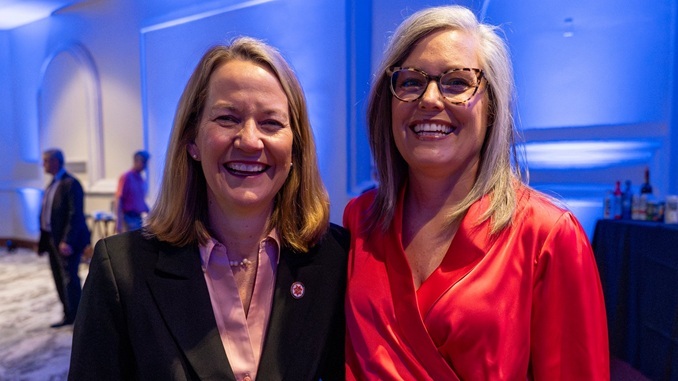
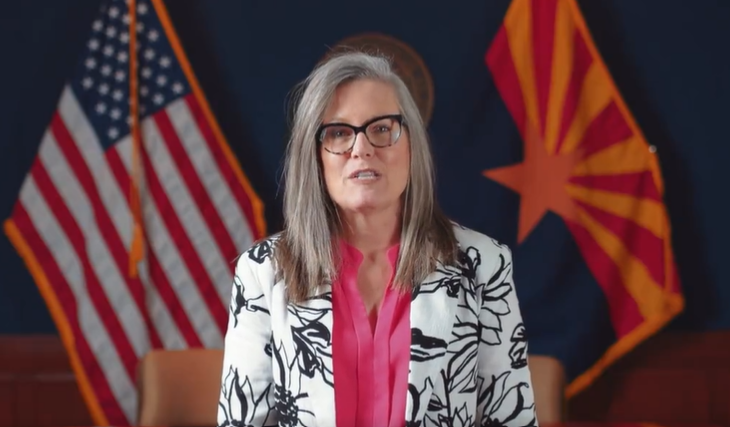
A new complaint filed this week alleges that Arizona’s governor, secretary of state, and attorney general may have participated in a straw donor scheme.
The complainant, San Tan Valley resident Gary DeBerge, has asked Arizona District Attorney Timothy Courchaine and Maricopa County Attorney Rachel Mitchell to look into what he says are “mysterious and unexplained” irregularities in the campaigns of Gov. Katie Hobbs, Secretary of State Adrian Fontes, and Attorney General Kris Mayes.
A copy of the complaint obtained by AZ Free News alleges that recent filings by one of the campaigns reflect “repeatedly altered reported receipts by millions of dollars” due to alleged eliminations of prior reported contributions.
Elect Katie Hobbs, the governor’s reelection campaign account, issued 10 amended reports for the 2026 Quarter 2 report, several of which varied by millions of dollars.
Exempt small contributions amounting to less than $100 totaled more than $1.4 million in the original filing and the first amended report, dropped to $0 in the second and third amended reports, then rose to nearly $400,000 in subsequent amended reports.
Total receipts amounted to more than $2.6 million in the original filing, but jumped to $3.1 million in the first amended report, then dropped below $1.7 million in the second amended report, then rose again to more than $2.2 million in the third amended report, and then rose again, back to more than $2.6 million in subsequent amended reports.
Donations under $100 are considered eligible for aggregate rather than individual reporting.
The complaint petitioned investigators to determine whether the millions moved around in amended filings reflected “a calculated attempt to obscure the true source and disposition” of the funds.
As noted by the complaint, Hobbs’ campaign reported much smaller totals of exempt small contributions throughout 2025 and the first quarter of 2026. Exempt small contributions across five quarters amounted to $600,000 in total. Then, in the second quarter of this year, the campaign reported a surge in exempt small contributions that amounted to more than double what the campaign pulled for an entire year and a quarter.
“Elect Katie Hobbs has reported approximately $1.4 million in exempt contributions and then later reported that those same contributions never existed,” stated the complaint. “This should immediately raise questions regarding the accuracy of one, if not all, of the recent filings made by this committee.”
The Trump administration and Republican leaders in Congress have initiated investigatory efforts into straw donor schemes by online fundraising platforms.
An example of this was illustrated prominently in the media earlier this year, when investigative reporters discovered that ActBlue, the primary fundraising platform for Democrats, allegedly misattributed around $100,000 in donations across thousands of individual political contributions over five years to one Elizabeth Waffle, an 88-year-old woman in Michigan living in a trailer with limited income. ActBlue allegedly misattributed more than 13,000 donations that occurred once or multiple times on a daily basis.
The complaint also questioned the number of contributors listed as “not employed” across the three campaigns’ 2026 filings to date.
Below are the total number of instances in which individual contributors were listed as “not employed” for the three report filings due so far this year and the four report filings made in 2025. These instances exclude retirees and may include individuals who contributed more than once.
Candidate
“Not Employed” or “Unemployed” in 2026 Filings
“Not Employed” or “Unemployed” in 2025 Filings
Katie Hobbs
46,335
26,643
Andy Biggs
26
21
Kris Mayes
17,530
13,162
Warren Petersen
0
0
Adrian Fontes
12,640
3,294
Alexander Kolodin
2
1
AZ Free News is your #1 source for Arizona news and politics. You can send us news tips using this link.
The state ceased imposing mandatory guardrails for parent caregiver payouts nearly a year ago.
The year of potentially runaway spending may have wasted nearly half a billion dollars, a new report from the auditor general revealed.
The audit found that the Arizona Health Care Cost Containment System (AHCCCS) and the Department of Economic Security (DES) had failed to implement cost-control requirements to the Arizona Long Term Care Services (ALTCS) program, within which is one of the biggest program costs: the Parents as Paid Caregivers (PPC) service delivery model.
PPC was established during COVID with substantial funding from the federal government, initially with the intent of being a temporary program. However, stakeholders desired permanence for the program when those pandemic dollars ran out. Gov. Katie Hobbs received approval from the Biden administration to make PPC permanent in 2024, which required Arizona to cover more than a third of the costs.
According to the audit, AHCCCS and DES leadership acted contrary to state law in order to implement laws how and when they saw fit, not how and when it was required of them.
One of the main cost-control requirements the agencies failed to implement was the standardized assessment tool.
AHCCCS suspended the tool in mid-October 2025, 16 days after initiating it according to state law. Those assessments made between Oct. 1 and 16, 2025, were reversed.
As a consequence, the auditor general estimated that the agency failed to realize between $133 million and $493 million in potential cost reduction “risking additional cost increases and shortfalls.”
DES was forced to request $83 million in supplemental appropriation from the state legislature for fiscal year 2026 as a consequence.
The threat of legal action reportedly prompted the agency to buck state law.
“AHCCCS reported that it halted implementation due to the threat of litigation and instead of implementing the policies it created it decided to engage in emergency rulemaking,” reported the audit.
The auditor general did assess that the tool lacked the ability to contain costs in the long term, and suggested legislative changes and federal approval.
The audit also reported that AHCCCS and DES failed to fully implement other cost-control measures, including executing processes to ensure parents reside in the state for at least six months prior to becoming paid caregivers, and prohibiting payments for parent-provided services between 10 p.m. and 6 a.m. and when the child isn’t home.
Further, AHCCCS and DES were found to have not enforced the 40-hour limit on parent-provided care until April of this year. The agencies were required to implement that limit back in July 2025. The audit found this delay caused DES to overpay some parents.
AHCCCS and DES ignored the law by delaying the limit for 10 months to avoid penalizing parents.
“[D]espite lacking the authority to do so, [the agencies] delayed enforcing the requirement because [they] sought to increase compliance through an educational and not punitive approach,” stated the audit.
The audit also found that DES was inconsistent about maintaining member records and ensuring the accuracy of member assessments. The auditor general warned that the former could result in unsupported service authorizations and impair payment oversight, and the latter could result in incorrect payments, waste, and mismatched service authorizations.
The auditor general issued 11 recommendations:
Implement the required standardized assessment tool
Continue developing a formally documented Extraordinary Care Review process
Develop and implement a procedure to seek legal counsel prior to programmatic changes
Develop and implement all required cost controls and oversight processes to ensure functionality
Update monitoring processes to ensure timely oversight of compliance with contractual and statutory obligations related to ALTCS and PPCG
Require provision of timely access to utilization and vendor payment records
Develop and implement regular assessments of the 40-hour limit
Establish corrective action requirements for lack of enforcement concerning 40-hour limit
Conduct an analysis to identify additional cost-control measures to improve ALTCS finances
Implement any additional cost controls for ALTCS as discovered with aid of governor’s office and CMS
Notify the legislature of analysis results and plan of action
Roberta Harrison, AHCCCS interim director, responded that she disagreed with the auditor general’s findings but promised to implement the 11 recommendations. Harrison cited federal Medicaid requirements, legal and procedural considerations, data limitations, and implementation timelines as hindering agency compliance.
DES agreed with one of the findings, that required cost-control measures weren’t fully implemented, and disagreed with the other three. DES agreed to implement all but five of the 20 recommendations.
The auditor general’s office plans to follow up with AHCCCS and DES in six months’ time.
AZ Free News is your #1 source for Arizona news and politics. You can send us news tips using this link.
The American Civil Liberties Union (ACLU) has ended its lawsuit about a month after it filed to challenge the constitutionality of Proposition 314 — at least, for the time being.
The ACLU filed a notice of voluntary dismissal with the Arizona District Court on Wednesday. It made that filing a day after the preliminary injunction hearing was initially scheduled to occur, but which had been vacated the Friday prior.
Prop 314, passed by Arizona voters in 2024, gave law enforcement the authority to enforce federal immigration laws. An ACLU attorney representing Florence Immigrant & Refugee Rights Project (Florence Project), the plaintiff challenging the proposition, says their team can find no evidence of law enforcement exercising this new authority.
Prop 314 made illegal immigration a state crime. That means state and local police may arrest illegal aliens and state judges may order deportations of illegal aliens. The proposition also required immigration verification for financial aid and public welfare, and made it a Class 6 felony to submit false information or documents for purposes of employment or public benefits.
The proposition went into effect in mid-July.
ACLU attorney John Mitchell said their team would wait for evidence that law enforcement or state judges had acted upon Prop 314 before relaunching their challenge.
“The trajectory of this litigation has always depended on when and how the state chooses to enforce Section 5,” said ACLU attorney John Mitchell. “In the first month that Section 5 has become fully enforceable, we’ve just seen none. So, from a litigation standpoint, it means our best strategy is to hold off until we get evidence of that enforcement.”
Mitchell’s take appeared to be the ACLU heeding arguments made by Attorney General Kris Mayes, who was named as a defendant in the lawsuit. Mayes’ team warned in a filed response that the lawsuit was premature since no law enforcement or courts had exercised Prop 314 authority.
“Because Section 5 has barely gone into effect, Florence Project has not shown and likely cannot show that anyone has been subject to arrest, detention, or prosecution for violating the illegal entry provision,” stated the attorney general’s office. “Likewise, no one has been subject to an order to depart the country under [the law], because such orders are tied to a charge or conviction for violating the illegal entry provision.”
The Florence Project, with the support of the ACLU and the ACLU of Arizona, filed its lawsuit in early July, claiming Prop 314 violated the Supremacy Clause of the Constitution. The organizations stated that only the federal government may regulate immigration.
“Immigration is a quintessentially federal authority. Congress has created a carefully calibrated immigration system, with detailed procedures that determine whether a person may remain in the United States, when to pursue criminal entry charges in the exercise of prosecutorial discretion, and what protections people receive to ensure that they do not face persecution or torture upon removal,” stated their complaint. “Congress placed all relevant authority in the hands of federal officials — in keeping with the federal government’s exclusive immigration powers and the sensitive foreign policy implications of these powers.”
The Arizona District Court denied the organization’s motion for a temporary restraining order about two weeks ago.
Living United For Change, another progressive group, lost their lawsuit challenging the constitutionality of Prop 314 last year.
AZ Free News is your #1 source for Arizona news and politics. You can send us news tips using this link.
Gov. Katie Hobbs says public education is woefully underfunded, but fiscal reporting indicates districts are flush with cash.
According to the latest Arizona Department of Education annual financial report, public school districts carried forward more than $8.3 billion in unspent funds from the 2024-25 fiscal year.
That is nearly equivalent to total appropriations that the state allocated for public education in the 2024-25 fiscal year: $8.9 billion, which goes beyond K-12 schools to include the Board of Regents, community colleges, and universities.
That $8.9 billion accounts for 55% of total appropriations out of the state’s general fund, which amounted to more than $16.2 billion in the 2024-25 fiscal year.
Within the $8.3 billion carried over from the 2024-25 fiscal year:
$1.6 billion for bond building
$1.3 billion for maintenance and operations
$1.2 billion for “other” funding
$941,000 for the Classroom Site Fund and Instructional Improvement Fund
$884,000 for unrestricted capital outlay
$708,000 for federal projects
$672,000 for bond principal deduction
$393,000 for debt service
$248,000 for food service
$150,000 for adjacent ways
$147,000 for school plant
$41,000 for state projects
The emergency deficiencies correction, building renewal, and new school facilities funds had negative balances of approximately $395,000, $19 million, and $33 million, respectively.
Last fall, the Common Sense Institute estimated that school districts hold more than $20 billion in combined cash reserves and underutilized real estate.
Public school district enrollment has declined steadily since 2008, more so in recent years after the state allowed universal enrollment for the ESA program in 2022.
Hobbs has advocated for lawmakers to revive Proposition 123, which would take around $300 million every year from the State Land Trust Permanent Fund and give it to education. $300 million is equivalent to a drop in the public education fund bucket: approximately 3% of what the state allocated from its general fund in the 2024-25 fiscal year.
Hobbs credited Prop 123 as providing “critical funding” for districts and educators in her State of the State address earlier this year. The governor said the funding provided by the proposition curbed the budget shortfall and would enable teacher pay raises and prevent future tax hikes.
The governor and lawmakers have failed to reach a consensus on renewing Prop 123. The proposition expired in June 2025.
Teresa Leyba Ruiz, the Democratic nominee for superintendent of public instruction, wants to claw back another 3% from a potential funding source. As reported earlier this week, Ruiz proposed reverting the $350 million set aside in Empowerment Scholarship Account (ESA) program funds back to public schools.
32% of educators reported having an external job and 21% of educators indicated additional paid responsibilities and a second job outside their school, according to a 2024 report by Hobbs’ Educator Retention Task Force issued in partnership with the Arizona State University Morrison Institute for Public Policy.
That same report identified inadequate salary, unpaid duties and hours, pay differences, and salary compression as issues impacting retention. The report estimated that only 16% of educators agreed that their salary was satisfactory and motivated them to stay in their professions.
A more recent poll of more than 9,300 educators during the 2025-26 school year by the Arizona Department of Education also found that teacher pay was one of the biggest sources of dissatisfaction for educators.
AZ Free News is your #1 source for Arizona news and politics. You can send us news tips using this link.
A coalition of U.S. House Democrats have banded together to pledge against socialism, but none of Arizona’s Democrat congressional leaders signed on.
Reps. Adelita Grijalva (D-AZ-07), Greg Stanton (D-AZ-04), and Yassamin Ansari (D-AZ-03) have not signed the Promise to America, an organization pushing a pledge to align the Democratic Party around the principles of capitalism, safety, fiscal responsibility, effective government, common purpose, and patriotism.
The three congressional leaders have not publicly aligned with socialism, and are not known to be members of the Democratic Socialists of America. Stanton’s primary challenger, Kai Newkirk, was a self-identified democratic socialist.
However, top Democrats in Arizona appear to be looking to reclaim and redefine socialism. Gov. Katie Hobbs’ consultant Stacy Pearson, who has represented her campaign to the media, recently told KJZZ that all public goods qualified as socialism, and that Democrats needed to reclaim socialist ideology as their own.
“[W]hen politicians are arguing against socialism, they’re arguing against well-funded public education and good universities and public transportation and affordable housing,” said Pearson. “The Democrats need to get a hold of the word socialist like we did with abortion, and we stopped using weird pitter-patter words like ‘reproductive freedom’ and ‘reproductive rights.’ No, we’re really talking about a woman’s right to have an abortion when she needs one, period. And so I think we need to get a hold of the word again and remind people what it really means.”
The new pledge from U.S. House Democrats against socialism declares a belief in an economy driven by merit and hard work, secure borders and orderly immigration, a balanced budget, reduced bureaucracy, free speech, common political ground, and confidence rooted in patriotism.
“We are proud, not ashamed of America,” stated the pledge. “We believe America’s story is one of extraordinary achievement and unfinished work. We honor America’s strengths and exceptional character while striving to build a freer, stronger, more prosperous, and more perfect union.”
Ten congressional Democrats and five candidates have signed the pledge as of this report. Signatories hail from California, Colorado, Michigan, Nevada, New Hampshire, New Jersey, New York, North Carolina, Oregon, and Texas.
The pledge was developed by New York Rep. Tom Suozzi and California Rep. Adam Gray alongside a team of fellows following sizable wins from socialist candidates in the June primaries. The founding fellows were Felix Frisch, who serves as director; Mac Healey; Sarah Buchanan; Molly Uthoff; Aarynn Deleon; Chloe Stevelman; and Yenjay Hu.
Suozzi and Gray market themselves as the two Democrats to have successfully flipped districts that President Donald Trump won in the 2024 election cycle.
Promise to America appears to be aligned with the Welcome Party, which has an affiliated political action committee with millions in funding from the likes of LinkedIn cofounder and tech venture capitalist Reid Hoffman, former 21st century Fox CEO James Murdoch, and Walmart heir Samuel Walton.
Only one Democratic candidate from Arizona was listed as having signed the pledge: Marlene Galan Woods, who lost the Democratic nomination for the 1st congressional district seat to Amish Shah.
Candidates Jonathan Nez, 2nd congressional district; Elizabeth Lee, 5th congressional district; JoAnna Mendoza, 6th congressional district; Bernadette Greene-Placentia, 8th congressional district; and Dani Sterbinksy, 9th congressional district, also have not signed the pledge.
AZ Free News is your #1 source for Arizona news and politics. You can send us news tips using this link.