by AZ Free Enterprise Club | Sep 24, 2026 | Opinion
By the Arizona Free Enterprise Club |
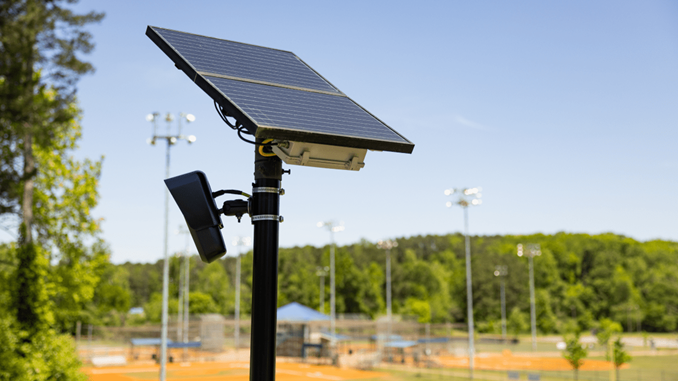
One by one, cities and towns across Arizona are abandoning their contracts with Flock Safety, the manufacturer of the controversial Automated License Plate Readers (ALPRs) you see around town. The black pole with a little solar panel on it? That is the infamous surveillance tool that has been taking over American communities in the name of safety at the small price of freedom.
These systems were not directly approved by voters or even the elected representatives. Many of these ALPRs likely would never have been approved by voters had they been given the choice. Privacy and government surveillance are across-the-board concerns. Whether on the right or left, Americans do not want their every move tracked.
Beyond privacy concerns, cases of law enforcement officers using Flock in inappropriate ways, such as stalking ex-wives or checking on family members, are not new. Across the country, Flock’s expansion has been accompanied by numerous cases of misuse.
Let’s take a look at where Arizona municipalities currently stand with Flock…
>>> CONTINUE READING >>>
by AZ Free Enterprise Club | Aug 27, 2026 | Opinion
By the Arizona Free Enterprise Club |
“I’m Katie Hobbs, and the rules don’t apply to me.” That might as well run at the end of the next campaign ad featuring Arizona’s governor. Since taking office in 2023, Hobbs has been building a rap sheet of scandals that would make Minnesota Governor Tim Walz blush.
From one of the largest Medicaid fraud scandals in Arizona history to a pay-to-play scheme that has put her administration under active criminal investigation, Hobbs has taken corruption to new heights in our state. But now, her latest campaign-finance reports are raising even more troubling questions: How did more than $1 million in small-dollar contributions disappear? And why are over 46,000 of her contributors listed as unemployed?
A Million-Dollar Campaign-Finance Mystery
How many times can a campaign-finance report be amended before it starts to raise red flags? For the 2026 Quarter 2 report, the Hobbs campaign has managed to amend it 10 times so far. But why? Were there some typos or decimals in the wrong spot? Nope. Many of these amendments repeatedly changed the amount of money the Hobbs campaign reported receiving.
The biggest mystery involves more than $1.4 million in small-dollar contributions. In its original filing, Elect Katie Hobbs reported $1.426 million in exempt small contributions—donations under $100 that can be reported in aggregate. The campaign reported the same amount in its first amended filing.
But something happened in its second and third amended filings. All of a sudden, that $1.426 million dropped to $0. And then, in the fourth amended filing, nearly $400,000 suddenly reappeared.
The campaign’s total receipts also followed a similarly bizarre path, jumping from $2.64 million to $3.1 million, falling below $1.7 million, and then climbing back above $2.6 million through various amendments.
So, where did the money go?
That’s a great question. And Hobbs has yet to answer. But it’s not the only anomaly in her campaign-finance reports…
>>> CONTINUE READING >>>
by AZ Free Enterprise Club | Aug 15, 2026 | Opinion
By the Arizona Free Enterprise Club |
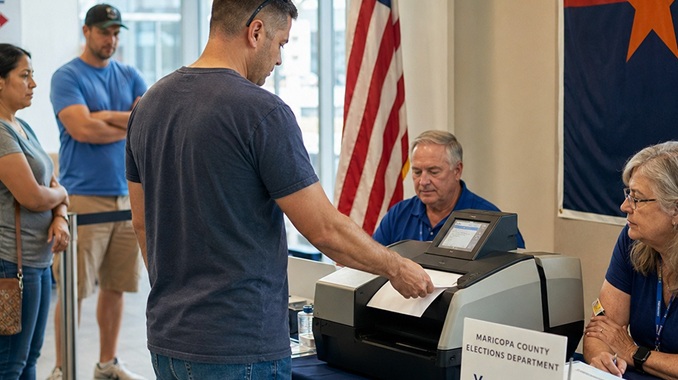
It’s pretty rare in politics to find a policy that is considered across the political spectrum as a true win, win. In the most recent primary election, Maricopa County implemented a new process that may actually be considered a win, win, win for elections.
Win number one: more options for voters, not fewer.
Win number two: faster election results.
Win number three: more integrity in the process.
What is it? On-site tabulation of early ballots. That’s right, a policy we spearheaded with Senator J.D. Mesnard in 2022. Then, it was SB1362. It was introduced on the heels of an election taking weeks to get election results and one of the largest drivers of the delay were early ballots that voters did not mail back, did not drop off during early voting, but instead held onto until election day and dropped them off en masse at polling locations. Hundreds of thousands of ballots dropped off, that later had to be transported to the county, signature verified, cured, removed from the envelope, and finally tabulated.
That wasn’t novel, and you can see why so many would choose to vote this way. For some, they simply forgot to return their ballot in time. Now it is election day, they don’t want to wait in line to fill out a two-page ballot again, so they drop it off. Or they filled out their ballot at home, and they don’t trust the mail to get it delivered and would prefer the assurance of dropping it off themselves. Or they like filling out their ballot at home, but they also like to go to the polling place on election day. Whatever the reason, a large portion of voters choose to do it every year. Most of them do not realize it delays results for weeks.
SB1362 began as a mandate on the counties, requiring them to provide this option to voters. Believe it or not, the counties fought it tooth and nail the entire session. Eventually, the bill was amended to make it optional for counties to implement. They still opposed it. Why? They knew that if voters found out that their county officials could be doing this but are refusing to do so, voters would get mad at them.
But that isn’t all…
>>> CONTINUE READING >>>
by AZ Free Enterprise Club | Jul 24, 2026 | Opinion
By the Arizona Free Enterprise Club |
The teachers’ unions and their allies at Save Our Schools (SOS) have proven time and time again that they will do anything to kill universal school choice in Arizona.
They’ve fought expansion of the program. They’ve pushed to cap it. They’ve worked with activist reporters in the legacy media with ties to the Red for Ed teachers’ union to push false claims about it. And we all witnessed it four years ago when they made their not-so-triumphant proclamation that they had enough signatures to repeal the program—only to discover they had miscounted by more than 50,000 signatures.
But their latest attempt to overturn the program is their lowest yet.
Earlier this month, the teachers’ unions and SOS announced they had submitted more than 420,000 signatures for a ballot initiative that would end the universal eligibility of Arizona’s Empowerment Scholarship Accounts (ESA) program.
Given their track record, the Arizona Free Enterprise Club worked closely with the Goldwater Institute and other school choice advocates to review the petitions. What we found was far more disturbing than another failed signature count.
Dozens of Convicted Felons—Including Registered Sex Offenders—Hired to Collect Signatures
The teachers’ unions and SOS want Arizonans to believe that their “Protect Education Act” campaign is a grassroots effort led by concerned parents and educators. But they made a very different choice when it came time to build their campaign…
>>> CONTINUE READING >>>
by AZ Free Enterprise Club | Jul 9, 2026 | Opinion
By the Arizona Free Enterprise Club |
Arizona taxpayers can’t catch a break from their local governments. From water rates and utility bills to property taxes and sales taxes, city councils have spent the last several months approving one increase after another. No matter the justification, the result is always the same: higher costs for the people paying the bills.
Here are some of the top offenders of the last couple of months:
Florence
In the Town of Florence, the town council approved a multi-year water and wastewater rate hike plan that starts with roughly 6–8% increases but compounds over several years into what many residents estimate will amount to around a 64% increase in total utility costs. At a time when families are already struggling with affordability, approving rate hikes of that magnitude is a serious burden on Florence residents. With increases that steep, one would think they’re trying to compete with Gilbert (100%+ increase over 3 years). The increases will start on July 1st, just in time for summer, so get your pocketbooks ready, Florence residents.
Tempe
Tempe has their own slew of problems that deserves an article of its own, self-imposed by mismanagement, obviously. The Tempe City Council recently voted on sending a 0.5% sales tax increase to the ballot for voters in November. This will tax all non-grocery food and is said to give 0.3% to public safety, 0.1% to transit such as light rail and buses and 0.1% to Tempe PRE, a city run free preschool.
As usual, local leaders are putting all blame on the legislature. One Tempe councilmember said, “Let me remind you what we set out to do with this initially: to address a … deficit that was created not by us but by the Arizona Legislature and the federal government.”
Meanwhile, this is occurring while the council has decided on things like a $2 million “Mill Ave” sign. Just plain, silver metal. Nothing special or aesthetic and $2 million is going towards this thing? Right, and it’s the legislature’s fault that they are in a budget deficit of about $24 million. It’s almost as if they didn’t spend your tax dollars on stupid things, they wouldn’t need to keep raising taxes…
>>> CONTINUE READING >>>