Reports have emerged that voters may have had their registration addresses moved by Arizona’s Motor Vehicles Division (MVD) without their consent, potentially jeopardizing their ability to vote.
Such unintended disenfranchisement occurred for thousands of voters in the 2022 midterm election.
The renewed concern for the eligibility of an untold number of legal voters emerged after GOP congressional candidate Abraham Hamadeh’s counsel, Jen Wright, brought up their discovery from earlier this year that the MVD moved the voter registration address for thousands of voters without their consent.
🚨ATTN: ARIZONA VOTERS🚨
In @AbrahamHamadeh’s case we found THOUSANDS of voters’ registration address was moved based on ANY interaction with MVD.
CHECK YOUR REGISTRATION NOW TO CONFIRM YOU ARE REGISTERED AT YOUR CURRENT, PRIMARY RESIDENCE.https://t.co/So7VKN545E
Wright was referencing the Hamadeh v. Mayes case, which the Arizona Court of Appeals decided in April.
In that case, Hamadeh’s counsel explained that they discovered voters who owned other properties in addition to their primary residence and found themselves disenfranchised.
“[A]fter interviewing hundreds of those voters, we found that many are voters who have connections to properties outside of their home county; and due to no fault of their own, but instead changes to the statewide computer system, their registration was moved from their county of residence to the county where they had some connection without the voter’s express knowledge, consent or intent in a way that lacks a requisite procedural due process requirement necessitated before depriving someone of their sacred right to vote,” stated counsel. “[I]t appears that more than 1,100 election day provisional voters were, we believe, wrongly disenfranchised. Turns out, with many of these declarations we have their voting record and history, and we can see when and how it was changed, and it was not by their own intent; and we know their intent because they did not show up to vote in the secondary county that was assigned to them.”
The MVD process that impacted those 1,100 voters went into place in April 2020. The court of appeals said that those Arizonans’ votes still couldn’t count since their registrations reflected an address outside the precinct they attempted to vote in, regardless of the change being made by MVD without the knowledge or consent of the voters.
“[E]ven if voters cast provisional ballots in the wrong precinct because of the alleged faulty but unchallenged election procedure, the voters still were not registered to vote in the precincts where they cast those provisional ballots,” stated the court. “Arizona law simply does not authorize opening the envelopes and counting those ballots.”
This hasn’t been the only case recently in which MVD interactions jeopardized Arizonans’ right to vote.
Last month, the Arizona Supreme Court ruled that nearly 100,000 longtime Arizona voters caught up in an MVD coding error were allowed to vote, despite a challenge from Maricopa County Recorder Stephen Richer, who put the blame on voters and asked that they be limited to voting a federal ballot only.
The Arizona Supreme Court ruled that those voters were eligible to vote. Chief Justice Ann Scott Timmer ruled that the fault was with the state, not the voters, for their registration changing.
“[A] state administrative failure permitted the Affected Voters to be registered without confirming that they provided DPOC when they received their driver’s licenses and where there is so little time remaining before the beginning of the 2024 General Election,” said Timmer.
AZ Free News is your #1 source for Arizona news and politics. You can send us news tips using this link.
A former middle school teacher out of Tucson will lose his Arizona teaching certificate several years after threatening to shoot a Trump merchandise store and kill a lawmaker.
As the Arizona Daily Independentreported, Donald Glenn Brown sent an email under the alias “Jessica James” to The Trumped Store in Show Low, Arizona on July 4, 2022 threatening to shoot up the store as well as murder State Senator Wendy Rogers. Brown was arrested in September of that year on the charge of attempting to commit terrorism, a class four felony.
Brown’s graphic email is replicated below from the Arizona State Board of Education (ASBE) meeting content regarding his case:
“Hello you Mother-F**king Disgusting Piece of Shit….this is Jim & Jessica James, we are friends of Ron Watkins, We are parked today July 4 at the Sonic Restaurant (Show Low), with a pair of AR-15s, We are going to walk in your f**king joke of a store, and start shooting, and put the barrell [sic] of a gun to Wendy Rogers face and pull the trigger and bow her f**king head off…and enjoy watching that f**king traitor grifting disgusting lying sick Bi*ch Wh*re C*nt Die, and her brains, head, blood sprayed all over your f**king store…and then we’re going to start shooting your f**king shit-hole up with a few AR15 rounds-some real patriots are going to Hit Back and F**king C*nt Rogers is going to die…..F**k You Traitor…..tRump Ass-licking C**k Sucker.”
Not until he pled guilty earlier this year in April did Brown resign from the Tucson Unified School District (TUSD). The Navajo County Superior Court sentenced Brown to two-and-a-half years in prison.
Brown’s hearing before ASBE is scheduled for next Monday, where it is anticipated he will lose his teaching certification. Brown didn’t appear before the Professional Practices Advisory Committee (PPAC) for his July hearing, due to his imprisonment; PPAC voted unanimously to recommend revocation of Brown’s teaching certification.
Brown maintains a preK-12 music education certificate set to expire next September. Brown taught at the Pistor Middle School within TUSD.
In addition to engaging in violent political threats, Brown appeared to be addicted to pornography.
According to his ASBE case information, Brown had his teaching credentials suspended in another state, New Mexico, based on a 2016 complaint by a female teacher that she had seen a picture of a naked woman bent over on Brown’s school computer screen. Brown later admitted to viewing pornography during school hours on a classroom computer when no students were present.
Brown applied for a substitute certificate with the state of Arizona during his suspension for the pornography viewing, which was part of a settlement agreement with the New Mexico Public Education Department.
In addition to his “Jessica James” alias, ASBE reported that Brown created a separate alias email “Marina Aleximov” to serve as “an outlet for political rage and tool for sexual gratification.” Under this alias, Brown pretended to be a young, ex-Mormon woman from Russia attacking Republicans online, including Rogers, and curating content from male porn stars, fintess models, and celebrities.
“[Y]ou need to move to Mar-a-Lago so you can be one of ex-King tRump’s wh*res,” wrote Brown. “You want to f**k Donald J Trump sooo bad, right? You worship and adore him, you even pray to him, go to Florida and suck his little orange c*ck and f**k him.”
AZ Free News is your #1 source for Arizona news and politics. You can send us news tips using this link.
Research uncovered by AZ Free News’ investigative team has followed a trail of money that leads from major Arizona labor unions to a Democrat-funding SuperPAC and then via several smaller PACs to a supposedly ‘Conservative’ PAC. The money finally arrives at a political consultant employed by State Rep. David Cook to be used against his 2024 opponent Arizona Sen. Wendy Rogers.
It started in February with a $400,000 donation, from Arizona Pipe Trades 469 to Residents for Accountability a SuperPAC, which has dumped over $1.36 billion into the Democrat funding machine ‘ActBlue’ in 2024, which donated $261,617.02 precisely to ‘Revitalize Arizona,’ a well-known Democratic Political Action Committee (PAC). And in the end, led to a $261,617.02 payment from Arizona First to McShane, LLC: high-end political consultants who represent Rep. David Cook, earmarked to be used in opposition to Wendy Rogers For AZ Senate per election filings.
The money metaphorically went into the laundry blue and came out red on the other side.
The story unfolding today bears more than a little similarity to another funding scheme uncovered by AZ Free News in 2022 involving the Democratic Revitalize Arizona and Rep. David Cook after he sided against his party on a key bill to prohibit cities and counties from requiring prevailing wages or union labor as a condition of receiving a bid or contract. Cook’s vote was decisive. The bill failed by a single vote in a victory for the unions and a defeat for local governments and small contractors.
“Revitalize Arizona, a Tempe-based PAC, is chaired by Israel Torres, a partner in the Torres Consulting and Law Group, which chairs the same address as the PAC. The PAC funneled $48,000 to the group in 2020, totaling over $122,100 over the past decade. It also paid Torres Multicultural Communications, previously known as Torres Marquez Communications, over $681,200 over the past decade, with the majority paid out to the firm in 2019: nearly $646,000.
All of their funds come from another PAC run by Torres: Residents for Accountability. That PAC receives its funds largely from unions. Among its funders from the past two years are the Arizona Pipe Trades 469 PAC, affiliated with a union, and Chicanos Por La Causa (CPLC) Action Fund PAC, affiliated with a social justice nonprofit. Over the past decade, a number of other union-affiliated PACs have funded Residents for Accountability.
The PAC has a history of investing in Democratic polling companies such as the D.C.-based Lake Research Partners, whose past clientele have included President Joe Biden, former President Bill Clinton, House Speaker Nancy Pelosi, Janet Napolitano, Sheila Jackson Lee, AFL-CIO, and the United Food and Commercial Workers (UFCW) Arizona.
They’ve also invested in Democratic polling company SKD Knickerbocker, from which Anita Dunn hailed — Biden’s senior advisor and former President Barack Obama’s communications director.”
A key difference in the 2024 scenario is the route the money took, and it’s final purpose and destination. From Revitalize Arizona, the exact same amount, $261,617.02, was moved to Arizona Voters, yet another PAC, this time managed by the American Campaign Finance Foundation. From Arizona Voters, the very same $261,617.02 went to Arizona First, which OpenSecrets.com identifies as a Conservative SuperPAC. And from there, the money in the precise amount of $261,617.02 finally arrives at McShane, LLC on June 25, 2024, five months after it left the union’s hands, in five easy steps.
Arizona Republicans again got the better of Governor Katie Hobbs with their second installment of a state budget amid a tenuous divided government.
On Saturday night, the Republican-led Arizona Legislature passed the 2024-2025 state budget and adjourned for the year after finishing its tasks. This latest budget was negotiated between Senate President Warren Petersen, House Speaker Ben Toma, and Democrat Governor Katie Hobbs.
“Following last year’s state budget, where Republican lawmakers provided inflationary relief to everyday Arizonans through $274 million in tax rebates distributed to struggling families, as well as a ban on the tenant-paid rental tax taking effect this January, Republicans are again successfully supporting our hardworking citizens while simultaneously reining in spending,” said Senate President Warren Petersen. “In this year’s budget, we defended more than $520 million allocated last year for much-needed transportation projects statewide. We also cut fees for Maricopa County drivers on emissions testing by 5%, and we banned fee increases on Arizonans from state boards for the next two years.”
🚨FOR IMMEDIATE RELEASE: Republicans Eliminate Deficit, Increase Border Security Spending, Fully Fund Public Safety, Protect School Choice, Shrink Government in 2024-2025 State Budget
House Speaker Ben Toma added, “At a time when Arizonans are having to tighten their financial belts, so is state government. The Arizona House of Representatives has passed a fiscally conservative, structurally balanced state budget that solves the nearly $1.5 billion deficit, without touching the rainy-day fund or using budget gimmickry. The budget trims government and protects conservative priorities. It increases funding for local border support operations and assists fentanyl interdiction efforts by law enforcement. It funds transportation and infrastructure and maintains our state’s commitment to water security.”
✅House Approves Fiscally Conservative State Budget that Trims Government and Protects School Choice
“At a time when Arizonans are having to tighten their financial belts, so is state government. The Arizona House of Representatives has passed a fiscally conservative,… pic.twitter.com/yJRtoKAZqb
— Arizona House Republicans (@AZHouseGOP) June 16, 2024
According to a press release from the Arizona Senate Republicans Caucus, some of the highlights from the agreed-upon budget included the following:
Reduction of state spending by $1.7 billion below the 2023-2024 budget (10%);
Reduction of ongoing spending by $330 million; and
Addition of $5 million for local border security support and $4 million for fentanyl interdiction and law enforcement response.
The Senate Republicans also noted that their efforts this year produced a budget that did not add any new taxes, tax increases, or debt. Additionally, the budget did not pull dollars from the rainy-day fund, ensuring that the state would have sufficient funds to draw upon should it experience more stormy weather in future years.
“We tightened the state’s belt by trimming fat from state agencies, and we reallocated unspent tax dollars to the general fund to eliminate the deficit, without irresponsibly tapping into our rainy-day fund,” said Senate Appropriations Chairman John Kavanagh. “Most government operations within the state received a healthy and manageable 3.5% reduction in spending, with a few exceptions. Safe communities free of crime and a secure border are the biggest priorities to Arizonans and Republicans alike, and we want to ensure our budget reflects that. As a result, funding for the Department of Public Safety, the Department of Corrections, and the Arizona Auditor General remains intact, while we’re also investing millions in border security, all without raising taxes or creating new debt.”
“Our budget also reflects our support for our citizens’ Second Amendment rights,” said Senator David Gowan, Chairman of the Senate Committee on Military Affairs, Public Safety & Border Security. “We’re funding two full time positions at the Department of Public Safety to address a backlog of concealed carry permit applications and renewals, with a requirement to prioritize Arizona residents first. This move can have a positive impact in our state by ultimately strengthening the safety and security of our communities as our citizens seek avenues to protect themselves, their families, and their private property. Additionally in this budget, we’re infusing crucial dollars into the Critical Access Hospitals (CAH) located in our rural communities, so these residents have convenient access to emergency care.”
Not every Republican was on board with this budget, however. State Representative Matt Gress explained his “no” vote on the most-recent edition, writing, “This year’s [budget] seems more focused on just ‘getting it done’ than ‘doing it right.’ There’s a reason there is bipartisan opposition. This is not a budget that reflects the shared priorities of Arizonans.”
Gress’ fellow Republican colleague in the chamber, Representative Jacqueline Parker, opined, “Literally the ONLY ones saying good things about this budget are Democrats…”
Literally the ONLY ones saying good things about this budget are Democrats… 🤔 pic.twitter.com/NIW1tSc4KF
— Rep. Jacqueline Parker (@electjacqparker) June 16, 2024
Senator Wendy Rogers weighed in after the vote in her chamber, posting, “This was a solid Republican budget and I voted for it.”
State Representative John Gillette agreed with Rogers’ sentiments, saying, “After a hard fight and two days of voting, we finally passed the 2024-2025 budget with tax cuts and NO new debt. Fiscal responsibility and conservative values prevailed.”
After a hard fight and two days of voting, we finally passed the 2024-2025 budget with tax cuts and NO new debt!
Fiscal responsibility and conservative values prevailed.
Republicans will now have to make the case to Arizona voters in the all-important November General Election about why they should return to power in the state legislature for another two years in a divided government with Governor Hobbs. Throughout the past two years, Republicans have been mostly united and focused on protecting several of their priorities from the clutches of Democrats eager to dismantle values and principles. That balance of power, though, hangs on a knife’s edge as fall awaits.
Daniel Stefanski is a reporter for AZ Free News. You can send him news tips using this link.
Arizona legislative Republicans are working to give voters an opportunity to help make future elections more efficient.
Last week, the Arizona Senate Elections Committee considered and passed a strike-everything amendment to HCR 2056, an elections-related ballot measure. If passed by the state Senate and House, the proposal would go to Arizona voters in the November General Election.
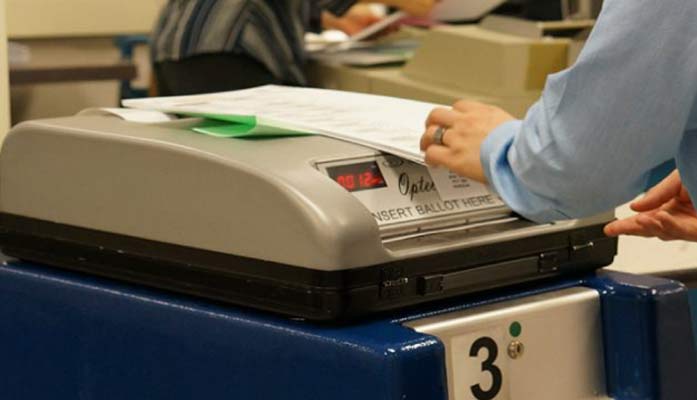
According to the purpose from the State Senate’s fact sheet, the bill would “prohibit the use of foreign monies for election administration purposes or to influence the outcome of a ballot measure, change the date by which early ballots must be returned to a polling place from 7:00 p.m. on election day to 7:00 p.m. on the Friday before election day, with exceptions for delivery to the office of the county recorder during emergency voting, [and] require the county recorder or other officer in charge of elections to provide for on-site tabulation of all ballots for all voting conducted during early voting or on election day.”
Senator Wendy Rogers issued a statement after the successful passage of the measure out of the committee, writing, “I’m thrilled to report we’re advancing a ballot referral through the Legislature that voters may be able to consider in November to help speed up the process of determining the winners of our elections. Arizona has become the laughing stock of the nation with how long it takes our state to accurately tabulate ballots, not to mention the long lines and wait times voters encounter at the polls. I’m confident our solution is a big step in the right direction to eliminate the chaos.”
//This would go STRAIGHT to the BALLOT – bypassing the ‘governor’//
SO WE CAN GET OUR VOTE RESULTS IN 5 DAYS RATHER THAN 3 WEEKS!
Rogers added, “We moved a ‘strike everything amendment’ to HCR 2056 through Senate Elections Committee this week. It would require the use of on-site tabulators in polling places for both Election Day and for early voting, which would lead to a considerably more efficient elections process and faster results. It would also reduce the timeline of when mail-in ballots will be accepted at polling places, but will allow voters to drop them off at the recorder’s office or any designated drop box. Lastly, it would ban all foreign funding of our elections.”
The vote in the Senate Elections Committee was 4-3 in favor of the measure’s advancement. One member did not vote.
Arizona Senate Democrats shared a video out of the Elections Committee, where Secretary of State Adrian Fontes expressed his opposition to the measure. Fontes said, “As it stands today I don’t think the voters deserve to see something like this when there is no sufficient funding in the bill.”
“As it stands today I don’t think the voters deserve to see something like this when there is no sufficient funding in the bill.”
We couldn’t agree more, @AZSecretary. Sending HCR2056 to voters is disingenuous and dangerous. If Republicans care about protecting our elections,… pic.twitter.com/JcYjKOL3aC
— Arizona Senate Democrats (@AZSenateDems) May 19, 2024
The Senate Democrats’ “X” account also asserted that “this rushed ballot referral will increase provisional ballots, prohibit ‘late early’ drop-offs, and result in longer wait times for EVERYONE.”
If the Republican’s goal is actually faster election results, pushing HCR2056 to the voters is the wrong plan.
This rushed ballot referral will increase provisional ballots, prohibit “late early” drop-offs, and result in longer wait times for EVERYONE. #azlegpic.twitter.com/zqmXXzrTEx
— Arizona Senate Democrats (@AZSenateDems) May 17, 2024
The ACLU of Arizona also weighed in on the proposal. Darrell Hill, the policy director for the state’s chapter, said, “Any bill that claims to speed up the election processes by reducing a voter’s ability to cast their ballot is not a solution – it’s blatant voter disenfranchisement.”
Voting rights are under attack in Arizona and HCR 2056 will lead to voter disenfranchisement. It's time to protect democracy, not undermine it. pic.twitter.com/nr3q9V89ed