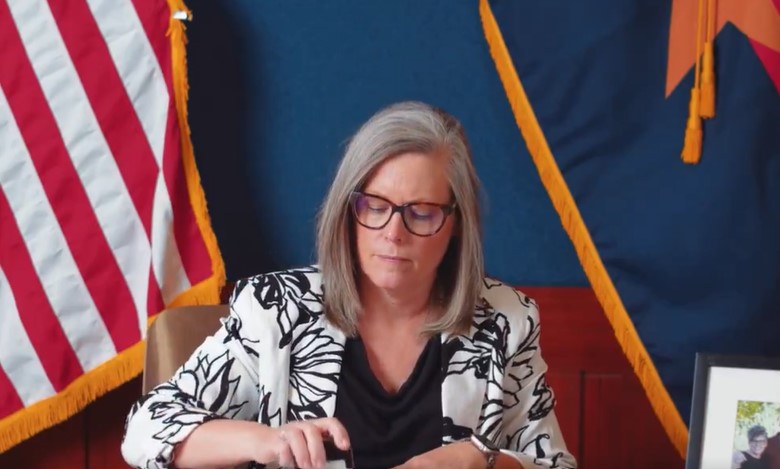
Gov. Katie Hobbs once again vetoed key election bills, blocking a Republican-backed reform package.
The governor rejected six Senate bills restricting election equipment internet connection, expanding chain-of-custody requirements, publicizing cast vote records and voter registration rolls, increasing anti-counterfeiting measures for election ballot vendors, clarifying voter registration standards for those residing temporarily out of state, and requiring disclosures for out-of-state circulators.
Similar proposals were included in bills passed by the legislature and vetoed by Hobbs last year.
The following were the veto explanations Hobbs gave for the election reform package:
SB 1037: Hobbs said further specifications regarding election equipment belonged in the Elections Procedures Manual, citing her 2025 veto of SB 1064
SB 1038: Hobbs claimed jeopardization of constitutional protections for voter privacy, citing her 2025 veto of SB 1280
SB 1040: Hobbs claimed that voter registration information could be redistributed or posted online, citing her 2025 veto of SB 1375
SB 1057: Hobbs claimed election officials would endure added expenses and complexities, citing her 2025 veto of SB 1123
SB 1060: Hobbs claimed the bill would prevent U.S. citizens from registering to vote, citing her 2025 veto of SB 1052.
SB 1429: Hobbs claimed U.S. citizens would be prevented from registering to vote, namely those born overseas to service members, citing her 2025 veto of SB 1052
Arizona Senate Republicans rejected Hobbs’ arguments as unconvincing, and accused the governor of “a troubling pattern” in which she has been intentionally “keeping Arizona voters in the dark.”
A press release from the caucus issued Tuesday made the case that voters should have more opportunities to verify the integrity of their elections — not be forced into their current position where Republicans say their only option is, allegedly, to trust the outcome.
State Sen. Mark Finchem (R-LD1) insisted that these election reforms were necessary to combat voter insecurities over election results.
“When questions about election results come up, and they always do, election officials and poll workers need real tools to show their work and defend the outcome,” said Finchem. “These vetoes strip away the very things that would help good people running elections prove the system is working. Public cast vote records, stronger ballot security, and clearer chain-of-custody rules aren’t about attacking anyone. They’re about giving the people who administer elections the ability to back up their results with evidence instead of just statements. Blocking these reforms year after year doesn’t build trust, it makes the job of defending Arizona’s elections harder.”
State Sen. Wendy Rogers (R-LD7), chair of the Senate Judiciary and Elections Committee, argued that Hobbs had also prevented additional means for voters to have hands-on oversight of their elections.
“She blocked public cast vote records, stronger anti-fraud features on ballots, tighter security on voting equipment, and more transparency on voter rolls and ballot measures. If everything is already so secure and trustworthy, why is she fighting so hard to keep voters from seeing more of it?” said Rogers. “These bills weren’t radical, they were basic safeguards. The governor keeps telling people to just trust the system while she works to keep it in the dark.”
AZ Free News is your #1 source for Arizona news and politics. You can send us news tips using this link.
Senate Republicans have advanced legislation aimed at strengthening private property rights and streamlining the removal of unlawful occupants from homes and residential properties.
Senate Bill 1426, sponsored by Senator Wendy Rogers (R-LD7), passed the legislature on May 26, 2026, and is now headed to the Governor’s desk.
The legislation strengthens Arizona’s forcible entry and detainer statutes by creating a clearer, faster process for property owners to reclaim their homes from squatters. SB 1426 defines specific conditions under which a person is considered an unauthorized occupant — including individuals who are not current or former tenants, immediate family members, or parties to any verbal or written agreements to occupy the property. It also established criteria for situations involving forcible entry into residential homes not open to the public.
Key provisions of the bill include:
Allowing courts to issue a writ of restitution immediately upon judgement in qualifying cases involving unauthorized occupants.
Directing the Arizona Supreme Court to adopt rules for the expeditious resolution of these claims.
Preserving all existing protections and remedies under the Arizona’s Residential Landlord and Tenant Act.
“Private property rights are not a suggestion; they are a cornerstone of our freedoms,” stated Senator Rogers. “If someone breaks into your home, moves into your property, and refuses to leave, the law should stand with the homeowner, not the unlawful occupant. That’s just common sense.”
Hats off to ALL the law enforcement, constables, sheriffs and our astute Senate legal policy advisor Brooke Huppenthal who got this DONE… protecting Arizonans! A wonderfully collaborative effort. 🔥 https://t.co/PGfb34MacE
Rogers emphasized that the bill resulted from extensive collaboration with stakeholders, lawmakers, and law enforcement. “This bill has been years in the making,” added Rogers. “The overwhelming support we’ve received, including from members of law enforcement who deal with these situations firsthand, shows just how badly these reforms are needed. Arizonans shouldn’t have to spend months fighting to reclaim property they already own. SB 1426 cuts through the red tape, closes loopholes that have been exploited for too long, and puts homeowners back where they belong—in control of their property. I’m proud to see this legislation finally reach the governor’s desk and hopeful she will sign it into law so Arizona families can receive the protections they deserve.”
The bill amends Arizona Revised Statutes sections 12-1171 and 12-1173. Among other updates, it expands the definition of forcible detainer to include unauthorized persons who refuse to leave a residential property after reasonable request from the owner or authorized agent, provided multiple safeguards are met.
Ethan Faverino is a reporter for AZ Free News. You can send him news tips using this link.
The Arizona House of Representatives approved Senate Bill 1041 with a bipartisan 41–11 vote on Wednesday, advancing legislation that would allow electronic monitoring in long-term care facilities.
According to a press release from AARP Arizona, the bill is intended to provide an additional option for families seeking to monitor the care of residents who may be unable to report abuse or neglect. The amended measure now returns to the Arizona Senate for approval.
SB 1041, if enacted, would permit residents or their representatives to install electronic monitoring devices, such as cameras, in long-term care settings under specified conditions.
The House vote follows recent media reports of an alleged abuse incident involving a long-term care worker and a resident with dementia
“This legislation gives families an additional option to help protect residents who may not be able to speak for themselves,” said Dana Marie Kennedy, state director of AARP Arizona, in the release.
Kennedy cited a recent incident involving the alleged abuse of a dementia patient, which, according to the release, “came to light only after the resident’s daughter placed a camera in her mother’s room and captured what occurred, leading to the worker’s arrest.”
According to AZ Family, Gamacy Gilles, 46, was arrested and accused of abusing a dementia patient at Grand Court Senior Living in Mesa on Sunday.
“That case highlights why SB 1041 matters,” Kennedy said, “Families should not have to depend on chance or learn after the fact that a loved one was harmed.”
Kennedy said the bill builds on several years of advocacy focused on improving safety and oversight in long-term care facilities. AARP Arizona has worked on related issues since 2017, according to the organization.
AARP Arizona also acknowledged the bill’s sponsor, Wendy Rogers (R-LD6), and its House sponsor, Quang Nguyen (R-LD1), and urged the Arizona Senate to approve the measure.
The Arizona Senate has passed a comprehensive package of transportation bills designed to enhance roadway safety, improve mobility, reduce congestion, and support long-term economic development across the state.
The measures, which advance critical infrastructure projects in both rural and urban areas, were approved this week without raising taxes or imposing new fees on Arizona drivers.
The legislation targets high-priority corridors experiencing pressure from population growth, increased freight traffic, and tourism demand. Key components of the package include targeted safety and capacity improvements on several major routes.
SB 1062, sponsored by Senator Wendy Rogers (R-LD7), appropriates $1,000,000 from the state general fund for FY26-27 to the Arizona Department of Transportation. The funding will support planning, design, construction, and right-of-way acquisition for an additional left-turn lane and related intersection improvements at the busy intersection of U.S. Route 60 and Superstition Mountain Drive in Pinal County. These enhancements aim to ease traffic flow and improve safety along this heavily traveled corridor.
SB 1063, also sponsored by Senator Rogers, allocates $11,100,000 for critical safety improvements on U.S. Route 70 between Mile Post 225 and Mile Post 301. This rural route serves commuters, freight operators, and emergency services in eastern Arizona. The project addresses longstanding roadway deficiencies to enhance travel reliability and safety for users across the region.
SB 1064, another measure sponsored by Senator Rogers, appropriates $3,000,000 from the state general fund in FY26-27 to the Arizona Department of Transportation for distribution to the City of Flagstaff. The funding will support the design and construction of improvements along U.S. Route 66 between I-40 and Milton Road. Under the bill, the Department of Transportation must enter into an intergovernmental agreement with the City of Flagstaff by September 15, 2026, and, if executed, distribute funds to the city by November 1, 2026. The project will help modernize infrastructure along one of northern Arizona’s busiest tourism and business corridors.
“Transportation is about safety, mobility, and economic opportunity,” stated Senator Rogers. “These projects address real pressure points on our highways, keep traffic moving, and support the continued growth of communities across Arizona.”
SB 1204, sponsored by Senator Janae Shamp (R-LD29), provides $5,500,000 for planning and environmental analysis for future interchange improvements at the intersection of U.S. Route 60 and Loop 303 in the rapidly growing West Valley. The area continues to see significant residential expansion and rising freight traffic.
“The West Valley is growing at an incredible pace, and our infrastructure has to keep up,” stated Senator Shamp. “This project prepares one of our most important corridors for the traffic we know is coming, improving daily commutes while supporting job growth and regional commerce, as well as preventing traffic fatalities.”
SB 1455, sponsored by Senate Appropriations, Transportation & Technology Committee Chair David Farnsworth (R-LD10), appropriates $500,000 for surveying, design, and study work on the future extension of State Route 24 east of Ironwood Drive in the East Valley—one of Arizona’s fastest growing regions.
“As families and businesses continue moving into the East Valley, transportation planning has to look ahead, not behind,” stated Senator Farnsworth. “Extending SR 24 will strengthen regional connectivity, reduce future congestion, and ensure infrastructure keeps pace with responsible growth.”
The measures now move to the Arizona House as part of the ongoing state budgeting process.
Ethan Faverino is a reporter for AZ Free News. You can send him news tips using this link.
Arizona Senate Republicans advanced legislation last week addressing insurance coverage requirements and the use of taxpayer funds for gender transition procedures.
The legislative package includes Senate Bills 1014 and 1177. The measures passed the Arizona Senate and now move to the House for further consideration.
SB 1014, sponsored by Sen. Janae Shamp (R-LD29), would require health insurers that provide coverage for gender transition procedures to also cover gender detransition procedures. The bill also requires certain healthcare providers who perform transition procedures to provide detransition care and establishes reporting requirements related to those services.
“If insurance companies are going to profit from covering gender transition procedures, they must also take responsibility for the continuum of care – including detransition,” Shamp said in a statement.
“We are hearing more and more stories from individuals who feel misled, who regret these procedures, and who are left without support when they seek to reverse course. That is unacceptable,” she added. “This legislation ensures that patients are not abandoned and that insurers cannot pick and choose coverage based on convenience or ideology. If they’re going to cover the front end, they must cover the consequences on the back end. That’s not just policy – that’s basic fairness and accountability.”
Under the legislation, insurers would be required to submit reports to the Arizona Department of Insurance and Financial Institutions detailing claims related to detransition procedures, including demographic and procedural information, while prohibiting the disclosure of personally identifiable data.
The proposal also includes provisions requiring state agencies to establish processes that allow individuals undergoing detransition to update official documents reflecting name, sex, or gender changes.
SB 1177, sponsored by Sen. Wendy Rogers (R-LD7), would prohibit the use of public funds for gender transition procedures.
The Senate Republican Caucus stated that both measures are intended to address healthcare policy and insurance practices related to gender transition and detransition services.
The bills are part of a broader set of proposals considered by the Arizona Legislature this session related to gender transition procedures and healthcare policy.
If approved by the House and signed into law, SB 1014 would become effective on January 1, 2027. If signed into law, SB 1177 would take effect on Arizona’s general effective date, typically 90 days after the Legislature adjourns for the session.