by Staff Reporter | Sep 16, 2026 | Education, News
By Staff Reporter |
Scottsdale Unified School District (SUSD) is contemplating more school closures as enrollment continues to decline.
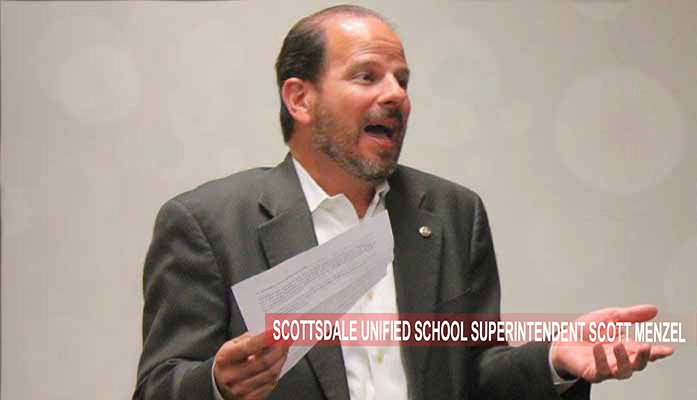
The SUSD governing board discussed their options going forward during Tuesday’s meeting. Superintendent Scott Menzel said “some very, very difficult decisions need to be made.”
Since 2010, SUSD enrollment has declined by 6,000 students and the district has only closed one school. SUSD also reported rising costs, competition against school choice programs for students, and underutilized facilities as key pressures on district conditions.
“We have far more physical space than we have students to fill that space,” said Menzel.
As part of Phase I of restructuring for “full and thriving schools,” SUSD decided to close Pima Elementary School and Echo Canyon School. The district is now in Phase II, where it will decide the fate of the Desert Mountain Learning Community and Copper Ridge School.
Capacity is below 50% at Laguna Elementary (43%), Desert Canyon Elementary (37%), and Cheyenne Traditional (11%).
SUSD is facing an open meetings violation complaint pertaining to these closed-door Phase II proceedings to determine closures and consolidations.
SUSD’s Phase II Design Advisory Team doesn’t permit the public to attend its meetings under its classification as a Superintendent Advisory Committee, but the complaint against the district contends that the team was formed at the direction of the governing board.
The Maricopa County Attorney’s Office (MCAO) is now handling the complaint after the Arizona Attorney General’s Office cited a potential conflict of interest.
The MCAO told AZ Free News that they just recently received the complaint from the attorney general on July 17, though it was filed back in April. Their office also told us that it couldn’t provide any additional details at this time since it is an open investigation.
The Phase II Design Advisory Team presented three options for further restructuring, in the following order of greatest to least preferences:
First-most preference: close Copper Ridge K-8 and Laguna Prep, redistribute boundaries, and a possible Desert Canyon K-8 merger. This option would impact 773 to 872 students and provide more than $2.7 million in savings.
Second-most preference: move Cheyenne Traditional K-8 to Copper Ridge, move Laguna Prep and Redfield to Cheyenne campus, and a potential Desert Canyon K-8 merger. This option would impact 2,126 to 2,232 students and provide nearly $2.6 million in savings.
Third-most preference: merge Desert Canyon schools into K-8 at Copper Ridge, close Laguna Prep, repurpose Desert Canyon campuses and Laguna Prep. This option would impact 2,132 to 2,153 students and provide nearly $2.7 million in savings.
Impact was measured beyond students moving into schools to include certain students at receiving schools.
All three options were presented with multiple potential models for restructuring boundaries.
Member Amy Carney attempted to explain that she believed closing schools was the “easy option,” to which she objected, but was interrupted multiple times by Governing Board Vice President Mike Sharkey and counsel with cautions that she shouldn’t express opinions about what the board should and shouldn’t do prior to community debate on the options.
Member Carine Werner urged agendizing a board discussion about the options before them prior to the board meeting in October in which they are scheduled to make a vote.
Member Matthew Pittinsky expressed caution against exploring other options beyond what the Phase II Design Advisory Team had presented to them; he characterized Carney’s position as “a very slippery slope.”
The district said it has not yet determined how it would repurpose any closed schools.
SUSD scheduled a special session to receive additional community input on September 22.
AZ Free News is your #1 source for Arizona news and politics. You can send us news tips using this link.
by Mike Bengert | Aug 31, 2026 | Opinion
By Mike Bengert |
At the June 23rd meeting, the three-member progressive majority of the Scottsdale Unified School District (SUDSD) Governing Board approved a $20,000 raise and contract extension for Dr. Menzel. His annual salary, not including stipends, bonuses, or other benefits, is now $245,000.
Member Amy Carney voted no. Explaining her vote, she said:
“My vote for extending the superintendent’s contract through 2029 is based on performance, accountability, and the financial realities facing our district. Scottsdale Unified School District continues to face significant challenges. Enrollments declined by approximately 6,000 students over the past decade, resulting in ongoing budget pressures and difficult decisions about closing and consolidating neighborhood schools. And at the same time, district academic performance indicators, including ACT scores, are still declining. This year, the superintendent received a lower evaluation score from the board than he received in previous years. Despite that decline, the board majority has approved both a salary increase and a three-year contract extension. I believe contract extensions should be earned through demonstrated results. When academic goals have not been met over a long span of time and a district is operating in a season of budget deficits, extending a contract is wrong. In most organizations, declining performance would not earn you additional compensation or a lengthened contract. Given those realities, I don’t believe giving our superintendent a raise or long-term contract extension is appropriate. My responsibility is to exercise sound stewardship of taxpayer dollars and hold district leadership accountable for results. So, for those reasons, my vote is a no.”
With this statement, Member Carney again showed the principled leadership she has brought to the Board throughout her four years serving SUSD students and parents.
For those who have been paying attention, this is not surprising.
Over the years, Member Carney has consistently challenged Menzel’s radical and destructive policies. For the past four years, she and outgoing Member Werner were the only voices of reason and common sense on the Board. Despite attacks and ridicule from progressive members who backed Menzel, they refused to serve as rubber stamps and would not be silenced.
Now let’s compare what the Menzel-aligned board members said about his new contract.
Menzel’s Followers on His Leadership
Explaining his vote to approve Menzel’s raise and contract extension, Member Pittinsky said in part:
“I think under Dr. Menzel’s leadership, we’re in the midst of several critical initiatives, all of which are multi-year, and he deserves the opportunity and we need his leadership and his expertise to see them through.”
According to Pittinsky, SUSD needs Menzel’s “leadership and expertise” to carry out “several critical initiatives,” including closing and consolidating schools. Yet those initiatives stem from actions Menzel took, with support from the Board majority, as part of his effort to disrupt and dismantle SUSD.
Then came comments from Governing Board President Dr. Lewis, another public education expert and former superintendent of the year.
Explaining her yes vote, Dr. Lewis said:
“Menzel’s asked frequently to serve and guide other superintendents around the state and that’s a compliment and a badge of honor for this district.”
She conveniently left out that Menzel is paid for his involvement in the Superintendents Collaborative Network with Grand Canyon University.
Dr. Lewis went on to say:
“I appreciate that he symbolizes who we are and what we’re about and is very in touch with some of the points of disagreement. And that takes a sophistication and complexity to weather while leaning in and taking the risk of leading.”
I’m not sure exactly what this means, especially the last sentence. But since Lewis and the other Menzel supporters on the Board routinely approve what Menzel wants, one interpretation is that, if Menzel “symbolizes who we are and what we’re about,” they also support his effort to “disrupt and dismantle” SUSD.
Menzel’s Followers on Enrollment
Pittinsky continued:
“I would point out that if you look at retention, which is the number of students who are in our schools that continue in our schools, every single year that Dr. Menzel has been superintendent, our enrollment has grown. We’ve had more than 100% of our students renew, which means we are attracting more students. Our enrollment trends are a function of starting kindergarten classes that are much smaller than graduating senior classes and that is largely a function of demographics. That is simple math.”
To try and understand Pittinskys’ statements about retention and enrollment trends, I went to the various presentations used by Menzel at the Board meetings.
Member Pittinsky’s statement that enrollment has grown under Menzel is proven wrong by Menzel’s own chart. Go to the 4/29/25 Enrollment Planning Study Session, slide #10, and see for yourself. From 2021 (21,455) to 2024 (20,930) enrollment has declined every year for a total of 525 (-2.4%) students. If you extend it to include 2025 (19,722) (from District Financial & Enrollment Overview 10/28/2025, slide #4) during period 2021-2025 the total drop in enrollment is 1,733, with 1,208 of that reduction happening between 2024 and 2025 alone. During Menzel’s tenure as superintendent the 1,733 enrollment reduction represents 29% of the total 6,032 between 2010 and 2025.
Again, using Menzel’s numbers, while SUSD enrollment was declining by 2.4% from 2021 to 2024, Great Hearts enrollment increased 5.6%. Must be demographics.
Pittinsky is arguing that Menzel should not be blamed for declining enrollment because kindergarten classes are smaller than graduation senior classes, due in large part to demographics. Yes, the math is simple, but it has followed the same pattern since 2010, with kindergarten enrollment lower than the number of graduating seniors every year by an average of over 500 students. But in the last five years under Menzel, we have graduated an average of over 700 more seniors than kindergarten students.
Explain again how we are attracting more students.
Menzel’s Followers on Capture Rate
During the February 11, 2025, board meeting, where the 2025-2026 budget was reviewed, Member Pittinsky commented that, due in part to demographics and the SUSD capture rate (currently 55%), the district would be “doing the same thing again in 12 months” without rethinking its expense structure.
At the February 2025 meeting, Pittinsky viewed the district low capture rate as a problem, but apparently now he views it as a positive while trying to defend his vote to give Menzel a raise and contract extension, he says:
“…if you look at our capture rate under Dr. Menzel, our capture rate has declined at the lowest rate of any of the recent superintendents.”
So, according to Pittinsky, while the SUSD capture rate under Menzel is bad and is declining, it is not as bad as other SUSD superintendents. This is the same logic Menzel uses when he says SUSD academic performance may be bad, but we still lead the state, a state where overall academic performance is a disaster.
I think this kind of logic is what they call spin.
Menzel’s Followers on Academic Goals
Pittinsky also notes that in this contract extension, the Board has set multi-year academic achievement goals for Menzel. But in his five years at SUSD, Menzel has not met a single academic goal. Why should this time be different? Goals may sound meaningful, but if they are repeatedly missed without consequences, they become little more than wasted time.
Menzel’s Followers on the State of the District
Pittinsky claims that according to surveys SUSD is a well-run district. Perhaps Pittinsky needs to review slides 30 and 31 from the 4/29/25 Enrollment Planning Study Session. Those exit surveys identified parents’ concerns about academic rigor, technology overuse, discipline and policy enforcement, bullying and safety, and dissatisfaction with school leadership.
According to Arizona Auditor General, a “review of the District’s data indicates that the District may be moving toward the highest-risk category.” The Auditor cites five areas at SUSD as high risk, including the change in weighted student count (-7.19% in 4 years), and four critical financial measures. You can review the details here Scottsdale Unified School District Approaching Highest Risk.
The Scottsdale Unified School District Spending Report shows that the District FY2025 instructional spending percentage of 54.0% is near the 25-year low of 53.6%
This story from March 2024 talks about the poor performance of 8th graders on the math testing with only 54% being proficient on the standardized math test. Look at the FY2025 8th grade math test scores on the Arizona Department of Education website here. You will see that only 49% of all 8th graders are proficient in math.
Does this sound like a well-run district?
Here is the bottom-line.
This November we have a choice. We need principled leadership on the SUSD Governing Board. We can’t afford to elect another member with no ties to the district other than being a Menzel supporter. Do your homework.
Mike Bengert is a husband, father, grandfather, and Scottsdale resident advocating for quality education in SUSD for over 30 years.
by Mike Bengert | Jun 16, 2026 | Opinion
By Mike Bengert |
I have opposed Scottsdale Unified School District (SUSD) Superintendent Dr. Menzel and his Governing Board allies since his arrival, and for good reason.
For decades, progressive education experts have promoted policies they said would raise achievement, often without any evidence. Whatever their intentions, the results have been disappointing and well documented.
After years of weak results, the No Child Left Behind (NCLB) Act of 2002 brought accountability-focused reform. By raising standards, measuring results, and targeting low-performing schools, it helped improve outcomes. Over its first decade, nearly half the states gained in 4th-grade reading and almost all improved in 4th-grade math.
Despite that progress, the “experts” replaced NCLB with Common Core and the Every Student Succeeds Act (ESSA). According to numbers from the National Assessment of Educational Progress (NAEP), that experiment has failed.
For 50 years, the National Center for Education Statistics has tracked performance through the NAEP, the Nation’s Report Card. The 2024 results reinforce concerns about the last decade of education policy and echo warnings first raised in 1983.
Let’s take a look at some of the key findings:
- Student proficiency has stagnated or declined since the early 1990s.
- Public school performance improved under NCLB, then stagnated after Common Core and declined under ESSA.
- From 2013 to 2024, charter schools were more stable across achievement levels.
- States with educator bargaining laws saw steeper reading declines, suggesting less instructional flexibility.
- Even with record per-pupil spending in some states, achievement remains low, showing funding alone is not enough.
One article summarizes it this way:
“The declines reflect the failures of more than a decade of educational policy—specifically, a retreat from expectations that began under the Common Core Standards and continued under the Every Student Succeeds Act.”
The data show that the pedagogies favored by education experts, including Dr. Menzel and the majority of the SUSD Governing Board, and have failed for decades.
Whole language failed as a reading method in the 1980s and 1990s. In its place, the Science of Reading emphasizes systematic, explicit phonics.
Common Core deemphasized cursive, and instruction declined after 2010 as its authors argued keyboarding mattered more. Another failure.
Was prioritizing laptops and keyboarding over handwriting the right choice?
Studies cited in Psychology Today say no.
“These studies show that handwriting is an essential cognitive process and a valuable intellectual activity that supports learning from the first day of school through advanced levels of education.”
“…children should first learn handwriting. Only after they become fully proficient—especially in complex narrative writing—should typing be introduced.”
One of the most consequential failures in recent U.S. education policy was the COVID-era closure of public schools, supported by education experts and teachers’ unions, which resulted in widespread learning loss. The shutdowns were not only costly and unnecessary but also lacked scientific support.
These are only a few examples of the failures of expert-led public education. In my view, the most damaging and still spreading nationwide, including in SUSD, is the Multi-Tiered System of Supports (MTSS).
In FY2020–2021, Dr. Menzel’s first year at SUSD, the Governing Board launched a future-focused strategic plan that made MTSS a key initiative.
In 2023, after a Scottsdale parent’s complaint, the Arizona Attorney General found that Menzel and the Governing Board’s strategic planning design team violated Open Meeting Law (OML). The AG did not punish the district or require rescission of the Strategic Plan, issuing only a warning, so the district still uses it today. Despite the OML training required by that finding, SUSD was hit with another OML complaint. Will Menzel ever learn?
MTSS began in the 1960s as a model for delivering mental health services in large urban areas. Schools later adapted it to identify students with special needs, and in the 2000s expanded it to all students.
MTSS requires schools to create support teams and policies that reshape how they handle behavior and learning. It has three tiers: tier one exposes all students to mental health awareness programs; tier two provides individual or group counseling for students identified by staff or self-referral; and tier three refers students needing more extensive services to outside professionals or clinics. In short, MTSS is designed to reshape school culture and organization around delivering mental health services.
Response to Intervention (RTI) focuses on academics, while Social-Emotional Learning (SEL) fits within MTSS on the premise that students cannot learn if social or emotional barriers block learning. Positive Behavioral Interventions and Supports (PBIS) and RTI were originally developed for special education students but are now used schoolwide.
MTSS spread gradually through U.S. public schools over two decades, with wider adoption in the 2010s.
Under Dr. Menzel’s leadership, SUSD has implemented MTSS and integrated PBIS, RTI, and SEL across the district, describing them as research-based and effective. The district also describes itself as a national leader in RTI.
Despite SUSD’s claims that MTSS is research-based and improves academic and social outcomes, the objective data from multiple studies do not support the claims.
Since 2010, SUSD enrollment has fallen by more than 6,000 students. Nearly 29% of that decline occurred during Dr. Menzel’s tenure from 2021 to 2025, including more than 1,200 students in the 2024–2025 school year alone.
Arizona Department of Education data show that since 2021, SUSD students have averaged 60% proficiency in English Language Arts, 56% in math, and 40% in science, with little improvement.
These numbers do not support the SUSD claims of better academics, improved discipline, or a more positive school culture at SUSD. If the claims were true, why have proficiencies remained stagnant during Menzel’s tenure?
While MTSS is simply a means of organizing and providing mental health services in schools, programs like PBIS address behavior through encouragement rather than disciplinary policies. Revising disciplinary policies was one of Menzel’s early priorities after coming into office.
Follow this link to SUSD’s policies, and you’ll notice that the policies JK Student Discipline, JKD Student Suspension, and JKE Expulsion of Students and their related regulations and exhibits were all updated December 12, 2023, within Menzel’s first couple of years at SUSD.
In May 2024, the SUSD Code of Conduct Committee made a presentation to the Board. Two points stand out: the committee appears to classify bringing a loaded gun to school as “a minor aggressive act” (slide 5 and item #2 on this list of 24 Shocking Moments of 2024)
Slides 6 and 7 emphasize MTSS, SUSD’s core discipline framework.
While the entire 24 Shocking Moments of 2024 list is worth reading, pay particular attention to #3, #5, #9, #10, #13, #16, #20, and #21. They illustrate what Menzel calls better academics, improved discipline, and a more positive school culture at SUSD.
Consistent with that list, exit interviews show parents most often leave SUSD over weak academics, excessive technology use, poor discipline and policy enforcement, bullying and safety concerns, and dissatisfaction with leadership.
MTSS also carries costs: it requires more master’s-level non-teaching staff and uses class time for mental health programming. Along with PBIS, RTI, and SEL, it has shifted resources from classroom instruction to non-academic support services.
According to the AZ Auditor General’s SUSD spending report, SUSD academic instructional spending fell from nearly 64% of the operating budget in 2004 to 54% in 2025. In the five years since Menzel was hired, non-academic support spending rose 1.9% while instructional spending fell 2.3%—a swing of more than 4 points. In 2025, SUSD spent $1,449 per pupil on support services, about 21% of its instructional spending ($6,959), up from $871 and 16% in 2020.
For years, education experts have promoted school-based mental health programs and SEL as ways to improve academics. But multiple studies—including a 2024 long-term study of nearly 500,000 Minnesota students—found no meaningful gains in test scores, attendance, or other academic outcomes. Research from Europe, Canada, Australia, and Latin America reaches the same conclusion: SEL may help behavior or social-emotional skills in some cases, but it does not reliably raise academic performance. (For more, see here.)
Schools often use universal mental health screenings to identify students for intervention. But without adequate safeguards and expertise, these screenings can produce false-positive rates as high as 90%, with potentially lasting consequences.
SUSD says it uses universal screening. Arizona Revised Statutes 15-104 and 36-2272 require written parental consent before school mental health screening. If your child was screened without your consent, you should contact the Arizona Attorney General’s Office and file a complaint.
Since March 2024, there has been no statutory exemption allowing school-based behavioral workers to practice behavioral health without a license. If you believe your child was subjected to behavioral health services at SUSD through MTSS or otherwise, you can file a complaint with the Arizona Board of Behavioral Health Examiners here.
Dr. Menzel is on a mission to disrupt and destroy SUSD, and he should be stopped.
If you think things can’t get much worse in SUSD, or in public education more broadly, just wait until the experts implement AI in the curriculum. We should build real intelligence in students before turning to artificial intelligence.
Unfortunately, the SUSD staff recently attended a 2-day event to “level up” and attend 66 engaging learning sessions focused on innovative instructional practices, student support, technology integration, and more. I can’t wait!
After researching and writing this piece, I am more convinced than ever that focusing on and supporting truly evidence-based academics and fiscal responsibility in our schools, puts me on the right side of the issues.
Wherever you live and whatever school your children attend, if you care about your child’s education, please visit Restore Parental Rights in Education and support its mission to “awaken and empower everyday citizens who advocate for excellence in K-12 education.”
Reversing the decline of public education in America will require people to unite and act together.
Mike Bengert is a husband, father, grandfather, and Scottsdale resident advocating for quality education in SUSD for over 30 years.
by Staff Reporter | May 17, 2026 | Education, News
By Staff Reporter |
Scottsdale Unified School District (SUSD) is once again facing another Open Meeting Law complaint over a non-public advisory committee.
The complaint, filed last month with the Arizona Attorney General’s Office, claims that SUSD Superintendent Scott Menzel has again violated Open Meeting Law during his phased approach to closing schools.
The Scottsdale resident who filed the complaint told AZ Free News that he felt compelled to look into SUSD’s process for school closures in response to the community shock over the governing board’s decision to close Pima Elementary School and Echo Canyon School last December.
The closures brought $2.5 million in savings to the district. SUSD began looking into the closing and consolidating of schools, among other solutions, to address an $8 million budget deficit driven by declining enrollment.
This latest complaint claims that SUSD’s non-public Phase II Design Advisory Team was formed at the direction of the board and therefore required to be open to the public. Superintendent Menzel encouraged the governing board to authorize the design advisory team during a regular governing board meeting last November.
The next month, during the same meeting to close the Pima and Echo Canyon schools, the governing board discussed the design advisory team’s formation. In that meeting, Menzel and SUSD governing board president Donna Lewis strategized on ways for the board to direct the design advisory team’s formation but style it as a superintendent’s committee. The board indicated that it wanted Menzel to move forward with the team, but didn’t take a vote to create the team.
The design advisory team operates under the classification of a Superintendent Advisory Committee, which is exempt from Open Meeting Law requirements. The newly filed complaint alleges that the governing board’s involvement in the creation of the Phase II Design Advisory Team makes that classification untrue.
The Phase II Design Advisory Team is charged with crafting recommendations on schools to the board, including further closures or consolidations.
The resident behind the complaint told AZ Free News that he filed against the district after SUSD personnel denied him entry to one of the design advisory team’s meetings in person.
SUSD told AZ Free News that it hasn’t received notification of this complaint.
SUSD got into trouble last year for similar non-public advisory committees.
Last summer, Attorney General Kris Mayes found SUSD had violated Open Meeting Law for using advisory committees in a manner similar to the alleged violation outlined in the complaint.
“The Open Meeting Law does not permit a governing board to evade the public meeting requirements by ‘informally’ forming or establishing, or by directing a superintendent to establish, a committee to perform work that would otherwise need to be conducted in public,” stated Mayes. “[W]e caution against an overly narrow reading of the law focused exclusively on the circumstances of a committee’s creation.”
The Phase II Design Advisory Team has held five meetings since it began in March. The team consists of two facilitators, Karen Benson and Quintin Boyce, and 45 members.
28 parents or guardians on the team represent current students at 11 schools: Anasazi Elementary School, Cheyenne Traditional School, Copper Ridge School, Desert Canyon Elementary School, Desert Canyon Middle School, Desert Canyon Mountain High School, Redfield Elementary School, Laguna Elementary School, Saguaro Middle School, Mountainside Middle School, and Mohave Middle School.
Other team members include eight SUSD staff members, six homeowners in the community, one community organization member, and one university partner.
AZ Free News is your #1 source for Arizona news and politics. You can send us news tips using this link.
by Arman Sidhu | May 16, 2026 | Opinion
By Arman Sidhu |
On May 12, the Scottsdale Unified School District (SUSD) Governing Board voted 5-0 to place a $375 million capital bond on the November 2026 ballot. Five months earlier, the same body voted 3-2 to close Pima Elementary and Echo Canyon K-8 over declining enrollment and its poor fiscal management.
SUSD has lost roughly 6,250 students since 2010-11, a 24% decline. Applied Economics, the district’s own demographer, projects another 2,400-student loss by 2035-36. Six additional campuses sit on the Phase II repurposing list and are likely the next to close. Yet, the district wants a bond 64% larger than the last one approved by voters to renovate buildings it is in the process of closing.
In 2019, Pima was rebuilt with funds from the last school bond approved in 2016 to boost the school’s enrollment. Seven years later, the Pima renovations are a startling example of hubris that comes at a colossal cost to taxpayers.
The Arizona Auditor General’s January 2026 financial risk analysis flags SUSD on five high-risk measures:
- State-funded enrollment is down 7.19% over four years, which directly reduces the per-pupil dollars the district receives.
- The day-to-day operating reserve lost nearly half its value in a single year, falling from $18.86 million to $10.60 million.
- SUSD spent more than it took in two years running, by 4.14% in FY25 and 8.52% in FY24.
- The General Fund savings account fell 25% in FY25 and 31% in FY24, a combined $28 million drawdown.
- SUSD pulled $4.2 million of its state capital aid, money meant for buildings, technology, and buses, and used it to cover payroll and operations instead.
In other words, SUSD is so operationally distressed that it is cannibalizing its capital fund to make payroll. A bond cannot fix that. By law, bond proceeds can only be spent on capital projects, not on salaries or classroom costs.
If this bond is approved, SUSD will still have to make cuts, most likely to staff while throwing away money to maintain spaces it cannot afford to operate.
This pattern is statewide. Chandler Unified has similarly delayed school closures and narrowly forced through a bond in 2025 after a 2024 bond request led to the district’s first school bond rejection in 30 years. Kyrene passed a $161 million bond in 2023 and is still closing six schools. Bonds do not solve enrollment declines, nor do they save jobs. Scottsdale Governing Board member Pittinsky put it plainly in the December 2025 closure vote: “SUSD is nearly 25% smaller than we were 15 years ago, yet we have closed only one program in that timeframe.”
The political machinery behind school bonds runs on the profit motives of vendors and not on the genuine needs of students, families, or the school district. The Arizona Center for Investigative Reporting documented that three architects, three construction firms, and three subcontractors captured more than half of Arizona K-12 contracts from 2013 to 2016, doing so through hundreds of thousands in political contributions to pro-bond PACs statewide.
SUSD voters have seen the worst side of school bonds co-opted by the greed and financial interests of vendors. In 2018, former Superintendent Denise Birdwell steered architectural work to Hunt and Caraway without competitive bidding, accepted $30,000 in payments during contract negotiations, and appointed an unlicensed architect with a prior felony theft conviction on the contractor selection committee. She was later indicted on 18 felony counts. Yet, the same conditions that enabled this malfeasance still remain in place with no real guardrails to protect taxpayers from the too cozy relationship between district leaders and vendors.
Before SUSD asks taxpayers for $375 million, the Governing Board and Superintendent Scott Menzel owe the district three deliverables that address the Auditor General’s findings.
- Complete Phase II closures before any new funding request.
- Align capital planning to the 2035-36 enrollment projection of 17,340 students.
- Cut district-level overhead and stop diverting capital to operations. Non-instructional positions in SUSD grew while enrollment fell and instructional spending dropped to a 20-year low at 54.0%.
These actions would constitute rightsizing in earnest through fewer schools, a smaller operational footprint, and a proportionally smaller payroll.
A district carrying five high-risk flags from the Auditor General has not earned the right to ask voters for $375 million. Scottsdale voters would be well-advised to reject the request this fall.
Arman Sidhu is a lifelong Arizonan, a professional educator, and a doctoral candidate at Arizona State University, where his research focuses on school bonds and K-12 education funding. The opinions presented are solely his own.