by Staff Reporter | Jun 4, 2026 | News
By Staff Reporter |
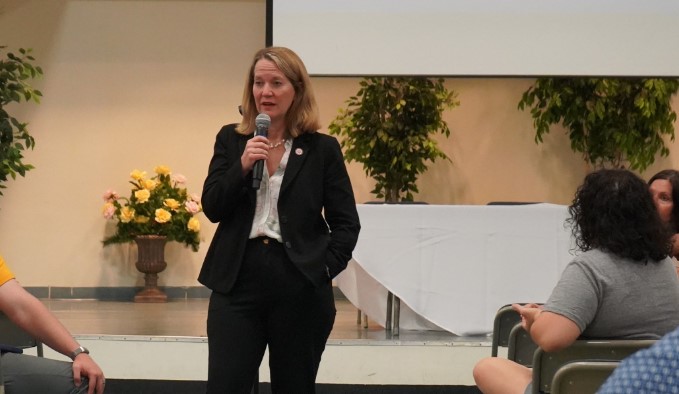
Arizona’s public utilities governing body is exploring its options for legal action against Attorney General Kris Mayes.
The Arizona Corporation Commission (ACC) accused Mayes of illegally impeding its ratemaking authority for political gain. Mayes is running for reelection. Although she has no primary candidates, she will either have to face off against one of two Republicans: Arizona Senate President Warren Petersen (R-LD14) or Air Force reservist prosecutor Rodney Glassman.
As part of a commission press release sent out on Monday, ACC Chairman Nick Myers issued a statement saying the ACC had to “force” Mayes to fulfill her attorney general duties toward the commission.
“She was unlawfully pocket vetoing our commission ratemaking authority by delaying the process pertaining to the repeal of the natural gas subsidies,” said Myers.
Myers also accused Mayes of “play[ing] politics,” naming Mayes’ disapproval of the ACC’s appeal of the Renewable Energy Standard and Tariff (REST) rules. The ACC submitted that appeal and one other for the Gas Utility Energy Efficiency Standard (Gas EE) rules to Mayes’ office for review.
“These costly mandates forced Arizona ratepayers to pay almost $4 billion more than they should have over the last 20 years,” said Myers. “The commission will continue to protect the ratepayers and will not allow the Attorney General to arbitrarily increase rates against the decision of the commission.”
In 2006, the ACC gave utility companies a new mandate through the establishment of the REST rules: generate 15 percent of their energy from renewable resources by 2025, and submit annual implementation plans describing compliance. Mayes was on the commission at the time.
The ACC unanimously voted to repeal the REST rules in March, citing in part a $2.3 billion financial burden for compliance passed on to customers through surcharges.
The ACC said in its most recent press release that Mayes had gone beyond her statutory authority — which they described as ministerial — since she had conducted a substantive review of ACC’s ratemaking rules authority. ACC contends their ratemaking rules authority is constitutionally exclusive and leaves no room for interpretation by the attorney general.
In her denial of the ACC appeal, Mayes claimed in a letter to the commission that it had violated its own rulemaking procedures. The commission denied this assessment and accused Mayes of vetoing rulemaking based on policy disagreement.
Mayes approved those impacted rules which mandated renewable energies while she was on the ACC.
The ACC called these “unnecessary subsidies,” and claimed Mayes’ denial of the rule appeal was a cover for her alleged ulterior motive: preventing the ACC from undoing her work to push renewables.
“As a commissioner, Kris Mayes voted for these expensive subsidies that have cost ratepayers billions of dollars,” said Commissioner Kevin Thompson. “It is an abuse of her position as Attorney General to use the ministerial rule approval process to substantively veto our lawfully enacted ratemaking rule repeal. Every day that goes by, she is responsible for increasing costs on ratepayers.”
This is the latest development in an ongoing power struggle between Mayes and the ACC.
Back in 2024, Mayes sued the ACC over its decision to reverse a Power Plant and Transmission Line Siting Committee order regarding environmental oversight for a UniSource Energy power plant project. A superior court judge ruled against the ACC last October.
And in April, Mayes hit the ACC with three rehearing requests for three different alleged issues.
Mayes spokesman Richie Taylor told the Arizona Capitol Times that Mayes had to take on ACC responsibilities because the ACC was giving “sweetheart deals” to data centers while raising utility rates on senior citizens.
“Chairman Myers should focus on fulfilling the constitutional obligations of the Commission on behalf of Arizonans so the Attorney General doesn’t have to step in and do it for them,” said Taylor.
AZ Free News is your #1 source for Arizona news and politics. You can send us news tips using this link.
by Matthew Holloway | May 23, 2026 | News
By Matthew Holloway |
The Arizona Corporation Commission (ACC) is urging residents to contact their electric utility providers now as summer temperatures rise and higher electricity bills are expected to impact households across the state.
According to a press release, the ACC warned that triple-digit temperatures and increased air conditioning use typically drive significant month-to-month increases in electricity bills beginning in June and continuing through the summer months.
The commission said higher summer energy usage can create affordability challenges for households and businesses and encouraged customers concerned about paying utility bills to reach out to their electric providers before balances become unmanageable. Utilities may offer payment arrangements, budget billing programs, and financial assistance options to eligible customers.
“As we head into summer, I encourage ratepayers to explore ways to manage their energy use and to contact their electric utility if they need financial assistance,” Arizona Corporation Commission Chairman Nick Myers said. “The Commission’s responsibility is to ensure rates are just and reasonable, while ratepayers have the ability to control their monthly bills through their energy usage.”
Commissioner Lea Márquez Peterson urged customers to prepare early for summer utility costs and highlighted the commission’s seasonal protections against service disconnections.
“It’s important that our regulated utility customers prepare now for the heat of Arizona’s summer months by reaching out to their utility to learn about energy saving tips and programs that can help during financial hardships,” Márquez Peterson said. “Remember – the ACC has approved a disconnection moratorium from June 1 – October 15 to ensure customers are not disconnected for non-payment and can work out a payment plan.”
The ACC said weather remains the largest driver of summer electricity costs and advised consumers not to delay seeking assistance if they anticipate difficulty paying upcoming bills. The commission said early communication with utility providers can help customers access support programs and avoid financial hardship.
The commission also provided several energy-saving recommendations for Arizona residents during the summer months, including keeping blinds and curtains closed, using fans for personal cooling, limiting use of high-energy appliances during peak hours, regularly replacing HVAC filters, and investing in smart thermostats or energy-efficient appliances when possible.
According to the ACC, several utility providers and assistance organizations offer relief programs for qualifying customers. Those include Arizona Public Service’s Energy Support Program (ESP) and Crisis Bill Assistance (CBA) resources, Salt River Project assistance programs, Tucson Electric Power’s Power AZ program, UniSource Energy Services payment assistance, and programs administered through Wildfire and community action agencies.
APS is currently seeking a residential rate increase from the ACC of approximately 14.5%. Residents packed a recent hearing to oppose the proposal, while Administrative Law Judge Charles Hains began reviewing testimony and evidence that will inform a recommended rate decision for commissioners to consider.
In a statement to the outlet, APS defended the increase, stating that “… over the past five years, APS has experienced rapidly rising costs of equipment needed to deliver power to customers. One example is transformer costs which are, on average, 49–90% higher now than when our rates were last set.”
Matthew Holloway is a senior reporter for AZ Free News. Follow him on X for his latest stories, or email tips to Matthew@azfreenews.com.
by Matthew Holloway | Apr 13, 2026 | News
By Matthew Holloway |
The Arizona Corporation Commission approved a temporary bill credit for UNS Electric customers, expected to reduce monthly costs during peak summer usage.
According to a Wednesday press release, the Commission approved an $18.50 monthly credit for customers with average usage of 884 kilowatt-hours. The credit will be in effect from May 1, 2026, through December 31, 2026. The measure was approved in a 5–0 vote during the Commission’s open meeting on April 8.
The adjustment is tied to the Purchased Power and Fuel Adjustment Clause (PPFAC), a mechanism which utilities use to recover fuel and purchased power costs. The Commission stated that utilities do not earn a profit on expenses recovered through the PPFAC.
Commissioner Kevin Thompson said in the release that the credit follows the Commission’s earlier action to address a significant under-collection in the PPFAC balance.
In May 2023, the Commission approved a temporary surcharge to reduce the balance, which was accruing interest costs that were being passed on to ratepayers.
“The Commission had to make a tough vote in 2023 to pay down significant fuel cost debt that had been allowed to build as a result of circumstances outside the utilities’ control,” Thompson said. “As a result of the temporary surcharge, UNS was able to rapidly pay down the debt and save ratepayers money in the long run. Asking ratepayers to pay more in their monthly bills to pay down costs is never an easy task, but this solution removes the massive debt hanging over the heads of the ratepayers and provides additional bill relief when customers need it most.”
The surcharge was eliminated in December 2025 after the balance was paid down. The Commission said that the change reduced the average residential customer’s bill by approximately $20 per month.
Following the removal of the surcharge, the utility reported a positive PPFAC balance of $5.6 million in mid-February 2026, which has continued to grow.
According to the release, UNS Electric began experiencing under-collection in October 2021, which grew to approximately $48 million. The deficit was attributed to increased natural gas prices during the COVID-19 pandemic, extreme weather events including Winter Storm Uri, and global energy market impacts related to the Russian invasion of Ukraine.
“As we are approaching the summer heat, I am glad the Commission was able to provide some rate relief for customers in Kingman, Lake Havasu, Nogales, and other smaller communities in Mohave and Santa Cruz counties,” Chairman Nick Myers said in a statement.
With the new temporary credit in place, the Commission said a typical residential customer is expected to see an average monthly reduction of approximately $38 this summer compared to the same period last year.
“As regulators we often have to make difficult decisions as we balance the various interests involved in ratemaking,” Myers said. “In this case, I am pleased that our difficult decision to address the PPFAC in 2023 has resolved the problem and resulted in a meaningful reduction in rates for UNSE customers through the end of the year.”
Matthew Holloway is a senior reporter for AZ Free News. Follow him on X for his latest stories, or email tips to Matthew@azfreenews.com.
by Matthew Holloway | Mar 12, 2026 | News
By Matthew Holloway |
The Arizona Corporation Commission (ACC) voted unanimously to repeal the state’s Renewable Energy Standard and Tariff (REST) rules during its March 4 open meeting, ending a regulatory framework that has governed renewable energy requirements for nearly two decades.
The REST rules, first adopted by the commission in 2006, required regulated electric utilities to obtain a specified portion of their retail electricity sales from renewable resources. The standard began at 1.25 percent in 2006 and increased incrementally until reaching 15 percent after 2024, with a portion of the requirement reserved for distributed resources such as rooftop solar.
According to the commission, the repeal finalizes a rulemaking process that began in January 2024 under the commission’s rulemaking docket RE-00000A-24-0026.
ACC Chairman Nick Myers joined the other commissioners in the unanimous 5-0 vote. In a statement following the decision, Myers said the mandates were no longer aligned with current conditions in Arizona’s electricity market.
Commission officials said the REST framework achieved its original goal of expanding renewable energy generation in Arizona. The state’s major regulated utilities, Arizona Public Service (APS), Tucson Electric Power (TEP), and UNS Electric (UNSE), have met or exceeded the renewable energy targets established under the rules.
Myers added, “The reality is that the renewable energy landscape in Arizona has changed dramatically in the past 20 years.”
Since the program began, the utilities have collected more than $2.3 billion in REST surcharges from customers to fund renewable programs and incentives, according to the commission. More than $779 million of that amount was distributed as incentives for renewable energy programs approved by the ACC. According to the commission, that amount does not include “above-market amounts paid out to rooftop solar customers under net metering and the current RCP approach.”
Commissioners also cited long-term power contracts entered into under the mandate as contributing to costs borne by ratepayers. One example highlighted by the commission involves a 30-year solar power agreement between APS and the Solana Generating Station, under which APS customers have paid approximately $274.3 million above market prices for power to date.
“The Solana plant is basically providing energy at 15 cents a kilowatt-hour when the rest of solar these days are around 2 to 2 1/2 cents a kilowatt-hour,” Myers said during the meeting.
Under the REST rules, utilities were required to obtain at least 15 percent of their electricity from renewable sources by 2025, with 30 percent of that renewable requirement coming from distributed sources such as rooftop solar.
Myers said utilities will continue to procure energy resources through competitive procurement processes designed to identify cost-effective and reliable power generation options.
Arizona Attorney General Kris Mayes released a statement in September and sent a letter to the commission opposing the repeal. During her tenure on the commission from 2003-2010, Mayes, then holding office as a Republican, participated in the adoption of the REST Rules and Arizona’s Electric Energy Efficiency Standard Rules (EEES Rules).
The Arizona Corporation Commission regulates the state’s investor-owned utilities and has authority over energy policy decisions such as renewable energy standards and utility rate structures.
Matthew Holloway is a senior reporter for AZ Free News. Follow him on X for his latest stories, or email tips to Matthew@azfreenews.com.
by Staff Reporter | Mar 8, 2026 | News
By Staff Reporter |
A retirement community in Eloy had its water rates raised significantly through a recent Arizona Corporation Commission (ACC) vote.
The ACC approved the rate increases narrowly, 3-2, during its meeting on Wednesday. Commissioners Kevin Thompson and Lea Marquez Peterson voted against the rate increases.
Marquez Peterson said the utility companies should have done more to conduct public outreach prior to engaging in the rate increase process.
“We received many public comments concerning the dramatic rate increase though an increase was certainly expected from a utility who hadn’t filed a rate case in over 25 years. I believe that more could have been done to promote gradualism in the sewer rate case,” said Marquez Peterson.
Picacho Water and Picacho Sewer Company serve the retirement community Robson Ranch, located south of Casa Grande. The community has historically enjoyed low water and sewer rates due mainly to subsidization from the developer behind the community, Robson Companies. The developer absorbed the cost of increased expenses rather than pass them onto the residents.
The rate increases would result in increases of just shy of $7 for water and $65 for sewer, for a combined increase of about $76. No rate changes have occurred since the 1990s. For years, residents paid an average of about $30 per month for water and $42 per month for sewer services.
ACC declined to impose a phased increase of rates.
Commissioner Thompson said that was where the rate increase plan lost his vote.
“For decades, the developer chose to operate the water utility at a loss. No one disputes that the new owner is entitled to recover lost revenues and earn a reasonable profit on those investments,” said Thompson. “But rate increases should adhere to principles of gradualism, and as a regulator, I felt I had a duty to advocate for a resolution that strikes an appropriate balance between all parties and not subject these ratepayers to the consequences of business decisions that were no fault of their own.”
The decision to adjust utility rates after nearly 30 years came after another company, JW Water, acquired both companies from Robson Companies in 2024.
Robson Ranch residents spoke out against the rate increases during Wednesday’s meeting. They accused JW Water of seeking to maximize shareholder return.
The residents also blamed Robson Companies for covering increased expenses rather than passing the cost along to the customers. Residents said they had no knowledge their rates were being subsidized all those years; they said low rates were marketed as a perk of buying within the community.
Jay Shapiro, speaking on behalf of Picacho Water and Picacho Sewer during the meeting, said the rate case was “difficult for everybody involved” and that no one would be happy with the final results.
Shapiro denied exploitation of customers. He argued the longstanding rates were no longer recovering the cost of service. He said the rates were “just and reasonable,” and not a result of “price gouging” to benefit foreign investors. Shapiro accused critics of the rate increases of conducting a smear campaign.
“Rate shock was inevitable — rate shock sure sucks,” said Shapiro. “It’s an unintended consequence of some rate filings.”
Chairman Nick Myers agreed with JW Water that these rate increases were a necessity for services provided, not a means of making up for lost profits.
“Though I personally would prefer not to approve rate increases, we have a constitutional duty as Commissioners to set just and reasonable rates,” said Myers.
Vice Chair Rachel Walden concurred.
“JW Water is NOT recovering revenue losses over the course of the past 25+ years, nor are they recovering the purchase price of the utilities,” said Walden. “This rate case is ONLY about setting rates to cover the cost of service. I put forth a verbal amendment that was supported in full to ensure that future growth will pay for itself.”
AZ Free News is your #1 source for Arizona news and politics. You can send us news tips using this link.