by Matthew Holloway | Oct 19, 2025 | News
By Matthew Holloway |
The U.S. Department of Justice (DOJ) has filed a brief in support of Arizona’s law requiring proof of citizenship to vote. The intervention comes in Mi Familia Vota v. Warren Petersen, a lawsuit filed by leftist groups against two laws passed by the Republican-controlled Arizona Legislature in 2022.
The laws require voters registering via the state form to provide documentary proof of U.S. citizenship to participate in state and local elections. The DOJ’s brief backs Senate President Warren Petersen’s defense of the laws following a Ninth Circuit Court of Appeals ruling that invalidated key provisions. The brief argues that Arizona’s birthplace attestation requirement “does not violate the Materiality Provision because it is generally important that an election official would consider important to the process of determining an applicant’s eligibility to vote.”
“We are thankful to again have a White House and Department of Justice committed to the rule of law and fair elections,” Petersen said in a statement. “The DOJ’s brief is appreciated in our fight to uphold a commonsense law and the will of the people. Given the clear precedent handed down from the U.S. Supreme Court, we are confident we will ultimately prevail. With the continued absence of our governor and attorney general, thankfully, the Arizona Legislature is again picking up the slack and is returning to our nation’s high court to defend election integrity.”
The case traces back to challenges by Mi Familia Vota and other groups, including some based outside Arizona, against House Bill 2492. The law bars enhances the legal guardrails of the Arizona voter registration process, ensuring that proof of citizenship is required to ensure only U.S. citizens are voting in our elections.
In August 2024, a three-judge Ninth Circuit panel vacated an emergency stay previously issued by another panel of the court. That decision permitted Arizona residents to register using the state form without proof of citizenship for federal races, such as U.S. president and Congress.
Petersen then sought emergency relief from the U.S. Supreme Court, which affirmed Arizona’s authority to reject incomplete registrations, marking the last binding order in the dispute until the Ninth Circuit’s latest deviation.
Eleven judges dissented from the Ninth Circuit’s most-recent majority opinion, saying, “Republican government serves as the keystone of the Constitution. In such a government, a majority of citizens who lawfully vote determines who represents us in the White House, Congress, and state legislatures. Courts must therefore defend the franchise—both by protecting the right of all citizens to vote, and by ensuring non-citizens do not vote. Arizona passed laws to protect the franchise… Sadly, the panel majority opinion undermines republican government, shreds federalism and the separation of powers, and imperils free and fair elections.”
The case now heads back to the U.S. Supreme Court for potential review, where Arizona will seek to enforce its citizenship verification requirements.
Matthew Holloway is a senior reporter for AZ Free News. Follow him on X for his latest stories, or email tips to Matthew@azfreenews.com.
by Staff Reporter | Apr 13, 2025 | News
By Staff Reporter |
The Trump administration will no longer continue its legal challenge to Arizona’s documentary proof of citizenship (DPOC) laws.
The Department of Justice (DOJ) filed a brief on Tuesday motioning to drop the case.
Assistant Attorney General Harmeet Dhillon filed the brief the very day after she was sworn into her position within the Civil Rights Division, alongside the controversial Interim Attorney for the United States Attorney’s Office for the District of Arizona, Timothy Courchaine.
Senate President Warren Petersen called the development “a major win for election integrity and the rule of law” in a statement Wednesday. Petersen previously submitted a letter to the DOJ requesting they drop the case.
“The @azsenategop and @azhousegop will continue to defend this law against the special interest groups challenging it,” said Petersen.
Petersen submitted his request letter to Attorney General Pam Bondi in mid-February.
The case, Mi Familia Vota v. Fontes, is before the Ninth Circuit Court of Appeals.
Arizona’s DPOC laws required automatic rejection of Arizona state form registration submissions lacking DPOC, prohibited individuals who hadn’t provided DPOC from voting for a president or returning a ballot by mail, and added mandatory fields to the state registration form for a registrant’s birthplace and a checkbox confirmation of the applicant’s U.S. citizenship.
Last August, the Ninth Circuit Court of Appeals ruled Arizona would have to accept state voter registration forms without DPOC.
Tuesday’s motion by the DOJ was the latest in the Trump administration’s efforts to cease legal action against states’ election laws.
Last month, the DOJ dropped multiple election-related lawsuits in Texas, Georgia, and Louisiana initiated under the Biden administration. Those lawsuits opposed voting maps and election integrity initiatives, respectively.
President Donald Trump and his administration have also taken steps to require proof of citizenship in elections, prompting resistance from the state’s top Democratic leaders.
Arizona Secretary of State Adrian Fontes, alongside Attorney General Kris Mayes, filed a lawsuit against the Trump administration over President Donald Trump’s recent executive order requiring DPOC to register to vote in federal elections as well as requiring all ballots to be received by Election Day.
Last week, Mayes and Fontes held a joint press conference announcing their lawsuit and accusing Trump of “unconstitutional intrusion” on states’ rights and congressional authority regarding elections. The pair want Trump to go through — not around — Congress for any election law changes.
“If President Trump wanted to make laws then he should have run for congress where the U.S. Constitution says that work is done,” said Fontes. “If the President wants to reshape our elections, he must propose realistic bipartisan legislation in Congress instead of forcing states into unfunded mandates through unlawful executive orders.”
“Clearly, Trump only supports state’s rights when it suits him,” said Mayes.
Last month in another case pertaining to DPOC, the Arizona Court of Appeals ruled against the Elections Procedure Manual (EPM) produced by Secretary of State Adrian Fontes. Fontes’ EPM would have allowed voters who failed to submit or couldn’t achieve verification of their DPOC.
AZ Free News is your #1 source for Arizona news and politics. You can send us news tips using this link.
by AZ Free Enterprise Club | Jul 26, 2024 | Opinion
By the Arizona Free Enterprise Club |
The surge of border crossings continues. There is an election in just over 3 months. Many voters want to know—can illegals vote?
Obviously, it’s illegal for non-citizens to vote. The real question is whether voters must prove their citizenship prior to voting. This discussion has culminated in the U.S. House passing the SAVE Act earlier this month. But with near unanimous Democrat opposition, a federal proof of citizenship requirement has stalled in Congress.
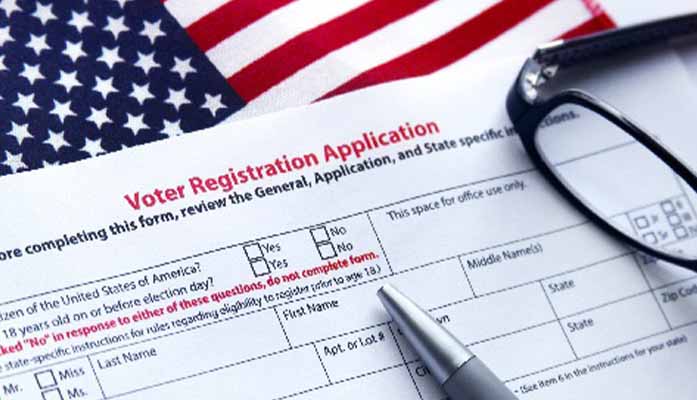
As both a border and swing state, Arizona is center stage in this national discussion. Even Elon Musk chimed in by sharing an image of our voter registration form that clearly states “proof of citizenship” is not required to vote.
However, Arizona has done far more than any other state to tackle the issue of illegals voting.
In Arizona, if someone registers without proof of citizenship, they are registered as a “Federal Only Voter” and they receive a different ballot with only federal races. This means that: 1) we know exactly who and how many have registered without proof; and 2) they don’t get to influence any of our state or local elections.
In all 49 other states, proof of citizenship is not only not required, but they are all blended onto one list, and they get to vote in every election. So those states have no idea who or how many there even are! Their problem could be far bigger, and they would never know it.
Now with the decision from the U.S. 9th Circuit last week, Arizona will stop even more illegals from voting, thanks to a bill the Arizona Free Enterprise Club authored in 2022…
>>> CONTINUE READING >>>
by Corinne Murdock | Mar 2, 2024 | News
By Corinne Murdock |
On Thursday, the Arizona District Court struck down provisions of two laws requiring proof of citizenship for voters.
In the 109-page order for Mi Familia Vota v. Fontes, Judge Susan Bolton ruled that several proof of citizenship provisions within HB2492 and HB2243, “Voting Laws,” violated federal laws pertaining to voting rights. The overturned provisions concerned birthplace requirement disclosures for voter registrations, county recorders investigating voters based on a “reason to believe” someone is a noncitizen, and disclosure of residence in order to register for federal elections.
There are over 19,000 federal-only voters who haven’t submitted proof of citizenship.
“The Court finds that though it may occur, non-citizens voting in Arizona is quite rare, and non-citizen voter fraud in Arizona is rarer still,” stated Bolton. “But while the Voting Laws are not likely to meaningfully reduce possible non-citizen voting in Arizona, they could help to prevent non-citizens from registering or voting.”
Bolton ruled that HB2492 violated the Materiality Provision of the Civil Rights Act because its requirement of proof of birthplace for voter registration was immaterial in determining eligibility to vote. Bolton said that since the provision wasn’t retroactive it wouldn’t apply to the approximately one-third of active voter registrations lacking birthplace.
“That Arizona has determined these voters are qualified to vote notwithstanding the lack of any meaningful birthplace information strongly indicates birthplace is immaterial,” said Bolton.
HB2243’s directive for county recorders to deny voters based on a “reason to believe” that the voter may be a noncitizen violates the Different Practices Provision, Bolton ruled. The judge said the provision would unfairly subject naturalized citizens to citizenship database checks, and not native-born citizens.
Bolton also ruled that the state couldn’t require individuals registering using federal-only forms to provide documentary proof of residence (DPOR). Bolton determined that the voting laws requiring attestation of residency was sufficient to determine eligibility.
“Because the Voting Laws require a State Form to include DPOR, the State Form is not ‘equivalent’ to the Federal Form,” said Bolton. “Arizona may not reject State Forms lacking DPOR and must register these applicants as Federal-Only Voters.”
However, Bolton ruled HB2243’s requirement of county recorders to investigate federal-only voters’ citizenship statuses doesn’t violate federal voting law, since the state doesn’t require individuals to submit additional information beyond the federal registration form. Bolton noted that overturning such investigatory efforts would leave states without the ability to discover proof of citizenship.
“Arizona must accept the Federal Form as prima facie proof of an applicant’s eligibility to vote but the NVRA does not preclude Arizona from independently determining that an applicant or voter is ineligible,” said Bolton. “Were the Court to embrace Plaintiffs’ theory that section 6 prohibited a county recorder from requesting information not contained on the Federal Form after confirming non-citizenship, Arizona seems left with no apparent means to request proof of eligibility before cancelling [sic] a registration.”
Bolton further ruled that the county recorders could use federal and state databases to review citizenship information.
Court proceedings revealed that county recorders haven’t submitted to the attorney general a list of all registered voters who haven’t provided documentary proof of citizenship (DPOC) by Oct. 31, 2022 as required by HB2492. Therefore, the attorney general hasn’t investigated the citizenship status of any dubious registered voters.
Contrary to the claims of Democratic lawmakers and activists, Bolton said that neither of the proof of citizenship laws were enacted with the intent of purposeful discrimination.
“The legislative record lacks any indicia of a nefarious motive,” said Bolton. “And despite [witnesses’] account of Arizona’s history of discrimination, neither expert articulated a persuasive factual nexus between this history and the Fifty-Fifth Legislature’s enactment of the Voting Laws.”
Bolton also ruled that the voting laws primarily imposed burdens on county recorders and the attorney general, not voters.
“The Voting Laws’ ongoing database checks, investigations by the Attorney General, and potential rejection or cancellation of a voter’s registration are not burdens, but merely the consequences of not providing DPOC,” said Bolton. “Considering the evidence as a whole, the Court concludes that Arizona’s interests in preventing non-citizens from voting and promoting public confidence in Arizona’s elections outweighs the limited burden voters might encounter when required to provide DPOC.”
Bolton indicated that she was open to weighing the socioeconomic burdens for certain individuals — especially those considered marginalized — but that the Democratic parties and activist groups hadn’t presented any witnesses or evidence to prove that the voting laws would impede qualified voters from registering to vote or remaining on the voter rolls. Specifically, they didn’t estimate the quantity or demographics of those federal-only voters who lacked DPOC.
Corinne Murdock is a reporter for AZ Free News. Follow her latest on Twitter, or email tips to corinne@azfreenews.com.
by Corinne Murdock | Sep 19, 2023 | News
By Corinne Murdock |
The Democratic Party’s go-to election lawyer that played a principal role in Hillary Clinton’s Russiagate hoax scored a victory against two Arizona laws requiring proof of citizenship to vote. Judge Susan Bolton — appointed by Clinton’s husband, former President Bill Clinton — issued the ruling last week.
Bolton ruled in the Arizona District Court case Mi Familia Vota v. Fontes that the two laws, HB 2492 and HB 2243, asked too much of voters by requiring proof of citizenship in order to vote. Bolton said the requirement constituted an “additional burden” that “disadvantages” voters.
Elias called proof of citizenship requirements “voter suppression.”
Whether or not the judge had ruled in favor of the state laws, the secretary of state’s office has apparently been ignoring certain reporting requirements in one of the contested laws. The Arizona Daily Independent reported that the legislature received neither of the required quarterly records on canceled voter registrations due to deaths, driver’s licenses in other states, jury questionnaire answers, and inactive voting history.
Bolton determined that the National Voter Registration Act (NVRA), the federal voter registration requirements and policies signed into law by Clinton, preempted both state laws. The NVRA requires states to register voters for federal elections using the federal government’s form; this form doesn’t require proof of citizenship, yet individuals may still cast votes in federal elections.
After the Supreme Court told Arizona in a 2013 ruling that it couldn’t reject NVRAs based on its lack of citizenship proof, then-Secretary of State Ken Bennett split the voter registration system to require proof of citizenship in statewide and local races, while offering the NVRA as an option to vote in federal races only. Those voters who capitalize on the latter are known as “federal-only” voters.
AZ Free News reported in 2021 that there were over 11,600 federal-only voters in the 2020 election based on limited vote data from several counties, most of which came from Maricopa County. That’s compared to the 1,700 federal-only votes cast in the 2018 election. At the time of our 2021 reporting, not all counties were publicly posting their federal-only ballots cast despite state law requiring the disclosure.
“[A]fter each general election, [the county recorder] shall post on the recorder’s website the number of ballots cast by those persons who were eligible to vote a ballot containing federal offices only,” states the law.
It appears that the state’s two largest counties neglected to adhere to the federal-only ballot disclosure law for the 2022 election.
Maricopa County didn’t publish a file like they did in 2020 disclosing the number of federal-only ballots cast for the 2022 election.
Pima County displayed the number of federal-only ballots cast for 2020, but it didn’t issue an update or similar public display for last year’s election. The county recorder only disclosed the number of provisional ballots it accepted or denied based on federal-only status in its December after-action report: 51, compared to the 107 provisional federal-only ballots accepted in the 2020 election and 108 provisional federal-only ballots accepted in the 2018 election.
Most of these federal-only ballots are likely absentee. About 89 percent of all voters in Arizona cast their vote by mail-in ballot.
In last week’s ruling, Bolton opined that the NVRA only allows states to place limits on mail-in voting when it comes to first-time voters, and not under any additional circumstances, like requiring proof of citizenship.
“Had Congress intended to permit states that allow absentee voting to require in-person voting under additional circumstances — including when a registrant fails to provide DPOC — it could have said so in the NVRA,” wrote Bolton. “Not only does the statute exclude failure to provide DPOC among the reasons a state may require an individual to vote in person, but as explained below, the purpose of the NVRA supports an interference that Congress meant to limit the number of circumstances in which a state could prevent an individual from voting by mail.”
The court addressed whether the laws were conducive to enhancing the participation of eligible citizens as voters in elections for federal office. The Fifteenth Amendment expressly assigns the right to vote with U.S. citizens, with the definition of citizenship provided in the amendment immediately preceding, the Fourteenth Amendment.
Bolton also ruled that the state failed to limit its systemic purges of voter rolls from occurring within 90 days of an election. She rejected arguments from the state that this 90-day window didn’t apply to voters who were found to be noncitizens. Meaning, individuals not qualified to vote can’t be purged from voter rolls in a systematic manner if they’re discovered as ineligible within 90 days of an election; these removals may only occur on a strictly individual basis.
“While the Court agrees with Plaintiffs that the State may still conduct individualized voter removals within the 90-day window, the systematic removal program mandated by HB 2243 violates Section 8(c)(2) of the NVRA,” stated Bolton.
Bolton opted not to rule yet on several issues. Two concerned the state’s requirement of investigations and cancellations of the voter registrations of those noncitizens identified through various government databases. Another concerned the state’s requirement of an individual to disclose their citizenship and birthplace, which Bolton noted were only in violation of the Materiality Provision when also providing the state with DPOC.
“The Checkbox Requirement violates the Materiality Provision when an applicant provides satisfactory evidence of citizenship,” stated Bolton.
Ruling on those questions will be issued sometime after the November trial.
Elias was joined in the lawsuit against the laws by the Department of Justice (DOJ) last summer.
Corinne Murdock is a reporter for AZ Free News. Follow her latest on Twitter, or email tips to corinne@azfreenews.com.